This book is about the social condition of Deaf people, told through a Deaf woman's autobiography and a series of essays investigating how hearing societies relate to Deaf people.
Michel Foucault described the powerful one as the beholder who is not seen. This is why a Deaf woman's perspective is important: Minorities that we don't even suspect we have power over observe us in turn. Majorities exert power over minorities by influencing the environment and institutions that simplify or hinder lives: language, mindsets, representations, norms, the use of professional power.
Based on data collected by Eurostat, this volume provides the first discussion of statistics on the condition of Deaf people in a series of European countries, concerning education, labor, gender. This creates a new opportunity to discuss inequalities on the basis of data. The case studies in this volume reconstruct untold moments of great advancement in Deaf history, successful didactics supporting bilingualism, the reasons why Deaf empowerment for and by Deaf people does and does not succeed. A work of empowerment is effective if it acts on a double level: the community to be empowered and society at large, resulting in a transformation of society as a whole. This book provides instruments to work towards such a transformation.
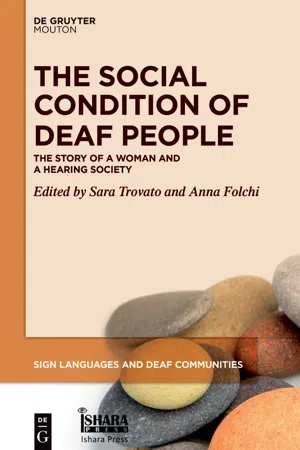
eBook - ePub
The Social Condition of Deaf People
The Story of a Woman and a Hearing Society
- 465 pages
- English
- ePUB (mobile friendly)
- Available on iOS & Android
eBook - ePub
The Social Condition of Deaf People
The Story of a Woman and a Hearing Society
About this book
Information
Conclusion
Anna and Sara, a Deaf and hearing woman, wrote this book together, with the intention to cross the lines.
As Virginia Volterra underlined (chapter 11a), Anna has been a bridge between two worlds. She has always been a participant in the hearing world – in work, in research – but coming from a Deaf family, she has been a native signer, she has studied and interpreted Deaf culture, she has been a leader of the Deaf community. Anna loves to share what she discovers in books with Deaf people – and she has presented her findings in dozens of conferences in sign language packed with hundreds of Deaf people.
Anna wanted her story to be written for hearing and Deaf people to be able to read it. Besides Anna’s story, to be found in the “a” chapters, the reader has read in these pages a series of essays, the “b” chapters.
A minimal objective of the essay chapters was to realize a non-discriminatory research. Their most realistic objective was to provide the reader with solutions and reflections on how to improve the participation of Deaf people to as varied institutions as education – from primary school to university and research –, labor market, cultural institutions, and political institutions. The maximal objective of the essay chapters in this book was to contribute to the foundation of a sociology of deafness that might be able to find its place within the broader domain of sociology (chapter 9b) – with the higher standards that sociology proper, as compared to advocacy, adopts.
As far as the first objective, the “minimal” one, non-discriminatory research, is concerned, Kenneth D. Bailey (1978) indicates that research with disadvantaged communities should not 1. exclude such groups from research; 2. reinforce and perpetuate stereotypes; 3. deny heterogeneity within the group; 4. amplify differences between privileged and disadvantaged groups; 5. distort research results; 6. be a research that is conducted approximately. As readers will go through these conclusive pages, they might keep these objectives in mind, as they will justify a series of theoretical choices.
These conclusions will be mostly centered on synthesizing the content of this book along the lines of the second objective, the “most realistic” one: providing solutions and reflections on how to include Deaf people in institutions that belong to them as citizens.
As to the third objective, the “maximal” one, contributing to founding a sociology of deafness – well, the reader that will go through these conclusions will agree that its achievement depends on the success in achieving the second objective.
Let us synthetize, then, the conclusions that can be drawn from this book.
The Deaf condition, quantitatively (chapters 3b 6b 10b 13b)
This is the first publication providing an idea about the aggregated condition of deaf1 people in a series of European countries and allowing to compare what institutions do and do not achieve for them in each country considered.
Institutions are more or less performant, and one could not hold responsible a non-performing system specifically for its deaf students’ less-than-good results, when hearing students also perform poorly, or for its deaf workers unemployment, when also hearing workers are equally unemployed. As a consequence, deaf and hearing data have been compared within the same educational or labor system, that is, one has to compare deaf and hearing data within each country.
This has led to consider societies somehow as variables, and deaf persons as constants. This is, if any, a move in Montesquieu’s Persian Letters’ style, that is, switching perspectives and considering as strange and new the “obvious” hearing society that everyone is accustomed to. To be more precise, more than a constant, the achievements of deaf persons have been considered as a dependent variable, while societies were observed to vary, in their policies, to determine variations in deaf persons achievements.
Inequalities do exist between deaf and hearing people: they exist in access to higher levels of education, in the choice among educational fields, in the access to professions, especially to the ones that exert social power. But, and this is the most important result of data analyses, the evidence that some European societies have indeed achieved considerable results in education (chapters 3b, 10b) and in labor (chapter 6b) implies that there is no crystallized social injustice against deaf people, but rather, solutions exist that some countries have achieved, others have not.
Another result is that many considerable social cleavages are not to be found between deaf and hearing people, but between men and women, or among people with different educational level, irrespective of whether they are hearing or deaf (chapter 13b). The distinctions between deaf and hearing people split society according to categories that are not always confirmed by social data. In particular, deaf and hearing people share the same condition, even more so than deaf and disabled people do (where “disabled” does not include deaf; chapters 3b, 6b, 9b).
This shows that the attitude which insists uniquely on the contrast between deaf and hearing people is not justified: social injustice is to be found along other distinctive lines: gender, educatio...
Table of contents
- Title Page
- Copyright
- Contents
- A duet as an introduction
- 1a Hearing people. A larger sphere and a smaller sphere
- 1b Hearing people. Power issues in Michel Foucault’s framework, and a society to share
- 2a My origins
- 2b Good reasons for the right to sign languages
- 3a A beautiful childhood
- 3b Deaf education results in ten European countries: Equitability, accessibility, and accountability of educational systems
- 4a An inadequate education at school, an effective education at home
- 4b Building written production in Deaf students. The “Free text writing” workshop in an excellent Italian bilingual school
- 5a Great history from my perspective: Student protests following 1968
- 5b Speaking for oneself: Language and power in the Italian deaf community
- 6a First jobs
- 6b Deaf people from school to labor in ten European countries
- 7a Deaf awareness
- 7b Deaf President then. Political pluralism in the unification of Deaf associations in liberated Italy
- 8a Theatrical activity. Joseph Castronovo’s story
- 8b A genial man in the wrong institutional environment. Deaf empowerment in Italian and French theatre experiences
- 9a A citizen of the world
- 9b Theories about deafness: Disability, culture, identity
- 10a Engaging for my community
- 10b Hypothesis on policy evaluation and school legislation: The effects of access to education, mainstreaming and instructional bilingualism
- 11a Research work
- 11b How society at large can become inclusive, sector after sector: Ethical choices in research as confronted to deafness and Deaf persons in Italy
- 12a Edgardo Carli, Deaf partisan. A conference of Anna’s
- 12b Academic matters. The Deaf perspective: Difficulties and proposed solutions
- 13a Being a Deaf woman
- 13b Deaf women, deaf men, hearing women, hearing men
- Anna’s acknowledgments
- Conclusion
- Index
Trusted by 375,005 students
Access to over 1.5 million titles for a fair monthly price.
Study more efficiently using our study tools.
Frequently asked questions
Yes, you can cancel anytime from the Subscription tab in your account settings on the Perlego website. Your subscription will stay active until the end of your current billing period. Learn how to cancel your subscription
No, books cannot be downloaded as external files, such as PDFs, for use outside of Perlego. However, you can download books within the Perlego app for offline reading on mobile or tablet. Learn how to download books offline
Perlego offers two plans: Essential and Complete
- Essential is ideal for learners and professionals who enjoy exploring a wide range of subjects. Access the Essential Library with 800,000+ trusted titles and best-sellers across business, personal growth, and the humanities. Includes unlimited reading time and Standard Read Aloud voice.
- Complete: Perfect for advanced learners and researchers needing full, unrestricted access. Unlock 1.5M+ books across hundreds of subjects, including academic and specialized titles. The Complete Plan also includes advanced features like Premium Read Aloud and Research Assistant.
We are an online textbook subscription service, where you can get access to an entire online library for less than the price of a single book per month. With over 1.5 million books across 990+ topics, we’ve got you covered! Learn about our mission
Look out for the read-aloud symbol on your next book to see if you can listen to it. The read-aloud tool reads text aloud for you, highlighting the text as it is being read. You can pause it, speed it up and slow it down. Learn more about Read Aloud
Yes! You can use the Perlego app on both iOS and Android devices to read anytime, anywhere — even offline. Perfect for commutes or when you’re on the go.
Please note we cannot support devices running on iOS 13 and Android 7 or earlier. Learn more about using the app
Please note we cannot support devices running on iOS 13 and Android 7 or earlier. Learn more about using the app
Yes, you can access The Social Condition of Deaf People by Sara Trovato, Anna Folchi, Sara Trovato,Anna Folchi in PDF and/or ePUB format, as well as other popular books in Langues et linguistique & Théorie et pratique de l'éducation. We have over 1.5 million books available in our catalogue for you to explore.