- 144 pages
- English
- ePUB (mobile friendly)
- Available on iOS & Android
eBook - ePub
About this book
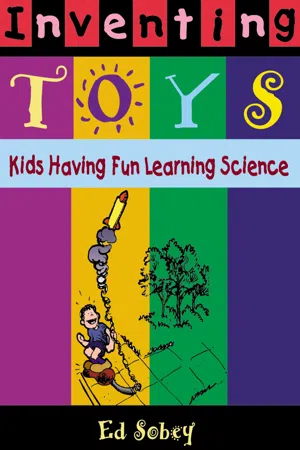
An intriguing combination of invention and toy making, this guide encourages students to work in teams to design and fabricate working toys while learning the fundamentals of science, design, tool usage, and the creative process. Toys range from cars to electric fans to rockets, and the trial-and-error process that students use to build these toys allows them to refine their models through experimentation—building, conducting tests, collecting and interpreting data, and making changes or improvements to their inventions. There are directions for seven workshops and suggestions for five more, and the science concepts and historical background involved in each project are explained for teachers.
Information
Topic
EducationSubtopic
Teaching Science & TechnologyPart I
Inventing to Learn
Education is not the filling of a pail, but the lighting of a fire.
Inventing and Learning
What is Inventing?
Inventing is the process of creating a new device or material, or a new variety of plant or animal. Although most people associate inventing with coming up with new ideas, ideas in themselves are not inventions. Inventing is really about making new things.
Until the inventor can prove a device works or a material can be made, it’s not an invention. Most ideas for new products fail because no one takes them far enough to build a working model. Everyone has ideas, but only a few people take action on their ideas. Those who do, we label inventors.
The process of transforming the idea or the design into a working model is where the hard work of inventing (or creating) lies. Edison said that inventing is 1 percent inspiration and 99 percent perspiration. The hard work occurs as inventors encounter and solve problems no one can anticipate.
As inventors transform ideas into working models, learning occurs. Inventors have to learn how to use tools, materials, and processes that may be new to them. They have to do things that they have never done—and possibly no one else has. This requires experimentation: designing, building, conducting tests, collecting and interpreting data, and making changes—hopefully improvements— to their inventions.
Faced with limits imposed by nature and technology, inventors develop an understanding of science and engineering principles, and by necessity they are also exposed to marketing and business planning principles. Inventors, like scientists, writers, and artists, are lifelong learners. They learn because they need to learn to keep inventing—learning empowers them to do what they enjoy doing. This observation applies to education as well. By creating environments in which students become inventors, we help them to be more enthusiastic learners.
As inventors transform ideas into working models, learning occurs.
Learning and Enjoyment
Professor Mihaly Csikszentmihalyi of the University of Chicago has studied inventors and other creative people. His research started with trying to understand why people enjoy some activities. In his book Flow—The Psychology of Optimal Experience, he lays out the handful of conditions that make a task or activity enjoyable:
- The task, although possibly difficult to accomplish, is doable.
- It is possible to concentrate on the task. Distractions can be eliminated.
- The task has clear goals.
- There is immediate feedback on progress.
- The task consumes one’s consciousness.
- The worker has a sense of control over what he or she is doing.
- Time passes quickly; one loses a sense of time.
Inventing and inventing to learn meet these conditions. Changing the learning process from a traditional flow of information to a challenging and thought-provoking activity where each learner injects his or her own creativity to help determine the outcome assures that the experience will be more enjoyable and learners will spend more time and effort on the learning tasks.
Inventing is not unique among creative pursuits in its association with learning and enjoyment. However, it is ideal for helping young students to learn science and technology as well as other subjects that can be woven into science projects.
Benefits of Using Inventing to Promote Learning
There are two main benefits of using inventing as a pedagogic tool to enhance learning. First, inventing makes kids think. We know that students aren’t just empty 2-liter bottles waiting to be filled with the great information we want to pour in. To get them to learn, we need them to make mental connections—we can’t do that for them. To make mental connections they must think, and inventing forces this to happen.
Like all inventors, they will think because they encounter challenges they need to solve in order to make their inventions work. When students become inventors they thirst for the information and skills that will help them improve their inventions. As a matter of course, they will encounter and learn physics, investigative techniques, and engineering principles.
The second benefit is that students will eagerly spend time on the task. It is generally agreed that the longer students spend actively working and thinking about something, the more they will learn. Inventing gets kids to spend longer on tasks because the activity is fun (it matches the conditions found by Csikszentmihalyi) and because they are working on their own creations. They have ownership and responsibility for the completed project, and they learn enthusiastically.
Inventors, like scientists, writers, and artists, are lifelong learners.
Inventing has additional learning benefits as well. Among other things, it helps students to learn the skills most sought by employers: working cooperatively with others, solving problems, using materials and time wisely, acquiring and using information, and using tools (U.S. Department of Labor, 1991). Thus, inventing not only helps students to learn science content and research skills, it also helps prepare them for employment.
Inventing versus Other Inquiry-Based Learning Approaches
How is inventing to learn different? In some inquiry-based learning, it is the author’s or the teacher’s questions that are investigated, not the student’s. For example, in most lab experiences, students don’t control the process, they follow the cookbook. There is one correct answer and, frankly, most kids don’t care what it is—they just need an answer to write on their lab handouts. In such situations, creativity is rarely encouraged.
With inventing to learn, we give students the goals and general parameters of an activity, and then leave it up to them to figure out how to meet those goals through the process of creating and improving their own inventions. Instead of stifling their creativity because it interferes with the lesson plan, we encourage it.
Creativity is an extremely strong force—creative people will tell you that they complete their projects because they are driven to see them finished. If they need to learn a new skill or acquire new knowledge in order to finish, they will do so. Letting your students be creative in a directed way will unleash this powerful force to help them learn.
Building a class of creative learners does require giving them support when they try something new. They need to be able to experiment without fear of failure or ridicule. But the rewards are great: the more self-confident they become, the more creative they become, and the more creative they become, the more responsible they will be for their own learning.
Structuring the Experience
Getting Students Involved
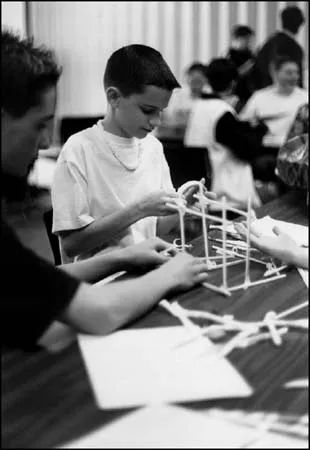
From the moment students enter the classroom for an inventing workshop they should be engaged in the process of inventing to learn. Have a simple preworkshop warm-up activity ready, one that you can describe in a few words. The goals should be clear and the materials close at hand. Have students work in teams of two or three so everyone participates. Here are a few suggestions:
- Straw structures. Teams construct a tower as tall as possible using only straws and masking tape. Measure completed structures with a yardstick or meter stick.
- Straw bridges. Teams build a bridge to span the space between two adjacent tables, and see how much weight the bridge can hold. (Use some common material for weight, like a chalkboard eraser.)
- Straw accessories. Teams pick an action figure or doll and build an accessory that could be sold along with that toy.
- Paper airplanes. Teams make paper airplanes that fly into a narrow target (such as a Hula-Hoop® or open trash bag) from across the room.
- New sandbox toy. Teams design on paper a new toy that preschoolers could use in a sandbox or at the beach. If the requisite materials are available, have them build a model.
As teams work, wander around asking what they are doing and making positive comments on their designs and their progress. Show off creative designs to everyone to inspire their creativity.
At the outset or at an appropriate point in the activity, it is a good idea to announce difficult time limits for completion. This will establish a precedent for inventing workshops to come. Although every team won’t be able to complete their project to the degree that they want, it’s important for students to learn that during the learning stage of the inventing process it is not necessarily appropriate to perfect a design. Point out that inventors have to work quickly and “make mistakes as fast as possible” so they can learn.

Transform the Classroom
Students should recognize from the outset that a toy inventing workshop is different from what they are used to at ...
Table of contents
- Cover
- Title Page
- Copyright
- Dedication
- Contents
- Preface
- How to Use this Book
- Part I: Inventing to Learn
- Part II: Workshops
- Part III: Additional Activities and Resources
- Index
Trusted by 375,005 students
Access to over 1.5 million titles for a fair monthly price.
Study more efficiently using our study tools.
Frequently asked questions
Yes, you can cancel anytime from the Subscription tab in your account settings on the Perlego website. Your subscription will stay active until the end of your current billing period. Learn how to cancel your subscription
No, books cannot be downloaded as external files, such as PDFs, for use outside of Perlego. However, you can download books within the Perlego app for offline reading on mobile or tablet. Learn how to download books offline
Perlego offers two plans: Essential and Complete
- Essential is ideal for learners and professionals who enjoy exploring a wide range of subjects. Access the Essential Library with 800,000+ trusted titles and best-sellers across business, personal growth, and the humanities. Includes unlimited reading time and Standard Read Aloud voice.
- Complete: Perfect for advanced learners and researchers needing full, unrestricted access. Unlock 1.5M+ books across hundreds of subjects, including academic and specialized titles. The Complete Plan also includes advanced features like Premium Read Aloud and Research Assistant.
We are an online textbook subscription service, where you can get access to an entire online library for less than the price of a single book per month. With over 1.5 million books across 990+ topics, we’ve got you covered! Learn about our mission
Look out for the read-aloud symbol on your next book to see if you can listen to it. The read-aloud tool reads text aloud for you, highlighting the text as it is being read. You can pause it, speed it up and slow it down. Learn more about Read Aloud
Yes! You can use the Perlego app on both iOS and Android devices to read anytime, anywhere — even offline. Perfect for commutes or when you’re on the go.
Please note we cannot support devices running on iOS 13 and Android 7 or earlier. Learn more about using the app
Please note we cannot support devices running on iOS 13 and Android 7 or earlier. Learn more about using the app
Yes, you can access Inventing Toys by Ed Sobey in PDF and/or ePUB format, as well as other popular books in Education & Teaching Science & Technology. We have over 1.5 million books available in our catalogue for you to explore.