eBook - ePub
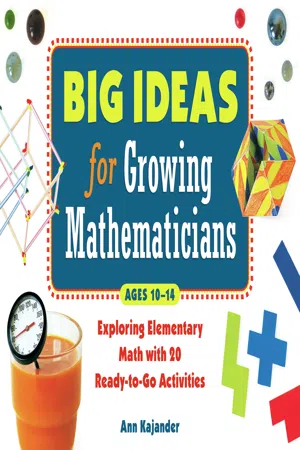
Big Ideas for Growing Mathematicians
Exploring Elementary Math with 20 Ready-to-Go Activities
- 160 pages
- English
- ePUB (mobile friendly)
- Available on iOS & Android
eBook - ePub
Big Ideas for Growing Mathematicians
Exploring Elementary Math with 20 Ready-to-Go Activities
About this book
Introducing sophisticated mathematical ideas like fractals and infinity, these hands-on activity books present concepts to children using interactive and comprehensible methods. With intriguing projects that cover a wide range of math content and skills, these are ideal resources for elementary school mathematics enrichment programs, regular classroom instruction, and home-school programs. Reproducible activity sheets lead students through a process of engaged inquiry with plenty of helpful tips along the way. A list of useful terms specific to each activity encourages teachers and parents to introduce students to the vocabulary of math. This second
Big Ideas book covers more advanced concepts, with projects including "One in a Million," where children use grains of rice to model the probability of astronomical odds; "Triangular Tessellations," in which students investigate the geometry and variations created by repeating patterns; and "Fractions of Salaries," where kids use a real-world scenario to multiply and divide fractions.
Information
Topic
EducationSubtopic
Teaching Mathematics1 One in a Million
The BIG Idea
Just how big is a million really?
Content Areas in This Activity
- Numeracy
- Estimation
- Basic probability
Process Skills Used in This Activity
- Creativity
- Reasoning
Prerequisite Knowledge and Skills
- Multiplication
- Place value for large numbers
Age Appropriateness
This activity is appropriate for all ages.
The Mathematical Idea
While babies can distinguish small numbers—for example, they can tell one object from two—older children are able to perceive larger numbers, such as distinguishing three from five or ten from twenty. Very large numbers, however, are much harder. Just how far does our numerical judgment go?
Lotteries, population figures, and high finance are but a few of the applications of math that use dazzlingly large numbers. It can be difficult to develop any appreciation of these very large numbers. How big is a thousand? How big is a million? They both sound big, but a million is much larger than a thousand—one thousand times larger in fact! So to have the same chance of winning a lottery with one ticket in a million as you would with one ticket out of a thousand, you would need 1,000 tickets from the first lottery! You can verify this as follows: Assume your chances of winning are the number of tickets you own out of the number of tickets sold. So if you own 1,000 tickets in a 1,000,000-ticket lottery, your chances of winning are:

HELPFUL TERMS
Probability: a fraction between zero and one representing how likely an event is to occur. For example, the chances of getting a two facing up when rolling a six-sided die is 1/6.
In this activity students investigate concretely just how big one million is and explore the chances of winning a one-in-a-million draw.
Making It Work
Objectives
Students investigate the chances of picking one object out of a million by attempting to model one million concretely.
Materials
Materials will vary depending on students’ choices of model.
- a small bag of rice and a scale or measuring spoons may be useful to introduce the activity
- calculators (optional but helpful)
Preparation
Counting out and measuring or weighing in advance 100 grains of rice may save time but is not necessary.
Procedure
1. Challenge students to think about the question of how big 1,000,000 really is and to come up with a tangible and concrete but affordable model of 1,000,000 objects.
2. Have students discuss their ideas in pairs or small groups.
3. Ask students to estimate the amount of various materials required to model their ideas.
For example, if they suggest grains of rice, have them do some quick counting and estimating that will show this idea to be unrealistic—depending on the size, it can take close to 30 bags of rice to make 1,000,000 grains!
Many ideas (such as rice) work well for 10,000 or 100,000 objects, but the number 1,000,000 makes things just that much more difficult.
4. Encourage students to make their models both affordable and transportable.
Suggestions
Since a main point of the activity is for students to devise and calculate the amount needed for various substances, suggestions of suitable materials should be withheld as much as possible. The investigation of unsuitable materials is fruitful in itself. When I first did the investigation, I was staggered at just how much rice 1,000,000 grains really was! However, here are a few suggestions to illustrate possibilities if really needed:

Assessment
Students’ models should be reasonably accurate but affordable and portable. I also like to see the entire 1,000,000—as opposed to students saying, “Well, if you had 10 of these . . .”—because it makes the activity more challenging. The “one” should be identifiable.
EXTENSION ACTIVITIES
Once students have finished their collections, they can experiment with trying to identify the winning “one” at random. For example, if you experiment and put your hand in a container of 1,000,000 objects and pulled out one object, how many times will it take before you pull out the winning object? Or will you give up before succeeding? Students can also compare this with their success with much smaller collections such as those of 100 or 1,000.
One in a Million Activity sheet
Have you ever seen a “one-in-a-million chance” advertised for winning a lottery or a contest and thought about entering? How does a million (1,000,000) compare with other large numbers, such as 1,000? In this activity you will investigate the number 1,000,000 to see for yourself just how big it really is!
Your task is to experiment with various materials to estimate and calculate the amount of each material you would need to make a collection of 1,000,000. For example, you could calculate the number of bricks on the wall of a building and then calculate the number of walls like that needed to use 1,000,000 bricks. You could paint one brick red to show the “one” in the million. But there is a catch: in this activity, your collection must be portable and affordable. You must find a creative solution to the problem that you can assemble yourself and actually see in front of you. Estimation is OK, but remember that it is 1,000,000 you are after, not a smaller number such as 100,000.
When you have finished your collection, identify one object as the “one” in your million—perhaps you might color it. Just how long do you think it would take to pick out the “one” at random? Try it!
Be sure you can explain how you knew there were 1,000,000 objects in your collection.
2 Math Magic
The BIG Idea
Lots of cool puzzles have math as their basis.
Content Areas in This Activity
- Numeracy
Process Skills Used in This Activity
- Problem solving
- Reasoning
Prerequisite Knowledge and Skills
- Place value for large numbers
- Basic algebra (to solve Puzzle 2)
Age Appropriateness
Children of all ages can enjoy doing the puzzles. Puzzle 1 is solvable with knowledge of multiplying by 1,000. Puzzle 2 may require algebraic equation solving to explain fully.
The Mathematical Idea
Puzzles 1 and 2 draw on the notion of place value. Puzzle 1 uses the fact that multiplying by 1,000 shifts the digits of a number left by three places. The numbers used in the “magic” of the puzzle have a pr...
Table of contents
- Cover
- Title
- Copyright
- Acknowledgments
- Contents
- Introduction
- 1. One in a Million
- 2. Math Magic
- 3. Cooperative Problems
- 4. Lots of Dots
- 5. Average Pentominoes
- 6. Distributing Tiles
- 7 Guess My Rule
- 8. The Rice Problem
- 9. Lines, Squares, Cubes, and Hypercubes
- 10. Fractional Salaries
- 11. A Temperature Experiment
- 12. Circular Reasoning
- 13. Coins for Compassion
- 14. Toothpick Rectangles
- 15. The Stairs Problem
- 16. Gumball Boxes
- 17. The Medicine Experiment
- 18. Fabulous Fractals
- 19. Triangular Tessellations
- 20. Kaleidocycles
- Glossary
- Index
Trusted by 375,005 students
Access to over 1.5 million titles for a fair monthly price.
Study more efficiently using our study tools.
Frequently asked questions
Yes, you can cancel anytime from the Subscription tab in your account settings on the Perlego website. Your subscription will stay active until the end of your current billing period. Learn how to cancel your subscription
No, books cannot be downloaded as external files, such as PDFs, for use outside of Perlego. However, you can download books within the Perlego app for offline reading on mobile or tablet. Learn how to download books offline
Perlego offers two plans: Essential and Complete
- Essential is ideal for learners and professionals who enjoy exploring a wide range of subjects. Access the Essential Library with 800,000+ trusted titles and best-sellers across business, personal growth, and the humanities. Includes unlimited reading time and Standard Read Aloud voice.
- Complete: Perfect for advanced learners and researchers needing full, unrestricted access. Unlock 1.5M+ books across hundreds of subjects, including academic and specialized titles. The Complete Plan also includes advanced features like Premium Read Aloud and Research Assistant.
We are an online textbook subscription service, where you can get access to an entire online library for less than the price of a single book per month. With over 1.5 million books across 990+ topics, we’ve got you covered! Learn about our mission
Look out for the read-aloud symbol on your next book to see if you can listen to it. The read-aloud tool reads text aloud for you, highlighting the text as it is being read. You can pause it, speed it up and slow it down. Learn more about Read Aloud
Yes! You can use the Perlego app on both iOS and Android devices to read anytime, anywhere — even offline. Perfect for commutes or when you’re on the go.
Please note we cannot support devices running on iOS 13 and Android 7 or earlier. Learn more about using the app
Please note we cannot support devices running on iOS 13 and Android 7 or earlier. Learn more about using the app
Yes, you can access Big Ideas for Growing Mathematicians by Ann Kajander in PDF and/or ePUB format, as well as other popular books in Education & Teaching Mathematics. We have over 1.5 million books available in our catalogue for you to explore.