A multidisciplinary activity book from four core academic areas—math, science, language arts, and social studies
Unlike the many activity books devoted solely to one type of activity—science experiments, art activities, math games, brain teasers, and the like—
Curious Minds takes a multidisciplinary approach, incorporating science, social studies, math, language arts, world languages, and more in 40 hands-on activities that promote kids' critical thinking and engaged interest in the world they live in. Designed for teachers, parents, or homeschoolers searching for new ways to motivate students aged 9–12, this illustrated resource provides a short mini-lesson for each activity, giving educational background information, related lingo, a materials list, step-by-step directions, and guidance for extending the activity. The wide range of activities—from exploring the physics of parachute flight to making homemade ink to testing how pollutants affect plants—ensures every learner's interest will be piqued.
eBook - ePub
Curious Minds
40 Hands-on Activities to Inspire a Love of Learning
- 160 pages
- English
- ePUB (mobile friendly)
- Available on iOS & Android
eBook - ePub
About this book
Information
Topic
EducationSubtopic
Education Teaching Methods
PART I
PHYSICS & MATH
SHOOT! MINE DIDN’T OPEN: THE SCIENCE OF PARACHUTES
Content Focus: Physics
Primary Skills Focus: Design and Model
Mission Objective: Jump into the basics of air resistance with a brief history of parachute design. Then, construct multiple styles of parachutes and test the merits of each design.
If you take a feather and pea and drop them from the same height, which one falls faster? The pea, right? One of the reasons this is the case is air resistance. In this mission you will become an expert in air resistance and design your own parachutes.
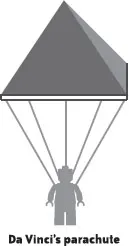
The idea of the parachute has been around for hundreds of years. While some say the ancient Chinese used a parachute-like device to jump from heights and perform acrobatics, Leonardo Da Vinci created the first known drawings of a modern-style parachute in 1483. His design was a four-sided pyramid made of wood and canvas. In June 2006 Adrian Nicholas glided to the ground safely using a parachute based on a sketch Da Vinci did of his parachute design. The builders of Nicholas’s parachute only used materials that would have been available to Da Vinci during his life. Isn’t that cool?
Parachutes work because of air resistance. When a parachute is deployed (opened) there is drag, or air resistance, that pushes up the parachute and slows down the jumper. It is the parachute’s light weight and large surface area that harness the power of air resistance. It’s all about air molecules. A human without a parachute would fall fast because he or she would push through the air molecules very easily (like the pea). Air resistance is generated as the parachute runs into air molecules when hurling toward the Earth (like the feather). The force of all these air molecules pushing against the parachute slows its descent (drop).
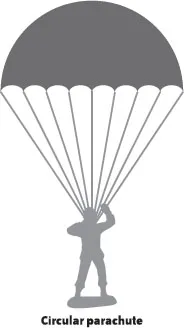
After Da Vinci made his initial drawings in the 15th century, progress on the idea slowed and the parachute did not play a significant role until the early 20th century (or 1900s). Parachutes had lost the rigid frame and were now made of either nylon or silk. From the early 1900s to the 1960s parachutes had a circular design as shown here:
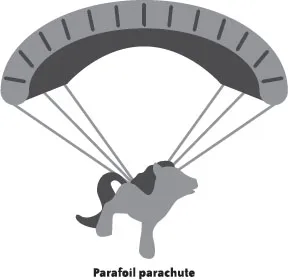
While these parachutes did get the traveler to the ground safely, the jumper didn’t have the ability to steer them. The parafoil parachute design created in the 1960s included that improvement. The parafoil design is a rectangular-shaped wing capable of being steered to where its passenger wants to land. Did you know that some competition jumpers can land within inches of a target?
Learning the Lingo
air molecules: The tiny, microscopic building blocks of nitrogen, oxygen, and carbon dioxide that make up the atmosphere around our planet.
descent: The movement down, or lower. In this case it refers to the parachute jumper’s fall to the ground.
drag: The air resistance that is created by an object falling. Typically, items with less mass and more surface area create more drag and fall slower.
parafoil: A parachute design developed in the 1960s that gave the jumper greater control and mobility. This is due to the rectangular design and air “pockets” that jumpers can steer with handles, or toggles. This design is still used today.
Materials
- 3 heavy trash bags
- 1 roll of tape
- 1 roll of string
- 50–75 Popsicle sticks
- Wood glue
- 3 plastic shopping bags
- 1 roll of paper towels
- 3 eggs
Plan of Attack
We know the parafoil parachute provides the jumper with the most mobility (the ability to steer), but which design (Da Vinci’s, a complete circle, or the parafoil) can land a jumper softest, and therefore safest?
1. Hypothesize (make your best educated guess) as to which design is safest. Why do you think that?
2. Use the trash bags, tape, string, and Popsicle sticks and glue to create three parachutes: a Da Vinci, a circular, and a parafoil. You will use the sticks and glue for the Da Vinci design but for the most part try to use the same amount of material for each parachute. You will want to reinforce the holes in the parachute corners where you tie your strings with small pieces of duct tape. The drag will put significant pressure on the bag and it may tear without reinforcement.
3. Use the plastic shopping bags to make a cradle for an egg to hang under the parachutes. Tie the parachute strings to the plastic shopping bag handle. At the bottom of the bag, use paper towels to cushion the egg.
4. Next, have an adult drop each egg/parachute combination. Try to drop them from an upstairs window, balcony, stairwell, or ladder. Your goal is to drop them from as high as possible to give the parachute the greatest opportunity to “catch” enough air resistance to guide the egg down.
5. What happened? Was your hypothesis correct?
6. Try putting a small hole in the middle of each parachute and see if that helps balance and smooth out th...
Table of contents
- Cover
- Title Page
- Copyright
- Dedication
- Contents
- Acknowledgments
- Introduction
- Part I Physics & Math
- Part II Chemistry
- Part III Language Arts
- Part IV Earth Science
- Part V Social Studies
- Part VI Biology
- Activities List by Primary Skills Focus
Trusted by 375,005 students
Access to over 1.5 million titles for a fair monthly price.
Study more efficiently using our study tools.
Frequently asked questions
Yes, you can cancel anytime from the Subscription tab in your account settings on the Perlego website. Your subscription will stay active until the end of your current billing period. Learn how to cancel your subscription
No, books cannot be downloaded as external files, such as PDFs, for use outside of Perlego. However, you can download books within the Perlego app for offline reading on mobile or tablet. Learn how to download books offline
Perlego offers two plans: Essential and Complete
- Essential is ideal for learners and professionals who enjoy exploring a wide range of subjects. Access the Essential Library with 800,000+ trusted titles and best-sellers across business, personal growth, and the humanities. Includes unlimited reading time and Standard Read Aloud voice.
- Complete: Perfect for advanced learners and researchers needing full, unrestricted access. Unlock 1.5M+ books across hundreds of subjects, including academic and specialized titles. The Complete Plan also includes advanced features like Premium Read Aloud and Research Assistant.
We are an online textbook subscription service, where you can get access to an entire online library for less than the price of a single book per month. With over 1.5 million books across 990+ topics, we’ve got you covered! Learn about our mission
Look out for the read-aloud symbol on your next book to see if you can listen to it. The read-aloud tool reads text aloud for you, highlighting the text as it is being read. You can pause it, speed it up and slow it down. Learn more about Read Aloud
Yes! You can use the Perlego app on both iOS and Android devices to read anytime, anywhere — even offline. Perfect for commutes or when you’re on the go.
Please note we cannot support devices running on iOS 13 and Android 7 or earlier. Learn more about using the app
Please note we cannot support devices running on iOS 13 and Android 7 or earlier. Learn more about using the app
Yes, you can access Curious Minds by Ty Kolstedt,Dr. Azeem Z. Vasi in PDF and/or ePUB format, as well as other popular books in Education & Education Teaching Methods. We have over 1.5 million books available in our catalogue for you to explore.