An inspirational tale of personal struggle with and triumph over Tourette syndrome, this is the story of Jeff Matovic and the radical treatment he sought to cure himself. After suffering from Tourette's for years—with his tics and outbursts getting progressively worse and with no results coming from drugs or physical or spiritual therapy—Jeff was able to convince his doctors and his insurance company to try a risky deep brain stimulation treatment, a surgery that involves the implantation of a pacemaker for the brain into his skull. Penned by a journalist who is also afflicted with Tourette's, this is the incredible story of a friendship that blossomed under their common experiences with this bizarre brain disorder. A complete discussion of the latest medical research of and treatments for Tourette's, written in accessible and easy-to-understand terminology, is also included.
eBook - ePub
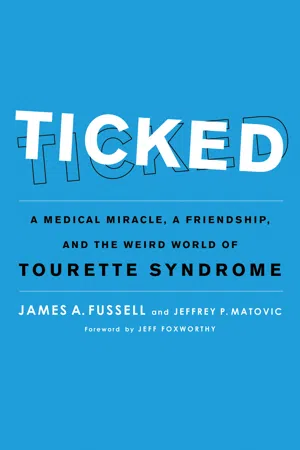
Ticked
A Medical Miracle, a Friendship, and the Weird World of Tourette Syndrome
- 272 pages
- English
- ePUB (mobile friendly)
- Available on iOS & Android
eBook - ePub
Ticked
A Medical Miracle, a Friendship, and the Weird World of Tourette Syndrome
About this book
Information
Topic
MedicineSubtopic
Social Science Biographies1
Where’s My Miracle?
“Who then can so softly bind up the wound of another as he who has felt the same wound himself?”
IN THE WINTER of 2004, in the features department of the Kansas City Star, I crawled under my messy, metal desk and began to sob. I didn’t want to die. I just wasn’t sure I had the strength to go on living. It was as if, when I wasn’t looking, someone had reached into my chest and stolen all the hope out of my heart.
That’s what Tourette Syndrome will do to you.
For forty years it had been a part of me, an evil puppet master forcing me to shake my head and twist my neck. And one dreary February morning, it simply overwhelmed me. The noises bouncing around the newsroom hit my head like a hammer. I wanted to disappear, to melt into the background. I slouched in my gray office chair and slowly began to sink. I had done this before. All the other times I caught myself and bolted upright. Not this time. I just … kept … going. Sliding off the front cushion of my chair, I plopped onto the coffee-stained carpet squares and pretended to look through some of my old stories that I kept on the floor in cardboard boxes. I liked the darkness and the snug feeling of protection. All of a sudden I was a child again, hiding in a fort, or under a blanket.
I was safe. But the feeling only lasted so long. In minutes the familiar urges to shake and move came back. I leaned over, resting my head against a stack of Sunday magazines, and closed my eyes until tears dripped from my short brown goatee. As a feature writer for nearly twenty years I couldn’t count the number of times I had listened to other people pour out their problems—alcohol, drugs, depression, cancer, car accidents, financial ruin. The one constant was that everything always turned out for the best. There was a comfort to the form. The hurting person found a way to survive—even, in many cases, to prosper. I always felt good for them. I really did.
Except … where was my miracle?
One day I was just going to snap. And all it would take was three little words.
“How are you?” someone would ask at just the wrong time, and that would do it. I’d spin them around as they walked past.
“How am I?” I’d say, breathing a little too hard. “Not very good, thanks. I got two hours’ sleep last night on top of one the night before. I feel like I’m carrying a three-hundred-pound man on my shoulders. My neck is on fire, and being stabbed by a thousand tiny ice picks. I’m so tired I can barely stand up, I can’t remember my computer password, and I couldn’t tell you what I wrote yesterday if you threatened to boil me in oil. My head is shaking, my neck is twisting, my stomach is tightening, and I worry that one of these mornings one of the monstrously hard head shakes I never let you see will finally jar something loose in my brain, and I’ll pitch forward in my oatmeal and that’ll be it for me. But thanks for asking. How are you?”
But then that would be wrong, wouldn’t it?
Usually I just say I’m fine.
Back under my desk I shook my head so hard I banged my dollar-store reading glasses into the side of a metal drawer, mangling them into a shape that no longer fit my face. I took them off and tried to bend the flimsy metal frame back to something resembling straight.
A plastic lens fell out of the right side and wouldn’t snap back in. Whatever, I thought. It was a perfect metaphor for my life. Bent up and broken, unable to be fixed. That’s what more than forty years of Tourette Syndrome had done to me.
That also was the great irony of my life: the man who wrote about other people’s happy endings who couldn’t find one for himself.
Or could I?
As I sat hopeless and crying under my desk, there was something I didn’t know. I didn’t know that halfway across the country, at roughly the same time, a Cleveland neurosurgeon was pointing a spinning drill bit at a patient’s head. I didn’t know that he and another doctor had taken months to plot an elegant route through that patient’s malfunctioning brain. And I certainly didn’t know that patient was about to change my life in ways no one could have foreseen.
But he was.
And all I had to do was hang on long enough to find him.
2
Second Chance
“Courage is not the absence of fear, but rather the judgment that something else is more important than fear”
University Hospitals, Cleveland, Ohio. February 9, 2004, 9:30 AM.
The surgical-grade bone drill gave a throaty wail as its razor-sharp bit spun up to speed inches above Jeff Matovic’s head. He knew its job; bore holes in his skull—two of them, nickel-sized, stopping just short of his brain.
Strapped to a padded operating table, head immobilized in a V-shaped titanium halo, the thirty-one-year-old closed his eyes and tried to breathe. He focused on the good things—his world-class doctors, the possibility of a new life, and the opportunity to advance research and make medical history. Sure, the operation had never worked on someone like him. But there was always a first time. Besides, he reminded himself, he’d asked for this. Begged for it.
No, risky, groundbreaking, quarter-million-dollar brain surgery wasn’t something to dread. It was a second chance at life. And even if it didn’t help him, he thought, maybe it would help someone else—later.
For three decades the six-foot-five Cleveland man struggled with a worsening case of the baffling movement disorder Tourette Syndrome. Sharp, repetitive, involuntary muscle spasms caused him to jerk like a mishandled marionette. There was no cure. No escape. Over thirty years, if he’d learned one thing about his condition it was this: severe Tourette’s didn’t kill you, it just made you wish you were dead.
He had tried prayer, pharmacies full of medications, even suicide. Now, staring into a bank of white-hot lights, he had one last hope.
Try for a miracle.
He dreamed of doing the little things other people took for granted—walking, talking, or holding blissfully still while doing absolutely nothing. He envisioned being well and getting the last laugh on every classless jackass who ever teased him, doubted him, or made his already hard life just a little harder.
At the same time he also remembered his maternal grandpa. He could still see the compassion in the old man’s eyes when—unable to fight back an avalanche of tics—the tortured teen would begin to cry. His grandpa never told him to stop. Instead he’d remove his glasses and sob alongside the grandchild he so loved but couldn’t fix.
“Jeff,” he’d say, wiping his eyes. “I promise you they’re going to find something someday.”
Maybe, Jeff thought, that someday is today. But even he knew the odds were against him.
Years ago his mother had asked him a question: “What do you want out of your life?”
“Mom,” he said. “I’ve had this so long that I really don’t care that much about me anymore. I just want other people to be OK. I want kids like me to be able to go through grade school and not be made fun of. I want people to be able to walk through a mall or a street or a strip plaza and not have to worry about who’s looking at them.”
Weeks before surgery, he thought about that conversation as he wrote a letter to his doctors.
“Whatever happens in surgery,” he told them, “whether I make it or not, I authorize you to audio tape, videotape, or use anything you can from this to help others.”
In the waiting room his parents prayed their son would just make it through the operation alive.
Back on the operating table Jeff glanced to the side, past a blue surgical hood covering his head, to see a familiar face sporting gray hair, light green scrubs, and a gold chain. “How ya doing, doc?” he said, greeting his neurosurgeon.
“Doing fine,” his surgeon said. “How are you doing?”
“I’m doing great,” Jeff said, managing a smile. “Let’s get this show under way.”
Doctors had given him a local anesthetic and marked two spots, four inches apart, on his closely shaved head where the holes would be drilled (clearly). Unlike other surgeries, this one required him to be awake so he could give critical feedback to doctors as they implanted two electrodes deep in his brain.
The procedure was not new. It had helped patients with Parkinson’s, dystonia, and essential tremor. But Tourette’s was more complex, its vexing variety of symptoms nowhere near as well understood. The surgery was more than experimental. By all accounts, using a brain stimulator to try to interrupt the misfiring signals of Tourette Syndrome was a medical Hail Mary.
Maybe that’s why no doctor had ever recommended it, or told him it had much of a chance to work. Worse, the operation wasn’t even approved for Tourette’s and carried risks of serious complications including stroke, paralysis, blindness—and death. The chance of death was small, less than 1 percent. But taken together, the risk of serious complications topped 20 percent.
Jeff didn’t care. The way he saw it, he didn’t have a choice. Enduring more in a day than many did in a lifetime, he’d lost interest in making it though one hellish day just to face another.
The drill wailed again.
Breathe, he told himself.
Louder now. It crept toward him.
This is what you wanted. This is your time.
He felt the bit tap against the top of his skull.
“Hold on with me, Jeff,” his surgeon yelled over the racket. “You’re going to feel a lot of pressure now.”
As he saw little white bits of bone fly past his face, it felt like someone had dropped a house on his head. He closed his eyes as his body trembled, and he balled his hands into fists.
Hail Mary, full of grace.
3
Umm … Are You Taking My Clothes off?
FOURTEEN YEARS BEFORE Tourette’s drove me under my desk and caused Jeff to beg doctors to bore into his brain, I stood in the middle of a nine-floor atrium in McLean, Virginia, wondering if it was illegal to be naked in the lobby of a Hilton hotel.
I know. What does one have to do with the others?
Everything.
In many ways this is where my part of the story starts. My wife, Susan, and I attended the 1990 National Conference of the Tourette Syndrome Association as delegates from Kansas City. This is where I first really learned about Tourette’s—and myself. More important, it is a key link in the chain of events that got me my job in the features department of the Kansas City Star, which led me to a face-to-face meeting with Oprah Winfrey, which led me to Jeff and the improbable miracles that helped change my life.
And it all started with a slender brunette in a little black dress.
“I’m Jennifer,” she said, kissing me softly on my cheek. “And I have to do this.”
Working quickly she unbuttoned my shirt to my navel, then pressed her cold hand flat against my warm chest.
A lot goes through your mind when a beautiful stranger suddenly starts unbuttoning your shirt. On the one hand, it was sexy as hell. On the other, it was sad. Her hands said one thing; her eyes quite another.
I smiled nervously and looked around for my wife.
“This is embarrassing,” Jennifer said, yanking my shirttail out...
Table of contents
- Cover
- Title Page
- Copyright
- Dedication
- Contents
- Foreword by Jeff Foxworthy
- Author’s Note by Jim Fussell
- Author’s Note by Jeff Matovic
- 1 Where’s My Miracle?
- 2 Second Chance
- 3 Umm … Are You Taking My Clothes off?
- 4 The Hand of Satan
- 5 The Tic Explosion
- 6 Dr. Dream Crusher
- 7 Jumping out of My Skin
- 8 My Search for Relief
- 9 I’d Rather Have Cancer
- 10 I Know How to Kill My Tourette’s
- 11 Butter and Salt on Your Neurons?
- 12 “I Need You to Cover Oprah”
- 13 Hope in the Mail
- 14 I Have a Bazillion Questions
- 15 “What Are You, Stupid, Matovic?”
- 16 Comfort From Katie
- 17 A Teenager with Tourette’s
- 18 Come on, Jesus, Time to Spill Corn Flakes
- 19 Saved by Sports
- 20 “God Bless You, Jeff Foxworthy!”
- 21 John Carroll University
- 22 Deep Brain Stimulation
- 23 Cemetery Man
- 24 Luvox, Klonopin, and a Suit to Be Buried in
- 25 “Get in Here and Take Care of Me!”
- 26 “Nice Boots!”
- 27 “Jeff, It’s Deb. Where Are You?”
- 28 “How Much Do You Love Me?”
- 29 A Little Beige on the Side
- 30 Debra’s Dilemma
- 31 Learn to Live with Your Pain
- 32 Take a Chance on Me
- 33 A Real Kick in the … Pants
- 34 Testing, Testing
- 35 Quarter-Million-Dollar Insurance Dance
- 36 The Story of Medtronic
- 37 Dr. Robert J. Maciunas
- 38 Keep Calm
- 39 Last Rites
- 40 Tic Tic Tic
- 41 The Pre-Op Comedy Hour
- 42 Turn Me on, Tina
- 43 “Welcome Back to Your Life”
- 44 Telling the World
- 45 Oprah and Good Morning America
- 46 Shining Star
- 47 “What Do You Mean I Won?”
- 48 Revenge of the Weirdos
- Epilogue
- Acknowledgments
Trusted by 375,005 students
Access to over 1.5 million titles for a fair monthly price.
Study more efficiently using our study tools.
Frequently asked questions
Yes, you can cancel anytime from the Subscription tab in your account settings on the Perlego website. Your subscription will stay active until the end of your current billing period. Learn how to cancel your subscription
No, books cannot be downloaded as external files, such as PDFs, for use outside of Perlego. However, you can download books within the Perlego app for offline reading on mobile or tablet. Learn how to download books offline
Perlego offers two plans: Essential and Complete
- Essential is ideal for learners and professionals who enjoy exploring a wide range of subjects. Access the Essential Library with 800,000+ trusted titles and best-sellers across business, personal growth, and the humanities. Includes unlimited reading time and Standard Read Aloud voice.
- Complete: Perfect for advanced learners and researchers needing full, unrestricted access. Unlock 1.5M+ books across hundreds of subjects, including academic and specialized titles. The Complete Plan also includes advanced features like Premium Read Aloud and Research Assistant.
We are an online textbook subscription service, where you can get access to an entire online library for less than the price of a single book per month. With over 1.5 million books across 990+ topics, we’ve got you covered! Learn about our mission
Look out for the read-aloud symbol on your next book to see if you can listen to it. The read-aloud tool reads text aloud for you, highlighting the text as it is being read. You can pause it, speed it up and slow it down. Learn more about Read Aloud
Yes! You can use the Perlego app on both iOS and Android devices to read anytime, anywhere — even offline. Perfect for commutes or when you’re on the go.
Please note we cannot support devices running on iOS 13 and Android 7 or earlier. Learn more about using the app
Please note we cannot support devices running on iOS 13 and Android 7 or earlier. Learn more about using the app
Yes, you can access Ticked by James A. Fussell,Jeffrey P. Matovic,Jeff Foxworthy in PDF and/or ePUB format, as well as other popular books in Medicine & Social Science Biographies. We have over 1.5 million books available in our catalogue for you to explore.