- 304 pages
- English
- ePUB (mobile friendly)
- Available on iOS & Android
eBook - ePub
About this book
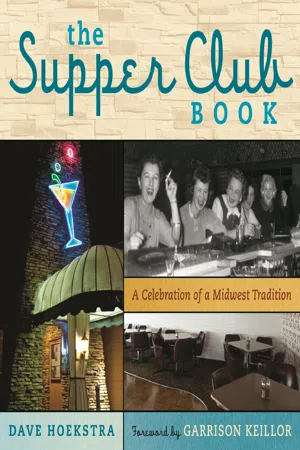
The phenomenon of the supper club—as unique to the Upper Midwest as great lakes, cheese curds, and Curly Lambeau—is explored for the first time in this attractive and engaging book. Revealing the rich history behind these time-honored establishments, it defines the experience for the uninitiated and reacquaints those in the know with a cherished institution. Painstakingly researched, the book documents modern supper clubs in Wisconsin, Minnesota, Iowa, Michigan, and Illinois, bringing to life the memorable people who created the tradition and keep it alive. It goes on to explain how combining contemporary ideas such as locavore menus and craft beer with staples like Friday night fish fries and Saturday prime rib has allowed the clubs to evolve over time and thrive. With numerous photographs, this combination social history and travel guide celebrates not only the past and present but the future of the supper clubs.
Information
Topic
Personal DevelopmentSubtopic
North American HistoryPART IV
Traditionals

Smoky’s Club. Classic neon is a sign of a good supper club. The Lannon stone was sourced just a couple blocks away from Smoky’s.
14
Smoky’s Club
3005 University Avenue, Madison, Wisconsin (608) 233-2120 • www.smokysclub.com
Everything has its place. Oscar “Ozzie” Huber knows this. He has been a dishwasher at Smoky’s Club in Madison, Wisconsin, since 1964. Oscar figures he has washed “a couple million” dishes in his lifetime. Dinner platters. Soup bowls. Wine glasses. Beer steins. Over and over and over again.
On a busy autumn Friday night Oscar reaches for a white dinner plate from a packed rack of stained dishware. He confidently picks up the plate with his left hand and brings it to a sink. He grabs a silver sprayer with his right hand and blasts the plate. He smiles from under the brim of a dirty white baseball cap. He is satisfied.
Oscar is blind.
Supper clubs are about a climate of vivid belonging. Oscar belongs here. “I’m the oldest thing in this kitchen,” he says. “This is my second home.”
Smoky’s is a classic Wisconsin supper club by way of its hearty steak-inspired menu, family warmth, neon sign, and linear architecture accented by beige Lannon stone that was quarried just a couple blocks away. The torch classic “Smoke Gets in Your Eyes” often can be heard in the parking lot.
Oscar was born with glaucoma on August 6, 1946. He has endured twenty-seven eye operations. Over time the retinas blew out in each of his eyes; Oscar went completely blind in 1991. “All I see is light,” he says. “No shadows. I don’t see pretty blonds. I used to see a lot of pretty blonds.”

Beloved dishwasher Oscar “Ozzie” Huber in the fall of 2011.
In the 1990s Oscar began working with a brown and gray guide dog named Fitch. Oscar brought Fitch to work, where the Smoky’s staff installed a small bed for the golden lab. The bed was installed under the dish line where the dirty dishes were unloaded and stacked on trays. Fitch was well trained and never complained about the noise and excitement of a busy kitchen. When Oscar was off duty, he would remove Fitch from his harness and the dog would beg for carrots. Fitch loved carrots. Otherwise Fitch would loyally wait for Oscar to finish work.
Oscar is on disability and works two nights a week at Smoky’s. He no longer has a guide dog, but a cane helps him negotiate his path. He does a 5:00 to 8:30 PM shift on the kitchen sprayer. Smoky’s co-owner Tom Schmock will gently take Oscar by an elbow and lead the Midwest’s best dishwasher to the kitchen.
“It’s different now,” Oscar says. “Two partners help me. They bring the dishes to me, I rack ‘em, push them through, and spray them off. Another guy takes the clean ones. I’m at the sprayer. I don’t carry no dishes. But I know the dishes.” He stops and twirls around to the sink. “This is a hash brown dish. These are monkey dishes for tomato juice. [A monkey dish is a universal restaurant term for a small liner-type dish that also can serve side condiments such as salad dressings.] This is a bar glass. I feel them.”
Oscar began his career in the original Smoky’s, a two-story house with a horseshoe bar a block from the current location, on what was then the outskirts of town. Owner Leonard “Smoky” Schmock and his wife, Janet, lived upstairs with their children, Tom, Larry, and Barb. Frank Lloyd Wright visited this version of Smoky’s, arriving with his dog through the rear entrance. He ate early because he was traveling to his home in Spring Green, Wisconsin.

Smoky’s at 2925 University Avenue in 1963—down the road from the present location.

Madison, Wisconsin, began expanding in 1970 and construction tore up University Avenue in front of the present-day Smoky’s. The tricked-out Shorewood House apartment building is in the background. That was built in 1966.
University Avenue expansion took out the first Smoky’s, and in 1969 the supper club moved into what had been Justo’s Club, owned by Jennie Bramhall, the wife of former Chicago Bear Art Bramhall. After retirement from the NFL Bramhall moved to Madison and became the radio voice for the University of Wisconsin football team. Smoky’s came on the scene just as the Brahmalls retired from the supper club game.
Oscar heard about Smoky’s when he lived in a rooming house in east Madison. A Smoky’s employee told him about the job opening. “I came here on a Friday night and started that night,” he recalls. “Washing dishes by myself. I didn’t know what I was doing. I didn’t have a job.”
Oscar remains in the kitchen while Tom walks out into the dining room. “Oscar always has had the best work ethic,” Tom says. “We were just kids when he started working in the business. He was half blind and couldn’t drive. He would ride his bicycle to Smoky’s every night. And work until we closed the kitchen at eleven, eleven thirty. Every night. I always wish I had ten more like him. Unfortunately his vision went and he can’t do the work he used to. So we keep him on two nights a week … just to keep that link.”
Like his brother Larry, Tom Schmock was a busboy at Smoky’s, where the dimly lit dining room seats about 120. He remembers the white napkins with the white tablecloths. “We had to fold them every night,” he says. “Of course Janet [his mother] was too pennywise, which was good at the time. It was too expensive to change tablecloths every time. So we would just lay another white napkin over the stain. We’d get two or three turns out of a table by just putting a napkin over a napkin.”
Janet says, “Do you remember, boys, when we lived upstairs I washed all the tablecloths in our old washing machine? I hung them out on the line and the truck drivers would come [down University Avenue] and I’d start to cry. They’d get dirty and dusty.”
In 1947 Janet was a waitress at the since-closed Hoffman House on the east side of Madison. Leonard Schmock was a Hoffman House bartender who had just returned home after serving in the US Navy in World War II. He tugged at her heart. She made him dance. There was no doubt. They were married three years later.
Janet is the product of a farm family in Black Earth, Wisconsin. Her parents, Erling and Ellen Punswick, came from Norway to Blue Mounds, Wisconsin, where Erling built a log cabin that still stands today.
Erling grew tobacco and raised dairy cattle. When Janet was a young girl her parents sold the large farm due to Erling’s arthritis after years of operating a horse-drawn plow. Erling and Ellen bought a smaller, forty-acre farm and again grew tobacco and raised dairy cattle. Janet worked as a maid around Madison before meeting Smoky.
As an early Friday night crowd files in, Larry Schmock says, “Both of my parents were in the supper club atmosphere. As soon as he got out of the war she was making gunpowder up at the Badger Ammunition Plant in the Baraboo Hills. After the war they wanted to get their own place; they had been saving money. This was perfect for them, a good starter place.”
Leonard was from Bloomer, about two hundred miles northwest of Madison. He came to Madison in 1937 to play football and study agriculture at the University of Wisconsin. After the war Leonard continued to fly and did crop dusting for regional farmers. He also worked as a bartender at the Cuba Club and as a salesman for Del Monte Foods before he knotted dreams with Janet.
“We had looked at quite a few restaurants the first year we were married,” Janet recalls. “We even looked at country clubs.” In 1952 Janet and Leonard finally bought Hogan’s Club, a half block east of Smoky’s. The supper club had been owned by Gus Hogan. Smoky and Janet changed the name, bought the entire building, and lived upstairs.
The club had twelve tables and twelve bar stools. On busy nights customers dined in the kitchen. “Smoky tended bar and for five years I cooked in the kitchen,” Janet says. “We had no children then. We would work until three or four in the morning. I baked the pies.”
When the University of Wisconsin Badgers were home on football Saturdays during the 1950s and ‘60s, Smoky’s would serve between four hundred and five hundred dinners. And dinners have always included homemade soup and salad.
“We boiled meat bones to make the soup stock,” Janet says. “We use whipping cream in our creamy soups. We could make up any soup. We never took recipes. The classic was the cabbage au gratin.”
Tom adds, “I remember when I took over the soup duties. Tuesday was my soup-making day. We had six-gallon kettles. I would do seven or eight of those. Then on Friday I’d make the seafood chowder, which would be another three [kettles]. So you’re talking at least sixty gallons a week.”
Soon the children arrived. Larry was born in 1955, Tom in 1957, and Barb in 1961. They all went to school in Smoky’s neighborhood. Janet made lunch for all of them when they came home from school. Tom recalls, “We didn’t have a lunch room at our grade school but we had the luxury of walking home for lunch every day and having roast beef, mashed potatoes, and gravy. We never had peanut butter sandwiches.”
Larry and Tom bought out their mother and father in 2000. Barb is a nurse in Madison and also bakes her famous chocolate chip cookies—Barbie’s Batch Made from Scratch—at Smoky’s.

Smoky’s daughter Barb Schmock and dishwasher Oscar Huber in Smoky’s kitchen, c. 1980.
Even the smallest supper club is defined by big personalities. Leonard “Smoky” Schmock was one of the biggest. His nickname was derived from his last name. Janet says, “He comes from Bloomer, where up there they say schmoke. They’re German. When he was here he was always called Smoky.”
Even at the end of his life, Leonard would work from seven AM to five PM six days a week. He died at home after a long illness in March 2001. He was eighty-five.
Everything has its place. “He’d always sit at the [west] end of the bar,” Tom Schmock recalls. “At four o’clock every day his crowd would come in to see him. They’d have a cocktail hour, then go about their way. Before that, during the day he’d come to the table in front of the window [facing University] and bring out the office—which was a cardboard box—with bills, checkbooks, charge slips, lay it all out on the table and go through it every day.”

Smoky Schmock setting up the bar, circa 1963.
Smoky’s friends would check in on a daily basis while he was doing his book-work. Some would bring him Smokey the Bears, which used to hang from the rafters of the supper club. A Smokey “prevent forest fires” poster remains affixed to a wall at the west end of the bar.
The walls and ceilings of Smoky’s were once filled with blowfish, signage from defunct Madison restaurants, and garage sale stuff, most of which was bequeathed to Smoky from customers and salesmen. Inflatable Oscar Mayer wieners hung from the rafters. “We had golf clubs that women would bring in after their husbands died,” Tom says. “They’d ask us to hang them above their table.” Everything has its place.

Smoky’s friends loved donating Smoky-related stuff to the supper club.
The supper club looked like a target for American Pickers. The place was cleaned up in 2009, although a 1940s sousaphone from the University of Wisconsin marching band still hangs from a wall. And there’s a stuffed muskie, a memory from when Smoky used to take his boys fishing in Hayward, Wisconsin.
“A lot of people didn’t understand it,” Tom says. “They’d walk in and turn around and walk out. They thought it was too much. Some people miss it; some people appreciate what we’ve done. The fire inspectors didn’t like all the fishing nets hanging in the dining and bar areas. They collected dust and grease.”
Tom remembers a story of one particular artifact. “A navy flyer, who is younger than my dad was, he lives in Illinois and he comes for the football games. We used to have this king crab mounted on a big red velvet board. I remember that, but it’s been long gone. He was stationed in Hawaii and he would fly up to Alaska. He got the crab just for that purpose. He went back to Hawaii and had it sitting out in the sun for a month to dry out. He mounted it on the board and brought it in here just for my dad.”

Even a University of Wisconsin tuba has found its way into Smoky’s. In 1992 a customer who played in the school band donated the tuba to the supper club.
Wisconsin football legend Elroy “Crazy Legs” Hirsch was a regular at Smoky’s. Green Bay Packer Fuzzy Thurston always impressed young Larry and Tom. Mickey Mantle and Indiana basketball coach Bobby Knight stopped in. So did television host Gene Rayburn, of Match Game fame.
“There were four or five supper clubs in town then,” Tom Schmock says. “Now we’re the only one left besides the Esquire.”

Anyone who has been to Smoky’s never forgets the damn house rules.
Leonard and Janet came of age in the Madison supper club scene. They went to the Cuba Club and Minnick’s Top Hat and danced at the Chatiliquer. Another regular stop was the fish fry at Crandall’s (now the Tornado Room) near the state capitol.
The family is adamant that Smoky’s is a traditional supper club. “What makes us a supper club is that we have the crocks to put on the table with all the fresh vegetables, the carro...
Table of contents
- Cover
- Title Page
- Copyright
- Dedication
- Contents
- Foreword by Garrison Keillor
- Supper Club Road Trip Map
- Introduction
- I The Roots
- II Supper Clubs with Shtick
- III Wacky-Named Supper Clubs
- IV Traditionals
- V The Future
- Postscript: Tribute to Supper Clubs Gone By
- Supper Club Listing by State
- Photo Credits
- Acknowledgments
Trusted by 375,005 students
Access to over 1.5 million titles for a fair monthly price.
Study more efficiently using our study tools.
Frequently asked questions
Yes, you can cancel anytime from the Subscription tab in your account settings on the Perlego website. Your subscription will stay active until the end of your current billing period. Learn how to cancel your subscription
No, books cannot be downloaded as external files, such as PDFs, for use outside of Perlego. However, you can download books within the Perlego app for offline reading on mobile or tablet. Learn how to download books offline
Perlego offers two plans: Essential and Complete
- Essential is ideal for learners and professionals who enjoy exploring a wide range of subjects. Access the Essential Library with 800,000+ trusted titles and best-sellers across business, personal growth, and the humanities. Includes unlimited reading time and Standard Read Aloud voice.
- Complete: Perfect for advanced learners and researchers needing full, unrestricted access. Unlock 1.5M+ books across hundreds of subjects, including academic and specialized titles. The Complete Plan also includes advanced features like Premium Read Aloud and Research Assistant.
We are an online textbook subscription service, where you can get access to an entire online library for less than the price of a single book per month. With over 1.5 million books across 990+ topics, we’ve got you covered! Learn about our mission
Look out for the read-aloud symbol on your next book to see if you can listen to it. The read-aloud tool reads text aloud for you, highlighting the text as it is being read. You can pause it, speed it up and slow it down. Learn more about Read Aloud
Yes! You can use the Perlego app on both iOS and Android devices to read anytime, anywhere — even offline. Perfect for commutes or when you’re on the go.
Please note we cannot support devices running on iOS 13 and Android 7 or earlier. Learn more about using the app
Please note we cannot support devices running on iOS 13 and Android 7 or earlier. Learn more about using the app
Yes, you can access The Supper Club Book by Dave Hoekstra in PDF and/or ePUB format, as well as other popular books in Personal Development & North American History. We have over 1.5 million books available in our catalogue for you to explore.