- 512 pages
- English
- ePUB (mobile friendly)
- Available on iOS & Android
eBook - ePub
About this book
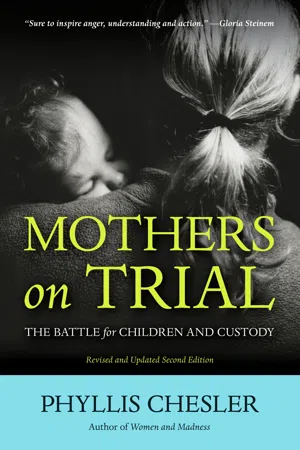
Updated and revised with seven new chapters, a new introduction, and a new resources section, this landmark book is invaluable for women facing a custody battle. It was the first to break the myth that mothers receive preferential treatment over fathers in custody disputes. Although mothers generally retain custody when fathers choose not to fight for it, fathers who seek custody often win—not because the mother is unfit or the father has been the primary caregiver but because, as Phyllis Chesler argues, women are held to a much higher standard of parenting. Incorporating findings from years of research, hundreds of interviews, and international surveys about child-custody arrangements, Chesler argues for new guidelines to resolve custody disputes and to prevent the continued oppression of mothers in custody situations. This book provides a philosophical and psychological perspective as well as practical advice from one of the country's leading matrimonial lawyers. Both an indictment of a discriminatory system and a call to action over motherhood under siege,
Mothers on Trial is essential reading for anyone concerned either personally or professionally with custody rights and the well-being of the children involved.
Information
Edition
2Subtopic
Family Law1
A Historical Overview

By the laws of England, the custody of all legitimate children from the hour of their birth belongs to the father. If circumstances, however urgent, should drive the mother from his roof, not only may she be prevented from tending upon the children in the extremity of sickness, but she may be denied the sight of them; and, if she should obtain possession of them, by whatever means, [she] may be compelled by the writ of habeas corpus to resign them to her husband or to his agents without condition—without hope. Let it not be supposed that this law is one which is rarely brought into operation. The instances in which it is brought before the public cognizance may be few, but [it] is ever in the background of domestic tyranny, and is felt by those who suffer in silence.
We true, natural women cannot live without our children. We had rather die than have them torn from us as your laws allow them to be. Spirit wrongs are the keenest wounds that can be inflicted upon women. When woman is brought before our man courts, and our man juries, and has no marks of violence upon her person, it is hard to realize that her whole physical system may be writhing in agony from spirit wrongs, such as can only be understood by her peers. Spiritual, sensitive women suffer on in silent anguish without appeal, until death. Kindly liberate her from her prisonhouse of unappreciated suffering.
In 1818 Harriet Brent Jacobs was born into slavery in North Carolina. Her “kind mistress” taught her how to read and then bequeathed her to Dr. James Norcom.1
Norcom, who was fifty-two years old, sexually harassed the twelve-year-old Harriet. He threatened to rape, sell, or kill her for resisting his advances. Mrs. Norcom persecuted Harriet for “attracting” her husband’s attention.2
When Harriet was fifteen, she fell in love with a “colored carpenter and free-born man.” She asked for permission to marry. Norcom threatened to whip her and shoot her “lover” on sight. Harriet’s grandmother then sent a friend to advise her.
Samuel Tredwell Sawyer, the “friend,” was a white man, a past member of the North Carolina legislature, and a future U.S. congressman. Within a year, Harriet gave birth to Sawyer’s son, Joseph.
Harriet’s “grim tormentor,” Norcom, “[pitched] her down a flight of stairs” and “[cut] her hair very close to her head, storming and swearing all the time.” Harriet had a second child, Louisa, by Sawyer. Norcom threatened to sell both her children if she saw Sawyer again while continuing to spurn him.
Children were a woman’s joy and only consolation. But a slave mother’s joy belonged to her master. Norcom fathered eleven slave children and sold every one to “spare” Mrs. Norcom’s feelings and profit from his own “licentiousness.” What would prevent Norcom from selling all of Harriet’s children once she became pregnant by him?
Ah, if Harriet didn’t exist, Norcom would not hold her children hostage. Harriet escaped. Norcom imprisoned her children and then sold them to a speculator whom Sawyer had secretly sent.
In hiding, Harriet rejoiced. Her children—her children—would be free. Sawyer then sent Joseph and Louisa to live with their great-grandmother. Harriet fled her hiding place and walked through the dreaded “snaky swamp.” From there she went swiftly to her grandmother’s house and up into a dark and “airless” space, which measured seven by nine feet, beneath the roof.
For seven years Harriet was entombed here. She could never stand up or walk around. All summer she was aflame with red insect bites; in winter she developed frostbite. Harriet bored a peephole through which, sight unseen, she saw but could not touch or talk to her children.
On one of these sale days, I saw a mother lead seven children to the auction block. She knew that some of them would be taken from her: but they took all. The children were sold to a slave-trader, and their mother was bought by a man in her own town. Before night her children were all far away. She begged the trader to tell her where he intended to take them: this he refused to do. How could he, when he knew he would sell them, one by one, wherever he could command the highest price? I met that mother in the street, and her wild, haggard face lives to-day in my mind. She wrung her hands in anguish, and exclaimed, “Gone! All gone! Why don’t God kill me?” I had no words wherewith to comfort her.3
Sawyer, newly married, offered to send Louisa to live with his relatives “up North,” out of Norcom’s scheming reach. After six long months, a letter arrived from “Brooklyn, Long Island,” praising Louisa as a good “waiting maid” to her cousin. Had Sawyer sent his daughter north as a slave? Had Harriet’s entombment been in vain?
Harriet had to know. She escaped north by ship. At first Harriet didn’t recognize Louisa—she was so shabbily dressed and so obviously “unattended” to. At nine, Louisa was still illiterate. Harriet immediately found work as a domestic. She bought Louisa shoes and clothes and paid for her to see a doctor.
Harriet’s experience at the hands of both her master and mistress was echoed in Autobiography of a Female Slave, written by ex-slave Mattie Griffiths:
I once saw a white lady, of refinement, sitting on the portico of her own house, with her youngest born, a babe of some seven months, dallying on her knee, and she is toying with the pretty gold threads of his silken hair, whilst her husband was in the kitchen, with a whip in his hand, severely lashing a negro woman, whom he had sold to the trader—lashing her because she refused to go cheerfully and leave her infant behind. The poor wretch, as a last recourse, fled to her mistress, and, on her knees, begged to have her child. “Oh, mistress,” cried the frantic black woman, “ask master to let me take my baby with me.” What think you was the answer of this white mother? “Go away, you impudent wretch, you don’t deserve to have your child. It will be better off away from you!” Aye, this was the answer accompanied [by] a derisive sneer, [that] she gave to the heart-stricken black mother.4
Harriet lived in terror of Norcom’s “bounty hunters.” Warned of her imminent capture, Harriet fled New York for Boston. She took Louisa with her. Once settled, Harriet sent for Joseph, who arrived one morning out of breath, “having run all the way.”
For the first time in nine years, Harriet and her children lived together in broad daylight. Harriet sewed; Louisa studied; Joseph learned a trade. On June 21, 1853, under a pseudonym, Harriet published an article in the New York Tribune about the separation of children from their slave mothers.5
Again Mattie Griffiths confirmed this grim but common reality:
A tall, hard-looking man came up to me, very roughly seized my arm, bade me open my mouth; examined my teeth, felt my limbs; made me run a few yards; ordered me to jump; and being well satisfied with my activity, said to Master Edward, “I will take her.” After a while, my mother came up to me. Her whole frame was distorted with pain. She walked toward me a few steps, then stopped, and suddenly shaking her head, exclaimed, “No, no, I can’t do it. Here, Kitty,” she said to an old negro woman, who stood near, “you break it to her. I can’t do it. No, it will drive me mad. Oh, heaven. That I was ever born to see this day.” Then rocking her body back and forth in a transport of agony, she gave full vent to her feelings in a long, loud, piteous wail…. Why, I remember that when master sold the gray mare, the colt went also. Who could, who would, who dared separate the parent from her offspring?6
Harriet’s pursuers were now willing to sell her. In 1855, when Harriet was thirty-seven years old, her friend and employer, Mrs. Willis, bought her for three hundred dollars. She wrote, “Those words struck me like a blow. So I was sold at last! A human being sold in the free city of New York! The bill of sale is on record, and future generations will learn from it that women were articles of traffic in New York, late in the nineteenth century of Christian religion. I well know the value of a bit of paper; but much as I love freedom, I do not like to look upon it.”7
As a mother, Harriet longed for “marriage” and a “home made sacred by protecting law.” She says so over and over again in her remarkable autobiography, Incidents in the Life of a Slave Girl.8
Harriet Brent Jacobs was right. She was also wrong. Laws do not keep mothers and children together. The whitest and most married of Christian mothers has no legal right to her husband’s children. By law, children “belong” to their fathers.

In 1816 Reverend Ware’s only daughter, Elizabeth, was born in Massachusetts. Elizabeth was “blest” with modesty, religious fervor, and “a liberal education.” In 1839 Elizabeth married the Reverend Theophilus Packard, who was fourteen years her senior. They moved to Illinois, where Elizabeth gave birth to six children in sixteen years. She ran the household, cared for her beloved children, helped Theophilus write his sermons, raised church funds, and “ministered” to her husband’s congregation.9
Theophilus Packard was “sluggish” and “[clung] serf-like to the old paths, as with a death grasp.” Elizabeth had a more “active” and “progressive temperament.” The “dull” and “crafty” Theophilus seized upon Elizabeth’s belief in a “free and open-minded discussion of original sin” as proof that she was “insane.”
In 1860 when their youngest child was eighteen months old, Theophilus had Elizabeth “forcibly” removed to the insane asylum in Jacksonville. Dr. Andrew McFarland, the asylum director, confiscated Elizabeth’s clothes, books, and writing paper. He sexually harassed her, threatened to kill her, threw her into solitary confinement, and imprisoned her on the asylum’s “worst ward.”
Elizabeth Packard ministered to her sisters in bondage. She washed them, comforted them, prayed with them, and tried to shield them from beatings and from suicide. After three and a half years, Elizabeth finally convinced the asylum trustees that she was lucid and God-fearing. They released her.
Theophilus forbade Elizabeth to return home or to see or speak with their children. Elizabeth decided that she had to return to her husband’s legal “protection.” She could not see her children if she remained apart from Theophilus. Elizabeth was right. American courts followed British law. Thus, for example, in 1857 in New York State an abusive husband was granted sole custody of his infant child. The decision reads as follows:
Mr. Rhoades has been wanting in respectful and kind attentions to his wife, and has often used harsh, profane, and vituperative expressions to her and to others concerning her, but he has been guilty of no such misconduct as would justify the wife in a separation. The only difficulty arises from their child being of tender age, and deriving sustenance, in part from the breasts of the mother. But upon the evidence, I think these circumstances form no obstacle to the father’s right. [The child] was placed by the father with a competent person, [and has] been doing well and growing fleshy. Therefore, on the undisputed facts of the case the father [has] the legal right to the custody of the child.10
Our hero Elizabeth arrived home one snowy November morning. Theophilus did not bother to conceal his hostility. Elizabeth embraced her children. She did not raise the subject of her psychiatric imprisonment. She had returned to “resume her domestic duties.”
Theophilus forbade Elizabeth to heat water on the stove or to hire anyone to help her clean the house. Elizabeth scoured the house by herself with cold water. Theophilus intercepted Elizabeth’s mail. He forbade her to leave the house. Then he locked her in her bedroom both day and night.11
After six weeks, Elizabeth smuggled out a note. Friends took it to a judge, who issued a writ of habeas corpus for her. Before Theophilus could act on his plan to psychiatrically imprison Elizabeth again, he had to first prove to a jury that she was “insane.”
In 1864 a jury of twelve men “acquitted” Elizabeth of insanity. She returned to her husband’s custody only to discover that Theophilus had mortgaged her dowry-bought house and fled to Massachusetts with their children. Elizabeth was alone and destitute. She had no legal right to her dowry or her children.
Her fate was echoed by that of Catherine (Mrs. Charles) Dickens, who resided in London. Professor and author Phyllis Rose writes,
Mrs. Charles [Catherine] Dickens was to have a settlement. Her own house, and her eldest son, Charley, would live with her. But all the other [nine] children were t...
Table of contents
- Cover
- Title
- Copyright
- Contents
- Acknowledgments
- New Introduction to the 2011 Lawrence Hill Books Edition
- 1 A Historical Overview
- 2 A Contemporary Overview
- 3 What Is a “Fit” Mother or Father? An “Unfit” Mother or Father? Who Decides?
- 4 Do “Good Enough” Mothers Still Lose Custody of Their Children in North America Today? The Results of an Original Study
- 5 The “Sexual” Mother: Anna Karenina Today
- 6 The “Uppity” Mother
- 7 The Lesbian Mother
- 8 The Mother Married to a Violent Man
- 9 Paternal Brainwashing
- 10 The “Voluntarily” Noncustodial Mother
- 11 The Price of Battle: Mothers Encounter the Psychological and Economic Law
- 12 The Mother-Lawyer Relationship
- 13 The Mother-Judge and Father-Judge Relationships
- 14 Court-Enabled Incest in the 1980s and 1990s
- 15 Court-Enabled Incest in the Twenty-First Century
- 16 Legal Torture from 1986 to 2010
- 17 The International Custody Situation
- 18 The Fathers’ Supremacist Movement from the 1980s to 2010
- 19 Contemporary Legal Trends, Part I: Joint Custody, Mediation, Incest, and Parental Alienation
- 20 Contemporary Legal Trends, Part II: Mental Illness, Gay and Lesbian Custody, Surrogacy, and the Primary Caretaker
- 21 Mothers’ Wisdom: Philosophical Perspectives on Having and Losing Children
- 22 Mothers’ Voices, Written on the Wind: What Is a Custody Battle Really About? · 367
- 23 What to Expect When You’re Expecting a Divorce: An Interview with Divorce Lawyer Susan L. Bender
- Resources
- Notes
- Index
Trusted by 375,005 students
Access to over 1.5 million titles for a fair monthly price.
Study more efficiently using our study tools.
Frequently asked questions
Yes, you can cancel anytime from the Subscription tab in your account settings on the Perlego website. Your subscription will stay active until the end of your current billing period. Learn how to cancel your subscription
No, books cannot be downloaded as external files, such as PDFs, for use outside of Perlego. However, you can download books within the Perlego app for offline reading on mobile or tablet. Learn how to download books offline
Perlego offers two plans: Essential and Complete
- Essential is ideal for learners and professionals who enjoy exploring a wide range of subjects. Access the Essential Library with 800,000+ trusted titles and best-sellers across business, personal growth, and the humanities. Includes unlimited reading time and Standard Read Aloud voice.
- Complete: Perfect for advanced learners and researchers needing full, unrestricted access. Unlock 1.5M+ books across hundreds of subjects, including academic and specialized titles. The Complete Plan also includes advanced features like Premium Read Aloud and Research Assistant.
We are an online textbook subscription service, where you can get access to an entire online library for less than the price of a single book per month. With over 1.5 million books across 990+ topics, we’ve got you covered! Learn about our mission
Look out for the read-aloud symbol on your next book to see if you can listen to it. The read-aloud tool reads text aloud for you, highlighting the text as it is being read. You can pause it, speed it up and slow it down. Learn more about Read Aloud
Yes! You can use the Perlego app on both iOS and Android devices to read anytime, anywhere — even offline. Perfect for commutes or when you’re on the go.
Please note we cannot support devices running on iOS 13 and Android 7 or earlier. Learn more about using the app
Please note we cannot support devices running on iOS 13 and Android 7 or earlier. Learn more about using the app
Yes, you can access Mothers on Trial by Phyllis Chesler in PDF and/or ePUB format. We have over 1.5 million books available in our catalogue for you to explore.