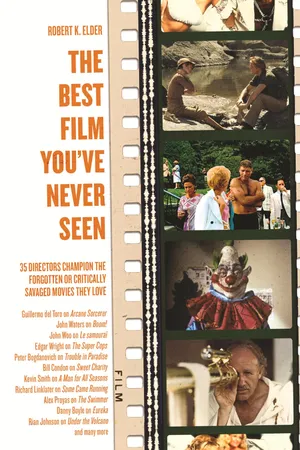
Revealing a festival of guilty pleasures, almost-masterpieces, and undeniable classics in need of revival, 35 directors champion their favorite overlooked or critically savaged gems in this guide. The list includes unsung noir films The Chase and Murder by Contract, famous flops Can't Stop the Music and Joe Versus the Volcano, art films L'ange and WR: Mysteries of the Organism, theatrical adaptations The Iceman Cometh and The Homecoming, B-movies Killer Klowns from Outer Space and The Honeymoon Killers, and even Oscar-winners Breaking Away and Some Came Running. The filmmakers, including Guillermo del Toro, John Waters, John Woo, Edgar Wright, and Danny Boyle, defend their choices, wanting these films to be loved, admired, and swooned over, arguing the films deserve a larger audience and their place in movie history be reconsidered. Some were well-loved but are now faded or forgotten, others ran afoul of critics or were just buried after a dismal opening run, and still others never even got proper distribution. A few of these titles qualify as bona fide obscurata, but now most can be found on DVD or streaming from Netflix or Amazon. The filmmakers are the perfect hosts, setting the tone, managing expectations, and often being brutally honest about a film's shortcomings or the reasons why it was lost in the first place.
eBook - ePub
The Best Film You've Never Seen
35 Directors Champion the Forgotten or Critically Savaged Movies They Love
- 304 pages
- English
- ePUB (mobile friendly)
- Available on iOS & Android
eBook - ePub
The Best Film You've Never Seen
35 Directors Champion the Forgotten or Critically Savaged Movies They Love
About this book
Information
Subtopic
Film & Video1
Austin Chick
After Dark, My Sweet
Austin Chick is attracted to charged, emotional interactions between characters. His films often explore the ways people either are or aren’t able to work together and communicate. Chick’s selection, James Foley’s After Dark, My Sweet, has similar themes of alienation and that staple question of noirs: whom can you trust?
After Dark, My Sweet is an adaptation of Jim Thompson’s pitch-black novel of the same name, and part of Chick’s fascination with the film is with its bleak atmosphere. But asked to describe why he chose to defend this movie, Chick used two words: “Jason Patric.”
“It’s Jason Patric’s best performance by far,” Chick says. “He’s always exceeding your expectations of who that character is … and then you realize that he’s actually much smarter and more complicated than you initially give him credit for being.”
Austin Chick, selected filmography:
XX/XY (2002)
August (2008)
Girls Against Boys (2012)
After Dark, My Sweet
1990
Directed by James Foley
Starring Jason Patric, Rocky Giordani, Rachel Ward, Bruce Dern, and others
How would you describe After Dark, My Sweet to someone who’s never seen it?
CHICK: It’s a thriller based on a Jim Thompson book about a vagrant ex-boxer who stumbles into town and meets a mysterious widow, who draws him into a kidnapping plot with others. They try to use him as the fall guy, and complications ensue.
I definitely first saw it on video, probably in film school. I remember being totally surprised by it. I felt that the inner monologue was kind of used as a crutch, but one of the things that’s so interesting about the film is that the main character, Kevin “Kid” Collins (Jason Patric), is constantly reinventing himself. He’s always exceeding your expectations of who that character is, and a big part of it is his inner monologue. You think he’s one thing, and then you realize that he’s actually much smarter and more complicated than you initially give him credit for being.
He is hyperaware of how things may play out and others’ motivations— but not his own.
CHICK: It’s Jason Patric’s best performance by far. I was so impressed with him in that movie that I went and saw Geronimo: An American Legend in theaters. I was so into Jason Patric after seeing that, and Geronimo is a fucking terrible movie.
I had seen Rush, and everyone talked about how great he was in that movie, and I didn’t really buy it. Then I must have seen After Dark, My Sweet, and I was like, “Holy shit, this guy is phenomenal.”
Previously, he had been cast as the teen idol. He was in Solarbabies, but The Lost Boys was his big break.
CHICK: I had seen The Lost Boys. It was one of those movies, when I was a little kid, that was kind of big, and everyone was into that movie. It wasn’t really my kind of film.
What are the dangers of relying on voiceover?
CHICK: Very often, it’s a cheap way to deal with exposition or a cheap way to try to get an audience into a character’s head. Generally speaking, it’s not looked at as a very cinematic device. I have written scripts with voiceover, and I always feel like it’s a cop-out. I’ve never made a movie with voiceover.
To use it when there’s sort of an unreliable narrator or unreliable protagonists, like this movie does, the voiceover is giving you something other than exposition and other than talking you through what you’re seeing.
So why does this film deserve recognition?
CHICK: For one thing, Jason Patric is phenomenal in the movie. It’s beautifully shot—and I haven’t seen all of James Foley’s stuff—but to me it feels like a perfectly crafted, albeit small, piece of cinema. There’s an overall sense of visual design to the film that you don’t really see in the other James Foley films. At Close Range is a really interesting film, but it feels kind of dated.
But After Dark, My Sweet—from beginning to end—every frame and every camera move is clearly thought out and brilliantly, beautifully executed. It had a really clear, straightforward sense of visual design throughout the entire film.
How does this stack up against other Jim Thompson adaptations?
CHICK: The Grifters is an amazing film. I love that movie. The similarities between this and The Grifters have a lot to do with the complex relationships between the characters, the distribution of power, the dark take on what greed does to people and what paranoia can do to a relationship. The thing that’s amazing about The Grifters is really the writing and the performances.
Perhaps After Dark, My Sweet is overlooked because it stands in the shadow of The Grifters.
CHICK: Yeah. I also feel like there are certain things about After Dark, My Sweet that are demanding of the audience, because a number of plot points are pretty subtle and hard to keep track of. The Grifters is much more straightforward. Psychologically, what’s going on between the characters is easier to follow—as are the twists and turns and double-crossings. It’s as interesting and complex, but it’s a little bit more palatable for an audience.
Palatable for two reasons: After Dark, My Sweet has a peculiar structure, because Kid Collins initially walks away and the script goes off track for nearly twenty minutes—did it feel that way to you?
CHICK: Yeah, and in some ways it suffers from being stuck in that house for so much of the movie. But the shifting power among those three characters— between Jason Patric, Rachel Ward, and Bruce Dern—is fascinating. The moment when Jason Patric takes the wrong kid in order to mess with Bruce Dern’s character and the whole use of that Vertigo shot is a really great turning point in that film.
Rachel Ward said in an interview around the time of the film, “Thompson does not ask you to love his characters.” Do you think that’s true, and then how do you keep an audience interested?
CHICK: Maybe it’s not the average viewer’s response to the movie, but I think that Kid Collins is a very sympathetic character. Ultimately, he sacrifices himself. I don’t know if you’d really call him a victim, but you definitely get the feeling he’s been taken advantage of and stepped on throughout his life.
One of the things that makes After Dark stand out in the Thompson canon is the presence of sexual attraction between the main characters, which was meant to make the story more palatable to audiences. In fact, the love scene is the only time when the characters seem to really connect. First, is my reading of that correct?
CHICK: That fade in/fade out lovemaking stuff dates the movie a little. You’re asking about whether or not the sexual attraction works in terms of making the film feel more commercial. It’s on track to doing that, but then it derails too quickly to really satisfy that urge.
That first moment where he follows her into the bathroom and they start kissing seems like it should be the fulfillment of a desire that’s been building through the whole movie, but … [trails off].
After that sex scene, it seems like it should be bringing them together, but then they cut it right off. If I remember, it’s a hard cut. We come back, and those two characters, rather than being closer, they’re at each other’s throats. You come to realize that she’s trying to do something by hiding the boy. In theory, she’s trying to do something so they can get away and have a life together, but Jason Patric, being somewhat paranoid, immediately mistrusts her, and everything gets that much more complicated between the two of them.
My reading was just the opposite: It’s the first time she feels close with Kid Collins, so he’s no longer sacrificial. So she hides the boy to sabotage their relationship and narrow her options.
CHICK: I assumed that she was hiding the kid because she was hoping that they were going to be able to run away together. That’s definitely the way I read him, although he’s kind of a dick to her even before he finds out the boy is gone. He wakes up feeling like he’s going to get fucked. He wakes up mistrusting her, right? From the moment that he wakes up and she walks into the room, he’s an asshole.
It’s interesting that you chose this film, because this scene we’re talking about contains echoes of your film XX/XY. Mark Ruffalo’s character is looking for a sexual connection with two women, which ends up driving them apart and sowing mistrust with the one woman he could have a life with.
CHICK: It didn’t really occur to me. But to a certain degree, I can see the connection. Very often in films people getting together is too easy. Things aren’t easy, and sex very often can complicate things and do the exact opposite of bringing people together emotionally.
It’s been observed that sex scenes can stop a movie dead. Having had to direct them yourself, how do you approach sex scenes?
CHICK: They’re never easy to shoot. I’ve shot four of them. The first time I ever had to shoot a sex scene was the three-way sex scene in XX/XY, and we tried to rehearse just the blocking of it, because there were nudity issues with some of the actors. You end up getting into the situation where you say, “You don’t have to show this; you have to show this.” Everything has to be approved and signed off on before you get into production.
I thought that rehearsing just the choreography of it—who’s going to move where, where the camera’s going to be, how the camera’s going to move—was something that would make it easier. Big mistake. That day ended in tears.
There are two different philosophies about shooting sex scenes from a production standpoint. Either you put it early in the schedule, with the hope that the actors will all be professional and do their jobs and do the sex scene, or you put it late in the schedule, with the hopes that the actors will be more comfortable with each other. But you also run the risk of the actors having grown to hate each other, in which case it becomes, you know, exponentially more difficult.
All the sex scenes that I’ve shot are about the discomfort of being intimate, but that one [from XX/XY ] especially. It’s about this character who’s decided to do something she’s not totally comfortable with, and over the course of the scene, she becomes really uncomfortable with it. So the fact that the actors were not really comfortable with it—you can see them giggling a little bit—that sense of discomfort worked for that scene.
The next sex scene that we shot was just between Mark Ruffalo and Maya Stange, and that one I was able to choreograph a little bit more. It was part of the overall visual design of that movie that the camera wanders around a little bit. We shot a lot of close-ups and landscapes of places. The third sex scene in that movie is probably the one that might draw the clearest parallel to the sex scene in After Dark, My Sweet. You feel the tension for a while, and then it explodes in this sexual impulse that then backfires.
What did you learn from After Dark, My Sweet as a director?
CHICK: There is some very simple technical stuff in that film that really made me rethink certain things. There’s a moment where he runs away in the mi...
Table of contents
- Cover
- Title Page
- Copyright
- Dedication
- Contents
- Introduction
- 1 Austin Chick
- 2 The Brothers Quay
- 3 Guillermo Del Toro
- 4 Phil Lord
- 5 Neil Labute
- 6 John Waters
- 7 Richard Curtis
- 8 Jonathan Levine
- 9 Guy Maddin
- 10 Danny Boyle
- 11 Henry Jaglom
- 12 Richard Kelly
- 13 Atom Egoyan
- 14 Todd Solondz
- 15 Arthur Hiller
- 16 Michael Polish
- 17 Joe Swanberg
- 18 Jay Duplass
- 19 Steve James
- 20 Brian Herzlinger
- 21 Kevin Smith
- 22 Antonio Campos
- 23 John Woo
- 24 Richard Linklater
- 25 Edgar Wright
- 26 Bill Condon
- 27 Alex Proyas
- 28 Sean Durkin
- 29 Frank Oz
- 30 Peter Bogdanovich
- 31 John Dahl
- 32 Kimberly Peirce
- 33 Rian Johnson
- 34 John Mcnaughton
- 35 Alex Gibney
- Acknowledgments
- Index
Trusted by 375,005 students
Access to over 1.5 million titles for a fair monthly price.
Study more efficiently using our study tools.
Frequently asked questions
Yes, you can cancel anytime from the Subscription tab in your account settings on the Perlego website. Your subscription will stay active until the end of your current billing period. Learn how to cancel your subscription
No, books cannot be downloaded as external files, such as PDFs, for use outside of Perlego. However, you can download books within the Perlego app for offline reading on mobile or tablet. Learn how to download books offline
Perlego offers two plans: Essential and Complete
- Essential is ideal for learners and professionals who enjoy exploring a wide range of subjects. Access the Essential Library with 800,000+ trusted titles and best-sellers across business, personal growth, and the humanities. Includes unlimited reading time and Standard Read Aloud voice.
- Complete: Perfect for advanced learners and researchers needing full, unrestricted access. Unlock 1.5M+ books across hundreds of subjects, including academic and specialized titles. The Complete Plan also includes advanced features like Premium Read Aloud and Research Assistant.
We are an online textbook subscription service, where you can get access to an entire online library for less than the price of a single book per month. With over 1.5 million books across 990+ topics, we’ve got you covered! Learn about our mission
Look out for the read-aloud symbol on your next book to see if you can listen to it. The read-aloud tool reads text aloud for you, highlighting the text as it is being read. You can pause it, speed it up and slow it down. Learn more about Read Aloud
Yes! You can use the Perlego app on both iOS and Android devices to read anytime, anywhere — even offline. Perfect for commutes or when you’re on the go.
Please note we cannot support devices running on iOS 13 and Android 7 or earlier. Learn more about using the app
Please note we cannot support devices running on iOS 13 and Android 7 or earlier. Learn more about using the app
Yes, you can access The Best Film You've Never Seen by Robert K. Elder,Robert K. Elder in PDF and/or ePUB format, as well as other popular books in Media & Performing Arts & Film & Video. We have over 1.5 million books available in our catalogue for you to explore.