Tracing the remarkable history of a certain kind of flying machine—from the rocket belt to the jet belt to the flying platform and all the way to Yves Rossy's 21st-century free flights using a jet-powered wing—this historical account delves into the technology that made these devices possible and the reasons why they never became commercial successes on a mass scale. These individual lift devices, as they were blandly labeled by the government men who financed much of their development, answered man's desire to simply step outside and take flight. No runways, no wings, no pilot's license were required. But the history of the jet pack did not follow its expected trajectory and the devices that were thought to become as commonplace as cars have instead become one of the most overpromised technologies of all time. This fascinating account profiles the inventors and pilots, the hucksters and cheats, and the businessmen and soldiers who were involved with the machines, and it tells a great American story of a technology whose promise may yet, one day, come to fruition.

eBook - ePub
The Great American Jet Pack
The Quest for the Ultimate Individual Lift Device
- 240 pages
- English
- ePUB (mobile friendly)
- Available on iOS & Android
eBook - ePub
About this book
Information
1

FLYING SHOES AND HOVERING PLATFORMS
In the fall of 1942, a thirty-four-year-old engineer named Charles Horton Zimmerman was thinking about flight and what it would take to make it available to everyone. He had been working at Chance-Vought, a manufacturer of military aircraft, as well as at the laboratory of the National Advisory Committee for Aeronautics. For an aeronautical engineer, he held an unorthodox belief: he thought airplanes were too difficult to fly. He knew that trained pilots could fly them, but he hoped aviation could be pushed to a point where anyone could fly. “I couldn’t see any future for personal aviation. There seemed to be no prospect of a plane I’d want to fly.” Zimmerman wondered how to simplify the flying machine. What was necessary to lift a man into the air? Reduced to its components, it wasn’t much. An upward force pressed against his feet would lift a man if the force was greater than that of gravity. Could an individual, simply being lifted, remain stable in “flight” like this? If so, it was simple. There it was: lift and control. Two problems Zimmerman hoped to overcome to allow the average person to fly.
Zimmerman knew that stability in the air was the real problem. He had been working on airplane stability in wind tunnels for more than a decade and was an expert on the subject. Like so many inventors, he opted to work out of his garage while attacking the problems of personal flight. He hung ropes from the rafters and placed a board between them. He put a stick under the board and then stood on it to see how hard it was to keep his balance when perched on such a small platform. He found it was much easier to keep his balance than he had expected. Could he balance on a platform if it was lifting him into the air? He thought so. He set out building a device he called his “Flying Shoes.”1
Zimmerman thought it might be possible to get the lift he needed using miniature helicopter blades.2 The device he built consisted of a small platform on a framework of tubing that stood just a few inches off the ground. Zimmerman, as the pilot, would stand between two small four-cylinder engines powering two-bladed propellers that faced upward. The spinning blades were about knee-high to Zimmerman and controlled by a throttle handle extending upward from the base.
As he worked on developing the Flying Shoes Zimmerman became convinced that he could not only balance on the device when it was aloft, but that he could also maneuver it with kinesthetic control.3 That is, he believed he could stand on the Flying Shoes and simply lean in the direction he wanted to go. If he leaned forward, it would tip the device and the change in the angle of the propellers would move the platform forward. To stop, he thought he could just lean backward. If true, this meant that an operator would not need special training to pilot the Flying Shoes. The flight controls were intuitive. This would be the flying machine he had dreamed of, the one that could be flown by anyone.
Zimmerman filed for a patent on the Flying Shoes in 1943. The patent was granted in 1947, and it is clear Zimmerman had some great aspirations for his invention. Patent filings often contain quite broad and general descriptions of an invention and sometimes appear primitive when compared to the products that follow. Zimmerman’s patent for a Helicopter Flying Apparatus covered the Flying Shoes, but it was outlandishly different from what he had built. In his patent, Zimmerman imagined the flyer attaching himself to the machine, which had blades surrounded by rings. The pilot stood directly on top of the propeller housings, which—when compared with the open-bladed Flying Shoes prototype—seemed a much safer design. The drawings in the patent show that Zimmerman did not simply intend for his device to hover. He drew small wings on the back of the pilot and even smaller wings on the side of the operator’s head.
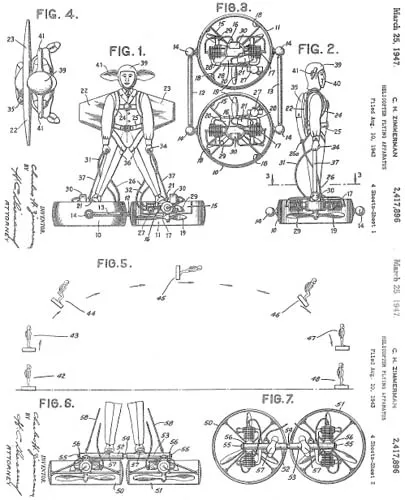
Charles Zimmerman’s Flying Shoes allowed a man to hover, although Zimmerman imagined that the pilot would be able to fly horizontally as well. While the machine never fulfilled that dream, it did demonstrate kinesthetic control.
An accompanying illustration showed a typical flight: the flyer would lift off the ground, tip forward, and then fly in the manner of an airplane, using the wings on the flyer’s back and head. When he wanted to land, he would slow down and swing his legs beneath him and then land vertically. Zimmerman had never gotten his shoes to do any such thing, and he never would. The claims he made in his patent for the device were likewise impossible. He said the device “should be able” to travel 350 miles at speeds approaching two hundred miles per hour.
Notwithstanding the outlandish performance claims, Zimmerman’s patent contained real elements that made it groundbreaking. He proposed a device to be worn by its pilot, with vertical take-off and landing, that would be controlled kinesthetically. The only mechanical control for the pilot was the throttle. Zimmermann went so far as to suggest his device could be powered someday by a turbine engine.4
Even though Zimmerman worked in an aeronautical laboratory, he chose to build the Flying Shoes in his garage using his own money. The engines cost him $500 each and the propellers were $100 for the pair. Zimmerman, like many other inventors, insisted on testing the device himself. A magazine reporter remarked on Zimmerman’s bravery, standing on the Flying Shoes with the wooden propellers whipping by just four inches away from his knees.
While Zimmerman was fine-tuning his Flying Shoes, he met Stanley Hiller Jr., a twenty-one-year-old businessman and inventor who built and flew his own helicopters and had, at the age of seventeen, established Hiller Industries in Palo Alto, California. Hiller’s company, later known as Hiller Aircraft and then Hiller Helicopters, developed helicopters for the military and civilian markets. 5 Hiller was always looking for new developments and inventions. While he was traveling on the East Coast in 1946, Hiller heard about an inventor working on a “crazy machine” nearby.6 The man telling Hiller the story thought Hiller would get a kick out of it since the machine contained elements of a helicopter. Hiller went and visited Zimmerman to see what he had created. He was intrigued.
Hiller brought the Flying Shoes to California for testing.7 It didn’t go well. It was hard to keep the two engines running at the same speed and, as a result, the device proved unstable. Plus, what would happen if one of the engines failed in flight?8 Worse, how safe was it for the operator to be standing so close to two propellers spinning at full speed? And the machine never got far off the ground; it hovered at an altitude of a few inches.9 Hiller sent the Flying Shoes back to Zimmerman but remained intrigued by the idea.
Meanwhile, Zimmerman remained fixated on the idea of kinesthetic control, convinced that a person could balance and control a hovering device using nothing more than body movement. But how could this be proven? The National Advisory Committee for Aeronautics agreed to let Zimmerman work on the problem using its facilities. The scientists and engineers there routinely used large quantities of compressed air stored in giant tanks. Zimmerman thought he might be able to build a rig where a small platform would be blasted upward using nothing more than the compressed air. On February 2, 1951, under his direction, Zimmerman’s engineers attached air hoses to a piece of plywood with a small nozzle in its center. The hoses fed air through the nozzle at several hundred pounds per square inch, and Zimmerman’s feet were strapped to the board. They connected safety tethers to him, in case it didn’t work. Then, they let the air loose.
The air shrieked through the nozzle and Zimmerman waited to see what would happen. Nothing. Then he looked around and realized that his safety lines were no longer taut. He later said he was hovering off the floor but hadn’t felt the board move. He stood motionless for a minute and then signaled for the air supply to be cut off. He had proven he could remain stable on a column of air, but could he maneuver? Zimmerman and another man named Paul Hill took turns flying the board and studying the limits of hovering flight. They realized that Zimmerman had been correct: they could move about on the column of air by simply leaning in the direction they wanted to go. “Paul Hill became adept at sashaying around the 15-foot circle to which the dragging lines limited him.” Soon others were riding the board on a cushion of compressed air.10
Paul Hill liked the idea so much he built a contraption that looked like a double-bladed, upside-down helicopter. It weighed 140 pounds, but it flew. The blades were powered by compressed air. Its seven-foot propellers were on the same axis but spun in opposite directions. It responded to the pilot’s body movements, even if it wasn’t as responsive as the flying board. Word of these NACA experiments found their way to Hiller, who had not forgotten the Flying Shoes.11 Hiller was so convinced the idea was viable that he began looking for a government sponsor.
2
THE HILLER AND DE LACKNER FLYING PLATFORMS
In 1953, the Office of Naval Research–Naval Sciences Division heard about the NACA work and Stanley Hiller’s desire to create a practical individual lift device. It offered Hiller a contract to develop a ducted-fan flying platform, suggested by a government scientist named Alexander Satin who had followed the work of Charles Zimmerman and Paul Hill.1 Zimmerman reportedly waived any patent rights he might have in whatever Hiller developed.2 The proposed device consisted of two large propellers that spun, one in each direction, inside a round fiberglass housing that was a foot or so tall. On top of the housing was a small spot for the pilot to stand, surrounded by a frame of aluminum tubing to keep the pilot from falling off the device. In essence, the device was a huge fan pointed at the ground. The pilot would stand on top of the platform and when it lifted itself, it would lift the pilot with it. The flying platform would be controlled kinesthetically.3 In many respects, it was a larger version of the Flying Shoes, slightly reconfigured. An advantage of this new design was that the duct—the circular shroud that surrounded the propellers—concentrated the air more efficiently than a non-shrouded propeller. Hill and Zimmerman consulted with Hiller on the design, and the project was developed and built under strict secrecy.4 While Hiller Helicopters employed nine hundred people, only fifteen knew about the flying platform before it was unveiled publicly, according to Hiller.5 The work began in January 1954 and Hiller had a working prototype before the end of the year.6 The device was five feet across and two men could lift and carry it. It became the “first ducted fan VTO vehicle to fly successfully.” It has also been claimed that it was the “first heavier-than-air aircraft capable of being flown from the outset by someone without flight training,” although it is unclear if anyone who was not a pilot ever actually flew the Hiller Flying Platform.* While the flights were not spectacular, they highlighted the simplicity of kinesthetic control. The VZ-1 Flying Platform made its first free flight January 27, 1955.7
By April 1955, Hiller was ready to let the world know about its new flying machine. Hiller reported it to Flight magazine, an aerospace periodical that acted as a sort of yearbook for the aviation industry. Although the magazine covered all manner of aircraft, the editors found the flying platform unusual. “Retrospectively, the past twelve months seem to have introduced—albeit in rudimentary forms—an unprecedented number of curious types of flying machine. One of the strangest of all is [the Hiller Flying Platform].”8 Flight cautioned readers not to expect to see the flying platforms in widespread use just yet; the flying platform was a “research tool,” and “further research and development will be necessary.”9
Hiller publicized the new invention in the mainstream press also, and as would become commonplace, the new individual lift device was introduced to the general public with overblown superlatives, setting it up to almost certainly disappoint. It could never live up to the hype. Reporters from Collier’s were given a demonstration of the VZ-1 and could barely contain themselves, gushing about the platform and the impact it was sure to have on society. “A radically different one-man aircraft, it hovers, climbs and darts sideways, ‘riding a column of air.’ It’s probably the simplest flying machine ever created—and it may revolutionize aeronautics.”10
Hiller touted the machine as being equally valuable to the civilian market as it might be to the military. “It is not inconceivable that it might become the long-awaited ‘airplane in every garage,’ which never became a reality because of the high cost of planes and helicopters. Simplicity is the keynote of the Hiller-ONR machine, and simplicity means lower cost. Anyone with a sense of balance can learn to fly such a vehicle. If you’ve ever ridden a bicycle you’re a platform pilot prospect.” A project engineer gave the reporter an even better standard: “A trained bear could fly this machine.”11 Further, it would work wonders for the American fighting man. It could be used to assault beaches, cross rivers, or patrol “otherwise inaccessible areas.”12
Stanley Hiller Jr., the president of Hiller Helicopters, was ...
Table of contents
- Cover
- Book Title
- Copyright
- Dedication
- Contents
- Introduction
- 1 Flying Shoes and Hovering Platforms
- 2 The Hiller and de Lackner Flying Platforms
- 3 The Age of Man Rockets
- 4 The Quest for the Rocket Belt
- 5 Wendell F. Moore and the Bell Rocket Belt
- 6 The Rocket Belt Flies
- 7 The Bell Rocket Men
- 8 The Sud Ludion and the Pogo
- 9 William P. Suitor: Rocket Man
- 10 The Jet Flying Belt
- 11 The WASP
- 12 The WASP Gets Kinesthetic Control: The WASP II
- 13 The Rocket Belt Returns
- 14 The Pretty Bird Saga
- 15 Civilian Rocket Belts
- 16 The Modern Rocket Belt in the Public Eye
- 17 Ducted Fan Lift Devices
- 18 Hal Graham
- 19 Jetlev
- 20 Jetman: Yves Rossy
- 21 When Will We Have Jet Packs?
- Epilogue | Where Are They Today?
- Appendix | Origin Hoaxes
- Acknowledgments
- Bibliography
- Notes
- Index
Trusted by 375,005 students
Access to over 1.5 million titles for a fair monthly price.
Study more efficiently using our study tools.
Frequently asked questions
Yes, you can cancel anytime from the Subscription tab in your account settings on the Perlego website. Your subscription will stay active until the end of your current billing period. Learn how to cancel your subscription
No, books cannot be downloaded as external files, such as PDFs, for use outside of Perlego. However, you can download books within the Perlego app for offline reading on mobile or tablet. Learn how to download books offline
Perlego offers two plans: Essential and Complete
- Essential is ideal for learners and professionals who enjoy exploring a wide range of subjects. Access the Essential Library with 800,000+ trusted titles and best-sellers across business, personal growth, and the humanities. Includes unlimited reading time and Standard Read Aloud voice.
- Complete: Perfect for advanced learners and researchers needing full, unrestricted access. Unlock 1.5M+ books across hundreds of subjects, including academic and specialized titles. The Complete Plan also includes advanced features like Premium Read Aloud and Research Assistant.
We are an online textbook subscription service, where you can get access to an entire online library for less than the price of a single book per month. With over 1.5 million books across 990+ topics, we’ve got you covered! Learn about our mission
Look out for the read-aloud symbol on your next book to see if you can listen to it. The read-aloud tool reads text aloud for you, highlighting the text as it is being read. You can pause it, speed it up and slow it down. Learn more about Read Aloud
Yes! You can use the Perlego app on both iOS and Android devices to read anytime, anywhere — even offline. Perfect for commutes or when you’re on the go.
Please note we cannot support devices running on iOS 13 and Android 7 or earlier. Learn more about using the app
Please note we cannot support devices running on iOS 13 and Android 7 or earlier. Learn more about using the app
Yes, you can access The Great American Jet Pack by Steve Lehto in PDF and/or ePUB format, as well as other popular books in Technology & Engineering & Science General. We have over 1.5 million books available in our catalogue for you to explore.