eBook - ePub
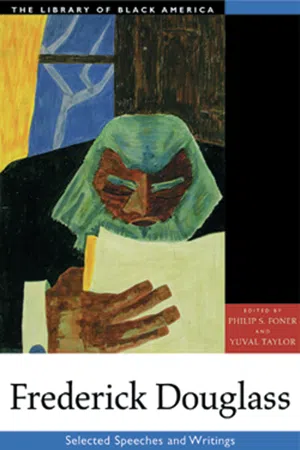
Frederick Douglass
Selected Speeches and Writings
- 808 pages
- English
- ePUB (mobile friendly)
- Available on iOS & Android
eBook - ePub
Frederick Douglass
Selected Speeches and Writings
About this book
One of the greatest African American leaders and one of the most brilliant minds of his time, Frederick Douglass spoke and wrote with unsurpassed eloquence on almost all the major issues confronting the American people during his life—from the abolition of slavery to women's rights, from the Civil War to lynching, from American patriotism to black nationalism. Between 1950 and 1975, Philip S. Foner collected the most important of Douglass's hundreds of speeches, letters, articles, and editorials into an impressive five-volume set, now long out of print. Abridged and condensed into one volume, and supplemented with several important texts that Foner did not include, this compendium presents the most significant, insightful, and elegant short works of Douglass's massive oeuvre.
Information
PART ONE
From 1841 to the Founding of The North Star
From the beginning of his career as a lecturer, Douglass moved beyond the narrow limits prescribed for him by the Garrisonians. He had been hired to tell the story of his slave experiences, and in his first public addresses he discussed nothing else. But within two months, he was discussing the “progress of the cause.” … [In this early speech,] Douglass struck the central theme of his career as an Abolitionist—the twin battle against slavery in the South and prejudice in the North….
Here was no mere copy of other Abolitionist lecturers. Here was a spokesman for his people who experienced their degradation every day of his life, and who could express in vivid burning language the pent-up indignation of the American Negro. [1:48–49]
THE CHURCH AND PREJUDICE, speech delivered at the Plymouth Church Anti-Slavery Society, December 23, 1841
At the South I was a member of the Methodist Church. When I came north, I thought one Sunday I would attend communion, at one of the churches of my denomination, in the town I was staying. The white people gathered round the altar, the blacks clustered by the door. After the good minister had served out the bread and wine to one portion of those near him, he said, “These may withdraw, and others come forward”; thus he proceeded till all the white members had been served. Then he drew a long breath, and looking out towards the door, exclaimed, “Come up, colored friends, come up! for you know God is no respecter of persons!” I haven’t been there to see the sacraments taken since.
At New Bedford, where I live, there was a great revival of religion not long ago—many were converted and “received” as they said, “into the kingdom of heaven.” But it seems, the kingdom of heaven is like a net; at least so it was according to the practice of these pious Christians; and when the net was drawn ashore, they had to set down and cull out the fish. Well, it happened now that some of the fish had rather black scales; so these were sorted out and packed by themselves. But among those who experienced religion at this time was a colored girl; she was baptised in the same water as the rest; so she thought she might sit at the Lord’s table and partake of the same sacramental elements with the others. The deacon handed round the cup, and when he came to the black girl, he could not pass her, for there was the minister looking right at him, and as he was a kind of abolitionist, the deacon was rather afraid of giving him offence; so he handed the girl the cup, and she tasted. Now it so happened that next to her sat a young lady who had been converted at the same time, baptised in the same water, and put her trust in the same blessed Saviour; yet when the cup, containing the precious blood which had been shed for all, came to her, she rose in disdain, and walked out of the church. Such was the religion she had experienced!
Another young lady fell into a trance. When she awoke, she declared she had been to heaven. Her friends were all anxious to know what and whom she had seen there; so she told the whole story. But there was one good old lady whose curiosity went beyond that of all the others—and she inquired of the girl that had the vision, if she saw any black folks in heaven? After some hesitation, the reply was, “Oh! I didn’t go into the kitchen!”
Thus you see, my hearers, this prejudice goes even into the church of God. And there are those who carry it so far that it is disagreeable to them even to think of going to heaven, if colored people are going there too. And whence comes it? The grand cause is slavery; but there are others less prominent; one of them is the way in which children in this part of the country are instructed to regard the blacks.
“Yes!” exclaimed an old gentleman, interrupting him—”when they behave wrong, they are told, ‘black man come catch you.’”
Yet people in general will say they like colored men as well as any other, but in their proper place! They assign us that place; they don’t let us do it for ourselves, nor will they allow us a voice in the decision. They will not allow that we have a head to think, and a heart to feel, and a soul to aspire. They treat us not as men, but as dogs—they cry “Stu-boy!” and expect us to run and do their bidding. That’s the way we are liked. You degrade us, and then ask why we are degraded—you shut our mouths, and then ask why we don’t speak—you close your colleges and seminaries against us, and then ask why we don’t know more.
But all this prejudice sinks into insignificance in my mind, when compared with the enormous iniquity of the system which is its cause—the system that sold my four sisters and my brothers into bondage—and which calls in its priests to defend it even from the Bible! The slaveholding ministers preach up the divine right of the slaveholders to property in their fellow-men. The southern preachers say to the poor slave, “Oh! if you wish to be happy in time, happy in eternity, you must be obedient to your masters; their interest is yours. God made one portion of men to do the working, and another to do the thinking; how good God is! Now, you have no trouble or anxiety; but ah! you can’t imagine how perplexing it is to your masters and mistresses to have so much thinking to do in your behalf! You cannot appreciate your blessings; you know not how happy a thing it is for you, that you were born of that portion of the human family which has the working, instead of the thinking to do! Oh! how grateful and obedient you ought to be to your masters! How beautiful are the arrangements of Providence! Look at your hard, horny hands—see how nicely they are adapted to the labor you have to perform! Look at our delicate fingers, so exactly fitted for our station, and see how manifest it is that God designed us to be His thinkers, and you the workers—Oh! the wisdom of God!”—I used to attend a Methodist church, in which my master was a class-leader; he would talk most sanctimoniously about the dear Redeemer, who was sent “to preach deliverance to the captives, and set at liberty them that are bruised”—he could pray at morning, pray at noon, and pray at night; yet he could lash up my poor cousin by his two thumbs, and inflict stripes and blows upon his bare back, till the blood streamed to the ground! all the time quoting scripture, for his authority, and appealing to that passage of the Holy Bible which says, “He that knoweth his master’s will, and doeth it not, shall be beaten with many stripes!” Such was the amount of this good Methodist’s piety.
National Anti-Slavery Standard, December 23, 1841

George Latimer, a fugitive slave, had fled to Boston from Norfolk, Virginia, in October, 1842. He was arrested without a warrant and thrown into a Boston jail solely on a warrant order to the jailer of Suffolk County from James B. Gray who claimed to be his owner. Friends rallied to the slave’s side and demanded a trial by jury. When Chief Justice Shaw denied the demand and refused to grant a writ of habeas corpus, the movement to save Latimer gained tremendous momentum.
Boston was wild with excitement. Placards were distributed and handbills posted throughout the city denouncing the outrage, and summoning the citizens to a meeting in Faneuil Hall “For the Rescue of Liberty!” “Agitate! Agitate!” cried the Liberator of November 11, 1842. “Latimer shall go free! … Be vigilant, firm, uncompromising, friends of freedom! friends of God!” …
In mid-November Latimer was purchased from Gray for four hundred dollars, and then set free. Around this event, the Abolitionists organized a series of celebrations with Latimer as the central figure. Douglass, a prominent speaker at the celebrations, was moved by Latimer’s freedom to unusual brilliance.1
[This is the first public letter Douglass ever wrote.] [I:54]
TO WILLIAM LLOYD GARRISON
Dear Friend Garrison:
The date of this letter finds me quite unwell. I have for a week past been laboring, in company with bro[ther] Charles Remond, in New Bedford, with special reference to the case of our outraged brother, George Latimer, and speaking almost day and night, in public and in private; and for the reward of our labor, I have the best evidence that a great good has been done. It is said by many residents, that New Bedford has never been so favorably aroused to her anti-slavery responsibility as at present. Our meetings were characterized by that deep and solemn feeling which the importance of the cause, when properly set forth, is always calculated to awaken. On Sunday, we held three meetings in the new town hall, at the usual meeting hours, morning, afternoon, and evening. In the morning, we had quite a large meeting, at the opening of which, I occupied about an hour, on the question as to whether a man is better than a sheep. Mr. Dean then made a few remarks, and after him, Mr. Clapp of Nantucket arose and gave his testimony to the truth, as it is in anti-slavery. The meeting then adjourned, to meet again in the afternoon. I said that we held our meetings at the regular meeting hours. Truth requires me to make our afternoon meeting an exception to this remark. For long before the drawling, lazy church bells commenced sounding their deathly notes, mighty crowds were making their way to the town hall…. After a short space, allotted to secret or public prayer, bro[ther] J. B. Sanderson arose and requested the attention of the audience to the reading of a few passages of scripture, selected by yourself in the editorial of last week. They did give their attention, and as he read the solemn and soul-stirring denunciations of Jehovah, by the mouth of his prophets and apostles, against oppressors, the deep stillness that pervaded that magnificent hall was a brilliant demonstration that the audience felt that what was read was but the reiteration of words which had fallen from the great Judge of the universe. After reading, he proceeded to make some remarks on the general question of human rights. These, too, seemed to sink deep into the hearts of the gathered multitude. Not a word was lost; it was good seed, sown in good ground, by a careful hand; it must, it will bring forth fruit.
After him, rose bro[ther] Remond, who addressed the meeting in his usual happy and deeply affecting style. When he had concluded his remarks, the meeting adjourned to meet again at an early hour in the evening….
The meeting met according to adjournment, at an early hour. The splendid hall was brilliantly lighted, and crowded with an earnest, listening audience, and notwithstanding the efforts of our friends before named to have them seated, a large number had to stand during the meeting, which lasted about three hours; where the standing part of the audience were, at the commencement of the meeting, there they were at the conclusion of it; no moving about with them; any place was good enough, so they could but hear. From the eminence which I occupied, I could see the entire audience; and from its appearance, I should conclude that prejudice against color was not there, at any rate, it was not to be seen by me; we were all on a level, every one took a seat just where they chose; there were neither men’s side, nor women’s side; white pew, nor black pew; but all seats were free, and all sides free. When the meeting was fully gathered, I had something to say, and was followed by bro[thers] Sanderson and Remond. When they had concluded their remarks, I again took the stand, and called the attention of the meeting to the case of bro[ther] George Latimer, which proved the finishing stroke of my present public speaking. On taking my seat, I was seized with a violent pain in my breast, which continued till morning, and with occasional raising of blood; this past off in about two hours, after which, weakness of breast, a cough, and shortness of breath ensued, so that now such is the state of my lungs, that I am unfit for public speaking, for the present. My condition goes harder with me, much harder than it would at ordinary times. These are certainly extraordinary times; times that demand the efforts of the humblest of our most humble advocates of our perishing and dying fellow-countrymen. Those that can but whisper freedom, should be doing even that, though they can only be heard from one side of their short fire place to the other. It is a struggle of life and death with us just now. No sword that can be used, be it never so rusty, should lay idle in its scabbard. Slavery, our enemy, has landed in our very midst, and commenced its bloody work. Just look at it; here is George Latimer a man—a brother—a husband—a father, stamped with the likeness of the eternal God, and redeemed by the blood of Jesus Christ, outlawed, hunted down like a wild beast, and ferociously dragged through the streets of Boston, and incarcerated within the walls of Leverettst. jail. And all this is done in Boston—liberty-loving, slavery-hating Boston—intellectual, moral, and religious Boston. And why was this—what crime had George Latimer committed? He had committed the crime of availing himself of his natural rights, in defence of which the founders of this very Boston enveloped her in midnight darkness, with the smoke proceeding from their thundering artillery. What a horrible state of things is here presented. Boston has become the hunting-ground of merciless men-hunters, and man-stealers. Henceforth we need not portray to the imagination of northern people, the flying slave making his way through thick and dark woods of the South, with white fanged blood-hounds yelping on his blood-stained track; but refer to the streets of Boston, made dark and dense by crowds of professed Christians. Take a look at James B. Gray’s new pack, turned loose on the track of poor Latimer. I see the blood-thirsty animals, smelling at every corner, part with each other, and meet again; they seem to be consulting as to the best mode of coming upon their victim. Now they look sad, discouraged;—tired, they drag along, as if they were ashamed of their business, and about to give up the chase; but presently they get a sight of their prey, their eyes brighten, they become more courageous, they approach their victim unlike the common hound. They come upon him softly, wagging their tails, pretending friendship, and do not pounce upon him, until they have secured him beyond possible escape. Such is the character of James B. Gray’s new pack of two-legged blood-hounds that hunted down George Latimer, and dragged him away to the Leverett-street slave prison but a few days since. We need not point to the sugar fields of Louisiana, or to the rice swamps of Alabama, for the bloody deeds of this soul-crushing system, but to the city of the pilgrims. In future, we need not uncap the bloody cells of the horrible slave prisons of Norfolk, Richmond, Mobile, and New-Orleans, and depict the wretched and forlorn condition of their miserable inmates, whose groans rend the air, pierce heaven, and disturb the Almighty; listen no longer at the snappings of the bloody slavedrivers’ lash. Withdraw your attention, for a moment, from the agonizing cries coming from hearts bursting with the keenest anguish at the South, gaze no longer upon the base, cold-blooded, heartless slave-dealer of the South, who lays his iron clutch upon the hearts of husband and wife, and, with one mighty effort, tears the bleeding ligaments apart which before constituted the twain one flesh. I say, turn your attention from all this cruelty abroad, look now at home—follow me to your courts of justice—mark him who sits upon the bench. He may, or he may not—God grant he may not—tear George Latimer from a beloved wife and tender infant. But let us take a walk to the prison in which George Latimer is confined, inquire for the turn-key; let him open the large iron-barred door that leads you to the inner prison. You need go no further. Hark! Listen! hear the groans and cries of George Latimer, mingling with which may be heard the cry—my wife, my child—and all is still again.
A moment of reflection ensues—I am to be taken back to Norfolk—must be torn from a wife and tender babe, with the threat from Mr. Gray that I am to be murdered, though not in the ordinary way—not to have my head severed from my shoulders, not to be hanged—not to have my heart pierced through with a dagger—not to have my brains blown out. No, no, all these are too good for me. No: I am to be killed by inches. I know not how; perhaps by cat-hauling until my back is torn all to pieces, my flesh is to be cut with the rugged lash, and I faint; warm brine must now be poured into my bleeding wounds, and through this process I must pass, until death shall end my sufferings. Good God! save me from a fate so horrible. Hark! hear him roll in his chains; “I can die, I had rather, than go back. O, my wife! O, my child!” You have heard enough. What man, what Christian can look upon this bloody state of things without his soul swelling big with indignation on the guilty perpetrators of it, and without resolving to cast in his influence with those who are collecting the elements which are to come down in ten-fold thunder, and dash this state of things into atoms?
Men, husbands and fathers of Massachusetts—put yourselves in the place of George Latimer; feel his pain and anxiety of mind; give vent to the groans that are breaking through his fever-parched lips, from a heart emersed in the deepest agony and suffering; rattle his chains; let his prospects be yours, for the space of a few moments. Remember George Latimer in bonds as bound with him; keep in view the golden rule—”All things whatsoever ye would that men should do unto you, do ye even so to them.” “In as much as ye did it unto the least of these my brethren ye have done it unto me.”
Now make up your minds to what your duty is to George Latimer, and when you have made your minds up, prepare to do it and take the consequences, and I have no fears of George Latimer going back. I can sympathize with George Latimer, having myself been cast into a miserable jail, on suspicion of my intending to do what he is said to have done, viz., appropriating my own body to my use.
My heart is full, and had I my voice, I should be doing all that I am capable of, for Latimer’s redemption. I can do but little in any department; but if one department is more the place for me than another, that one is before the people.
I can’t write to much advantage, having never had a day’s schooling in my life, nor have I ever ventured to give publicity to any of my scribbling before; nor would I now, but for my peculiar circumstances.
The Liberator, November 18, 1842
1. The Latimer Journal and North Star, Nov. 26, 1842. After Latimer’s purchase, the Abolitionists presented a petition to the State Legislature praying that fugitive slaves should never again be arrested by town or city officials, nor held as prisoners in the jails of Massachusetts, and that the State Constitution should be “so amended as shall forever separate the people of Massachusetts from all connection with slavery.” The petition, signed by 60,000 persons headed by George Latimer himself, was presented on February 17, 1843, to the Massachusetts House of Representatives. It resulted in the passage of a law, with very few dissenting votes, making it a penal offense for any magistrate or executive officer of the state to assist in the arrest or delivery of any person claimed as a fugitive slave and prohibiting those having charge of the jails and other places of confinement to u...
Table of contents
- COVER
- TITLE
- COPYRIGHT
- INTRODUCTION by Yuval Taylor
- PREFACE by Philip S. Foner
- PART ONE: From 1841 to the Founding of The North Star
- PART TWO: From the Founding of The North Star to the Compromise of 1850
- PART THREE: From the Compromise of 1850 to the Kansas-Nebraska Act of 1854
- PART FOUR: From the Kansas-Nebraska Act to the Election of Abraham Lincoln
- PART FIVE: From Secession to the Emancipation Proclamation
- PART SIX: From the Emancipation Proclamation to the Eve of Appomattox
- PART SEVEN: Reconstruction, 1865–1876
- PART EIGHT: The Post-Reconstruction Era, 1877–1895
- INDEX
Trusted by 375,005 students
Access to over 1.5 million titles for a fair monthly price.
Study more efficiently using our study tools.
Frequently asked questions
Yes, you can cancel anytime from the Subscription tab in your account settings on the Perlego website. Your subscription will stay active until the end of your current billing period. Learn how to cancel your subscription
No, books cannot be downloaded as external files, such as PDFs, for use outside of Perlego. However, you can download books within the Perlego app for offline reading on mobile or tablet. Learn how to download books offline
We are an online textbook subscription service, where you can get access to an entire online library for less than the price of a single book per month. With over 1.5 million books across 990+ topics, we’ve got you covered! Learn about our mission
Look out for the read-aloud symbol on your next book to see if you can listen to it. The read-aloud tool reads text aloud for you, highlighting the text as it is being read. You can pause it, speed it up and slow it down. Learn more about Read Aloud
Yes! You can use the Perlego app on both iOS and Android devices to read anytime, anywhere — even offline. Perfect for commutes or when you’re on the go.
Please note we cannot support devices running on iOS 13 and Android 7 or earlier. Learn more about using the app
Please note we cannot support devices running on iOS 13 and Android 7 or earlier. Learn more about using the app
Yes, you can access Frederick Douglass by Philip S. Foner,Yuval Taylor, Philip S. Foner, Yuval Taylor in PDF and/or ePUB format, as well as other popular books in History & American Civil War History. We have over 1.5 million books available in our catalogue for you to explore.