eBook - ePub
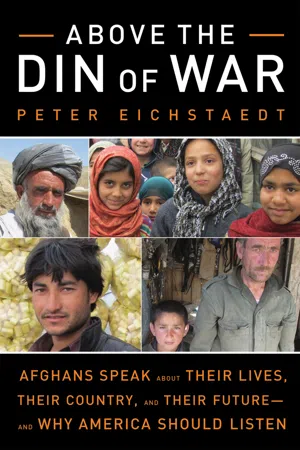
Above the Din of War
Afghans Speak About Their Lives, Their Country, and Their Future—and Why America Should Listen
- 304 pages
- English
- ePUB (mobile friendly)
- Available on iOS & Android
eBook - ePub
Above the Din of War
Afghans Speak About Their Lives, Their Country, and Their Future—and Why America Should Listen
About this book
Veteran journalist Peter Eichstaedt exposing himself to grave dangers crisscrossing Afghanistan to interview an astonishing array of Afghans. Readers find emotional commentary from a former warlord; blunt talk from a Taliban judge; harrowing stories of abuse from teen-age victims of self-immolation; the economic realities of poppy growers; and many others. Eichstaedt reveals the truth behind the calculated rhetoric of war, politics, and diplomacy, and suggests a path forward toward a sustainable future for Afghanistan and southern Asia.
Information
1
PRISONER OF THE TALIBAN

THE RED SUN FLATTENED as it faded into the hazy horizon of western Afghanistan. Abdul Manan Nurzai, fifty-six, walked in the waning light through the streets of Shindand with his two youngest sons, heading to the neighborhood mosque. It was Ramadan, the high holy days, and his Muslim faith was strong. Prayer at the nearby mosque was mandatory, and he gladly complied. A motorcycle approached from behind. Gunshots crackled in calm evening air, bullets slamming into Nurzai’s body. He crumpled to the ground as horror gripped the two young boys.
Nurzai’s eldest son, Kaus Hashimi, heard the shots and ran up the street, his heart pounding. Nurzai had declared himself a candidate for parliament some months earlier and was confident he’d win. Few others in town were as popular or respected as Nurzai. The family had represented Shindand in the Kabul government before, and Nurzai was certain he could help his community prosper. It was his duty, he told Hashimi. It was his honor.
“When my father was shot, he was not far from our house,” Hashimi said. “My younger brothers shouted for help. I took my father in my arms. He was still alive. He wanted to talk, but it was impossible.”
Blood oozed from Nurzai’s neck and chest, soaking his loose, white cotton clothes. Hashimi and his brothers found a car, lifted Nurzai into it, and soon pulled up to the hospital’s doors. But there was little the poorly equipped and understaffed Shindand clinic could do except put a needle in Nurzai’s arm and hook it to a bottle of plasma, Hashimi said. “We had no people to operate.” The brothers drove their unconscious father to the hospital in Herat, nearly two hours to the north. On the long journey, their father died.
A gaggle of local reporters greeted the boys at the Herat hospital, asking questions, taking photos, filming it all. Hashimi wanted none of it. They kept Nurzai’s body in the hospital overnight and then returned to Shindand the next day, intending to bury him as soon possible, as was the custom. The town turned out to share the family’s grief. “Lots of people came to help. People were crying and shouting for him.” In the late afternoon on the day after Nurzai had been murdered, Hashimi lowered his father’s body into the ground.
Hashimi wore a black leather jacket when we met just a couple of months after his father’s death. He sat stiffly, his feet flat on the floor, rubbing his palms on his knees as he talked. His dark eyes were fearful. He didn’t know who had killed his father, and the police had done nothing to investigate. Not one officer had talked to him or his neighbors. It was as if the killing had never happened. The family stayed indoors and lived in fear. “We can’t distinguish who are our enemies and who are our friends.”
Stories published at the time quoted district chief Mohammad Omerzai as saying the local authorities had opened an investigation. When I asked Hashimi about that, he answered angrily. “It’s entirely not true.” He said he should know, because “I am the son of this man.”
Nurzai’s death typified the bloody mayhem that made the 2010 Afghan parliamentary election, especially in the provinces, a deadly undertaking. A declaration of candidacy could be a death wish. The killings and intimidation behind the election were routinely blamed on local Taliban insurgents who had been battling the government in most every corner of the country. Shindand District south of Herat was no exception, making it yet another treacherous corner of the Afghan mosaic. Though local officials attributed Nurzai’s death to the Taliban, the local Taliban never claimed responsibility for it.
I asked Hashimi about that, suggesting that his father’s death might have been part of a fight between factions wrestling for regional dominance. Hashimi insisted that his father was independent and not a pawn in someone else’s game. “My father nominated himself.” Nurzai ran because he felt that the community had been passed over as development money was being distributed in western Afghanistan. “My father was an active person,” Hashimi said; his father had told his family and friends, “I can bring lots of facilities to my people.” Nurzai was not a politician but according to his son was “confident he could become a good leader.”
“Did your father have controversial backers, or were there others who didn’t want him to run?” I asked.
Again, Hashimi said no. “Nobody supported him financially.”
Nurzai’s campaign had been a grassroots effort supported by friends and neighbors, many of whom survived on meager incomes—much like Hashimi, an auto mechanic who supplemented his income by selling used cars. He was involved in his father’s campaign only because he felt it was the right thing to do. “I myself worked and supported my father. He got lots of supporters from our village” who hung his campaign posters around town. “People were ready to help,” he said.
“Was your father worried about election violence?” I asked.
Hashimi shrugged and said violence was a part of Afghan life. “Shindand unfortunately has a lack of security.” Other candidates traveled with armed bodyguards, but not his father. “My father was respected,” and he refused to hire bodyguards, saying, “‘I’m a popular person. I have support of my people.’ Never did he think he would be in danger because never had he done anything wrong to his people.”
“Who would want to kill him, then?” I asked.
Hashimi was reluctant to answer. “My idea is that my father expected to win. It was 100 percent certain that he could win.” But there were others in the area who didn’t want him in office because he was independent. So they had him killed. There was no evidence, Hashimi said, only a gut feeling. “Common people would not do this. It would be impossible for them.” Nurzai’s murder was never investigated, adding to suspicions that local authorities were involved. “No prosecutors or lawyers have come to our home.”
“Why not?” I asked.
“If I was rich, I could ask for an investigation,” Hashimi said. Substantial bribes were often required in Afghanistan to get governmental authorities to act. But it was more than money, Hashimi said. He didn’t want to aggravate an already tense situation and did not want to irritate local officials, who he suspected were aware of those responsible for Nurzai’s death. Asking too many questions was dangerous. “My mother is afraid. She won’t leave the house,” he said.
Hashimi tried to put his father’s death behind him, because it had become his job to keep his family safe and alive. “Who should feed them?” he asked, if something should happen to him because of asking too many questions. The family wanted to leave Shindand, but that, too, had to wait for better times.
That Nurzai’s death had gone uninvestigated was an indictment of the government that he had wished to join. His very public killing on a main street during the holiest time of the year spoke to the mayhem in Afghanistan. What dark forces were at play here? Why didn’t the government respond? Didn’t the government’s lack of action only propel the swelling tide of support for the insurgency? The answers to these questions swirled as the Taliban, like a tornado, tore across the land.
Ambush Alley
“I’m not armed,” proclaimed Abdul Hadi Jamshidi, a member of parliament from north of Herat. But he said nothing about the person with him, a chiseled man with a steel-gray turban and mirthless eyes who carefully monitored two cell phones arranged on the padded arm of his chair. Jamshidi had contacted me earlier that day and insisted that we meet later in a private room just off the lobby of a Herat hotel.
Jamshidi came from a political family, his father having been in the Afghan parliament in the early 1950s. He had been part of the Loya Jirga, the 2002-2003 gathering of Afghans who had formed the country’s current government and its constitution. It was a time of passion and positivism that had prompted Jamshidi to run for parliament. He was elected easily, served five years, and was running again. This time, things were different.
“From the first day, I was threatened [and told] not to run.” The warnings didn’t come from political rivals but from the Taliban, “because I would be one of their worst opponents. I would do something against them. They know I will fight them.”
He was adamant that the Taliban be fought at every turn. “We should press against the Taliban” and the growing insurrection. “Let’s solve this problem now. This is the time to remove these groups,” Jamshidi said. While his hatred of the Taliban was deep, he knew that the Afghan government could never defeat the Taliban without international help. He was chagrined that the men, arms, and resources from around the world that had helped put Afghanistan on its feet during the past ten years were preparing to leave.
“Why has the Taliban rebounded?” I asked.
“Corruption has made people worried and frustrated,” Jamshidi said. “People are disappointed. They’ve lost confidence in government.” But the solutions were clear to him. “Give people a choice, better security. Pay attention to people. Don’t let them be threatened. Get ideas from people.”
I had to remind myself that I was talking to an elected official in the same government that was supposed to be doing what he said needed to be done. What had the government been doing for the past five years that Jamshidi had been in office? Was the reality that Afghanistan was a failed state for all practical purposes, except in the minds and pocketbooks of the army, police, and government officials who were propped up by international support? My suspicions deepened as Jamshidi talked.
Contributing to the growing insurgency in Herat Province was the annual turnover in the governor’s post for the past six years. The revolving door in the governor’s office had meant inconsistent programs and growth. The Taliban had capitalized on the situation. Jamshidi explained that some governors had blocked military operations that could have stopped the Taliban resurgence in its infancy, despite the dire consequences that inaction had and would continue to create. “It came true,” he said of the Taliban rebound.
The extent of the Taliban resurgence was beyond what most people were willing to admit. Since 2004, Herat Province had been transformed from one of the safest into one of the most dangerous in Afghanistan. The Taliban’s shadow government in the city and throughout the province meant most people considered them the true power. Jamshidi said without hesitation, “The Taliban government is stronger than the Afghan government.”
Jamshidi regularly traveled between his office in Herat and his house in Taliban territory north of the city, relying on a cadre of bodyguards who were close friends and relatives to escort him. To travel safely required his own intelligence network that included area tribal elders. One evening in the midst of his campaign, Jamshidi called his brother, telling him he was about to head home. He asked if the road was safe. His brother said yes, there would be no problem that night. But the situation quickly changed once Jamshidi got under way. A few miles out of Herat, he received a call from an elder in his network saying that Taliban gunmen had set up an ambush.
“I called my brother and told him there were gunmen on the way,” Jamshidi said. “My brother said he would go and check.” His brother and a couple of cousins jumped on their motorcycles, planning to meet Jamshidi at the halfway point to escort him home. His brother sped into the darkness, the cousins following.
As Jamshidi’s brother reached the crest of a hill, the cousins were far behind. The gunmen were already in place and opened fire, hitting Jamshidi’s brother and knocking him off his motorcycle. Moments later, the cousins also rode into the ambush but managed to leap from their cycles and find cover. The Taliban emerged from hiding and found Jamshidi’s brother lying by the side of the road, still alive. They shot him several more times.
The cousins called Jamshidi, telling him what had happened and warning him to turn back. Angered and vowing revenge, Jamshidi called his brother’s phone, knowing that if he were alive, he would answer. The phone rang and rang. Jamshidi then called the local police commander, asking for help. The police chief said he would try to get there as soon as he could.
As Jamshidi approached the ambush scene with his bodyguards, he called the police commander again. The commander apologized, saying he was delayed. Realizing that no help was coming, Jamshidi and his guards barreled into the ambush, guns blazing. “We opened fire. We pushed them back.”
As his bodyguards pursued the Taliban attackers, Jamshidi turned to his brother. “He was about to die.” Jamshidi lifted his brother into the vehicle, found his two cousins, and took them all to the hospital in Herat. His brother died on the way, but his cousins survived, one requiring multiple surgeries.
As we lapsed into silence, Jamshidi looked at me stoically and explained that he had driven nearly two hours from the north to tell me his story.
“Why?” I asked.
No one had ever asked him about the details of the ambush and his brother’s death, he said. Not the police, not the government, not the Afghan press. I was the first.
I asked how the government, his own countrymen, could not investigate an attack on an elected representative of parliament.
Jamshidi shrugged.
His story was sadly similar to what other candidates had also told me.
“Why didn’t you quit?” I asked.
He shrugged again.
“Do you want revenge?” I asked.
“My house is in an insecure place. It was by chance that I lost my brother. I can tell you that 90 to 95 percent of the people support me. They are trying to stop me,” he said of the Taliban. “Their target was me, not my brother. They were watching.”
“Can there be peace with the Taliban?” I asked.
Jamshidi shook his head. “We never will be able to negotiate with the Taliban. Their policies are completely different. They don’t share ideas. It’s impossible.”
I mentioned to him that NATO forces had reportedly given Taliban leaders safe passage to meet with President Karzai’s peace commission.
“Karzai has offered ‘safe passage’ before, but [the Taliban] has rejected it,” Jamshidi said.
“If it is impossible to negotiate with the Taliban, then what?” I asked.
“It’s a complex issue,” Jamshidi said. “When the people accept the government, then we will have a good country. But now, the government is not doing enough for the local people.”
It was late when Jamshidi and I parted company. He thanked me for listening to his story, but I could not have been more dismayed. Here was an elected member of the government who could not find anyone to take action against the murder of his brother and the attack on his relatives. If this had been any other country, an attack on a national official would have prompted swif...
Table of contents
- Cover
- Title Page
- Copyright
- Contents
- Map
- Prologue
- 1 Prisoner of the Taliban
- 2 You Have the Watches; We Have the Time
- 3 The Fearless
- 4 Talking with the Taliban
- 5 Taliban Justice
- 6 The Mullah is a Terrorist
- 7 Confessions of a Suicide Bomber
- 8 The Jalalabad Video War
- 9 The Killing Fields of Marja
- 10 Burning in Hell
- 11 Bones in the Desert
- 12 Rejecting the Taliban
- 13 The Caves of Bamiyan
- 14 Of Copper and Culture
- 15 A War Gone Wrong
- Epilogue: Slouching toward Calamity
- Acknowledgments
- Index
Trusted by 375,005 students
Access to over 1.5 million titles for a fair monthly price.
Study more efficiently using our study tools.
Frequently asked questions
Yes, you can cancel anytime from the Subscription tab in your account settings on the Perlego website. Your subscription will stay active until the end of your current billing period. Learn how to cancel your subscription
No, books cannot be downloaded as external files, such as PDFs, for use outside of Perlego. However, you can download books within the Perlego app for offline reading on mobile or tablet. Learn how to download books offline
Perlego offers two plans: Essential and Complete
- Essential is ideal for learners and professionals who enjoy exploring a wide range of subjects. Access the Essential Library with 800,000+ trusted titles and best-sellers across business, personal growth, and the humanities. Includes unlimited reading time and Standard Read Aloud voice.
- Complete: Perfect for advanced learners and researchers needing full, unrestricted access. Unlock 1.5M+ books across hundreds of subjects, including academic and specialized titles. The Complete Plan also includes advanced features like Premium Read Aloud and Research Assistant.
We are an online textbook subscription service, where you can get access to an entire online library for less than the price of a single book per month. With over 1.5 million books across 990+ topics, we’ve got you covered! Learn about our mission
Look out for the read-aloud symbol on your next book to see if you can listen to it. The read-aloud tool reads text aloud for you, highlighting the text as it is being read. You can pause it, speed it up and slow it down. Learn more about Read Aloud
Yes! You can use the Perlego app on both iOS and Android devices to read anytime, anywhere — even offline. Perfect for commutes or when you’re on the go.
Please note we cannot support devices running on iOS 13 and Android 7 or earlier. Learn more about using the app
Please note we cannot support devices running on iOS 13 and Android 7 or earlier. Learn more about using the app
Yes, you can access Above the Din of War by Peter Eichstaedt,Peter Eichstaedt in PDF and/or ePUB format, as well as other popular books in History & Military & Maritime History. We have over 1.5 million books available in our catalogue for you to explore.