eBook - ePub
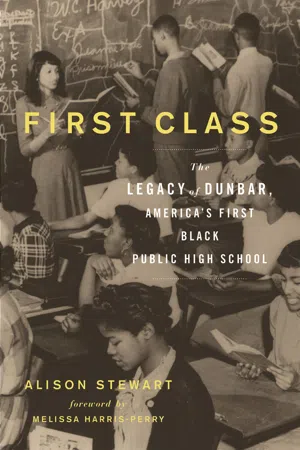
First Class
The Legacy of Dunbar, America's First Black Public High School
- 352 pages
- English
- ePUB (mobile friendly)
- Available on iOS & Android
eBook - ePub
First Class
The Legacy of Dunbar, America's First Black Public High School
About this book
Combining a fascinating history of the first U.S. high school for African Americans with an unflinching analysis of urban public-school education today,
First Class explores an underrepresented and largely unknown aspect of black history while opening a discussion on what it takes to make a public school successful. In 1870, in the wake of the Civil War, citizens of Washington, DC, opened the Preparatory High School for Colored Youth, the first black public high school in the United States; it would later be renamed Dunbar High and would flourish despite Jim Crow laws and segregation. Dunbar attracted an extraordinary faculty: its early principal was the first black graduate of Harvard, and at a time it had seven teachers with PhDs, a medical doctor, and a lawyer. During the school's first 80 years, these teachers would develop generations of highly educated, successful African Americans, and at its height in the 1940s and '50s, Dunbar High School sent 80 percent of its students to college. Today, as in too many failing urban public schools, the majority of Dunbar students are barely proficient in reading and math. Journalist and author Alison Stewart—whose parents were both Dunbar graduates—tells the story of the school's rise, fall, and possible resurgence as it looks to reopen its new, state-of-the-art campus in the fall of 2013.
Information
1 IT IS WHAT IT IS
ON SEVERAL COLD, DARK mornings, and a few weekends too, the Dunbar Senior High School marching band practiced, practiced, and practiced some more for the historic day. Within six weeks Dunbar’s band, the Crimson Tide, would participate in the inaugural parade for the forty-fourth president of the United States.
A high-profile performance like this was something band director Rodney Chambers couldn’t have pulled off four years earlier, when he arrived at Dunbar. “We had sixteen kids in the band. That was everybody.”
In the summer of 2004, Chambers, a transplanted North Carolinian, was working in DC with a music-education nonprofit when he heard through the grapevine that Dunbar didn’t have a band director. “This was like a week, two weeks before school started. I’m like ‘What?’ I said, ‘Well, I’ll see if I can find somebody.’ ”
Sporting a shaved head and a goatee, the forty-year-old Chambers has the manners of a southern gentleman and the physique of a former football player. “I talked to the principal and told her I would do it for a month or two. She said, ‘There’s no need to volunteer; you might as well get paid.’ And I’ve been here four and a half years.”
Chambers didn’t realize what he had signed on to do. The principal who hired him left the school, as did her successor—and her successor’s successor. The twenty-first-century Dunbar Senior High School had problems—academically, physically, and, it could be persuasively argued, spiritually. The almost forty-year-old facility, a hulking “greige”-colored building that had clearly been designed in the 1970s, was in bad shape all the way around. The alarms on the doors didn’t work. The escalators between the cavernous floors rarely worked. Kids ran wild in the parts of the building that were no longer in use due to dwindling attendance. The library had encyclopedias from the 1990s and computers that could be museum pieces.
In the lobby, pictures of illustrious alumni hung in broken plastic picture frames. It was a hall of fame featuring strong African American leaders such as Senator Ed Brooke and Dr. Charles Drew, looking out at students who couldn’t recognize them as role models because the kids didn’t recognize them at all. The halls echoed with the sounds of “motherfucker” and mangled variations the verb “to be.” Truthfully, the academic picture wasn’t unique for an urban high school facing persistent economic and social challenges, but the sight was indeed shocking given Dunbar’s rich history. Shocking and sad.
Once upon a time, not so long ago, Dunbar High School was a nationally known, academically elite public high school. Its graduates were among the most educated and most productive Americans of a generation. Flying in the face of racist stereotypes and restrictive segregation laws, Dunbar graduates broke through glass ceilings and shattered assumptions. The first black general in the US Army was a Dunbar graduate, as was the first black federal court judge and the first black presidential cabinet member. Once upon a time, not so long ago, expectations for Dunbar students were extremely high. By the early 2000s expectations were depressingly low.
“When I got here, it was, like, so much they needed,” band director Chambers recalled. Things like instruments. When Mayor Adrian Fenty and Schools Chancellor Michelle Rhee took over the school system in 2007, Chambers was already a year into wading through streams of red tape, trying to redirect some funds his way. “They gave us $3.7 million, and we got uniforms and instruments for everybody. It took almost three years to get those things. It has been really tough.” He had forty band members by the end of September 2004. He said he recruited forty-five students by the end of 2005. There were persistent rumors and whispers that Chambers used ringers—any kid who would show up, a warm body—to supplement the band, not that anyone would have noticed.
However he did it, Chambers grew the band to sixty-five students by the end of 2007. He wanted to convey the message that music can take you to places you’ve never been. “Kids want to travel, to go places. Sometimes the only way to get there is to be a part of a band or football or something because some of the kids have never even been to the south side of Washington. They don’t cross the river.”
By the fall of 2008, there were about eighty-five kids in the band. That’s when Chambers put into action his plan to be a part of the inauguration. It would give the kids a goal. He worked on the band’s résumé, listing the awards it had won for indoor dance and drum-line competitions, and made a DVD. “The DVD kind of told the story, not just the DVD of performance, but told the story of where we’ve come from and what we’ve done, and we had some really good recommendation letters,” Chambers said.
Dunbar alumni, including then DC city council chairman Vincent Gray and Congresswoman Eleanor Holmes Norton, weighed in with their support. But Chambers knew the odds were long. There were 1,382 applications submitted for only a handful of slots. Chambers wanted to protect the kids and himself from disappointment. “We told everybody we weren’t going to apply like the other high school bands. If we didn’t get it, then we’d have egg on our face. So we were telling everybody, ‘No we’re not applying, we’re not applying.’ ”
Chambers got the official invitation on December 9, 2008.
The media flocked to the story. It was an irresistible headline. MARCHING INTO HISTORY read the Washington Times. D.C.’s DUNBAR, THE FIRST BLACK HIGH SCHOOL IN THE U.S., PREPARES TO HONOR THE NATION’S FIRST BLACK PRESIDENT read the banner on one website. Barack Obama had been elected exactly 138 years to the day after the country’s first black public high school opened its doors.
The inaugural eve concert would take place on Martin Luther King Jr. Day and would be dedicated to America’s children. The story wrote itself. C-SPAN covered the band’s preparation four days before the big event. Chambers instructed the kids to keep their lines straight and to keep their knees high. “It’s going to be twenty degrees on Tuesday!” he yelled. One young student named Lynwood told the C-SPAN interviewer, “I’m honored to do it for Barack Obama. He’s a black president and now that shows hope—that now black kids can now say I can grow up and be a black president because, you know, we never really had no black president before.”
“We understand it is a privilege,” a nervous but smiling Chambers told the C-SPAN interviewer.
On January 20, 2009, at 5:09 PM, the Dunbar Senior High School marching band made its way past the First Family on the reviewing stand. It was a feat, given what had happened that morning.
Earlier in the day, the band joined the other parade participants, lining up for the big event. It was a bitterly cold day with the wind chill in the teens. People were lining up along the parade route as early as 7:00 AM, even though the parade didn’t begin until 2:30 PM. “We had to wait so long out there in the cold, and the kids, not all of them, behaved poorly,” Chambers said. “They were tired and cold, and there’s not a lot of parental support, so they think they are adults. And they were cussing and stuff like that.”
Chambers recalled the story a week later, hunched over with his forearms on his knees, hands clasped and fingers laced as if praying, his shaved head hanging low. He almost hadn’t shown up for the meeting. A week after the inauguration he had agreed to a post-parade interview but initially was nowhere to be found in the Dunbar school building. He wasn’t in the band room or in the main office. Repeated calls and text messages to his cell phone went unanswered. He finally surfaced around noon and explained that he hadn’t answered the messages because he had been in his car getting a few minutes of peace before heading back to the classroom. “I guess all the excitement is over now, so I guess I’m a little melancholy,” he said with a shrug.
One would expect Rodney Chambers to be completing a victory lap after the big day, but he really didn’t want to talk about what had happened. “It was bittersweet. We had a lot of problems that day with the kids.”
The morning of the inauguration, while the band was getting into formation, Chambers realized that some band members were missing. They’d all arrived together, but now his head count was off. Some of his students had taken off into the crowd of a million and a half people. “And then they got lost. And then the military picks them up. We had to wait three hours after the parade, on our buses, for the military to deliver those kids.” Chambers looked pained retelling the story. “It wasn’t a good day.”
Without its renegade members, the rest of the group, which had practiced so hard for this big day and wanted to do the best job possible, did what they went there to do. The Crimson Tide reached the viewing stand where the President, First Lady, and their then ten- and seven-year-old daughters watched the parade. Three pretty girls in red, shiny, formfitting track suits and white knit caps were energetically high-stepping as they held the gold and red D-U-N-B-A-R sign. Behind them came ten more girls, the Dunbar Dolls, clad in tight white spandex unitards, faux white fur vests, and white headbands. They looked simultaneously cute and a tad mature. The high energy drum majors were next, followed by musicians with a heavy horn and drum sound. The flag team brought up the rear.
As the Dunbar Dolls reached the stand, their drop-it-like-it’s-hot moves reflected the times—and in a few instances might have impressed an exotic dancer. Two young men, the drum majors, couldn’t be missed with their Trojan warrior helmets with foot-long white feather plumes. They looked more confident than the others and tried to keep the spirits high and the musicians on beat.
In two minutes, the big moment in front of the president was over. However, thanks to the Internet, moments like the Dunbar band’s brush with the new First Family last forever. The video of the band’s performance was uploaded to YouTube within a day, and the viewer’s comments were blunt.
southeasttink wrote: “Dunbar was a disgrace”
delemadiance wrote: “… luckily there were other black schools to counteract the raunch and filth displayed.”
bluephi182k wrote: “I disagree with most of you, its not about the way they danced in front of the President because that’s what they normally do. Don’t get upset with the band staff and parents now.”
Ripshanky08 wrote: “All yall that is hatin on dunbar, fuck yall, yall just mad because yall cant wear something like dat … they was good so fuck all yall all that don’ like them and how they performed.”
CT4L wrote: “Poor kids. Blame the band director.”
There’s plenty of blame to go around for Dunbar’s troubles. The band director blamed the students’ difficulties on an inadequate school system and strained home environments. “The kids struggle. They have a lot to do…. They go home and take care of young brothers and sisters.” As if having an epiphany, he added, “Out of the eighty-five kids I had, I could only think of one kid who has the mother and father at home. And her behavior is so much better than all the rest.”
The poor behavior of the students was on display as he spoke. He repeatedly had to raise his considerable voice and request that a couple of unwelcome loungers leave the band room. The loiterers ran off, for the moment, and he continued his train of thought, speaking like a man who needed to get something off his sizeable chest.
“Some of these kids I’ve taught for four years—I’ve never met a parent. What is that about? I took the band to Florida for six days. We went to Ohio, and New York, North Carolina, and some of the parents I’ve never met. I wouldn’t know who they were if they were to walk in the door now.” He said he personally paid for kids’ food on many of these trips. “I’ve never been in a place where parents don’t seem to care. But the only time you see parents really here is when the kids get in a fight, and then their parents come to fight. The parents come to school to fight.”
He went on, “When I grew up in North Carolina, if I got in a fight, my mother gave me a good whipping.” Chambers expressed despair about what happened at the inauguration, what had been happening at the school, the loss of good teachers, and the school’s changing principals. He was contemplating leaving, maybe before the end of the school year. “I’m not sure. I keep praying on it. I’m still taking some mental time to try to decide where I want to go from here.”
As his next class began to trickle in, a huge commotion broke out in the hallway. The band room was on the first floor by one of the school’s exits. Suddenly a man’s voice came over the P.A. It was the principal.
“Pardon me for the interruption. At this time I need for all my security administration to make sure that they are walking the halls and [to] remind some of our students if there are any fights in my building today, I’m going to make you aware that I am putting you up for involuntary transfers, so today will be your last day at Dunbar Senior High School. I will be doing involuntary transfers. So, staff, please give me their names, I’ll just pull them out of here.”
At the time, according to Section 2501.1 of the disciplinary code for the District of Columbia Public Schools, educators have several choices for discipline:
Disciplinary options for intervention, remediation, and rehabilitation shall include, but are not limited to, the following strategies: in order is as follows: (a) Reprimands; (b) Detention; (c) Additional work assignments; (d) Restitution; (e) Mediation; (f) In-school disciplinary centers; (g) Alternative educational programs and placements; (h) Rehabilitative programs; (i) Crime awareness/prevention programs; (j) Probation; (k) Exclusion from extracurricular activity; (l) Peer court; and (m) Transfer.
Dunbar’s principal said that day he’d choose the last option, transferring out whoever had started that fight. That student would be someone else’s problem tomorrow. According to Rodney Chambers, “A lot of people don’t want to work in DC. It’s rough. You hear all the things on the news and then once you get inside and experience it …” His voice trailed off.
An ambulance arrived shortly after the announcement. Chambers gave me a sidelong glance and said, “You say your mom went here?” Pause. “It’s not the same Dunbar.”
2 TEACHING TO TEACH
APRIL 16 IS A legal holiday in Washington, DC: Emancipation Day. The only reason anyone outside the District might know this is that occasionally the District-wide day off pushes back the income tax deadline. On a spring day in 1862, President Abraham Lincoln signed the Compensated Emancipation Act, which ended slavery for the estimated thirty-one hundred slaves in Washington, DC—a small number compared to the four million in the country at the time. The move happened almost nine months before Lincoln’s more well-known Emancipation Proclamation. The official language of the DC act read, “Be it enacted that all persons held to service or labor within the District of Columbia by reason of African descent are herby discharged and freed of and from all claims to such service or labor.” The compensation part of the law referred to local slave owners who would be given $300 for the loss of their human property. Washington, DC, was now a city with a large population of free colored men, women, and children, which meant old systems would have to adjust. Just one month later, on May 21, 1862, Congress would pass a bill requiring publi...
Table of contents
- Cover
- Title Page
- Copyright
- Contents
- Foreword by Melissa Harris-Perry
- Introduction
- Prologue
- 1 It is What It is
- 2 Teaching to Teach
- 3 The Law Giveth and the Law Taketh Away
- 4 It’s the Principal
- 5 Bricks and Mortarboards
- 6 Old School
- 7 Chromatics
- 8 Coming of Age
- 9 Right to Serve
- 10 Boiling, Not Brown
- 11 Elite versus Elitism
- 12 New School
- 13 Children Left behind
- 14 From Bed-Stuy to Shaw
- 15 The Fall
- 16 New New School
- 17 Back to the Future
- Acknowledgments
- Notes
- Selected Bibliography
- Index
Trusted by 375,005 students
Access to over 1.5 million titles for a fair monthly price.
Study more efficiently using our study tools.
Frequently asked questions
Yes, you can cancel anytime from the Subscription tab in your account settings on the Perlego website. Your subscription will stay active until the end of your current billing period. Learn how to cancel your subscription
No, books cannot be downloaded as external files, such as PDFs, for use outside of Perlego. However, you can download books within the Perlego app for offline reading on mobile or tablet. Learn how to download books offline
Perlego offers two plans: Essential and Complete
- Essential is ideal for learners and professionals who enjoy exploring a wide range of subjects. Access the Essential Library with 800,000+ trusted titles and best-sellers across business, personal growth, and the humanities. Includes unlimited reading time and Standard Read Aloud voice.
- Complete: Perfect for advanced learners and researchers needing full, unrestricted access. Unlock 1.5M+ books across hundreds of subjects, including academic and specialized titles. The Complete Plan also includes advanced features like Premium Read Aloud and Research Assistant.
We are an online textbook subscription service, where you can get access to an entire online library for less than the price of a single book per month. With over 1.5 million books across 990+ topics, we’ve got you covered! Learn about our mission
Look out for the read-aloud symbol on your next book to see if you can listen to it. The read-aloud tool reads text aloud for you, highlighting the text as it is being read. You can pause it, speed it up and slow it down. Learn more about Read Aloud
Yes! You can use the Perlego app on both iOS and Android devices to read anytime, anywhere — even offline. Perfect for commutes or when you’re on the go.
Please note we cannot support devices running on iOS 13 and Android 7 or earlier. Learn more about using the app
Please note we cannot support devices running on iOS 13 and Android 7 or earlier. Learn more about using the app
Yes, you can access First Class by Alison Stewart,Melissa Harris-Perry,Melissa Harris-Perry in PDF and/or ePUB format, as well as other popular books in Social Sciences & Multicultural Education. We have over 1.5 million books available in our catalogue for you to explore.