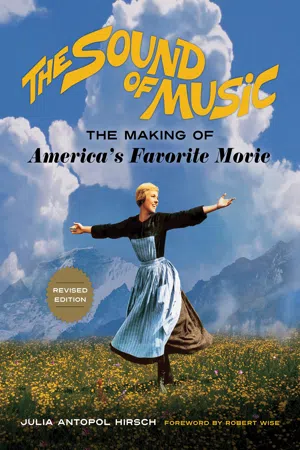
The Sound of Music is a classic film cherished in the hearts of millions. It won five Oscars, including Best Picture, upon its release in 1965. This tribute to a Hollywood classic is sure to thrill everyone who's ever sung along to "My Favorite Things" at one of the many screenings that still take place today. Through interviews with the cast and crew, in-depth access to memorabilia and personal scrapbooks and archival research at Fox Studios, author Julia Antopol Hirsch reveals the lively human story behind the making of the von Trapp family film. Fans will learn what motivated Christopher Plummer to take the part of the Captain, the challenges Julie Andrews faced filming the iconic opening scene and what life was like on an Austrian set for the seven children actors. Now completely updated and in full color throughout, this engaging celebration is the ultimate insider's guide to America's favorite movie.
Trusted by 375,005 students
Access to over 1.5 million titles for a fair monthly price.
Maria Augusta Kutschera made her grand entrance into the world in a fashion that would later typify her character: in motion. She was born on January 26, 1905, on a train racing toward Vienna. Already displaying signs of a restless nature, she was just too impatient to wait until the train reached the city, where a staff of doctors would surely be waiting at the hospital. Instead, her mother, Augusta, was forced to recruit a train conductor to act as midwife, and just before the stroke of midnight, he helped deliver Augusta’s baby daughter.
Augusta died of pneumonia when Maria was two years old, and her father left the youngster with an elderly cousin’s family so that he could be free to travel throughout Europe. (This seemed to be her father’s pattern; when his first wife died, he had left Maria’s older brother to be raised by the same relatives.) Maria was reared in a family of adults, and she became a lonely and unhappy child. The household she lived in was also so strict and her uncle, who became her legal guardian after her father died, so physically abusive that she developed a rebellious nature as well.
Maria’s guardians had brought her up as a socialist and raised her to be cynical toward all religion, but a visiting Jesuit priest who lectured at her college changed her life. His speech had a powerful impact on the vulnerable young student, though Maria still felt compelled to meet the priest a few days later to “enlighten” him as to all the reasons his beliefs were wrong. But at that meeting the priest’s composure and quiet confidence impressed the romantic young woman, and all her arguments were forgotten. Instead she found his unwavering faith and utter tranquility the perfect medicine to heal her troubled heart.
Maria’s newfound religious beliefs became so strong, in fact, that after graduating from college with a degree in education, the once-devout atheist traveled to Salzburg, Austria, and joined the Nonnberg Abbey as a postulant. Maria was intensely devoted to the convent, but her dedication did not prevent the former tomboy from getting into mischief. The sudden change from her free-spirited college days of mountain climbing to the more sedate life at the abbey also seemed to adversely affect her health.
One day, the Reverend Mother called Maria to her office. Maria’s headaches had worried the abbey’s doctor; he thought she needed exercise and fresh air. So the Mother Abbess had decided to send Maria to the home of retired naval captain Georg von Trapp, to be governess to one of his young daughters. The child, also named Maria, had developed rheumatic fever and was forced to spend much of her time in bed. The young postulant accepted her new post only after she received the Reverend Mother’s promise that in nine months she could return to the abbey for good.
But, as we all know, Maria never did come back to stay. She married the Captain on November 26, 1927, and had three children to add to the seven from his first marriage. The family, whose members seemed to have a natural talent for music and whose voices blended beautifully, began to perform professionally—at the Salzburg Festivals, on the radio, and even touring Europe. When Hitler invaded Austria and the Captain was called back into service for the navy of the Third Reich, the family, violently opposed to the Nazi regime, decided to escape. They climbed over the mountains to Italy; from there they traveled to England, then crossed the ocean to America, where they continued to perform as the famous Trapp Family Singers.
When the young Maria rang that steeple bell, she had had no inkling that her innocent wish to become a writer would come true or that her life would eventually be the subject of two German motion pictures, a Broadway play, and the most successful American musical film of all time. But had she known, Maria would not have been surprised. She was a strong personality and a powerful promoter of her family.
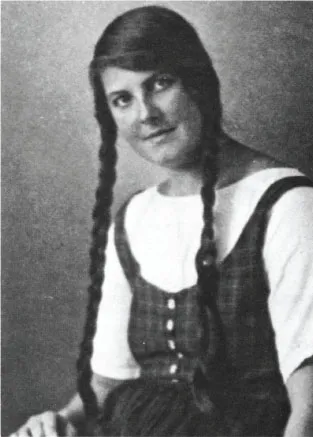
Maria at State Teachers School of Progressive Education.
Mary Martin, who starred as Maria in the Broadway musical, wrote in her autobiography, My Heart Belongs, “I came to the conclusion that perhaps the family didn’t just climb that mountain to escape. She pushed them, all the way up.”
Promoting her family was one of the reasons Maria wrote The Story of the Trapp Family Singers in 1948. Soon after the book was published, Hollywood beckoned. But the producers wanted to buy only the title of her book, and Maria turned them down flat. They’d have to buy the whole story or nothing.
According to Maria’s autobiography, Maria, in 1956, German producer Wolfgang Reinhardt, son of the famous film director Max Reinhardt, approached Maria with a contract for $10,000 to buy the rights to her entire story. That was a tidy sum to a widow with ten children (the Captain had died in 1947), but Maria’s lawyer suggested that she also ask for royalties.
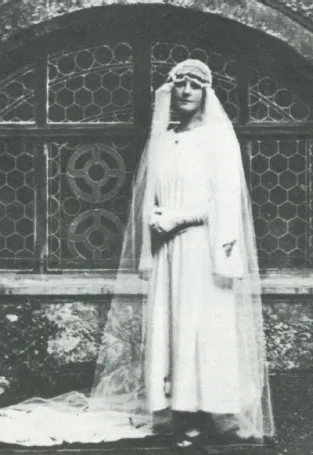
Maria on her wedding day.
Heeding his advice, Maria met again with the producer’s agent and asked for a share of the movie’s profits. The agent hesitated and said he’d have to call Germany and ask Reinhardt’s permission. He came back shortly and said, “I am sorry, I have to inform you that there is a law in existence which forbids a German film company from paying royalties to foreigners.” (Maria was now an American citizen.) Maria took the man at his word and didn’t even verify his story with her lawyer. She signed the contract and, at the same time, unknowingly signed away all film rights, including all profit participation, to her story. Not only had the agent misled her (no such law existed), but he actually called her a few weeks later and suggested that if she would agree to take $9,000 instead of the full $10,000, he could give the entire amount to her immediately. She needed the cash and made the deal.
Die Trapp Familie was produced in Germany in 1956 and became a big hit. It did so well that Reinhardt followed it up in 1958 with a sequel titled Die Trapp Familie in Amerika. Both movies starred Ruth Leuwerik as Maria and Hans Holt as the Captain and were directed by Wolfgang Liebeneiner. They soon became the most successful films produced in Germany since World War II and subsequently became hits in Europe and South America as well.
Paramount Pictures in Hollywood purchased the US film rights to the two movies, hoping to produce an English-language version as a vehicle for its young star, Audrey Hepburn. At the time, Paramount had just signed Broadway and television director Vincent Donehue to a contract with no specific project in mind. One of the first things they showed him was the film Die Trapp Familie. Donehue sat watching the picture in Paramount’s projection room, and when the lights went up, he turned to John Mock, story editor at Paramount, and said, “I think this would make a great vehicle for Mary Martin!”
Donehue had directed Mary Martin in the national tour of Annie Get Your Gun along with the television version of the musical. He’d also worked with Martin in the stage and television versions of The Skin of Our Teeth and two other television specials. Donehue, Martin, and Martin’s husband, producer Richard Halliday, had been looking for another project to work on together for the Broadway stage. Donehue flew the film back to New York and screened it for Martin and her husband. They fell in love with the idea and began working on the project.
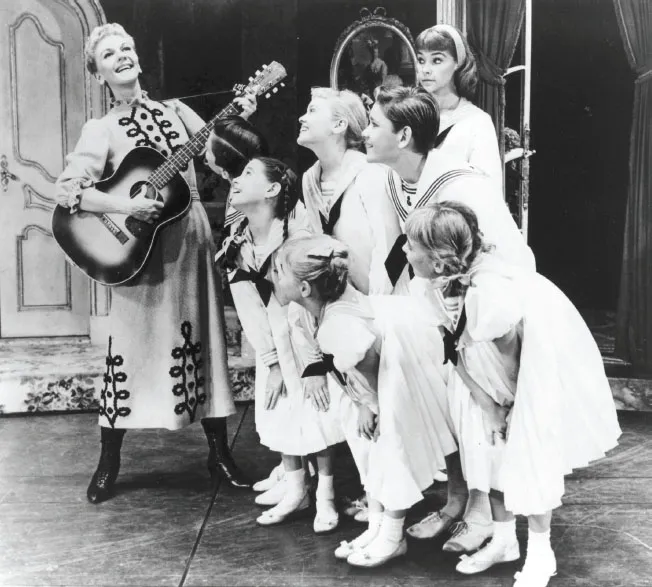
Mary Martin and the children from the stage version of The Sound of Music.
By the time they went to buy the rights, however, Paramount had dropped its option and no longer owned the rights to the German films. So Halliday, unaware of Maria’s deal with the German producers, thought he had to go through Maria to get permission. Maria, who was involved in missionary work in New Guinea at the time, soon began receiving strange notes from an American producer saying he wanted to turn her story into a Broadway play starring Mary Martin. Maria received three of these notes, and each time she got one she tore it up. She didn’t know who Mary Martin was, and she thought the whole idea of a play based on her book was preposterous!
When Maria returned from New Guinea, an undaunted Richard Halliday was waiting to meet her ship in San Francisco. He invited her to see his wife’s performance in Annie Get Your Gun that evening. Maria loved the show and afterward went backstage to meet Mary Martin.
From the moment they met, Maria and the future “Maria” felt they were kindred souls. But unfortunately, the real Maria von Trapp had no say in whether or not Halliday could buy the rights to the book. Reinhardt’s company in Germany had seen to that. So Halliday and his partner, Leland Hayward, made a deal with the German producer. And although legally the American producers didn’t owe Maria a penny, they voluntarily gave her three-eighths of 1 percent in royalties on the Broadway show. It was more than Maria expected, and she was grateful.
Initially Martin and Halliday conceived of their version of Die Trapp Familie as a straight dramatic play, using the actual folk songs and religious numbers the Trapp family sang on tour. So they hired playwrights Howard Lindsay and Russel Crouse—whose previous successes had included Life with Father and State of the Union, for which they had won the Pulitzer—to write the stage play. The writing team had also produced many shows on Broadway, including Arsenic and Old Lace.
After securing Lindsay and Crouse, Halliday and Martin approached the legendary composing team of Richard Rodgers and Oscar Hammerstein II and asked them to write one original song for Martin to sing in the play. But Rodgers and Hammerstein thought that mixing the two styles of music, theirs with authentic Austrian folk songs, would be like mixing oil and water. They did, however, offer to write an entirely fresh new score and to act as coproducers of the show. The one stipulation they had was that Halliday and company wait until Rodgers and Hammerstein completed work on their current project, Flower Drum Song. Halliday and Martin decided it was worth the wait to get the talented duo on board.
The Sound of Music opened at the Lunt-Fontanne Theater in New York on November 16, 1959. The reviews ranged from indifference to loathing. The critics found it too “sweet” and “saccharine” (terms that would later haunt the film version), but the audience must have had a sweet tooth, because they ate it up. As Richard Rodgers wrote years later, “It’s my conviction that anyone who can’t, on occasion, be sentimental about children, home or nature is sadly maladjusted.”
The show ran on Broadway for 1,443 performances, won six Tony Awards including Best Musical, and sold more than three million cast albums. Martin’s popularity was a big contribution to the show’s success; even before the play opened the box office had garnered $2 million in advance ticket sales. For 1959, when theater ticket prices hovered around $5, a $2 million advance was a notable beginning.
On opening night, legendary motion picture agent Irving “Swifty” Lazar, who represented the show’s writers, Rodgers, Hammerstein, Lindsay, and Crouse, was sitting in the audience with the president of Twentieth Century Fox, Spyros Skouras. Skouras wa...
Table of contents
Cover
Title Page
Copyright
Contents
Acknowledgments
Foreword
Prologue
1: “Let’s Start at the Very Beginning …”
2: “When You Read You Begin with ABC …”
3: “Search High and Low …”
4: “With Each Step, I Am More Certain …”
5: “Climb Every Mountain …”
6: “I Must Have Done Something Good …”
7: “What Will My Future Be, I Wonder …”
8: “Till You Find Your Dream …”
Bibliography
Credits
Frequently asked questions
Yes, you can cancel anytime from the Subscription tab in your account settings on the Perlego website. Your subscription will stay active until the end of your current billing period. Learn how to cancel your subscription
No, books cannot be downloaded as external files, such as PDFs, for use outside of Perlego. However, you can download books within the Perlego app for offline reading on mobile or tablet. Learn how to download books offline
Perlego offers two plans: Essential and Complete
Essential is ideal for learners and professionals who enjoy exploring a wide range of subjects. Access the Essential Library with 800,000+ trusted titles and best-sellers across business, personal growth, and the humanities. Includes unlimited reading time and Standard Read Aloud voice.
Complete: Perfect for advanced learners and researchers needing full, unrestricted access. Unlock 1.5M+ books across hundreds of subjects, including academic and specialized titles. The Complete Plan also includes advanced features like Premium Read Aloud and Research Assistant.
Both plans are available with monthly, semester, or annual billing cycles.
We are an online textbook subscription service, where you can get access to an entire online library for less than the price of a single book per month. With over 1.5 million books across 990+ topics, we’ve got you covered! Learn about our mission
Look out for the read-aloud symbol on your next book to see if you can listen to it. The read-aloud tool reads text aloud for you, highlighting the text as it is being read. You can pause it, speed it up and slow it down. Learn more about Read Aloud
Yes! You can use the Perlego app on both iOS and Android devices to read anytime, anywhere — even offline. Perfect for commutes or when you’re on the go. Please note we cannot support devices running on iOS 13 and Android 7 or earlier. Learn more about using the app
Yes, you can access The Sound of Music by Julia Antopol Hirsch in PDF and/or ePUB format, as well as other popular books in Media & Performing Arts & Film & Video. We have over 1.5 million books available in our catalogue for you to explore.