![]()
PART I
THE OPERATION
![]()
1
A ROUGH SPOT
MARCH 4, 1893, should have been a triumphant day for Grover Cleveland. After all, it was the day he was sworn in for an unprecedented second, nonconsecutive term as president. But when he awoke that morning, his emotions must have been mixed. Snow had fallen overnight, covering Washington in a frozen blanket. Gray skies threatened more. A cold wind rattled the windows of his suite at the Arlington Hotel on Vermont Avenue.
And the lousy weather was the least of his worries.
It was not an auspicious moment to assume the presidency, and Grover Cleveland knew it. “I hope the skies will lighten up by and by,” he’d written a friend a few weeks earlier, “but I have never seen a day since I consented to drift with events that I have not cursed myself for yielding.” He was about to take the reins of a nation teetering on the brink of chaos. The economy was in ruins. Unemployment was rampant. Stock prices were plummeting. Banks and factories were closing by the score. Just nine days earlier, the once mighty Reading Railroad had gone bankrupt. More and bigger businesses were sure to follow the Reading into insolvency. Foreign investors who had flooded the country with capital after the Civil War were retreating like Lee from Gettysburg.
The Panic of 1893 was underway. It would spawn the worst economic catastrophe in American history, unsurpassed until the Great Depression.
Cleveland, who was just two weeks shy of his fifty-sixth birthday, emerged from the hotel at eleven o’clock that morning and climbed into a gleaming black carriage for the short ride to the Executive Mansion.* Though he weighed nearly three hundred pounds, Cleveland moved with an easy grace that belied his massive girth. Just under six feet tall, nearly rectangular in shape, with thinning brown hair combed straight back and a big walrus moustache, Grover Cleveland was, figuratively and literally, the biggest political figure of his generation.
Wrapped in a long, black overcoat with a velvet collar, Cleveland rode the open carriage to 1600 Pennsylvania Avenue. There he called on President Benjamin Harrison. Four years earlier, their roles had been reversed: Cleveland was the outgoing president, Harrison the incoming. The two men spent a few minutes in the Blue Room discussing the transition and then climbed into another open carriage for the mile-long ride down Pennsylvania Avenue to the inauguration ceremony at the Capitol. On the way they chatted amiably about the weather. Eight years earlier, in 1885, the sun had shone so brightly on Cleveland’s first inauguration that “Cleveland weather” became a national catchphrase for a sunny day. But there would be no Cleveland weather on this day, for, as one congressman recalled, the conditions were “as bad as mortal man ever endured, windy, stormy, sleety, icy.”
When they reached the Capitol, Cleveland and Harrison went inside the Senate chamber for the swearing in of Vice President Adlai Stevenson. (Stevenson was the grandfather of the 1952 and 1956 Democratic presidential nominee of the same name.) Many dignitaries were delayed by the weather, and it was nearly one thirty—ninety minutes late—before the festivities moved outside for Cleveland to take his own oath. A wooden platform draped with bunting had been erected at the bottom of the steps on the east side of the Capitol. About ten thousand people stood shivering on the frozen ground to watch the ceremony. Frances Cleveland, Grover’s wildly popular wife, was one of the first to emerge from the Capitol. As soon as she appeared, a huge cheer went up—the loudest of the day, according to some observers. Frances took special care walking down the slippery marble steps to her seat on the platform, for, unbeknownst to anyone outside her family, the once and soon-to-be First Lady was two months pregnant.
Then came members of the outgoing and incoming cabinets, the nine Supreme Court justices, and assorted foreign diplomats in plumed hats. Finally, Harrison and Cleveland emerged, walking down the steps side by side. Harrison took his seat in a plush leather chair in the front row, while Cleveland removed his top hat and, without introduction or fanfare, walked up to the front of the platform. Snow had started falling again. Cleveland held his hat in his left hand. Facing a sea of black umbrellas, he launched into his second inaugural address.
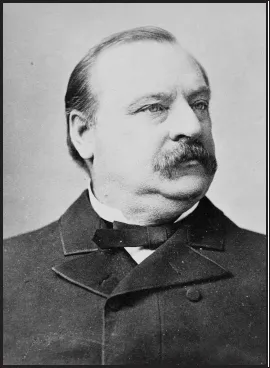
Grover Cleveland, photographed in 1888. Cleveland is the only president to have served two nonconsecutive terms. When he began his second term, the country was in the throes of an economic crisis that would come to be known as the Panic of 1893. LIBRARY OF CONGRESS
Cleveland was one of the most famous public speakers of his time. Befitting a man of his size, he had a booming voice—stentorian, as the papers liked to say. He once gave a speech to twenty thousand people at the old Madison Square Garden, and, it was reported, every single one of them could hear every single word. And he always delivered his speeches from memory, without so much as notes. His memory was said to be photographic. One newspaper reported that he could “repeat pages of poetry or of prose, after a single reading.”
But even a bellowing Grover Cleveland could not overcome Mother Nature. Without the benefit of artificial amplification, his words were scattered by the howling wind. The speech lasted about twenty minutes. The frigid crowd barely heard a word of it.
Which is too bad, because, as inaugural speeches go, it wasn’t half bad. He railed against “the waste of public money,” and he gave one of the most unequivocal calls for civil rights that had ever been expressed in an inaugural, though it was expressed in his typically cumbersome way: “Loyalty to the principles upon which our government rests positively demands that the equality before the law which it guarantees to every citizen should be justly and in good faith conceded in all parts of the land. The enjoyment of this right follows the badge of citizenship wherever found, and, unimpaired by race or color, it appeals for recognition to American manliness and fairness.”
Regarding the ruinous economy, which he delicately referred to as “our present embarrassing situation,” he promised to do everything in his power to “avert financial disaster,” but he also warned Americans not to expect a handout: “The lessons of paternalism ought to be unlearned and the better lesson taught that, while the people should patriotically and cheerfully support their Government, its functions do not include the support of the people.”
Cleveland also made an interesting analogy, saying “it behooves us to constantly watch for every symptom of insidious infirmity that threatens our national vigor.”
”The strong man who in the confidence of sturdy health courts the sternest activities of life and rejoices in the hardihood of constant labor may still have lurking near his vitals the unheeded disease that dooms him to sudden collapse.”
After the speech, Chief Justice Melville Fuller rose and administered the oath of office, his black robe whipping in the wind. Cleveland put his hand on the same family Bible he’d been sworn in on eight years earlier, listened as Fuller read the oath, and then “assented” to it with a bow of his head. Cleveland bent down to kiss the Bible, which was opened to the ninety-first psalm: “With long life will I satisfy him, and shew him my salvation.” As the newly inaugurated president turned to walk back into the Capitol, Frances suddenly stepped forward and kissed him tenderly on the cheek. It was a shocking display of public affection for the time, and the audience roared in surprise and delight. Amid great cheering, Cleveland, a tad embarrassed, walked up the steps of the east portico and into the Capitol.
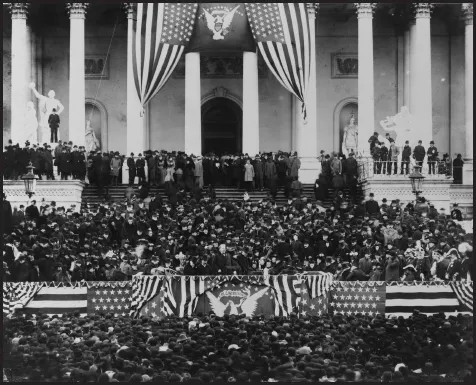
Grover Cleveland’s second inaugural ceremony, March 4, 1893. LIBRARY OF CONGRESS
That afternoon, Grover watched the inaugural parade from a reviewing stand in front of the White House, while Frances watched from inside a friend’s apartment. More than twenty-five thousand people marched in the wind and snow, including thousands of Civil War veterans. The parade featured Buffalo Bill Cody and his Wild West show, as well as trained seals, acrobats, dancing horses, and dog acts. One marcher released a brown rooster in front of the reviewing stand as a gift for the Clevelands’ seventeen-month-old daughter, Ruth. A contingent from the Army Corps of Engineers stopped in front of the president and released a dozen carrier pigeons bearing messages to be delivered to the Naval Academy in Annapolis (“Beat Navy,” perhaps?).
The inaugural parade also included, for the first time, women.
It lasted more than four hours. By the time it was finally over, Grover’s moustache was covered with frost, and the reviewing stand was dripping with icicles.
Yet for all the ceremony and spectacle, the mood in the capital that Inauguration Day was subdued, even somber. The bleachers that lined the parade route along Pennsylvania Avenue were half empty. The railroads estimated it was the lowest attended inaugural in memory. Disappointed vendors, laden with a dizzying array of Cleveland trinkets— badges, medallions, canes, handkerchiefs, balloons—couldn’t give them away. The inaugural ball held that night at the Pension Office—now the National Building Museum—was so poorly attended that one newspaper declared it a “failure.” The weather was partly to blame, of course, but so was the economy. Americans were in no mood to celebrate.
Underlying the financial crisis in 1893 was what was known, in the rather oblique vernacular of the day, as the money question. It was a question as old as mankind: What should represent value? In 1792 the United States Congress passed the Coinage Act, which defined one dollar as a coin containing 371.25 grains of pure silver. This put the fledgling nation on the silver standard, though the act also permitted the minting of gold coins and set the value of gold at fifteen times the value of silver. In 1834 the ratio was raised to sixteen to one. In other words, by law, sixteen ounces—one pound—of silver was worth the same as an ounce of gold.
During the Civil War, the U.S. Treasury began issuing paper banknotes in place of gold coins. These “gold certificates” were much cheaper to produce than coins, not to mention much easier to carry, and they could be redeemed for gold at the Treasury or one of its many branches, known as subtreasuries. This effectively put the country on the gold standard, and in 1873 Congress made it official by passing another Coinage Act, which “demonetized” silver. (The Treasury also experimented with fiat currency during the war. Those banknotes could not be redeemed for a metal but were still considered legal tender. It was an idea that took a while to catch on. But it did.)
Just in case anybody wanted to redeem their gold certificates, the Treasury kept an ample supply of gold on hand—at least $100 million. But as long as people had faith in the economy—and knew their gold was safe in a government vault and could, theoretically, be claimed at any time—everything was copasetic.
In 1877, U.S. gold production peaked at $46 million and then began a steady decline. The population, however, continued to grow, resulting in a “money famine”: there wasn’t enough cash to go around. Economists refer to this period in American history as the Great Deflation.
With gold production declining, mine operators turned to silver, and by 1890 silver production reached $57 million annually, far exceeding gold production. The most productive silver mines were in the Western states, and as those states began to enter the union (Nevada in 1864, Colorado in 1876, Montana in 1889) their representatives in Congress began to clamor for “bimetallism”—they wanted banknotes to be backed by silver as well as gold. In 1878 Congress passed the Bland-Allison Act, which required the Treasury to issue silver certificates for the first time. Twelve years later, in 1890, Congress passed the Sherman Silver Purchase Act, which required the federal government to buy a staggering 4.5 million ounces of silver every month and issue a commensurate amount of banknotes—notes that could be redeemed for either silver or gold. This dramatically increased the amount of money in circulation, resulting in rampant inflation.
Of course, Western silver mining interests didn’t mind a little inflation. Nor did Southern and Midwestern farmers, who, after a string of poor crops, were heavily in debt. Now the money they paid their bills with was worth less than the money they’d borrowed. The “cheaper” money made it easier for them to pay their creditors. If you’re in debt, inflation is good. If you’re a lender, not so much.
And the lenders, by and large, were Eastern bankers and businessmen, who liked to call themselves “sound money men.” They blamed silver—and the inflation it caused—for the nation’s economic woes and their own diminishing fortunes. They wanted silver demonetized again and the nation categorically returned to the gold standard.
As new and larger silver veins were discovered, the financial situation deteriorated precipitously. While the value of silver to gold was set by law at sixteen to one, by the early 1890s the real value of silver to gold had plummeted to something closer to thirty-two to one. And, since silver certificates could be redeemed for either metal . . . well, you didn’t have to be J. P. Morgan to figure out that you could double your money by exchanging fifty cents’ worth of silver for a dollar in gold. It was legislated alchemy. Inevitably, the Treasury’s gold supply began to dwindle, and, in April 1893, just a month after Cleveland began his second term, it dipped below the hugely symbolic $100 million mark for the first time; the panic that was gripping the nation only heightened.
The money question divided the nation more bitterly than any issue since slavery. It pitted Eastern “goldbugs” against Southern and Western “silverites.” In pro-silver Kansas there was even talk of secession.
Compounding the financial crisis was a speculative bubble: railroads. Between 1870 and 1890, the number of miles of rail lines in the United States doubled to more than 120,000, while the population grew just 63 percent. The industry was...