- 160 pages
- English
- ePUB (mobile friendly)
- Available on iOS & Android
eBook - ePub
About this book
Surprising and seemingly impossible effects result from the 40 experiments included in this fascinating science resource—all based on real magnetic physics. Each experiment—such as using a common refrigerator magnet to create a three-dimensional image or floating a magnet and carbon sheet in midair—is outlined with step-by-step instructions and diagrams that illustrate the key concepts of magnetism. Even the most experienced science teacher or at-home tinkerer will find dozens of new tricks in this amazing collection.
Information
Experiment 1
Magnetic Money, Rocks, Beach Sand, Total® Cereal, and Dirt
It’s shown that money, many rocks, beach sand, Total® cereal, and even common dirt are magnetic.
Materials
U.S. $1 bill
Cellophane tape
Very strong magnet (such as an NdFeB magnet)
Rock (see page 2)
Several handfuls dry beach sand
Two small, nonmagnetic jars (such as glass baby food jars) and their lids
Several handfuls Total® cereal
Medium-sized bowl
Pestle or heavy spoon
Several handfuls dirt
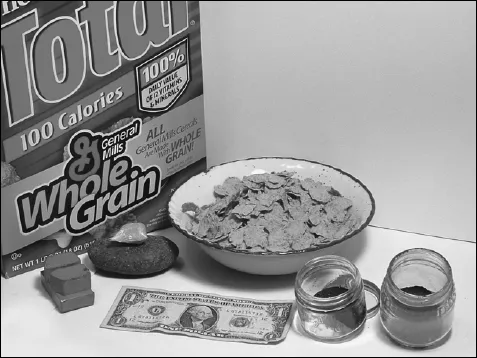
Elements of magnetic money, rocks, beach sand, Total® cereal, and dirt
Fold the $1 bill tightly into a roughly ½-inch square and hold it together with cellophane tape, as shown. Show that the $1 bill is attracted to the strong magnet.
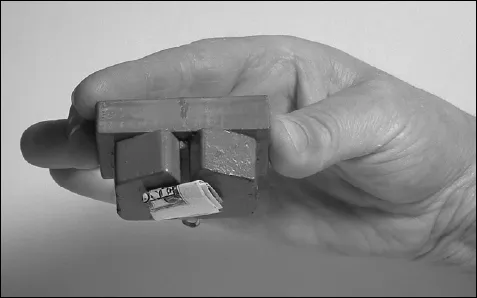
Magnetic money
Next, show that the rock can be suspended under the magnet. You will need to find a suitable rock before you begin—not all rocks are attracted to a strong magnet. Go to a beach or a streambed or anywhere where there is a large variety of rocks, touch your strong magnet to different small stones, and in a short time you should be able to find one that will work for this demonstration.
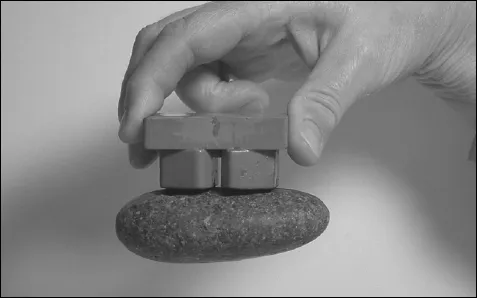
Magnetic rock
Place a large handful of beach sand in one of the jars and secure the lid. Turn the jar upside down and tape the magnet to its bottom. Shake the jar briskly for a few minutes, then remove the lid and slowly pour out the sand. A tablespoon or so of coarse, strongly magnetic black powder will remain in the jar, attracted to the magnet.
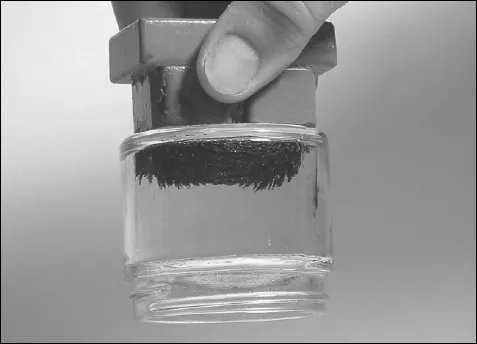
Magnetic beach sand
Remove the magnet from the jar and pour the black powder into another small jar for safekeeping. Using the same sand, repeat the procedure a few times to separate a bit more magnetic material from the sand. Transfer the black magnetic powder to the other small jar and set aside.
Using additional handfuls of sand, repeat the process, transferring the black magnetic powder that’s collected to the second jar as you go. (This powder can be used to make a crude but effective Magnetic Mountain demonstration, which is described in Experiment 7.)
Place a large handful of cereal in the bowl and, using the pestle or spoon, grind it into a very fine powder. Pour the powdered cereal into one of the jars and secure the lid. Turn the jar upside down, tape the magnet to the bottom of the jar, and briskly shake the jar for a few minutes. Remove the lid and slowly pour out the powdered cereal. About a teaspoon of magnetic material will remain inside, attracted to the magnet. You may have to repeat this process a few times, using new bowls of cereal, to collect a significant amount of magnetic material. Shown on page 4 is a small amount of magnetic cereal matter suspended in a plastic bag.
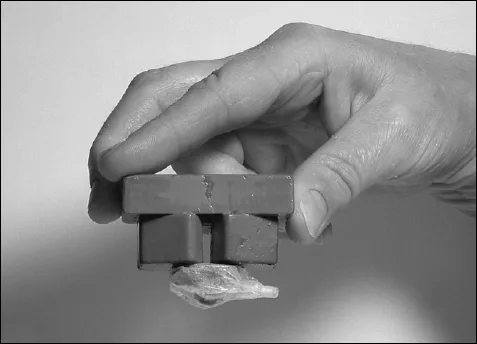
Magnetic Total® cereal
Finally, take a few handfuls of ordinary dirt from the garden and refine it in the same manner as for sand. This photo shows the jar of magnetic dirt suspended below the magnet.
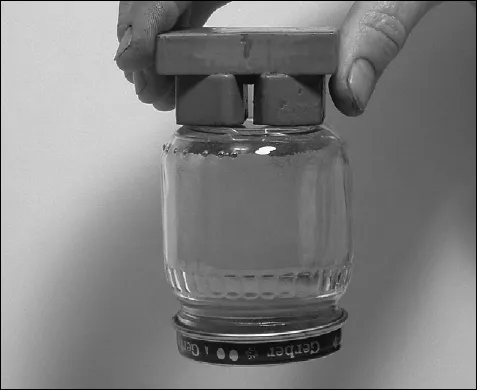
Magnetic dirt
The Science Behind It
Why are all these things magnetic?
In each case, the black magnetic material that’s collected is iron oxide. Iron is the fourth most abundant element in the earth’s crust. The most abundant iron oxide is black Fe3O4, which is strongly magnetic. A $1 bill is magnetic because the black ink on the portrait side of the bill is loaded with black iron oxide Fe3O4 pigment. The bill contains only about 5 mg of the oxide. The bill weighs almost exactly 1 gm, so the Fe3O4 present in the pigment is easily holding up more than 200 times its own weight! This Fe3O4 pigment was originally put in the ink to make it black, not to make it magnetic. The hysteresis loop of a $1 bill is shown below. The coercivity is about 100 Oe and the remanent moment is appreciable.
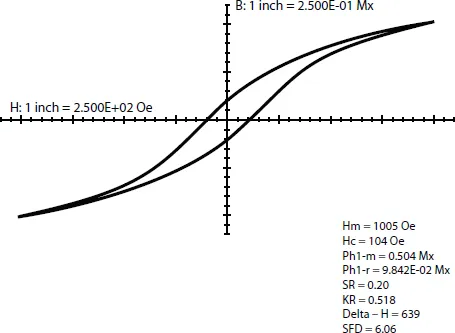
Hysteresis loop of a $1 bill
The image on the next page was made by scanning the surface of a $1 bill with a magnetic read head similar to those used in modern tape recorders and hard disk drives. (The image is courtesy of Fred Chamberlain, who was at San Diego Magnetics at the time that he provided it.)
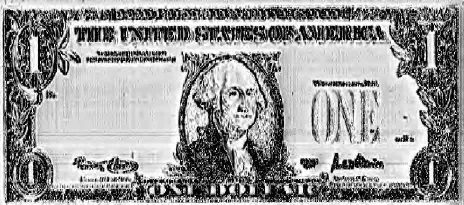
Magnetic image of a $1 bill
Comparing the magnetic image above to an actual dollar bill, the observant viewer will note that the treasury seal on the left side of the portrait is black, but is not magnetic. That is because the black ink in the seal contains no Fe3O4. This fact is the basis of some simple counterfeit currency detectors.
The rock shown in this experiment is magnetic because it also contains Fe3O4. About 1 in 20 Southern California beach rocks is slightly magnetic, while about 1 in 100 rocks is magnetic enough to be picked up.
Below is an M-H loop of the powdered cereal. Also shown is an almost identical loop of metallic iron powder.
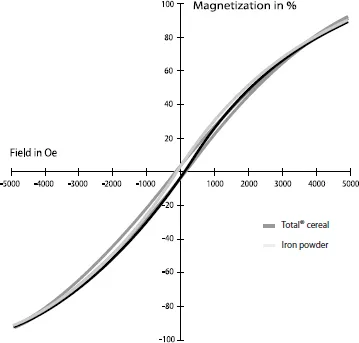
M-H loops of Total® cereal and iron powder
The obvious conclusion from this plot is that Total® fortified cereal is “fortified” with iron that has been added in the form of metallic iron powder. It remains to be seen if metallic iron is digested and absorbed by the body.
The beach sand and dirt both contain varying amounts of Fe3O4. The rock, sand, and dirt all have M-H loops very similar to that of the $1 bill, because all three contain small particles of Fe3O4.
Experiment 2
The Super Strong Magnetic Nail
A common nail is used to pull a string of small steel objects off a very strong magnet. The objects remain suspended under the nail until the magnet is removed, whereupon they fall off.
Materials
8-cm long iron framing nail
3 common steel balls measuring 1.3 cm, 1 cm, and 0.8 cm, respectively
1-cm square steel nut
Very strong 5-cm by 5-cm by 2.3-cm NdFeB magnet (magnetized in the 2.3-cm direction)
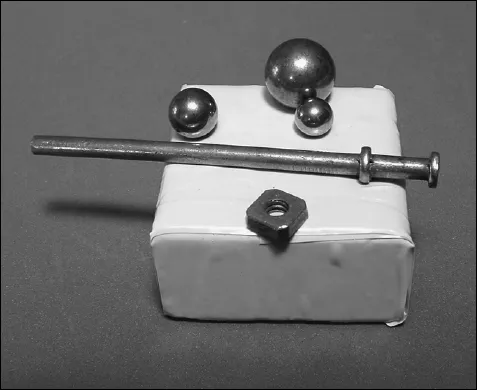
Super strong nail equipment
A nail alone...
Table of contents
- Cover
- Title
- Copyright
- Contents
- Introduction
- 1 Magnetic Money, Rocks, Beach Sand, Total® Cereal, and Dirt
- 2 The Super Strong Magnetic Nail
- 3 The Magic Table Knives
- 4 The Mysterious Magnetic Arch
- 5 The Strange “Zinging” Magnets
- 6 The Amazing Magnets That Fall Through Each Other
- 7 The Magic Magnetic Mountain
- 8 The Magnetic” Hedgehog”
- 9 Mercurial Water
- 10 The Magnetic Jumping Jack
- 11 The Nail That Standson Its Point and One That Won’t
- 12 The lnvisible Magnetic Bowl
- 13 Why the Magnet Stays in the Hole
- 14 The Washers and the Coat Hanger
- 15 The Strange, Reversing Magnetic Field
- 16 The Compass That Points Only North or South
- 17 The Mysterious Compass That Changes Its Mind
- 18 The Floating Globe
- 19 The Super Levitron® Floating Top
- 20 The Floating Magnet
- 21 The Floating Sheet of Carbon
- 22 The Rolling Disk
- 23 The Red Sea Effect
- 24 Invisible Magnetic “Syrup”
- 25 A Magnetostatic Linear Accelerator
- 26 The One-Candle-Powered Pendulum
- 27 The Amazing Lengthening (or Shortening) Magnetic Materials
- 28 The Crazy Spinning Balls
- 29 The Spinning Ball That Rolls East or West, but Not North or South
- 30 The Popping Magnet
- 31 The Rolling Magnets
- 32 The Little Motor That Shouldn’t Run, but D oes Anyway
- 33 The Magnetic Picture Sheet
- 34 The Strange Magnetic Physics Taking Place on Your Refrigerator
- 35 Magnetic Recording Made Visible
- 36 The Amazing Magnetic Hot Glue
- 37 The Magnetic Patterns That Cant Be Erased
- 38 The Sliding Magnet
- 39 Magnetic Bacteria
- 40 The Earth as a Magnetic Recorder
- About the Author
- Index
Trusted by 375,005 students
Access to over 1.5 million titles for a fair monthly price.
Study more efficiently using our study tools.
Frequently asked questions
Yes, you can cancel anytime from the Subscription tab in your account settings on the Perlego website. Your subscription will stay active until the end of your current billing period. Learn how to cancel your subscription
No, books cannot be downloaded as external files, such as PDFs, for use outside of Perlego. However, you can download books within the Perlego app for offline reading on mobile or tablet. Learn how to download books offline
Perlego offers two plans: Essential and Complete
- Essential is ideal for learners and professionals who enjoy exploring a wide range of subjects. Access the Essential Library with 800,000+ trusted titles and best-sellers across business, personal growth, and the humanities. Includes unlimited reading time and Standard Read Aloud voice.
- Complete: Perfect for advanced learners and researchers needing full, unrestricted access. Unlock 1.5M+ books across hundreds of subjects, including academic and specialized titles. The Complete Plan also includes advanced features like Premium Read Aloud and Research Assistant.
We are an online textbook subscription service, where you can get access to an entire online library for less than the price of a single book per month. With over 1.5 million books across 990+ topics, we’ve got you covered! Learn about our mission
Look out for the read-aloud symbol on your next book to see if you can listen to it. The read-aloud tool reads text aloud for you, highlighting the text as it is being read. You can pause it, speed it up and slow it down. Learn more about Read Aloud
Yes! You can use the Perlego app on both iOS and Android devices to read anytime, anywhere — even offline. Perfect for commutes or when you’re on the go.
Please note we cannot support devices running on iOS 13 and Android 7 or earlier. Learn more about using the app
Please note we cannot support devices running on iOS 13 and Android 7 or earlier. Learn more about using the app
Yes, you can access Mondo Magnets by Fred Jeffers in PDF and/or ePUB format, as well as other popular books in Physical Sciences & Physics. We have over 1.5 million books available in our catalogue for you to explore.