eBook - ePub
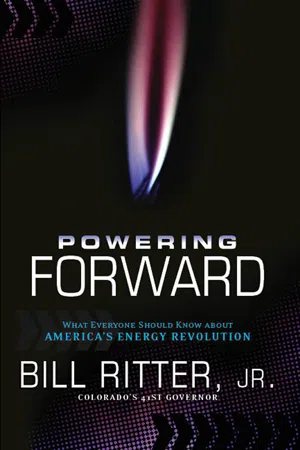
Powering Forward
What Everyone Should Know About America's Energy Revolution
- 304 pages
- English
- ePUB (mobile friendly)
- Available on iOS & Android
eBook - ePub
About this book
A historic energy revolution is underway in the United States. Wind, sunlight, and other sustainable resources are now the fastest growing sources of energy in the U.S. and worldwide. American families are installing power plants on their roofs. Entire communities are switching to 100% renewable energy. The urgent need to prevent climate change is causing people around the planet to question their reliance on carbon-intensive oil, coal, and natural gas. Author Bill Ritter Jr., the 41st governor of Colorado and one of America's foremost leaders on sustainable energy resources and implementation, discusses the forces behind the energy revolution, the new ways we must think about energy, and the future of fossil and renewable fuels. It is an essential read for any who want to understand one of history's biggest challenges to peace, prosperity, and security in the United States.
Information
1
The Colorado Promise
The activist is not the man who says the river is dirty. The activist is the man who cleans up the river.
– Ross Perot
Colorado has not been exempt from the weather disasters that are increasing in frequency and intensity around the world. These events can be attributed to complicated causes, but their impacts are profoundly personal.
Few Coloradans will forget the Hayman forest fire that burned southwest of Denver in 2002. It was so large and intense, it created its own weather system. More than 5,300 people had to evacuate their homes. Or the record Waldo Canyon fire near Pikes Peak in 2012 that killed two people and destroyed 346 homes. Or the 2013 Black Forest fire near Colorado Springs that set another record, destroying 511 homes and killing two more people. Or the West Fork fire the same year, which forced the evacuation of the entire community of South Fork.
Then, in the fall of 2013, 100 miles to the north of the West Fork fire, eight days of rains produced epic flooding across 17 Colorado counties and nearly 2,400 square miles – a disaster ranked as a 1,000-year rainfall event. The floods changed the course of rivers and the future of riverside communities.
Between 2006 and 2013, Coloradans were hit with nearly $4 billion in property damages and 70 fatalities due to severe weather; only eight other states had higher levels of deaths and damages.14page 235 State officials have tracked a temperature increase of approximately 2°F between 1977 and 2006, the blink of an eye in geophysical terms.
The rising temperatures have been accompanied by drought. In 2006, parts of Colorado were still recovering from a 2000–2003 drought that resulted in the driest conditions in the state’s instrumented history.15page 235 The Colorado River, a vital source of water to 30 million people in seven states, fell to its lowest level since monitoring began in 1885.16page 235
Water Worries

In the meantime, Shell Oil was buying water rights for use in future oil shale gas production, raising concerns that the oil and gas industry would compete with agriculture, cities, tourism, and other industries for Colorado’s limited water supplies. We can expect the impacts of climate change to get much worse. In 2006, for example, Colorado College issued a study showing that the state’s ski industry could disappear by mid-century unless global warming and its adverse effects on snowpack were reversed.17page 235
This was some of the backdrop when I contemplated running for governor in the 2006 election. Nevertheless, neither clean energy nor climate change were high on my list of interests. My personal history up to that point helps explain why. I was born in Denver and raised on a farm not far from the city, the middle child of twelve. At the age of 14, I began working summers in the construction industry to help support my family. I earned a bachelor’s degree at Colorado State University and a law degree at the University of Colorado. The law, not environmental sciences, became my career path.
After college, I worked as a deputy district attorney for the City and County of Denver. Then in 1987, my wife Jeannie and I volunteered as lay missionaries in Zambia. This experience taught us a great deal about poverty, hunger, and aspiration in a less developed nation – the kind of nation, I would later understand, that has the most to lose from and the least ability to cope with climate change. When we returned to Denver three years later, I became a federal prosecutor. In 1993, then-governor Roy Romer appointed me as Denver’s district attorney, and I served in that post for the next 12 years.
Deciding to Run
I began thinking about running for governor more than a year before the election. It is safe to say, I think, that most candidates who believe in public service are sincere in wanting to make their jurisdictions better places to

live and work, and that was the case for me. In the relative quiet before the fray of a statewide political campaign, I studied the issues that seemed most important to the future of our state. They extended beyond my experience as an attorney, missionary, and prosecutor. Colorado deserved a better education system, better transportation, better health care, a better way to deal with immigration, plans to ensure ample and clean water supplies, and, of course, a strong economy and new jobs.
After I decided to run for the governorship and assembled a campaign team, we bundled these goals into a platform we called the Colorado Promise, and our pledge was to help Colorado reach its full potential.18page 235 To be frank, the Colorado Promise was not only a statement of what my goals would be as governor, it was also an early campaign strategy to define myself as a candidate before my opponent could try to define me. A typical tactic for running against a former criminal prosecutor is to attack his or her record. In my case, the attacks would be about how my office used plea bargains rather than going to trial to prosecute criminals, and to resolve cases involving illegal immigrants. I would have no trouble defending myself against such attacks, but I wanted the campaign to be about bigger issues. The Promise theme put those issues on the table.
An important element in the Colorado Promise was to make the state a national leader in the use of clean energy. Energy was not my highest priority early in the campaign; it did not appear until page 24 in our 52-page booklet. It clearly was on the minds of Colorado’s voters, however. In November 2004, after the state legislature rejected several consecutive proposals to establish a Renewable Energy Portfolio Standard (RPS) – a requirement that electric utilities generate a specific percentage of their power from renewable resources – citizens took matters into their own hands. Renewable energy advocates gathered en...
Table of contents
- Introduction
- 1
- 2
- 3
- 4
- 5
- 6
- 7
- 8
- 9
- 10
- 11
- 12
- 13
- 14
- 15
- 16
- 17
- 18
- 19
- 20
- Notes
Trusted by 375,005 students
Access to over 1.5 million titles for a fair monthly price.
Study more efficiently using our study tools.
Frequently asked questions
Yes, you can cancel anytime from the Subscription tab in your account settings on the Perlego website. Your subscription will stay active until the end of your current billing period. Learn how to cancel your subscription
No, books cannot be downloaded as external files, such as PDFs, for use outside of Perlego. However, you can download books within the Perlego app for offline reading on mobile or tablet. Learn how to download books offline
Perlego offers two plans: Essential and Complete
- Essential is ideal for learners and professionals who enjoy exploring a wide range of subjects. Access the Essential Library with 800,000+ trusted titles and best-sellers across business, personal growth, and the humanities. Includes unlimited reading time and Standard Read Aloud voice.
- Complete: Perfect for advanced learners and researchers needing full, unrestricted access. Unlock 1.5M+ books across hundreds of subjects, including academic and specialized titles. The Complete Plan also includes advanced features like Premium Read Aloud and Research Assistant.
We are an online textbook subscription service, where you can get access to an entire online library for less than the price of a single book per month. With over 1.5 million books across 990+ topics, we’ve got you covered! Learn about our mission
Look out for the read-aloud symbol on your next book to see if you can listen to it. The read-aloud tool reads text aloud for you, highlighting the text as it is being read. You can pause it, speed it up and slow it down. Learn more about Read Aloud
Yes! You can use the Perlego app on both iOS and Android devices to read anytime, anywhere — even offline. Perfect for commutes or when you’re on the go.
Please note we cannot support devices running on iOS 13 and Android 7 or earlier. Learn more about using the app
Please note we cannot support devices running on iOS 13 and Android 7 or earlier. Learn more about using the app
Yes, you can access Powering Forward by Bill Ritter, Jr. in PDF and/or ePUB format, as well as other popular books in Politics & International Relations & Sustainability in Business. We have over 1.5 million books available in our catalogue for you to explore.