eBook - ePub
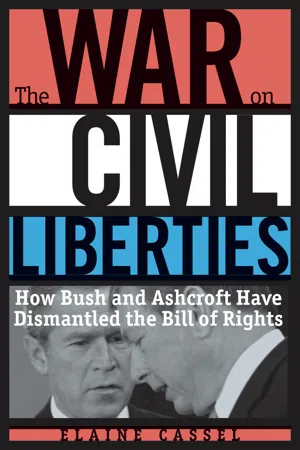
The War on Civil Liberties
How Bush and Ashcroft Have Dismantled the Bill of Rights
- 208 pages
- English
- ePUB (mobile friendly)
- Available on iOS & Android
eBook - ePub
About this book
Examining the legal foundations of the war on terror, this book investigates the loss of the civil liberties of American citizens and legal immigrants. In a detailed look at bills such as the 1996 Antiterrorism and Effective Death Penalty Act, the USA Patriot Act, and the Homeland Security Act, and executive orders, it provides a comprehensive picture of the war on terror and explores the claimed victories by the Bush administration. Chronicling the major battles with Muslim charities, immigrants, lawyers, and "enemy combatants," this exposé reveals how the values and freedoms of all Americans are at risk or have already been destroyed. Also surveyed is the growing grassroots dissent by groups such as the ACLU and the resistance movement against the policies and major figures of the Bush administration.
Information
1
TERRORISM, PATRIOTISM,
and HOMELAND SECURITY
and HOMELAND SECURITY
The Legal Foundation for the War at Home
Our war on terror begins with al Qaeda, but it does not end there. It will not end until every terrorist group of global reach has been found, stopped, and defeated.
—PRESIDENT GEORGE W. BUSH, September 20, 20011
When President George W. Bush declared a war on “terror,” no one, not even Bush himself, could have envisioned how this war would be carried out. Soon it became clear that there would be a war in Afghanistan that would lead to the deaths not only of America’s enemies, but also of Afghani civilians as well as military and civilian personnel from the United States and its allies. But President Bush also put Americans on notice that it would take more than military might to wage this war. The campaign would require a new arsenal of laws and regulations at home. The president got just that. A month after Bush’s declaration of war, Attorney General John Ashcroft led a virtually unquestioning Congress to enact laws that would change the concept of what it means to be “free” in America that dated back over 200 years. If the September 11 hijackers hated us for our freedoms, as Bush said, today there is far less to hate.
The legal firepower behind the war on terror consists of three pieces of legislation—the Antiterrorism and Effective Death Penalty Act of 1996, the USA Patriot (Uniting and Strengthening America by Providing Appropriate Tools Required to Intercept and Obstruct Terrorism) Act of 2001, and the Homeland Security Act of 2002—as well as a host of executive orders and federal agency regulations. Ashcroft, Bush, and numerous federal courts have decreed that freedoms must be curtailed in the name of fighting terrorism. But that formulation suggests that this curtailment will be temporary. Given the nature of terrorism—and of politics—that is extremely unlikely. Bush, after all, has said repeatedly that this is to be a war of many years’ duration, a life’s work. It will not end until every threat the United States identifies as terrorist is vanquished. It is a global war without territorial boundaries and without a known cast of enemies, save one: “evil.” And it’s being fought at home, in churches and town squares, in courtrooms and libraries.
At the center of this new body of antiterrorism and homeland security laws lies a vague and amorphous definition of its central term: “terrorism.” What is “terrorism”? As revealed throughout this book, there are as many definitions as there are laws and regulations using the term. The Patriot Act defines terrorism as “acts dangerous to human life that are a violation of criminal law” that “appear to be intended to influence the policy of a government by intimidation or coercion.” This definition is so broad that practically any act of civil disobedience could be construed to be “terrorism.” (A political demonstration taking place in the path of an ambulance, for example, could be termed “dangerous to human life.”) Under the Patriot Act, any organization that engages in legitimate as well as illegitimate activities can be presumed a terrorist organization for all purposes (see chapter 4). And the prohibited activity that lands a group on the government’s list need not consist of violent acts directed at people; anything that is intended to destabilize a government or “influence” its policy by coercion can be termed terrorism. Flooding a congressional office with e–mails critical of government policies and jamming a server in the process—is that an act of terror? Some organizations that use the Internet to ask people to e–mail members of Congress fear that it might be so construed.
As well they should. For the war on terror now encompasses a breathtaking range of new government powers here at home. More than ever before, merely dissenting could make you a target in the Bush administration’s war on terror. Indeed, protestors against the war in Iraq and against U.S. trade and monetary policies abroad have discovered that the First Amendment’s protections of freedom of speech and assembly can be curtailed at the whim of the executive branch of the government—all in the name of fighting terrorism.
The Bill of Rights
What we think of as civil liberties, a term first coined in the mid–seventeenth century, refers to individual rights free from the powers of the government. In the strictest sense, civil liberties are liberties inherent in our bodies, our homes, our minds, our churches, our travel, and our associations. These most elemental of freedoms, along with rights of the people in the face of government power, were granted to Americans in the Bill of Rights. Ironically, these most cherished of American values were not a part of the original Constitution. The Bill of Rights came about primarily through the efforts of George Mason, Virginia’s delegate to the Constitutional Convention of 1787. Having crafted a Bill of Rights for the Virginia Constitution, Mason was distressed that the framers of the federal Constitution made no such provision. The Articles of Confederation, he pointed out, were all about federal power, leaving open the opportunity for centralized tyranny—a prospect familiar to the former subjects of King George III.
After Mason left the convention in protest over its failure to adopt provisions that protect individual liberties, the first Congress of the United States adopted twelve amendments to the Constitution on September 25, 1789, and proposed them to the states for ratification. The Constitution required then, as it does now, that the proposed amendments be ratified by three–quarters of the states. Two of the proposed amendments that addressed the number of congressional representatives and their compensation were not ratified. But the other ten were, and on December 15, 1791, they became the first ten amendments to the Constitution—what we know today as the Bill of Rights.
In the name of fighting a war on “terror,” the Bush administration, with the help of Congress and the courts, has trampled on the Bill of Rights, particularly the First, Fourth, Fifth, Sixth, and Eighth Amendments, and curtailed many of the freedoms it granted. We will examine far too many instances in subsequent chapters. For example:

Table of contents
- Cover
- Title Page
- Copyright
- Contents
- Acknowledgments
- Introduction
- 1 Terrorism,Patriotism,and Homeland Security The Legal Foundation for the War at Home
- 2 The War in the Courts
- 3 The War Against Lawyers
- 4 Guilt by Association The Islamic Charities
- 5 Seizures, Detentions, and Deportations
- 6 Popular Resistance in the War on Civil Liberties
- 7 A War Without End
- Afterword: Further Updates
- Resources For Keeping Current
- Endnotes
Trusted by 375,005 students
Access to over 1.5 million titles for a fair monthly price.
Study more efficiently using our study tools.
Frequently asked questions
Yes, you can cancel anytime from the Subscription tab in your account settings on the Perlego website. Your subscription will stay active until the end of your current billing period. Learn how to cancel your subscription
No, books cannot be downloaded as external files, such as PDFs, for use outside of Perlego. However, you can download books within the Perlego app for offline reading on mobile or tablet. Learn how to download books offline
Perlego offers two plans: Essential and Complete
- Essential is ideal for learners and professionals who enjoy exploring a wide range of subjects. Access the Essential Library with 800,000+ trusted titles and best-sellers across business, personal growth, and the humanities. Includes unlimited reading time and Standard Read Aloud voice.
- Complete: Perfect for advanced learners and researchers needing full, unrestricted access. Unlock 1.5M+ books across hundreds of subjects, including academic and specialized titles. The Complete Plan also includes advanced features like Premium Read Aloud and Research Assistant.
We are an online textbook subscription service, where you can get access to an entire online library for less than the price of a single book per month. With over 1.5 million books across 990+ topics, we’ve got you covered! Learn about our mission
Look out for the read-aloud symbol on your next book to see if you can listen to it. The read-aloud tool reads text aloud for you, highlighting the text as it is being read. You can pause it, speed it up and slow it down. Learn more about Read Aloud
Yes! You can use the Perlego app on both iOS and Android devices to read anytime, anywhere — even offline. Perfect for commutes or when you’re on the go.
Please note we cannot support devices running on iOS 13 and Android 7 or earlier. Learn more about using the app
Please note we cannot support devices running on iOS 13 and Android 7 or earlier. Learn more about using the app
Yes, you can access The War on Civil Liberties by Elaine Cassel in PDF and/or ePUB format, as well as other popular books in Politics & International Relations & Human Rights. We have over 1.5 million books available in our catalogue for you to explore.