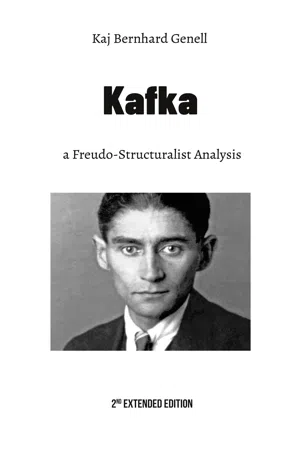
"Kafka - a Freudo-Structuralist Analysis" deals with stylistic effects of Kafka's Novels and Short Stories and concentrates mainly on understanding what contributed to the famous Kafka effect - the "Kafkaesque". The author - Kaj Bernh. Genell, born in Sweden, who is also an author of novels in English and Swedish, thoroughly explains the determining structural triplicity of a discourse seen as Consciousness. Important in this structure is how Freud, Romantic irony, and Symbolistic Literature simultaneously co-work as a mythical subtext. Kafka created what would become key parts of the definition of Modern Man. Thus, understanding Kafka - and his very strange technique - is - according to the author - the main road to understanding Modernity and our Future.
- 242 pages
- English
- ePUB (mobile friendly)
- Available on iOS & Android
eBook - ePub
About this book
Trusted by 375,005 students
Access to over 1 million titles for a fair monthly price.
Study more efficiently using our study tools.
Information
PART I
CHAPTER I
A SHORT BIOGRAPHY
PRAGUE.
During this time, the double monarchy of Habsburg was intact, powerful, and wealthy. This superpower was compounded of about fifteen different nationalities, and it was run, since 1848, by the emperor Franz Joseph. Prague is situated on both sides of the river Moldau, almost in the midst of Bohemia. This ancient town 1900 had about 40.000 German-speaking inhabitants, while the majorities were 400.000 Czechs. These groups – who were both Christians and Jews, lived almost segregated. Different groups existed side by side "with and against each other," as someone has said. In Prague, 9% of the population was, like the Kafka family, Jews at this time.
Prague was a more complex city concerning class than, for example, Vienna, the center of power of the Habsburg dynasty, was at this time. In Vienna, with its 1.7 million inhabitants, the group of Jews had rapidly grown to a more predominant group of people, and anti-Semitism was much more trouble than in Prague. The Jewish ghetto of Josephstadt, which was the biggest in Europe, and probably the oldest, had been dissolved in the revolutionary year 1848 when Franz Joseph became ruler, and the Jews had acquired their full rights to marry, etc.
In Prague, socioeconomic bonds generally prevented anti-Semitism, except in economically challenging times, when one blamed the Jews as one had done for centuries all over Europe. Official business, government, and institutions were run mainly by Germanspeaking people, while Czechs handled commerce in general and in the Czech language. Jews in Bohemia were either German or Czech speaking, but they all spoke Yiddish, and many of them in the countryside could read Hebrew. The general Class inequalities in Bohemia were enormous like they were in the empire and Europe.
Prague at this time had a German university with about 17000 students and two German theatres. Kafka could enjoy dramas by August Strindberg and Ibsen, Shakespeare's Hamlet, Lessing's Nathan der Weise, Schiller's, Goethe's, Molière's plays, and those of G. B. Shaw and Arthur Schnitzler. Kafka perhaps attended Verdi's Rigoberto, with Caruso in the main part.
Max Brod asserts that the mood of Prague was naïve. It was almost revolutionary when the Zionist M. Buber started his newspaper there or when Karl Kraus came to town. Karl Kraus was the founder of Die Fackel, a Vienna newspaper concentrating on political satire. "Prussia is very generous as far as muzzles concerns." Kraus pointed out. "Austria is the isolation cell, where you are allowed to scream."
Kraus, in Prague, during lectures, spoke in front of a roaring, excited crowd in the student club, "Die Halle." The great critic of both political and cultural matters, not least of newborn Psychoanalysis, came to this small cultural club more than fifty times, from 1910 and on. We do not precisely know if Kafka listened to Kraus in person, but it is very likely he did so. From his diaries, we see that he was well informed, widely read, and interested in everything in society.
Many Jews in Prague were secular Jews. Kraus had left Judaism, just like f. ex. Wittgenstein did. Kraus later became a forceful opponent of the famous Viennese founder of modern Zionism, Theodor Herzl and Buber. Like Vienna, Prague did not have any radiant cultural figures with the stature of Kraus, i.e., intellectuals, who fundamentally could stir society and stimulate change. Kraus's influence upon Central Europe was enormous, to which many vital scholars, such as Freud, Musil, and Arnold Schonberg, bore witness.
Max Brod, FK's life-long friend, would later characterize himself, together with Franz, as Prague-Austrians, which tells us a lot about the two young authors and their social situation. The era was marked by the dominance of the bourgeoisie and, consequently, by a moral of double standards characterized by the oppression of women.
Oswald Spengler, another important essayist academic voice, nicknamed "der Untergangster" by Kraus, bluntly asserted, in his Untergang des Abendlandes, that every culture was subject to demolition. His field of study, History of Culture, was physiognomics; Culture was a living organism. Spengler´s historicism was of an extremely impressionist kind, quite like Vico´s and Friedell´s.
Certainly, in juxtaposition to Vienna, Prague had acquired a unique, dense, and slightly ghostly atmosphere perhaps because of the city of Prague´s lack of political importance. Its literature reflects this. Within Czech literature, which stood very close to the classic German Romantic one, a genre marked by mysticism, often called "Ghost literature," might be traced back to Rabbi Yehuda Loew, who wrote the famous fable of the strange Golem. Golem was a small creature made of clay that, in this myth, came to life when a rabbi, Maharal, put a small piece of paper with God's name on it in the mouth of Golem. Loew lived around 1600, and his works were done into pastiche by G. Meyrink, E.E. Kisch, and others.
Kafka was part of the very important, somewhat educated German bourgeoisie in Prague during this turbulent time. Around 1910, he rapidly came as a young aspiring author to be a part of Modernism. As a citizen, he never became a revolutionary activist; his early sympathy for anarchism and various socialist movements was known only to a minimal circle of friends. However, it later became an essential subject in many of his short stories and prose poems.
----------------------------------------
Kafka was no ordinary young man. He regarded himself as a kind of Unmensch, a "Quasimodo," and as being "literature." He thus often did not consider himself a human being. We do not precisely know why. Where are there hidden secrets in his life? Based on information in diaries and letters, we are prone to think that Kafka wrote to survive some ordeal. However, survival probably should also fulfill the needs of his mind. ( The strange thing with survival is that one normally does not survive on nothing at all. ) The writing was a "way out," but not into emptiness, but instead into delight. We will later discuss the relation Kafka - writing – desire/jouissance . Mainly the Central European culture of those days was a hedonistic, often eroticist one.
Franz Kafka was born in 1883. Franz [Anschel, as was his Jewish name] was the only son, the son of a son of a kosher butcher from the countryside in Märhren, not far from the place where Sigmund Freud´s grandfather lived.
Herman [ Hermann ] Kafka, FK:s father, was a successful merchant of Western Jewish descent. His wife, Julie, b. Löwy, of Eastern Jewish, was the daughter of a wealthy well known Prager brewer. Herman was a member of the Jewish community's counsel and the only synagogue in Prague that provided a Czech language service, which was the only language Herman ever fully mastered. Franz never got any orthodox Jewish education since this was not compliant with Herman's determinate vision of the Jewish people's future in Europe.
Kafka had three sisters, Valli, Elli, and Ottla, and they had a French governess, Mademoiselle Bailly. The family, who generally had three servants in the house, also had a children's nurse named Anna Pouzarová, not much older than the children themselves, a nurse/playmate of which Franz felt very strongly. G. Rieck asserts that this "forbidden love strongly marks the entire authorship."
It was a bilingual home, but he went to German schools. He never grew completely familiar with the Czech language, and he could not write literature in this idiom.
Already as a boy, Franz came into conflict with his father. The son got locked out on the balcony in the night for a minor offense, which created psychic trauma.
Young Franz never showed any interest in the family business, all the more in art and literature, and hence Herman often treated young Franz with sarcastic Irony. Julie Kafka is hardly mentioned in the diaries, while the father is almost permanently present in these. Franz always sought confirmation from him but hardly ever got any. He also felt physically inferior to his father. In connection with feelings of inability to live, the father more and more stood out as an example of human beings too fit to live. As far as we know, the emotional climate of the Kafka family was neither warm nor cold. There were not much dance and music in the home. Herman liked to play cards in the evening, and when his friends were not available, Julie played with him. Herman seemed to have been all for his business. Religion meant nothing to anybody in the Kafka family.
One might get a glimpse of Kafka's boyhood and Prague's surroundings where he lived from the prose collection Betrachtung, where one might perceive the bittersweet and the unattainable as themes. During high school, young Franz took a pronounced negative attitude to romantic verse. Nevertheless, he was, on the contrary, utterly thrilled by the romantic saga, the Kunst-Märchen – a highly stylized prose that, in a sense, was from the very start a parody of itself.
Kafka was not a prominent scholar in primary and secondary school but more of an average pupil and later student. Emil Utitz, who had been to school with Kafka, later, in a letter to Klaus Wagenbach, gave a vivid and memorable description of F.K.:
"If I were to say something characteristic concerning Kafka, it would be that it was not anything special at all with him."
He took his high school exam in 1901, and he began to study law at the Ferdinand-Karl's-Universität without any particular interest in the subject.
Between 1901 and 1906, he was a student at the University.
As a lawyer, he was later able to devote himself to writing in his spare time. This was his idea from very early on. During his lifetime, Kafka would many times stress the vast importance and meaningfulness of the possibility of indulging in writing, and he was mesmerized by literature and words. Kafka, as a teenager, wrote a lot. He seemed to be born with a very fluent literary style.
------------------------------
In high school, Kafka was introduced to a famous and influential philosopher of his time, Franz Brentano. He generally is described as a phenomenological thinker. Kafka appears to have been susceptible to observations on perception problems, often called a philosophy of mind, around which Brentano had evolved his philosophical psychology. It is striking how there are ideas similar to Brentano's regarding the mental experience in Kafka's Description of a struggle (1909) and some notes in the diary from 1913. B. Smith and J. Ryan are both referring to signs of the impact of Brentano upon Kafka in a passage in Kafka's early work:
"I continued my wandering. But since I as a pedestrian feared the troubles and strains of climbing the steep path, I made it more and more smooth, and then made it sloop down towards a distant valley. The rocks disappeared according to my will, and the wind ceased to blow..."
F.K. bases the content upon the" inner life" of the narrator, upon his fancies and wishes. Kafka purportedly draws consequence from the philosophy of Brentano in surpassing it. Brentano always stressed the difference between perception and object and that we are always left with our experience, of which we, while we have this experience, always obliquely at the same time, are consciously aware. We are thus, according to Brentano, aware of what we are aware. Kafka could easily have grabbed this idea and developed it in this manner, as is seen in the example. Practically, however, Brentano, in his philosophy of perception - like Dilthey does - comes into counter-position to the old romantic idealist philosophy.
Kafka does not mention Brentano at all in his notebooks. Brentano was probably of no significant importance to F.K.. However, F.K. still might have gained essential knowledge of moral philosophy and the philosophy of right by dealing with Brentano's writings, just as he possibly acquired some skill in still purer sophistry by reading the Talmud and other Jewish literature, which he often sought out as a compensation for the lack of intellectual and religious tradition in his own childhood home.
----------------------------------
At Prague University, there was a student Cultural Club, the aforementioned "Die Halle," where one could listen to lectures and discussions concerning political, philosophical, and cultural matters. One night on the 23rd of October 1902, a small, near-sighted, hunchbacked, extremely self-confident boy, Max Brod, held a speech about Schopenhauer's views on destiny at "Die Halle." Since Brod in his speech violently attacked Nietzsche's ideas in this speech and named him "Hochstapler" (scammer), and since Kafka very much did appreciate Nietzsche, Kafka afterward approached Brod, and they then violently discussed these matters. A lifelong friendship started with this quarrel.
Max and Franz soon began to study literature together in privacy, the readings of Plato and Flaubert. Kafka, who was fluent in French due to his love of his childhood nurse, loved to read Flaubert aloud in his baritone voice. Of course, both Brod and Kafka were fluent in both Latin, Greek, and even Hebrew, since they both passed high school. Franz and Max even translated parts of Plato´s Dialogues, which is interesting particularly for a Kafka scholar, since Plato's style might, to some degree, have affected Kafka's style. Being a solid skeptic and an astute Nietzsche fan, Kafka probably found it very hard to believe in the idea of the Good with Plato, though.
During his years at the Carolinum, Kafka also consumed many memoirs and biographies, his favorite lecture throughout his life, together with travel books. He usually read several newspapers and periodicals a day throughout his life, like the Bohemia, Deutsche Arbeit, Der Jude, Der Prager Tageblatt, Hyperion, and Wir.
Kafka wrote to his comrades O. Pollak, Baum, O. Kisch, and M. Brod during summer leaves. In the letters, he told them of his consummation of literature and the beauty of the landscape around the idyllic Triesch to the north of Prague, where Kafka used to visit his uncle, the country doctor.
Kafka was an assimilated Jew if it was possible to be "assimilated" at all in Prague. He was utterly irreligious. It seems that he supported secular Zionism more than covering such. Max Brod propagated lifelong for Zionism, moved to Israel, and ended his days in Israel as a convinced Zionist, acclaimed by the establishment as an honorary citizen. The Zionist outlook never won over Kafka himself. Friedlander: "Kafka was never a Zionist.". However, Kafka's interest in Jewish identity increased with the years - perhaps as his inner desperation grew. Perhaps in line with his surroundings, with the circle of Jewish intellectuals with which he socialized, he increasingly became aware of Prague's insulation, and many of his friends discussed a future ideal society in Palestine. Towards the end of his life, his studies in the Hebrew language were more intense. He first studied this language in two rounds, first as a 25-year-old and later in 1923 when he was dying. However, it is difficult to prove that this study affected his writing. B. Becker, in her thesis, investigated the possible Kabbalistic influences in F.K.'s authorship.
Kafka had read Karl Marx's Zur Judenfrage, written in 1844, where Jewish emancipation is scrutinized. This 88-page book has an essential discussion on power, the power of the mass, the difference between European and American politics and religion, and human rights. It is exceptionally well written, which was often the case with Marx. Marx points to an alleged inherent contradiction between freedom of religious belief and Human Rights. De Beaumont had earlier invented the concept and idea of human rights in France. Bruno Bauer –the opponent against whom the book explicitly is directed – claims that no emancipation for Jews is possible as long as there are religions. Marx asserts that there is no possible emancipation for the Jews before all humans are socially emancipated. This book also contains a minor discussion of alienation.
Kafka, in 1906, graduated with a Doctor of Law. After the usual practice period, the "Rechtspraktik" - a prerequisite for working in the state administration - F.K. got nine-month employment with an Italian insurance company, Assicurazioni Generali, which was headquartered in Trieste - then belonging to Habsburg, at their Prague office. In 1908, he soon got more suitable employment as an investigator at the large Arbeiter-Unfall-Versicherungs-Anstalt in Prague. The insurance system in Bohemia was extensive; over 200,000 contractors and about three million workers were affiliated. Officials' number was on this job not less than 250. Only two of these were Jews.
Kafka FK was an ambitious, resourceful, caring, and much-respected official. He always chose to work parttime but had a good salary and never had severe financial problems, apart from the last years. In Berlin, living with Dora, he was broke. Most often, F.K. lived with the family in different chilly and noisy apartments in Prague's absolute center and rarely rented his own rooms or apartments.
At nighttime Kafka was creative. From 22:30 to 02:00 or 03:00 at night, Kafka occupied himself with his literary work during his "vintage y...
Table of contents
- Dedication
- Table of Contents
- I. Preface. Franz Kafka – a unique writer
- PART I.
- PART II. ON KAFKA´S LITERARY TECHNIQUE AND THE STRUCTURE OF HIS WORKS
- ABBREVIATIONS USED
- LITERATURE USED AND/OR REFERRED TO
- Copyright
Frequently asked questions
Yes, you can cancel anytime from the Subscription tab in your account settings on the Perlego website. Your subscription will stay active until the end of your current billing period. Learn how to cancel your subscription
No, books cannot be downloaded as external files, such as PDFs, for use outside of Perlego. However, you can download books within the Perlego app for offline reading on mobile or tablet. Learn how to download books offline
Perlego offers two plans: Essential and Complete
- Essential is ideal for learners and professionals who enjoy exploring a wide range of subjects. Access the Essential Library with 800,000+ trusted titles and best-sellers across business, personal growth, and the humanities. Includes unlimited reading time and Standard Read Aloud voice.
- Complete: Perfect for advanced learners and researchers needing full, unrestricted access. Unlock 1.4M+ books across hundreds of subjects, including academic and specialized titles. The Complete Plan also includes advanced features like Premium Read Aloud and Research Assistant.
We are an online textbook subscription service, where you can get access to an entire online library for less than the price of a single book per month. With over 1 million books across 990+ topics, we’ve got you covered! Learn about our mission
Look out for the read-aloud symbol on your next book to see if you can listen to it. The read-aloud tool reads text aloud for you, highlighting the text as it is being read. You can pause it, speed it up and slow it down. Learn more about Read Aloud
Yes! You can use the Perlego app on both iOS and Android devices to read anytime, anywhere — even offline. Perfect for commutes or when you’re on the go.
Please note we cannot support devices running on iOS 13 and Android 7 or earlier. Learn more about using the app
Please note we cannot support devices running on iOS 13 and Android 7 or earlier. Learn more about using the app
Yes, you can access Kafka by Kaj Bernhard Genell in PDF and/or ePUB format, as well as other popular books in Languages & Linguistics & Linguistics. We have over one million books available in our catalogue for you to explore.