Chapter 1
The Conventional Definition of the School-to-Prison Pipeline
DURING MY RUN for governor of the State of Connecticut in 2017 to 2018, the Connecticut Conference of the NAACP hosted a gubernatorial debate in April 2018 in New Haven concerning reentry prospects for former prisoners. Then candidate and now Governor Lamont attended as did then candidate Susan Byciewicz now lieutenant governor, Bridgeport mayor Joe Ganim, and businessman Guy Smith. The questions were asked of the candidates by ex-cons and was a decent exchange of ideas. I was the only Republican candidate there. A special guest in the audience was Reverend Tommie Jackson, who had coined the phrase “Life, Love, Liberty” for the weekly sermons at Faith Tabernacle Missionary Baptist Church in Stamford, Connecticut. It was the positive message of Reverend Tommie Jackson and “Life, Love, Liberty” that motivated me to run for governor in May 2017 after attending a Realtor rally in our state’s capital, Hartford. The leading Democrat and Republican legislators spoke, with the exception of the governor, and they said absolutely nothing to indicate they had any idea of how to dig Connecticut out of its financial hole with anemic post-Great Recession growth, if what happened in Connecticut could be called growth.
It was under the tutelage of Reverend Tommie Jackson and the subsequent interim pastor, Dr. Boise Kimber, at Faith Tabernacle, along with the biweekly guest ministers from Norwalk, Bridgeport, Hartford, Newark, Queens, Manhattan, and other environs, that formed the genesis for this and other books. After the debate with my Democrat colleagues, photos were taken, and we were able to speak with some of the community members and ex-cons. I was gratified that some attendees had positive things to say about my debate messages, such as that the state puts needless roadblocks in the way of people to make their living, the poster child case being to get a license to cut hair, a thousand hours of barber school. In other cases, getting licenses to ply a trade or start your own business requires hiring your own attorney and paying them to sort your way through the morass of government regulations. One gentleman also appreciated my stand against poisoning our young people’s brains with recreational marijuana instead focusing on the gift of life in sobriety. We met a few times after the meeting in and around Bridgeport. One of the meetings was at a church in Bridgeport that also ran reentry programs for ex-cons, trying to keep them on a straight path to avoid recidivism or doing it again and ending up back in jail. The church had a doorman for access purposes, but both confided that the ex-cons did show greater respect at the church versus a typical municipal building, because a church deserves respect. Amen.
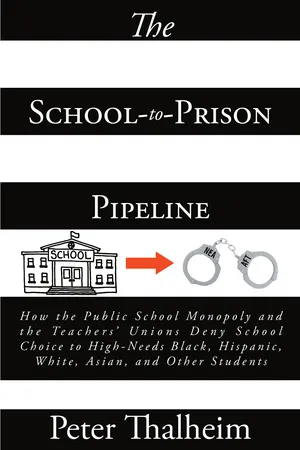
It was here that this gentleman and the administrator of the reentry programs, who had also been one of the panelists at the NAACP debate, introduced me to the concept of a school-to-prison pipeline. This concept of a school ultimately leading to prison runs diametrically opposed to the assumption that school is a great leveler. According to former Secretary of Education Arne Duncan, Horace Mann, in the nineteenth century, called education “the great equalizer of the condition of men.”
But Secretary Duncan warned:
Students who receive a poor education, or who drop out of school before graduating, can end up on the wrong side of a lifelong gap in employment, earnings, even life expectancy.
When pressed, this gentleman and the administrator for the reentry program confirmed that there was not an actual plan in Hartford, the state’s capital, of channeling students through school to prison to keep the state fully occupied as that would be too cynical. But let’s look at what commonality public school and prison have.
The state runs both the public schools and the prisons. When we speak of the school-to-prison pipeline, we are not talking about expensive private schools like Brunswick for boys or Greenwich Academy for girls in Greenwich, or the namesake school for Horace Mann in the Riverdale section of the Bronx, where my very smart friend from New Rochelle went to high school. We are not speaking of the Ethical Culture Fieldston School in Riverdale either. We are definitely not speaking of the many catholic schools run by the Catholic church all across America. We are not speaking of boarding schools such as Phillips Academy in Andover, Massachusetts, where my good friend from Duke Law School attended, nor the plethora of private and religious schools all across our great land. And we are not even speaking about new and expanding public charter schools in their different iterations. No, we are talking about public schools located in communities where there are tough socioeconomic conditions, family breakdown, crime, and other challenges. These schools are primarily run by the state and are not public charter schools.
It should not come as a surprise that public unions are the dominant force at both public schools and at state prisons. This pipeline inquiry is more about who feeds the pipeline to keep a steady supply going as opposed to who receives our young citizens in jail. The prisons do the best they can with the limited resources that they are given in pay and physical plant. The prisons do not control the pipeline; they just receive misdemeanors and felons coming out of the pipeline. And the pipeline is not about the many teachers who give of themselves every day to try to make a difference in the lives of young people who need the teachers’ guidance and learning. Teaching is a high calling.
No, the pipeline is operated by the public unions and statists, in my opinion. Let’s consider what a union is legally obligated to do. There is something that you may have come across in your own work, but it is definitely something that we learned in law school: fiduciary duty. “When someone has a fiduciary duty to someone else, the person with the duty must act in a way that will benefit someone else, usually financially.”
And a union owes its first fiduciary duty to its members. That would be the teachers. The second person the teachers’ union owes a fiduciary duty to is itself. Children come into view third after the adults and the union. So by law, children are legally third in line for the duties owed by public unions. The mission statement of the National Education Association, the largest teachers’ union, states, “We…are the voice of education professionals. Our mission is to advocate for education professionals.” Why would the citizenry allow entities that put children third to monopolize our public school system? That is a breach of the public trust. And how do the public unions monopolize our schools? In the State of Connecticut in 2017, we had approximately nine thousand students in public charter schools K-12, which is a little less than about 2 percent of our public school population. The public unions have fought adamantly against increasing that number, and they have been successful. In 2017, according to the Connecticut State Department of Education, there were over 7,200 mostly black and Hispanic students on waitlists to get into a charter school. That was an increase from the 6,762 students that were on a waitlist for the 2016–2017 school year. More than 85 percent of students in public charter schools in Connecticut are either black or Hispanic with over 70 percent reported as low income in 2016. But the state unions and statists figuratively stand in the doors to charter schools to prevent more students from attending if they can help it. They will not allow the number of charter schools to increase.
The late Democrat Governor George Wallace would be so proud of the NEA and the AFT for standing in the door of charter schools and refusing to let black and Hispanic students into new or existing schools, lest the public unions’ monopoly over public education be reduced just a little. This is just as Governor George Wallace did in 1963 when he led a “‘stand-in-the-school-house-door’ protest to prevent two black students from enrolling at the University of Alabama.” Governor Andrew Cuomo in New York used to be an unapologetic supporter of public charter schools in New York State. When demonstrations in favor of public charter schools would happen in Albany, large demonstrations of mostly “people of color,” to use the current nomenclature, would plead with Albany to expand public charter schools to give greater educational choice to their children. Governor Cuomo would have positive things to say about those parents and charter schools. Now with Democrats moving significantly to the left, Governor Cuomo’s championing of these underrepresented communities of color has faltered in the face of the march of the intolerants who oppose greater educational choice for high-needs students from communities of color. Allegations of sexual misconduct against Governor Cuomo in 2021 made it even less likely that he would stand up to the public school monopoly or the NEA and AFT on behalf of school choice for high-needs students.
Chapter 2
Advantages of Public Charter Schools
IDEALLY, IT SHOULD be enough that the parents and guardians desire for their children to attend a public charter school. Nobody knows their children better than the parents and guardians. Who is the state to question the choice of the parents and guardians? The state cannot know their children better than the parents and guardians. And our assumption is that parents and guardians have the best interests of their children at heart, particularly when you have to take extra measures to get into a public charter school. For a traditional public school, you merely move into the neighborhood and ask where the local elementary school, middle school, or high school is. Then you show your proof of residence, and then your child is in the school. To get into a public charter school, you actually have to find it as it may not necessarily be in your immediate vicinity, and then you have to fill out forms beyond what is necessary to get into your neighborhood school. This extra effort in and of itself would indicate that the parents and guardians of these children are looking out for them and trying to do what they believe is best for them. If the parents and guardians thought that the public charter school was not good for their children, for whatever reason, which could go beyond academics to class size or physical buildings or convenience for drop-off and pickup, that should be good enough for the state. It appears, however, that public charter schools have to prove that they are not just as good as conventional public schools, that they are in fact better. And if they are not better, then they may not merit consideration to remain open. Instead, the statists would push to close a public charter school that is merely as good as the local neighborhood school so as to bring the jobs and money that these students represent back into the local school system. But that is wrong as the parents and guardians of the children i...