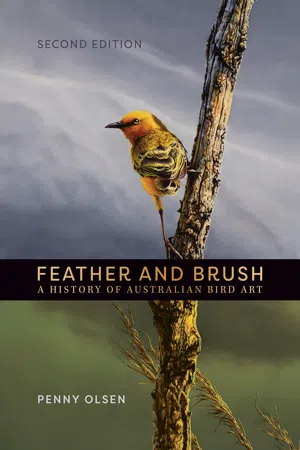
Feather and Brush traces the history of bird art in Australia – from the simple engravings illustrating accounts of the earliest European voyages of discovery to the diversity of artwork available today. It explores the early European approach, in which naval draughtsmen, officers, convicts, settlers, naturalists, artists and scientists alike contributed both to the art and the science of ornithology, through to a wealth of contemporary artists who feature birds in their works.
This book contains more than 400 images, representing the work of 158 artists; some well-known, others published for the first time. The illustrations have been selected for their interest, whether ornithological, historical or artistic. They range from classical to quirky, decorative to functional, monumental to intimate. Together they demonstrate the rich history of Australian bird art, as it evolved in Europe and Australia, and continues today, along with the trends and technologies of the times.
This second edition includes new and revised chapters, and features about 200 new artworks, including some by Indigenous artists.
Certificate of Commendation, The Royal Zoological Society of NSW 2022 Whitley Awards: Historical Zoology
Cultural sensitivity
Readers are warned that there may be words, descriptions and terms used or referenced in this book that are culturally sensitive. Aboriginal and Torres Strait Islander people should be aware that this book contains images and names of deceased persons.
No better way is there to learn to love Nature than to understand Art. It dignifies every flower of the field. And, the boy who sees the thing of beauty which a bird on the wing becomes when transferred to wood or canvas will probably not throw the customary stone (Oscar Wilde 1879).
BIRDS’ ENERGY, SHOWY COLOURS AND conspicuous behaviours have often caught the eye of the artist. Their ability to fly and their migrations cause imaginations to soar. Since early in human history, we have assigned them symbolic roles as patriotic eagles, vain parrots, peaceful doves and wise owls, and pronounced them messengers of heavenly gods, manifestations of abundance and harbingers of good or evil. Their eggs represent fertility, their nests, security, their flight, freedom.
Ancient human records of Australia’s birds are found in the cave, rock and bark paintings that were part of the spiritual and practical life of many Aboriginal peoples. Examples of this early bird art survive today. Near Victoria River, Northern Territory, several strong petroglyphs of eagles illustrate their social and cultural prominence, as do those far across the country in Wollemi National Park, north-west of Sydney, New South Wales. The more transient bark paintings of Arnhem Land and parts of the Kimberley region, northern Australia, often of Emus and Brolgas, are characterised by fine cross-hatched clan patterns that create a dazzling optical effect to evoke the presence of ancestral forces. These traditional art practices continue today, recording and respecting the ancient traditions, knowledge systems and stories connected to Country. Not only can they be artistic in expression, but they add to the pool of human knowledge of birds and their importance.
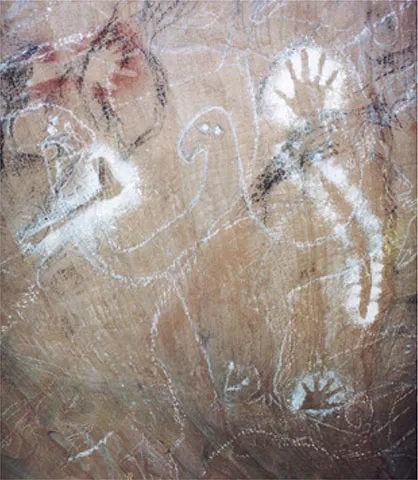
UNKNOWN ARTISTS The main figure in this rock art at the Eagles Reach site, Wollemi National Park, New South Wales, is interpreted by the contemporary Aboriginal people of the area as the Eagle Ancestor, a significant Dreamtime being. Each of its wings is overlaid with stencils of an axe (left) and a boomerang (right). There are also Emu footprints at lower left. The petroglyph is estimated to date back ~5000–6000 years and was made by up to five Aboriginal skin groups and clans. PHOTO BY PAUL S. TACON
In the late nineteenth century, Indigenous artists such as Tommy McRae and Mickey of Ulladulla were given pen and paper. They drew scenes of abundant wildlife, hunting and ceremonies that were passing – poignant records of their changing world. While such traditional and contact art is significant, Feather and Brush focuses on the European approach, which, historically, has been fundamentally ornithological.
The earliest known illustrations of Australian birds by Europeans were made in the late 1690s during Dutch voyages that reached Australia’s west coast – black swans by Victor Victorszoon on the Geelvink in 1697, and shorebirds made on Dampier’s voyage in 1699. Between 1750 and 1850, great voyages of discovery by the British and French opened up the world. Cloistered, classical ideals of order and perfection gave way to curiosity and a closer investigation of the natural world, and led to developing ideas of evolution. Scientifically accurate illustration, which had its genesis in the exquisite anatomical illustrations of Leonardo da Vinci and his Renaissance contemporaries, was put to good use describing nature. Indeed, a great deal of artistic talent was absorbed by the newly popular field of natural history study, which sought to describe and classify the planet’s plant and animal kingdoms. Coincidentally, the development of fast-drying watercolour, stored in dried cakes, provided an ideal medium for painting birds, especially while travelling or in the field.
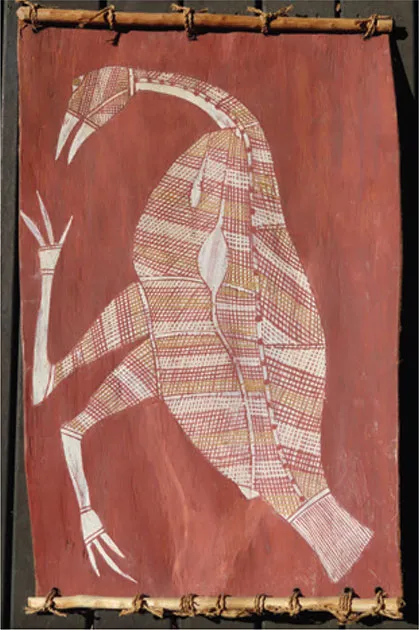
BOB YANYURR BUMARDA Emu Dromaius novaehollandiae. Earth pigments on the interior of eucalyptus bark, 54 × 34 cm; c. 1960s. Yanyurr was a figurative artist from Oenpelli (Gunbalanya), western Arnhem Land. He used a cross-hatching technique, often referred to as Rarrk, still commonly used by the Indigenous people of Arnhem Land to represent animals of spiritual and practical significance, at once expressing the artist’s relationship with the natural and supernatural worlds. Important internal organs and parts of the skeleton are sometimes depicted. This tradition, which dates back thousands of years, is dubbed X-ray painting and is most often seen in rock art. PRIVATE COLLECTION
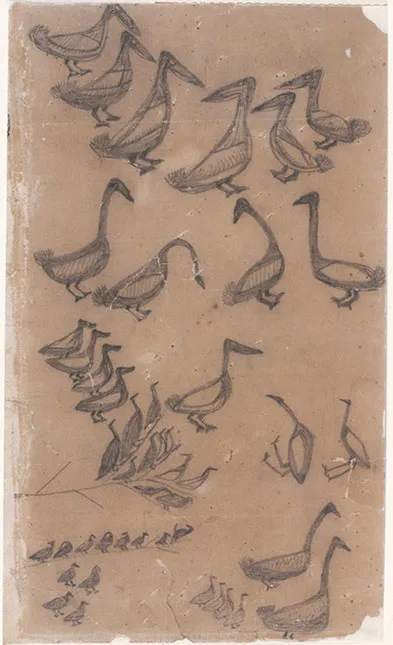
MICKEY OF ULLADULLA Pelicans, swans and other coastal waterfowl. Pencil, 24.4 × 14.4 cm; 1875. These birds and chicks were drawn by Mickey, a disabled Dhurga man, at Nelligen on the Clyde River. Much of his known work was done later, at Ulladulla, where he was given drawing material – including pastels, coloured pencils and watercolours, which he used to add soft colour to some of his art – by Mary Ann Gambell, the lighthouse keeper’s wife. Mickey was a boy when Europeans began taking over his people’s Country and his drawings show how life changed. STATE LIBRARY OF NEW SOUTH WALES
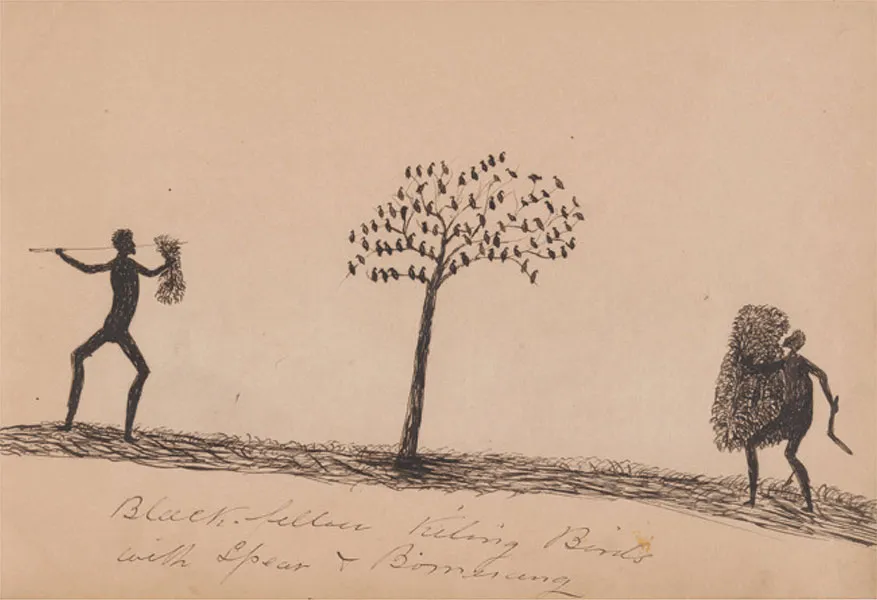
TOMMY MCRAE Unidentified birds. Pen and ink, 23.4 × 33.6 cm; c. 1890s. Tommy McRae, also known as Yackaduna or Warra-euea, probably belonged to the Kwatkwat clan of the upper Murray River region. McRae worked as a stockman and labourer for pastoralists, later making a living selling drawings, boomerangs and other artefacts. He filled sketchbooks with pen and ink drawings of traditional hunting and fishing techniques, conflicts and ceremonies, and interactions with squatters and Chinese farmers. In this typical sketch, two men hunt a flock of birds with a boomerang and a spear, approaching with their faces hidden behind handfuls of vegetation. STATE LIBRARY OF NEW SOUTH WALES
In the 1770s, Lieutenant (later Captain) James Cook made his well known voyages to the region. They were the first English voyages to include naturalists, most notably the wealthy botanist Joseph Banks, who championed the idea to the Admiralty, in part to fend off the French. The enthusiasm and influence of Banks helped to create a rage for collecting natural history objects (which then included ethnological material) from the South Pacific. Banks and his colleagues, often young men from the upper classes, scoured the world for land and trade-worthy products to benefit the British Empire. The items they collected were often subject to serious study and illustration, as part of the race for scientific prominence. A handful of newly discovered Australian birds were drawn on shipboard by Sydney Parkinson, Georg Forster and William Ellis. These illustrations and written records of birds from the period before colonisation are particularly important because, even when collections of birds were made, many have been lost.
By the time of British settlement of Australia in 1788, European art had moved away from the religious images of earlier centuries to present a more realistic view of the world. From the late eighteenth century, artwork was primarily intended to be informative. A universal system of naming and classifying plants and animals was in place and art was an established medium for the recording of science and the ordering of the natural world. An illustration could be used as evidence of a new species, and many First Fleet sketches were seized upon by Europeans clamouring to be the first to name and claim for both personal and imperial gain. This was the birth of an era when bird art and science were at their most intimate.
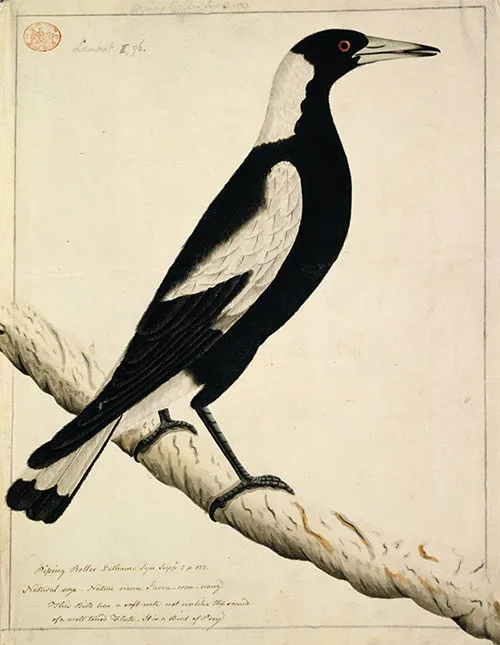
PORT JACKSON PAINTER Australian Magpie Gymnorhina tibicen. Watercolour, 42.5 × 32.8 cm; c. 1788–1792. Several unidentified convicts or officers were co-opted by John White to illustrate the fauna and flora of the new colony; some of them have collectively become known as the Port Jackson Painter. Drawn full-sized, the magpie is labelled the ‘Piping Roller.’ The Eora name is recorded as ‘Tarra-won-nang.’ In 1801, English zoologist John Latham scientifically described and named the Australian Magpie based on this drawing, which makes it the type specimen. NATURAL HISTORY MUSEUM, LONDON
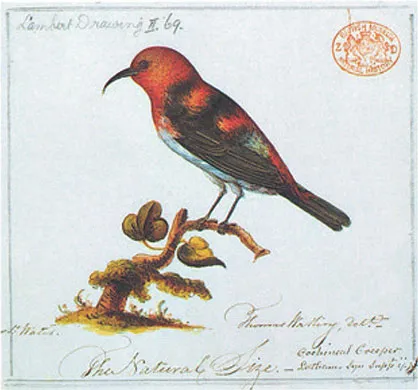
THOMAS WATLING Scarlet Honeyeater Myzomela sanguinolenta. Watercolour, signed, 10.7 × 15.5 cm; 1792–1797. Because of their ornithological significance, convict Thomas Watling’s drawings, together with those of the Port Jackson Painter, are the most important collection of early Australian natural history drawings – they are the first depictions of several species and the basis of many scientific descriptions of new species. John Latham described and named the Scarlet Honeyeater from this illustration. The label ‘Cochineal Creeper’, for the brilliant red of the adult male, later inspired its scientific names, meaning ‘blood-red honey-sucker.’ The female is brown with a faint red tinge to her face, which makes the species one of the two sexually dichromatic Australian honeyeaters. The drawing is annotated, ‘A Rare Bird only seen in the Spring.’ NATURAL HISTORY MUSEUM, LONDON
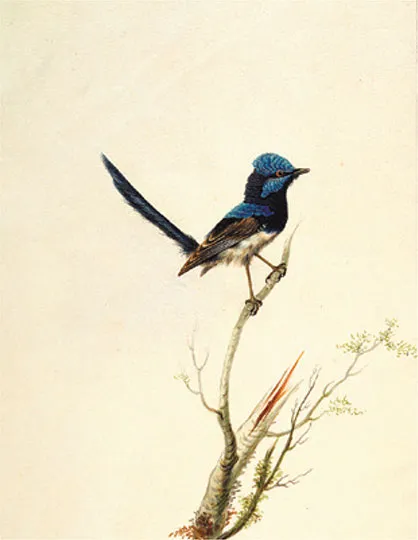
SARAH STONE Superb Fairy-wren Malurus cyaneus. Watercolour, 23 × 17.2 cm; c. 1790. Stone possibly prepared this watercolour for presentation, after completing a set of paintings of Australian birds, including two of the ‘Superb Warbler’, for First Fleet surgeon John White’s Journal of a Voyage to New South Wales (1790). She even managed to convey some of the species’ perkiness, despite drawing from a stuffed specimen. NATIONAL LIBRARY OF AUSTRALIA
To several administrators, convicts and colonisers, a sketchbook comprised a record of the resources of the new addition to the British Empire. To some it was also an escape from the hardships of an unfamiliar land and offered a temporary role in the making of a new colony. Ornithologically important illustrators such as John William Lewin, Thomas Watling and several unknown sketchers known collectively as the ‘Port Jackson Painter’ produced the first depictions of a multitude of species new to science. In several of these illustrations and accompanying annotations, a keen interest in natural history is evident. They are valuable records of the bird life of a continent at the time of European arrival. Nevertheless, much of the earliest illustration of Australia’s birds was by convicts commissioned to paint novelties and officers untrained in either art or science. Their efforts, while scientifically significant, are often amateurish and workmanlike. A further difficulty was faced back in Europe, where professional natural history illustrators struggled to produce realistic images from poorly stuff...
Table of contents
Cover
Front endpaper
Half Title
Title Page
Copyright
Contents
Preface
Acknowledgments
Cultural sensitivity warning
1. Introduction
2. New land, new birds: seamen and draughtsmen, 1600–1777
3. The escape of natural history study: convicts and officers, 1788–1800
4. Stirrings of an Australian sensibility: settlers and surveyors, 1800–1840
5. Through distant eyes: natural history artists in Europe, 1770–1840
6. A synergy of art and science: John and Elizabeth Gould and the Australia-based artist-cataloguers, 1840–1900
7. Family affairs: natural history artists in Europe, 1840–1940
8. Art and science estranged: inertia and an Australian field guide, 1900–1960
9. Art and science regroup: bird-lovers and conservationists in Australia, 1960–2000
10. Illustration for field identification: field guides and handbooks, 1920–2020
11. Art in the Anthropocene: Australian artists, 2000–2020
12. The contemporary artists
References
Alphabetical list of artists represented
Index
Back endpaper
Back cover
Trusted by 375,005 students
Access to over 1.5 million titles for a fair monthly price.
Study more efficiently using our study tools.
Frequently asked questions
Yes, you can cancel anytime from the Subscription tab in your account settings on the Perlego website. Your subscription will stay active until the end of your current billing period. Learn how to cancel your subscription
No, books cannot be downloaded as external files, such as PDFs, for use outside of Perlego. However, you can download books within the Perlego app for offline reading on mobile or tablet. Learn how to download books offline
Perlego offers two plans: Essential and Complete
Essential is ideal for learners and professionals who enjoy exploring a wide range of subjects. Access the Essential Library with 800,000+ trusted titles and best-sellers across business, personal growth, and the humanities. Includes unlimited reading time and Standard Read Aloud voice.
Complete: Perfect for advanced learners and researchers needing full, unrestricted access. Unlock 1.5M+ books across hundreds of subjects, including academic and specialized titles. The Complete Plan also includes advanced features like Premium Read Aloud and Research Assistant.
Both plans are available with monthly, semester, or annual billing cycles.
We are an online textbook subscription service, where you can get access to an entire online library for less than the price of a single book per month. With over 1.5 million books across 990+ topics, we’ve got you covered! Learn about our mission
Look out for the read-aloud symbol on your next book to see if you can listen to it. The read-aloud tool reads text aloud for you, highlighting the text as it is being read. You can pause it, speed it up and slow it down. Learn more about Read Aloud
Yes! You can use the Perlego app on both iOS and Android devices to read anytime, anywhere — even offline. Perfect for commutes or when you’re on the go. Please note we cannot support devices running on iOS 13 and Android 7 or earlier. Learn more about using the app
Yes, you can access Feather and Brush by Penny Olsen in PDF and/or ePUB format, as well as other popular books in Biological Sciences & Hospitality, Travel & Tourism Industry. We have over 1.5 million books available in our catalogue for you to explore.