- 340 pages
- English
- ePUB (mobile friendly)
- Available on iOS & Android
eBook - ePub
Trusted by 375,005 students
Access to over 1.5 million titles for a fair monthly price.
Study more efficiently using our study tools.
Information
Subtopic
Film & Video1. Prologue to Pearl
Shortly after noon on 17 July 1943, I set out for the West Side Theater; it was a thirty-minute walk from the wrong side of the tracks, where I lived in a Central European enclave in Scranton, Pennsylvania, to the other, not exactly the right but merely the less primitive side. Environment provides the first metaphor, and the railroad tracks were mine; they were the line of demarcation between the valley and the hill, the border beyond which lay civilization.
Beyond the tracks rose a hill, more arduous than steep, occasionally sinking into small depressions where the houses had settled with such finality that they resembled lopsided nests where birds stubbornly brooded. Although the hill was a trial to one who lived in the valley, scaling it was one of youth’s few triumphs over nature.
The hill curved at the top, then flattened into sidewalks that dipped periodically, breaking the rhythm that had been generated in the ascent. But what nature withholds, the will provides. I generated my own rhythm, the rhythm of anticipation. The windings and turnings culminated in Main Avenue, which like everything in West Scranton was not straight. It was an arc of contiguous buildings that folded into each other like accordion pleats, forming a natural declension as they sloped away from the top of the street where the West Side Theater stood.
Only the undiscriminating could love the West Side at first sight; for the fastidious, love came with the acceptance of the idea that the neighborhood movie theater is democracy in action, with darkness levelling all distinctions, including those between streetwalker and odalisque.
The West Side beckoned uninhibitedly to an interior where shoes picked up an adhesive of popcorn-studded gum, and nostrils contracted from the odor of disinfectant in the lavatory. In compensation for the theater’s other imperfections (which included an occasional rodent scampering down the main aisle), there was the security of belonging to a family where no authoritarian father was present to administer injustice, but only an indulgent earth mother whose smell betrayed her origins but whose womb was capacious enough for all who needed it. Yet the same maternalism that attracted the boy later repelled the adolescent, who forsook the West Side in favor of downtown theaters where an audience was not a family but a collection of anonymous individuals.
In 1943, however, I needed a family, and while I enjoyed an occasional trek to Central City, as downtown Scranton was called, where the theaters had red-carpeted foyers and lighting fixtures shaped like cigarette cases and compacts, my true home was the West Side. I had been a moviegoer for almost two years—an uncritical one but able to recite the names of the stars and record my impressions of the films I saw in a diary, writing in a scrawl as yet unsmoothed by the Palmer Method.
I knew where I had been on 7 December 1941: watching Sergeant York with my grandmother and noting later that both she and Margaret Wycherly, who played York’s mother, had eyes like dark marbles. I also knew that on 17 July 1943, the bill at the West Side was atypical. In fact, the theater’s entire weekend schedule was atypical: there was no change of program.
Generally, the Saturday and Sunday programs were different; sometimes Friday’s bill was not the same as Saturday’s. On the weekend of 9 July, for example, the West Side had offered three separate features: The Moon Is Down on Friday, I Walked with a Zombie on Saturday, and Crash Dive on Sunday. But this weekend, the same program was scheduled for all three days: Mr. Big (my first exposure to Donald O’Connor), and Prelude to War. This was not the usual Saturday matinee fare; Prelude to War, the main attraction, was shorter than the second feature. Besides, since we were well into the war, no prelude seemed necessary. Although I knew who Hitler was, I no longer joined in the boos and hisses when he appeared on the screen. By now, goose-stepping had become tiresome, and although I had seen Hitler’s Children two months earlier, the significance of German girls going off to breeding camps escaped me. I had gone to camp too, in the summer of 1942, and I hoped they would not be as miserable.
No one at the West Side on that July afternoon knew that Prelude to War had originally been intended for military personnel, not for civilian audiences; that after a White House screening, President Roosevelt had declared, “Every man, woman, and child must see this film;”1 that army chief of staff General George C. Marshall and Secretary of War Henry L. Stimson were as eager as President Roosevelt for the general distribution of Prelude to War; that commercial release had been delayed for six months because the Office of War Information’s Bureau of Motion Pictures found the film biased and superficial;2 and that the West Side was showing Prelude to War for the entire weekend because it was free.
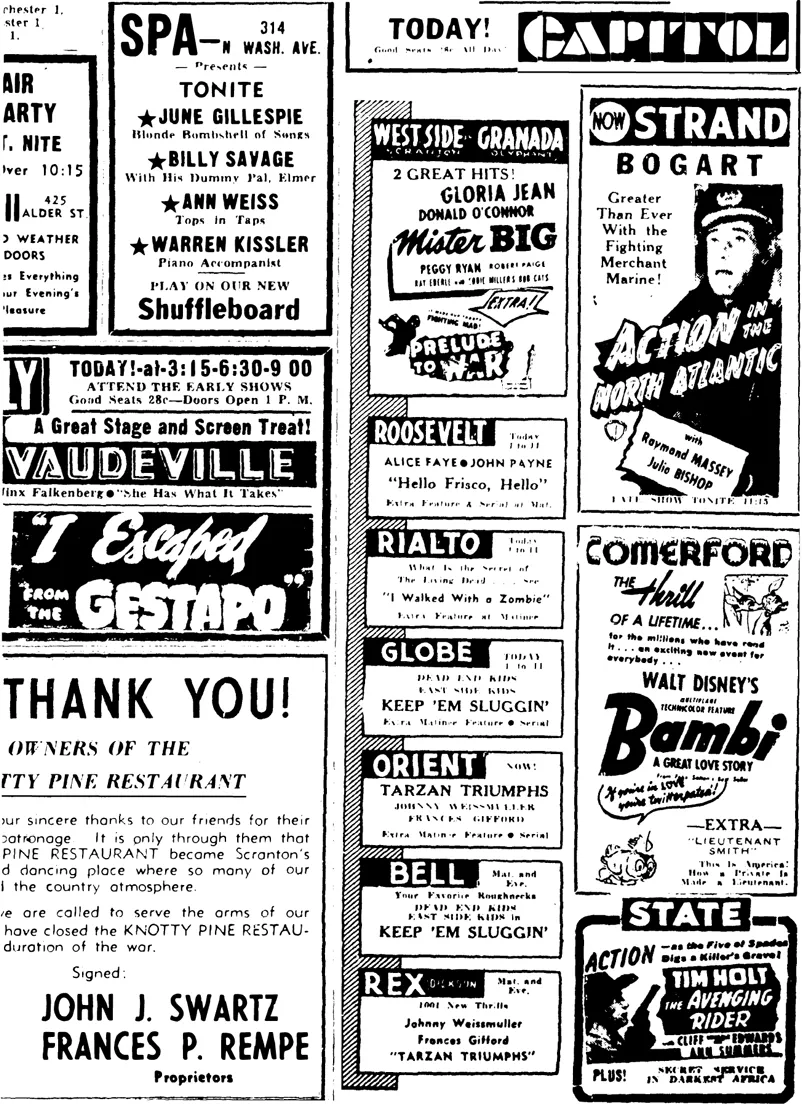
The movie page of The Scranton Tribune, 17 July 1943
Restless but not unruly, we endured what was really a fifty-five-minute newsreel in an era when the newsreel was part of the bill. But we would have groaned if we had heard that Winston Churchill wanted the entire Why We Fight series,3 of which Prelude to War is the first, shown throughout Britain; fortunately for British moviegoers, the Ministry of Information’s Film Division intervened.4
The 17 July 1943 entry in my movie diary consists of “ugh!” for Prelude to War and “kidstuff” for Mr. Big. Yet Prelude to War leaves its mark the way a summary lecture does in an uninspiring course; if the teacher can at least sum up the material or outline it on the blackboard, the student does not feel cheated.
Prelude has that quality. It claims to provide “factual information of events leading up to World War II”—a valid enough aim. The commercial showing of a government information film, one that received the 1942 Academy Award for Best Documentary, implies that such information had not been imparted; or at least had not been presented within a historical framework. While audiences had been witnessing Axis aggression on the screen for four years, they had witnessed it individually, not collectively; within the context of a particular film, not within the context of post-World War I history. Frank Capra, who directed Prelude to War and produced the others in the series, applied the methods of film to the lecture hall; by juxtaposing common features of Italian Fascism, Nazism, and Japanese imperialism, he eliminates the distinctions between black-shirts, brownshirts, and neo-samurai so that the enemy becomes one.
Similarly, the audience becomes a class called to attention by its teacher (narrator Walter Huston) who tosses out a question: “Why are we fighting?” Anyone at the West Side could have answered, but nobody got the chance. It is a rhetorical question, no sooner asked than answered—but answered in word and image. “Is it because of Pearl Harbor? Britain? France? China?” the voice inquires, listing a series of countries, each followed by an image (Britain by a shot of the Blitz, France by German troops marching down the Champs-Elysées). Voice-over and image—offscreen narration combined with music, superimpositions, animated maps, newsreel footage, and graphics—provide the “factual information.”
Some of the information, however, is interpretative. The opening and closing images are a parable in pictures: two globes, one white, the other black, revolving in space; the former representing the free world, the latter the enslaved. The narrator has little to show or say of the free world. It is supposedly pluralistic as quotations from the Koran, the Analects of Confucius, the New Testament, and the Ten Commandments attest, although “It Came upon a Midnight Clear” on the soundtrack implies that this pluralistic world is basically Christian.
In fact, the whole film seems Christian, which may be due to Frank Capra. Capra’s Meet John Doe (1941) features a populist Christ figure, and his most representative film, It’s a Wonderful Life (1946), extols personal sacrifice as humanity’s way of imitating Christ. The emphasis on Christianity is also an attempt to convince audiences that the Third Reich is not only anti-Semitic but also anti-Christian. Thus, a shot of a ruined synagogue is followed by several shots of desecrated churches; and for those still unconvinced, the words of the Nazi party’s official philosopher, Alfred Rosenberg, fill the screen, predicting the demise of Catholicism and Protestantism. With the Fuhrer as God, religion is superfluous.
Since Hitler’s rise would be chronicled in the second of the Why We Fight films, Prelude focuses on Mussolini and the New Order in southeast Asia. After tracing Italian Fascism to the disaffection, poverty, and inflation that followed the First World War, Prelude abandons objectivity for a parody of .Mussolini. But Mussolini himself is a parody, so the sight of Il Duce pounding his chest with simian vaunting needs no commentary, certainly not Capra’s comparison between fascist theatrics and musical comedy.
Just when Capra seems to be settling for the obvious, he comes up with a surprise. When the chronology reaches 1935 and Italy’s invasion of Ethiopia, he abruptly cuts to Japan; he will return to Italy when a related act of hostility can provide the right transition. But first he skips back a few years—to 1931, to 18 September 1931, to be precise: a date the narrator insists we memorize, noting it was then, not on 7 December 1941, that World War II really started. The date marks Japan’s invasion of Manchuria; the occasion, a pretext (a rigged railroad explosion). Capra has his transition: Mussolini also invaded Ethiopia on a pretext (a dispute over an oasis on the border of Ethiopia and the Italian Somaliland). Now Capra can cut back to Italy; and since Germany has to be worked into the finale, he combines the three Axis powers into a triptych, showing that it was Japan’s quest for raw materials, Mussolini’s attempt to restore to Italy its ancient imperial status, and Hitler’s cry for Lebensraum (“living space”) that plunged the world into war for a second time.
The roots of belligerence have been laid bare; all that remains is to show they belong to the same tree. In a three-shot, Hitler, Mussolini, and Hirohito appear together as the narrator warns, “If you see them, don’t hesitate.” No one thought to ask, “To do what?” Everyone knew.
While Hitler, Mussolini, and Hirohito were not strange bedfellows, they were not triplets, either. Capra makes their lack of individuality seem ludicrous; but that is his point. Sameness is a perennial source of humor, as Pascal has noted. Two faces that are alike will not inspire laughter when they are seen separately; yet together they will. Their juxtaposition—and this is particularly true in the case of comedies involving twins—illustrates the chief source of laughter: the incongruous, the discrepancy between what should be and what is. Human beings reproduce their kind; they do not duplicate themselves. Only machines duplicate. It is the confusion of human with machine, of the original with the copy, that makes mistaken identity and duplication such comic staples. For example, few moments in musical comedy are as amusing, or as devastating, as the party in Frank Loesser’s How to Succeed in Business without Really Trying (1961) at which everyone arrives wearing the same “Paris original.”
What is ludicrous is also vulnerable, and while portraying the Axis powers as an unholy trinity does not make them any less terrifying, it does make them seem more like a temporary menace than a permanent threat. Like the distorted figures that people our dreams and vanish at daybreak, the Axis too will depart when the long night is over.
Yet even before the night had ended, Prelude to War found a place on the grid of my memory. Although I must have been as disappointed as anyone else at not getting a real double feature, and probably stifled a yawn as I went blinking into the mellow brightness of late afternoon, I never forgot two points the narrator had made because they were made with such pedantic insistence: 18 September 1931 as the “real” date of World War II, and the Tanaka Memorial (Plan) as Japan’s blueprint for conquest. A few years later, I saw Blood on the Sun (1945), which dealt with a newspaperman’s attempt to uncover the Tanaka Plan. The mention of the plan produced something akin to the charm of recognition; my mind had made its first cross-reference. It was not until much later—in college, in fact—that I learned the truth about the Tanaka Plan: it was spurious. In 1929, however, despite Japan’s denial of its authenticity, it was regarded in the United States as the modus operandi of the New Order, beginning with the seizure of Manchuria and China and proceeding to the conquest of the Pacific.
And so the invasion of Manchuria becomes the result of a plan that probably never existed; and a date, 18 September 1931, enters the sacred chronology. Traditional dates are like received ideas: they are transmitted from generation to generation as part of an accepted chronology. Because they reduce an event to a mnemonic, they are a pedagogical blessing; but they also represent knowledge at its most skeletal. Since they are verifiable, they are not questioned; since they are not questioned, they foster imperfect learning by creating the impression that the past can be controlled if its chronology is mastered.
The chronology of World War II is not W...
Table of contents
- Cover
- Half Title
- Title Page
- Copyright
- Contents
- Dedication
- Preface to the Updated and Expanded Edition
- Introduction
- Preface
- Chapter 1. Prologue to Pearl
- Chapter 2. The War that Dared Not Speak Its Name
- Chapter 3. Hollywood as Premature Antifascist
- Chapter 4. Hollywood as Neutral Interventionist
- Chapter 5. Hollywood Mobilizes
- Chapter 6. Plotting the War
- Chapter 7. The People’s War
- Chapter 8. The Masters of the Race
- Chapter 9. California Comrades
- Chapter 10. Japs on Their Minds
- Chapter 11. Remembering Pearl Harbor
- Afterword to the 1996 edition
- Notes
- Bibliographical Essay
- Film Index
- Subject Index
Frequently asked questions
Yes, you can cancel anytime from the Subscription tab in your account settings on the Perlego website. Your subscription will stay active until the end of your current billing period. Learn how to cancel your subscription
No, books cannot be downloaded as external files, such as PDFs, for use outside of Perlego. However, you can download books within the Perlego app for offline reading on mobile or tablet. Learn how to download books offline
Perlego offers two plans: Essential and Complete
- Essential is ideal for learners and professionals who enjoy exploring a wide range of subjects. Access the Essential Library with 800,000+ trusted titles and best-sellers across business, personal growth, and the humanities. Includes unlimited reading time and Standard Read Aloud voice.
- Complete: Perfect for advanced learners and researchers needing full, unrestricted access. Unlock 1.5M+ books across hundreds of subjects, including academic and specialized titles. The Complete Plan also includes advanced features like Premium Read Aloud and Research Assistant.
We are an online textbook subscription service, where you can get access to an entire online library for less than the price of a single book per month. With over 1.5 million books across 990+ topics, we’ve got you covered! Learn about our mission
Look out for the read-aloud symbol on your next book to see if you can listen to it. The read-aloud tool reads text aloud for you, highlighting the text as it is being read. You can pause it, speed it up and slow it down. Learn more about Read Aloud
Yes! You can use the Perlego app on both iOS and Android devices to read anytime, anywhere — even offline. Perfect for commutes or when you’re on the go.
Please note we cannot support devices running on iOS 13 and Android 7 or earlier. Learn more about using the app
Please note we cannot support devices running on iOS 13 and Android 7 or earlier. Learn more about using the app
Yes, you can access The Star-Spangled Screen by Bernard F. Dick in PDF and/or ePUB format, as well as other popular books in Media & Performing Arts & Film & Video. We have over 1.5 million books available in our catalogue for you to explore.