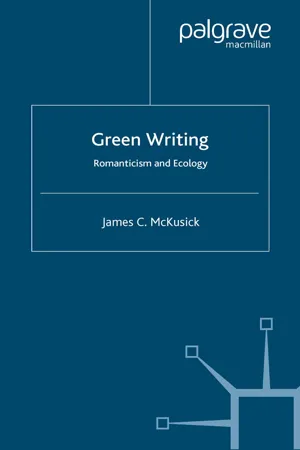
This book describes the emergence of ecological understanding among the English Romantic poets, arguing that this new holistic paradigm offered a conceptual and ideological basis for American environmentalism. Coleridge, Wordsworth, Blake, John Clare, and Mary Shelley all contributed to the fundamental ideas and core values of the modern environmental movement; their vital influence was openly acknowledged by Emerson, Thoreau, John Muir, and Mary Austin. By revealing hitherto unsuspected links between English and American nature writers, this book elucidates the Romantic origins of American environmentalism.
This chapter seeks to assess the significance of ecological thought in Coleridge’s intellectual development, and to examine the relevance of this way of thinking to our understanding of his poetry and prose. The main purpose of such an approach to Coleridge will be to elucidate, and perhaps to defamiliarize, the ways in which crucial aspects of his poetic language emerge from his perceptual and affective engagement with the local environment. An ecological reading of Coleridge will enable certain aspects of his conception of poetic form and his actual poetic practice to be understood more adequately than previous critical perspectives have allowed. In particular, the synergistic relationship between an individual organism and its habitat, which was first coming to be understood in its full complexity by late-eighteenth-century science, offers a fresh and suggestive model for analyzing the role of organicism in Coleridge’s poetic thought.
The Economy of Nature
The youngest of ten children, Samuel Taylor Coleridge was born in 1772 in the rural village of Ottery St. Mary in Devonshire. His father died in 1781, leaving the nine-year-old Samuel with limited means of support. He was sent to London and enrolled as a charity boy at Christ’s Hospital, a preparatory school of some intellectual repute, but a cold and inhospitable place for the young and impressionable orphan. Coleridge’s extraordinary intellectual talents were soon noticed by his teachers, who promoted him to the elite class of “Grecians” destined for the university. Coleridge’s mathematics teacher was William Wales, a professional astronomer on Captain James Cook’s second voyage, who told his students fascinating tales of his exploits in the Antarctic Ocean, where he encountered icebergs, albatrosses, and strange luminous phenomena. In 1791-94, Coleridge attended Cambridge University, where he became an academic prodigy, but he left without taking a degree. Together with Robert Southey, Coleridge devised a utopian (and ultimately impractical) scheme called Pantisocracy, which aspired to create an ideal agrarian community on the banks of the Susquehanna River in Pennsylvania. Since only married couples were expected to embark on the Pantisocratic adventure, Coleridge soon found himself engaged to Sarah Fricker, the sister of Southey’s fiancée. Married in 1795, the couple moved into a cottage at Nether Stowey, a rural village fifty miles southwest of Bristol.
Coleridge’s residence at Nether Stowey was one of his happiest and most productive periods, as he embarked upon an intensive collaboration with William Wordsworth. In July 1797 Wordsworth and his sister Dorothy moved into Alfoxden House, just three miles away from Coleridge’s cottage. Coleridge spent much of his time in their company, often walking out in stormy weather to discuss their literary projects. Among these was a collaborative volume of poems, Lyrical Ballads, published in September 1798. Lyrical Ballads marks a bold new departure in English verse, heralding the advent of Romanticism as a literary movement. Some of its most innovative features are the revival of ballad stanza, reliance upon the language of everyday life, and extensive use of natural imagery drawn from direct personal observation. In their composition of Lyrical Ballads, Wordsworth and Coleridge shared a common perception of the natural world as a dynamic ecosystem and a passionate commitment to the preservation of wild creatures and scenic areas.
In his Preface to Lyrical Ballads, published in the second edition of 1800, Wordsworth justifies his preference for the language of “low and rustic life … because in that condition the passions of men are incorporated with the beautiful and permanent forms of nature.” Wordsworth’s advocacy of simple vernacular diction is predicated on his view that human passion incorporates the forms of nature. His metaphor of incorporation, or embodiment, is essentially ecological since it suggests that all language, and therefore all human consciousness, is affected by the “forms of nature” that surround it. The natural world is a home (ο
κος), a birthplace and vital habitat for language, feeling, and thought. Although Coleridge did not fully accept Wordsworth’s theory of poetic language, he certainly shared the view that linguistic form must emerge from a distinctly local set of conditions; this is the main premise of his poetic style in the Conversation Poems, and it is explicitly developed in his early informal prose. In a notebook passage of 1799, written shortly after his return from Germany, Coleridge affirms his conviction that the naming practices of the Lake District are related to the inhabitants’ sense of political independence and their proximity to wild natural phenomena: “In the North every Brook, every Crag, almost every Field has a name—a proof of greater Independence & a society more approaching in their Laws & Habits to Nature.”1 Like Wordsworth, Coleridge was fascinated by the naming of places, and he often compiled lists of local place-names during his wanderings in the Lake District.2 Coleridge regarded this aspect of language as a key instance in which words are generated by complex interaction between the features of the landscape and the local residents. Language, most evidently in the case of place-names, is the result of an ongoing conversation between the land and the people who dwell upon it.
In the Biographia Literaria (1817), Coleridge’s insight into the nature of language is stated in terms of organicism, an aesthetic doctrine that owes something in the detail of its formulation to the eighteenth-century scientific concept of the organism. More than Wordsworth, Coleridge was attuned to the scientific controversies of his era, and by reading such works as Erasmus Darwin’s didactic poem, The Botanic Garden (1791), and his medical treatise, Zoonomia; or, the Laws of Organic Life (1794-96), Coleridge became steeped in the contemporary conception of the organism as an autonomous, cyclical, and self-regulating entity.3 This organic metaphor is apparent in his poetry as early as 1795, when it provides a conceptual foundation for the speculative pantheism of “The Eolian Harp”:
And what if all of animated nature
Be but organic Harps diversely fram’d,
That tremble into thought, as o’er them sweeps
Plastic and vast, one intellectual breeze,
At once the Soul of each, and God of all? (lines 44-48)
The term “organic” is used here with scientific precision; this passage asserts that all living creatures, no matter how “diversely fram’d,” must possess an internal process of self-regulation. Coleridge’s emphasis falls not on the autonomy of the organism, but on its vital response to an external stimulus, represented here as an “intellectual breeze” that sweeps over it. Although this passage is manifestly about the nature of sentient beings, it implicitly refers to the making of poetry and the ontology of the poetic artifact. If poems are organisms, then they should not merely be tightly woven structures, but they should also exist in harmony with their surrounding environment (metaphorically understood as a literary or discursive context). Such a conception of the poem as an organism residing in a local habitat is implicit in Coleridge’s poetic practice in the Lyrical Ballads, and it represents the culmination of an eighteenth-century tradition of speculation about the nature of poetic form. Before exploring the aesthetic implications of this concept any further, however, it seems appropriate to investigate its scientific origins.
During the eighteenth century, a holistic conception of the natural world was gradually articulated as the result of a growing scientific understanding of the dynamic operation of closed systems, ranging from the individual organism to a more global scale. The biological sciences made particularly striking advances in their understanding of how animals distribute and regulate their energy resources. The anatomist William Harvey (1578-1657) demonstrated in 1628 that the heart works as a pump to circulate blood in a closed cycle.4 This unexpected discovery led to further striking developments in the field of physiology during the eighteenth century, and it held enormous implications for the conception of living systems generally, since it demonstrated that all higher organisms, including humans, are permeated by a cyclical process that distributes nutrients throughout all parts of their bodies. The Dutch anatomist Anton Van Leeuwenhoek (1632-1723) continued the investigation of circulatory processes at the microscopic level; he was the first to describe red blood cells, and he extended the scientific knowledge of capillary function. Leeuwenhoek is perhaps best known for his discovery of “animalcules,” microscopic organisms whose ubiquity in such common substances as rainwater suggested the presence of a teeming microcosm that lurked just beyond the normal boundaries of perception. Luminescent “animalcules” were observed in seawater during Captain Cook’s first voyage, lending the ocean an eerie glow that later contributed to its luster in “The Rime of the Ancient Mariner.”
On a larger scale, the Swedish botanist Linnaeus (1707-78) envisioned the entire terrestrial globe as an interlocking web of cyclical processes, using the hydrological cycle of evaporation, condensation, and precipitation as a paradigmatic instance.5 In an influential essay entitled “The Oeconomy of Nature” (1751), Isaac Biberg (a disciple of Linnaeus) described how the hydrological cycle distributes water everywhere on Earth, sustaining all forms of life; he also described how predators and prey coexist in a hierarchical food chain that serves to maintain the population balance of various species. Biberg’s essay provides a classic formulation of the prevailing eighteenth-century scientific conception of the world as a harmonious, self-regulating system: “By the Oeconomy of nature we understand the all-wise disposition of the Creator in relation to natural things, by which they are fitted to produce general ends, and reciprocal uses.”6 All natural things, according to this view, exist in reciprocal relation to other things, resulting in a complex order of cyclical processes that was termed the “economy of nature,” and that bears some functional resemblance to our modern conception of a global ecosystem.
The chemist Joseph Priestley (1733-1804), in announcing his accidental discovery of photosynthesis in 1772, likewise employed a cyclical model, describing the respiration of plants as a “restorative” process that uses the energy of light to cleanse the “vitiated air” produced by animals and humans.7 Exploring the global implications of this hypothesis, Sir John Pringle (the President of the Royal Society) stated in 1774 that the vegetation of “remote and unpeopled regions” is essential to cleanse the polluted air produced by cities. In Pringle’s view, “good air” and “bad air” are circulated by wind currents in a process analogous to the hydrological cycle.8 Erasmus Darwin, in Part 1 of The Botanic Garden, entitled “The Economy of Vegetation” (1791), further described the vital environmental role of green plants in producing oxygen and sugar by means of photosynthesis; he also proposed a theory of evolution that in some respects fore-shadows that of his grandson, Charles Darwin, especially in the assertion that competition among individuals can lead to beneficial changes in the species.
From Linnaeus through Erasmus Darwin, an economic metaphor is employed to suggest that these cyclical processes in the natural world promote the efficient distribution and consumption of resources in much the same way that Adam Smith’s Wealth of Nations (1776) had described the circulation of goods in a free-market economy. The “Economy of Nature,” according to eighteenth-century science, operates very much like a capitalist economy, with the assurance that some “hidden hand” will optimize the results of individual action. Human intervention in the natural world is not generally seen as a controversial issue by these scientists, since human activities on a local scale, even if apparently destructive, are regarded as tending toward the improvement of the landscape and the development of its natural resources.
The new holistic sciences of the eighteenth century were thus quite limited in their understanding of the possible deleterious effects of human encroachment upon natural systems. There was also a significant gap, especially in the biological sciences, between macrocosm and microcosm. Despite the rapidly growing understanding of the inner dynamics of organisms and the large-scale cyclical processes of the terrestrial environment, there was very little effort to integrate these theoretical perspectives by investigating how particular plants and animals relate to each other within a regional context. In the field of taxonomy, there was a vast increase in the number of species described and catalogued, but only limited attempts to describe the range and habitat of each species, or to observe its behavior and life cycle as a member of a biological community. This type of detailed local investigation, forming a link between the individual organism and its role in the global “Economy of Nature,” was pioneered by Gilbert White, whose Natural History and Antiquities of Selborne (as previously discussed) was a landmark in the development of ecological thought.9 White’s scrupulous attention to the living organism in its local habitat marks a significant step beyond the narrow-minded specimen collecting and cataloguing that typifies much eighteenth-century natural history.10
Some of the most essential insights of ecological thought—the adaptation of species to their habitats, the interrelatedness of all life forms, and the potentially catastrophic effects of human intervention in natural systems—are first explicitly stated in the scientific writings of the eighteenth century. As Ian Wylie has demonstrated in Young Coleridge and the Philosophers of Nature (1989), Coleridge was well-versed in the scientific writings of this period and had fully internalized the broader implications of the new discoveries in chemistry and biology. In particular, Coleridge was fascinated by the new cyclical understanding of natural processes, and (as John Livingston Lowes first pointed out) he planned to use this scientific model as the basis for a series of hymns to the elements.11
For Coleridge, this scientific model also had social and political implications; his Pantisocracy scheme was evidently intended to create an “Economy of Nature” on the banks of the Susquehanna River. Coleridge’s radical democratic politics received welcome support from his view of the na...
Table of contents
Cover
Title Page
Copyright
Contents
Permissions
Foreword
Preface to the Paperback Edition
Acknowledgments
Introduction
Chapter 1: Coleridge and the Economy of Nature
Chapter 2: Wordsworth’s Home at Grasmere
Chapter 3: The Ecological Vision of John Clare
Chapter 4: The End of Nature: Environmental Apocalypse in William Blake and Mary Shelley
Chapter 5: Ralph Waldo Emerson: Writing Nature
Chapter 6: Henry David Thoreau: Life in the Woods
Chapter 7: John Muir: A Wind-Storm in the Forests
Chapter 8: Mary Austin: The Land of Little Rain
Conclusion: The Journey Onward
Notes
Index
Trusted by 375,005 students
Access to over 1.5 million titles for a fair monthly price.
Study more efficiently using our study tools.
Frequently asked questions
Yes, you can cancel anytime from the Subscription tab in your account settings on the Perlego website. Your subscription will stay active until the end of your current billing period. Learn how to cancel your subscription
No, books cannot be downloaded as external files, such as PDFs, for use outside of Perlego. However, you can download books within the Perlego app for offline reading on mobile or tablet. Learn how to download books offline
Perlego offers two plans: Essential and Complete
Essential is ideal for learners and professionals who enjoy exploring a wide range of subjects. Access the Essential Library with 800,000+ trusted titles and best-sellers across business, personal growth, and the humanities. Includes unlimited reading time and Standard Read Aloud voice.
Complete: Perfect for advanced learners and researchers needing full, unrestricted access. Unlock 1.5M+ books across hundreds of subjects, including academic and specialized titles. The Complete Plan also includes advanced features like Premium Read Aloud and Research Assistant.
Both plans are available with monthly, semester, or annual billing cycles.
We are an online textbook subscription service, where you can get access to an entire online library for less than the price of a single book per month. With over 1.5 million books across 990+ topics, we’ve got you covered! Learn about our mission
Look out for the read-aloud symbol on your next book to see if you can listen to it. The read-aloud tool reads text aloud for you, highlighting the text as it is being read. You can pause it, speed it up and slow it down. Learn more about Read Aloud
Yes! You can use the Perlego app on both iOS and Android devices to read anytime, anywhere — even offline. Perfect for commutes or when you’re on the go. Please note we cannot support devices running on iOS 13 and Android 7 or earlier. Learn more about using the app
Yes, you can access Green Writing by James McKusick in PDF and/or ePUB format, as well as other popular books in Literature & Literary Criticism in Poetry. We have over 1.5 million books available in our catalogue for you to explore.