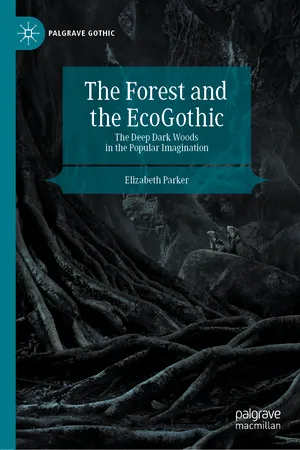
This book offers the first full length study on the pervasive archetype of The Gothic Forest in Western culture. The idea of the forest as deep, dark, and dangerous has an extensive history and continues to resonate throughout contemporary popular culture. The Forest and the EcoGothic examines both why we fear the forest and how exactly these fears manifest in our stories. It draws on and furthers the nascent field of the ecoGothic, which seeks to explore the intersections between ecocriticism and Gothic studies. In the age of the Anthropocene, this work importantly interrogates our relationship to and understandings of the more-than-human world. This work introduces the trope of the Gothic forest, as well as important critical contexts for its discussion, and examines the three main ways in which this trope manifests: as a living, animated threat; as a traditional habitat for monsters; and as a dangerous site for human settlement. This book will appeal to students and scholars with interests in horror and the Gothic, ecohorror and the ecoGothic, environmentalism, ecocriticism, and popular culture more broadly. The accessibility of the subject of 'The Deep Dark Woods', coupled with increasingly mainstream interests in interactions between humanity and nature, means this work will also be of keen interest to the general public.
eBook - ePub
The Forest and the EcoGothic
The Deep Dark Woods in the Popular Imagination
- English
- ePUB (mobile friendly)
- Available on iOS & Android
eBook - ePub
About this book
Information
Print ISBN
9783030351533
Subtopic
Film & Video© The Author(s) 2020
E. ParkerThe Forest and the EcoGothicPalgrave Gothichttps://doi.org/10.1007/978-3-030-35154-0_11. Introduction: Into the Woods
Elizabeth Parker1
(1)
St Mary’s University, Twickenham, London, UK
When we imagine the forest, we tend towards extremes. The landscape is commonly read as a binary space—as either ‘good’ or ‘bad’. When it is ‘good’, it is a remedial setting of wonder and enchantment; when it is ‘bad’, it is a dangerous and terrifying wilderness. It is with the forest’s fearsome associations that this book is concerned.
The Gothic forest—that is, the frightening and foreboding forest—is an archetypal site of dread in the collective human imagination. It is, according to influential human geographer Yi-fu Tuan, one of our classic ‘landscapes of fear’ and it is undoubtedly a well-established and instantly recognisable trope across our various fictions.1 The Deep Dark Woods are to be found throughout the centuries and in innumerable genres. This eerie landscape features, significantly, right from what is arguably the very first example of literature, The Epic of Gilgamesh (c.2100BC). It memorably opens The Divine Comedy (1320) and it dominates many of our most infamous fairy tales. We find it in J. R. R. Tolkien’s sinister manifestations of Mirkwood2 and in the sublime forests of the Gothic canon, as seen in titles such as The Mysteries of Udolpho (1794) and Dracula (1897). More recently, we find the terrifying arboreal manifested in everything from The Blair Witch Project (1999) to the Forbidden Forest of the Harry Potter series (1997–2007). This setting resounds throughout our stories. Yet, The Forest and the EcoGothic—which examines the forest in the context of the ecocritical Gothic—will be the first work devoted entirely to our more ominous depictions of the forest as a site of trial, trepidation, and terror—despite this setting’s continual, if not increasing pervasion.
Nowadays, for the majority of humankind in the West, there is little practical reason to be afraid of the woods. For most of us, this environment does not feature in our everyday lives and it does not present a threat to our existence. Most of its predators that have been seen to endanger humans, such as wolves and bears, are now threatened with extinction—and it is much more common for humans to die in towns and in cities, than in the midst of the woods. In this light, then, the woodland setting is just not that dangerous. And yet, as Sara Maitland proclaims, ‘inside most of us post-enlightenment and would-be rational adults there is a child terrified by the wild wood’.3 Her wording here is interesting: the implication is that the modern adult who fears the forest does so despite the fact that he or she is ‘post-enlightenment’ and ‘would-be rational’. It is suggested, therefore, that such fears are today not only unfounded, but regressive and irrational. As Stephen Sondheim’s version of Little Red Riding Hood informs us in his wonderful musical Into the Woods (1986): ‘the woods are just trees’ and ‘the trees are just wood’ and no one ‘should’ have any cause for anxiety.4 Yet, we all know that Little Red, made up though she is, has every reason to fear the forest and though we may like to think ourselves beyond fairy tales, there is much evidence to suggest that we continue, indeed, to be ‘terrified by the wild wood’.
This raises the question not only of why we evidently still fear the forest, but of what exactly it is that we fear, when we fear this environment. The Deep Dark Forest is exactly that—deep and dark—and the exact source of its terrors is often mysterious, shadowy, and just out of sight. In Arthur Machen’s words: the forest contains some ‘awful secret’.5 It is fitting, then, that there is a common, if largely undiscussed tendency to talk about the Gothic forest in decidedly vague terms. Indeed, referring portentously to the so-called ‘horror’ of the woods, but without actually stating or defining what in fact this horror is, is standard practice in fiction that exploits our fears of the forest. We repeatedly find a sense of imprecision and secrecy in the descriptive language used. For example, in Evil Dead (1981) we are told ‘there’s something in the woods’; in Hotel (2004) it is said that ‘something terrible is happening out there’; in Twin Peaks (1990–1991) we are warned that ‘there’s a sort of evil in the woods’; and in Algernon Blackwood’s ‘The Man Whom the Trees Loved’ (1912) it is aptly announced that ‘this tree and forest business is so vague and horrible!’ Time and again we are given stern warnings against entering this space—as with the sign to the Haunted Forest in The Wizard of Oz (1938), which reads ‘I’d turn back if I were you’ and in the unequivocal admonition ‘don’t ever, ever go into the woods’ in the horror film The Woods (2006)—but these are usually accompanied with very little, if any explanation. As summarised by one character in the 2013 film Jug Face: ‘there’s some weird shit going on in the woods’, which—if we know what’s good for us—‘we don’t want anything to do with’. There is the presiding sense that the forest’s ‘awful secret’, whatever it may be, is something that we should not learn.6
This book sets out deliberately to shed some light on the Deep Dark Woods. It seeks to interrogate the so-called ‘awful secret’ of this setting and to understand the patterns and ways in which the trope of the Gothic forest works in its manipulations of our fears. This book is important—and important now—for a number of reasons. In a broader sense, The Forest and the EcoGothic significantly examines our representations of and relationship to nonhuman Nature. It does so in a time when understanding—and questioning—this relationship is more vital than ever before. We now live in an age that has been dubbed by many ‘the Anthropocene’: a time when the effects of humankind on the Earth are recognised as so wide-reaching and extreme as to have geological impact.7 Though it is not officially recognised as our new geological age, the term ‘Anthropocene’, or at least the essential idea behind it, is increasingly common knowledge. As Matthew Hall writes: ‘Most people are aware that human beings are harming nature’.8 In this context, it is unsurprising that recent years have seen a flourishing of interest, evident in fictional and critical texts alike, in the more problematic and darker elements of our relationship with the natural world. This book serves as both a commentary on and an example of this interest. It holds that there is an extremely important, but often underestimated relationship between fiction and environmentalism: in line with Greg Garrard it contends that ‘environmental problems require analysis in cultural as well as scientific terms’9 and echoes the sentiments of Jonathan Bate, who highlights the ‘vital’ connections between contemporary green politics and the ‘language’ and ‘symbolism’ used in our fictional portrayals of Nature.10 It sees our stories about the environment—our ‘public dreams’, if you will—as ways of collectively working through what we think and feel about the nonhuman environment.11 Consequently, this book prioritises the considered analysis of the stories we tell about Nature—and specifically the stories we tell about the woods. One of the frequently cited effects of modern, enlightened civilisation is our alienation from the material natural world.12 This includes our disconnection from the forest specifically. Robert Pogue Harrison, in his seminal work Forests: The Shadow of Civilisation (1992), mourns the widespread loss of our connectio...
Table of contents
- Cover
- Front Matter
- 1. Introduction: Into the Woods
- 2. Theorising the Forest: Approaching a Dark Ecology
- 3. ‘What If It’s the Trees?’: The Living Forest
- 4. Where the Wild Things Are: Monsters in the Forest
- 5. ‘It Isn’t Right to Build so Close to the Woods’: Humans and the Forest
- 6. Conclusion: What Is ‘That Awful Secret of the Wood’?
- Back Matter
Trusted by 375,005 students
Access to over 1.5 million titles for a fair monthly price.
Study more efficiently using our study tools.
Frequently asked questions
Yes, you can cancel anytime from the Subscription tab in your account settings on the Perlego website. Your subscription will stay active until the end of your current billing period. Learn how to cancel your subscription
No, books cannot be downloaded as external files, such as PDFs, for use outside of Perlego. However, you can download books within the Perlego app for offline reading on mobile or tablet. Learn how to download books offline
Perlego offers two plans: Essential and Complete
- Essential is ideal for learners and professionals who enjoy exploring a wide range of subjects. Access the Essential Library with 800,000+ trusted titles and best-sellers across business, personal growth, and the humanities. Includes unlimited reading time and Standard Read Aloud voice.
- Complete: Perfect for advanced learners and researchers needing full, unrestricted access. Unlock 1.5M+ books across hundreds of subjects, including academic and specialized titles. The Complete Plan also includes advanced features like Premium Read Aloud and Research Assistant.
We are an online textbook subscription service, where you can get access to an entire online library for less than the price of a single book per month. With over 1.5 million books across 990+ topics, we’ve got you covered! Learn about our mission
Look out for the read-aloud symbol on your next book to see if you can listen to it. The read-aloud tool reads text aloud for you, highlighting the text as it is being read. You can pause it, speed it up and slow it down. Learn more about Read Aloud
Yes! You can use the Perlego app on both iOS and Android devices to read anytime, anywhere — even offline. Perfect for commutes or when you’re on the go.
Please note we cannot support devices running on iOS 13 and Android 7 or earlier. Learn more about using the app
Please note we cannot support devices running on iOS 13 and Android 7 or earlier. Learn more about using the app
Yes, you can access The Forest and the EcoGothic by Elizabeth Parker in PDF and/or ePUB format. We have over 1.5 million books available in our catalogue for you to explore.