This short, accessible book seeks to explore the future of work through the views and opinions of a range of expertise, encompassing economic, historical, technological, ethical and anthropological aspects of the debate. The transition to an automated society brings with it new challenges and a consideration for what has happened in the past; the editors of this book carefully steer the reader through future possibilities and policy outcomes, all the while recognising that whilst such a shift to a robotised society will be a gradual process, it is one that requires significant thought and consideration.
eBook - ePub
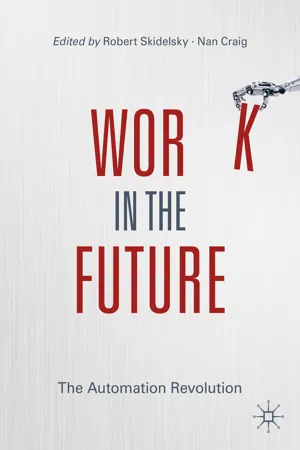
Work in the Future
The Automation Revolution
- English
- ePUB (mobile friendly)
- Available on iOS & Android
eBook - ePub
About this book
Information
© The Author(s) 2020
R. Skidelsky, N. Craig (eds.)Work in the Futurehttps://doi.org/10.1007/978-3-030-21134-9_11. Introduction
Robert Skidelsky1 and Nan Craig1
(1)
Centre for Global Studies, London, UK
Nan Craig (Corresponding author)
When we planned a symposium in February 2018 on the future of work, we divided the subject into eight areas. We hoped to cover more ground than is usual, and to look at how work has changed in the past as well as how it is changing now and in the future. Most of the contributions to this book came out of that symposium, and reflect their original beginnings as oral presentations. Other pieces were commissioned later in order to extend the thematic reach of the book even further.
When we talk about the future of work, too often the discussion is narrowly focused on automation, and the social or economic problems that are assumed to arise from it. What this collection of essays aims to do is to broaden that discussion. How has the character of work changed in the past, and what can that tell us about how it will change in the future? How have our attitudes to work shifted over time? How will increasing automation over the coming decades—of professional as well as routine or manual work—change our relationships with work and with each other? Finally, what kind of actions can we take in response to these changes?
The effect of automation on human work has been almost constantly in the headlines during the past few years—perhaps in part simply because slogans about ‘robots taking over’ make good copy. Whether reality lives up to the headlines is less certain. Technology destroys jobs, but in the past it has created new jobs to replace the ones it has destroyed. This could be the case in the future. In the past, it has not only created new jobs but reduced the hours of work per job. This could also repeat itself. On the other hand, there is the view that, whatever may have been true in the past, we have now reached a tipping point—or soon will—when the advent of intelligent machines is simply going to destroy existing jobs faster than it creates new jobs. If so, technological unemployment would turn from its relatively benign past process into a virulent involuntary one.
There are several issues worth discussing, keeping those two views in mind. First of all is history. What do the long run data of population growth, employment growth, hours of work, earnings per hour worked since the industrial revolution tell us? What do they actually show? Most people treat the Luddite fear of net job loss as a prediction that turned out wrong, but why they were wrong and how wrong were they? Given careful ceteris paribus conditions, the Luddites were correct, as indeed David Ricardo recognised in his essay ‘On Machinery’.
According to a recent McKinsey Global Institute report, 50% of time spent on human work activities in the global economy could, theoretically, be automated today, though the current trend suggests a maximum of 30% by 2030, depending on speed. However, estimates of jobs at risk tell one nothing about net job outcomes.
The most widely held view is that there will be net job losses, or technological employment, but these will be temporary or transitional. There is the old economists’ distinction between the short run and the long run; no one ever specifies how short the ‘short’ run is. Against that view that the job losses will only be transitional are more pessimistic views from people like Martin Ford and Larry Summers. They suggest that in fact job losses will be permanent unless something is done.
Another issue is where new jobs are to come from. Categories of human jobs widely expected to maintain themselves or expand in line with the contraction of others are creative jobs, jobs requiring exceptional manual dexterity, person to person services, notably healthcare, care work and so on. How many of these jobs will be created? Why should their number equal the total of jobs automated? For creative industries, a winner-takes-all projection is quite common. Top artists get top pay and ordinary ones get nothing, or almost nothing.
The next issue: the question of how much people will want to work, or need to work, depends not only on technology and the nature of future work, but on what we think about human wants and needs. Needs and wants are not identical, though they are treated as such by economists. We usually want what we need, but we by no means need all we want. The question of how much we will want to work in the future partly depends on a view we take about human nature and the drivers of consumption.
We began the symposium by looking into the past—in particular at the patterns of pre-modern work and how work has changed in the past few centuries. Pre-industrial work may have been arduous, but it was much more intermittent than modern work, since activity—certainly agriculture, but even fighting—was seasonal. What did work mean to people? The definition of work has narrowed in the twentieth century to paid employment, setting up a false dichotomy between work and leisure. Have we always distinguished between homo ludens and homo laborans? We have come to think of these as opposites, but it is not always so and may not be so in the future.
Richard Donkin stresses how for much of human history, work was inextricable from the rest of life—not only as a means of survival but also as an element of family or social life and as a pleasurable activity.
Richard Sennett looks to the craftsmanship of the past to show us how important the physical body is to mental labour , and how creativity of intellectual work is as reliant on physical processes as it is on mental effort. This belies the argument that automated systems can effectively replace human labour, and suggests that we should be cautious in adopting what appear to be labour-saving technologies which, by virtue of removing the physical element of intellectual work, undermine and hollow out skills.
Andrea Komlosy’s chapter charts the rise and fall of the gendered wage-earner/housewife model of work which took over from household economies during the industrial revolution, and how it spread from Western Europe, but failed to dominate in other areas of the globe. When neither men nor women want to or can afford to be purely ‘home-makers’ or ‘breadwinners’, how can work in the home and outside it be shared?
Having looked at some of the ways in which patterns of work have changed over time, we turn to changes in people’s attitudes to their work. As Studs Terkel put it in his oral history, Working, work is ‘about a search, too, for daily meaning as well as daily bread […] in short, for a sort of life rather than a Monday through Friday sort of dying’.
David A. Spencer explains how the attitudes of economists to work have influenced wider cultural narratives around this activity—in particular, the inability of classical and neoclassical economics to conceive of work as anything other than arduous and costly to the worker. Pierre-Michel Menger describes how positive and negative cultural attitudes to work can interact within one society—specifically, in France. Nan Craig traces the historical antecedents of our attitudes to work and suggests that we can broaden the definition of work again, and find ways to accommodate other kinds of work than waged jobs.
Next we directly address the technological developments that are giving rise to changes in working life. Both Carl Benedikt Frey and James Bessen are sceptical about the idea that advances in automation are likely to have either unequivocally positive or negative effects on working lives. Carl Benedikt Frey explains how attitudes to technological development and automation are likely to be affected by how that technology affects people’s working lives—and that the adoption of the technology itself will in return be mediated, in part, by those attitudes.
James Bessen describes the ways in which automation has changed jobs, and in what ways this is likely to continue or develop. He argues that specific jobs or categories of work rarely become obsolete in their entirety—rather, they evolve as technology becomes available to automate particular elements of the work. In deciding whether automation creates or destroys jobs, the decisive factor is demand rather than technology.
What are the advantages of technology? Often people say, ‘It is obvious that self-driving cars will reduce the numbers of road accidents. Automated diagnostic and treatment systems will reduce medical casualties and so on’. We know that argument, but will algorithmic trading increase the efficiency of financial markets, or render them more liable to crashes? So far, it seems the latter has been the case. We also need to scrutinise the more generalised idea that technology increases human welfare by increasing the affordability and thus availability of consumption goods. This invokes all kinds of questions about the relationship between consumption and happiness, and the damage done to the planet by the constant pursuit of material wealth.
Is technology determinative? Even technological utopians assume technological invasion takes place in a social and economic context, which determines what is invented, how quickly inventions are applied and so on. Historically, inventions did not necessarily become widely used; the history of technology, up until the early modern period, was patchy rather than progressive. Automata, for instance existed in the ancient world, but they were novelties for kings and did not prompt wider technological change.
Implicit in modern arguments is technological determinism. It underpins nearly everything currently being said about automation and we need to tease out its implicit assumptions. Is it true that technology is like a runaway train over which we have no control once it has left the station, and the only thing we can do is to adapt to its demands? This is certainly the implication of the ‘robots will take your job’ rhetoric.
In response to this, Thomas Tozer takes a theoretical view of whether artificial intelligence can truly replicate the abilities of humans. In contrast, Simon Colton argues that it is a mistake to compare human and machine intelligence, and that machines can be capable of intelligence and creativity without necessarily being conscious or having specifically human attributes.
In the next section, Daniel Susskin...
Table of contents
- Cover
- Front Matter
- 1. Introduction
- 2. The Future of Work
- Part I. Work in the Past
- Part II. Attitudes to Work
- Part III. Attitudes to Technology
- Part IV. Possibilities and Limitations for AI: What Can’t Machines Do?
- Part V. Work in the Digital Economy
- Part VI. AI, Work and Ethics
- Part VII. Policy
- Back Matter
Trusted by 375,005 students
Access to over 1.5 million titles for a fair monthly price.
Study more efficiently using our study tools.
Frequently asked questions
Yes, you can cancel anytime from the Subscription tab in your account settings on the Perlego website. Your subscription will stay active until the end of your current billing period. Learn how to cancel your subscription
No, books cannot be downloaded as external files, such as PDFs, for use outside of Perlego. However, you can download books within the Perlego app for offline reading on mobile or tablet. Learn how to download books offline
Perlego offers two plans: Essential and Complete
- Essential is ideal for learners and professionals who enjoy exploring a wide range of subjects. Access the Essential Library with 800,000+ trusted titles and best-sellers across business, personal growth, and the humanities. Includes unlimited reading time and Standard Read Aloud voice.
- Complete: Perfect for advanced learners and researchers needing full, unrestricted access. Unlock 1.5M+ books across hundreds of subjects, including academic and specialized titles. The Complete Plan also includes advanced features like Premium Read Aloud and Research Assistant.
We are an online textbook subscription service, where you can get access to an entire online library for less than the price of a single book per month. With over 1.5 million books across 990+ topics, we’ve got you covered! Learn about our mission
Look out for the read-aloud symbol on your next book to see if you can listen to it. The read-aloud tool reads text aloud for you, highlighting the text as it is being read. You can pause it, speed it up and slow it down. Learn more about Read Aloud
Yes! You can use the Perlego app on both iOS and Android devices to read anytime, anywhere — even offline. Perfect for commutes or when you’re on the go.
Please note we cannot support devices running on iOS 13 and Android 7 or earlier. Learn more about using the app
Please note we cannot support devices running on iOS 13 and Android 7 or earlier. Learn more about using the app
Yes, you can access Work in the Future by Robert Skidelsky, Nan Craig, Robert Skidelsky,Nan Craig in PDF and/or ePUB format, as well as other popular books in Economía & Gestión. We have over 1.5 million books available in our catalogue for you to explore.