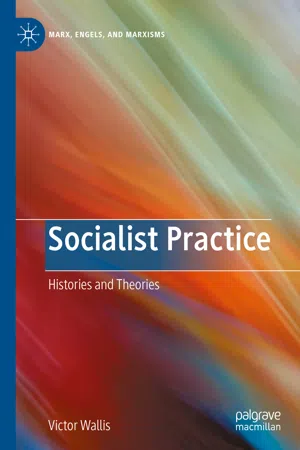
- English
- ePUB (mobile friendly)
- Available on iOS & Android
eBook - ePub
About this book
The level of popular discontent—in the United States as elsewhere—has shown a dramatic increase in recent years, but has yet to crystallize into a cohesive anti-capitalist political force. Socialist Practice aims to contribute to a popular movement for socialism. It does so by 1) revisiting, under present conditions, longstanding questions of Marxist theory and revolutionary history, and 2) illustrating the range of issues, activities, and forms of expression that can both inform and be informed by a Marxist approach. Essays spanning a range of national experiences address the crying need to generate a society-wide awakening, grounded in purposeful discussion among all those (the vast majority) whose interests are ill-served by continuation of the status quo.
Information
© The Author(s) 2020
V. WallisSocialist PracticeMarx, Engels, and Marxismshttps://doi.org/10.1007/978-3-030-35066-6_11. Introduction
Victor Wallis1
(1)
Liberal Arts Department, Berklee College of Music, Boston, MA, USA
Victor Wallis
The Present Moment and the New Discourse About Socialism
Historian Eric Hobsbawm titled his book on the twentieth century The Age of Extremes. For the twenty-first century, this would be an understatement. No rubric can convey the level of emergency in which our species now finds itself. We live, both now and into the future, under a threat of geological proportions.1 The magnitude of the danger is clearly seen—and acutely felt—by young people the world over. The discourse of the powers that be hovers far from the storm-center, mostly waging (especially in the United States) a relentless campaign to keep everyone’s eyes shut—if not to the reality of the eco-crisis, then at least to the idea that we might be able collectively to do something about it.
My own sense of the danger is longstanding but becomes more pressing with each passing year, even as capitalist politicians and corporate media squander precious time with their contrived emergencies, their self-indulgent jousting, and their endless flow of distractions.2 The longer this hegemonic denial continues—and, along with it, the aggressions of powerfully armed governments and their vigilante shock-troops against largely defenseless populations—the more urgent becomes the imperative to sweep from power all those who keep it up. The scope of the required changes has all along been of revolutionary proportions, but beyond this, the amount of time we now have for securing a future that is to any extent livable—for the majority of our species—has become desperately short.
The revolutionary implications of this crisis were the theme of my 2018 book Red-Green Revolution: The Politics and Technology of Ecosocialism. In it, I developed a wealth of considerations showing that the long-run changes necessary to our collective survival are inconceivable unless the capitalist economic calculus gives way to one grounded in the common good of both humanity and nature, as determined by a thoroughly informed democratic process. The transformation cannot come all at once (although there may be abrupt upheavals at particular moments along the way), but the incremental changes that are made in the near term must all be in tune with the ultimate goal; that is, they must be steadily creating structures—whether parties, educational networks, or governing apparatus—that embody the common interest of humanity as a whole and of a healthy environment. Empowering such structures is crucial to guaranteeing both the initial shift in class-power and the equally necessary permanent governing machinery grounded in universal participation.
The concept embodying this agenda, that of socialism, has an almost 200-year trajectory. But its most recent turns of historic fortune came, first, with the collapse or devolution, through the 1980s, of the majority of regimes claiming to embrace it, and subsequently, with the unexpected revival of popular interest in socialism in the United States in the years following the financial meltdown of 2008. In the wake of the “Occupy Wall Street” movement (2011), surveys have consistently shown, despite decades of anti-socialist indoctrination, an openness to socialism on the part of majorities or near-majorities both among African Americans and among people under 30. Of course, this does not yet reflect a precise notion of what socialism means, nor of what has shaped the historical attempts to implement it. But at least the S-word has ceased to be taboo for a great many people.3 As a consequence, it has become a target of ferocious attack not only from the governing Trump cabal but also from the “loyal opposition” of corporate Democrats, whose consistent pattern over the years has been to prefer defeat at the hands of the Republicans to any scenario that, while promising near-term electoral success for their own party, would entail the activation and mobilization of its popular base.
The dynamic of Democrat/Republican collaboration is now long established. On the one hand, Democratic electoral strategists rejoice in the most outlandish (racist, misogynist, etc.) conduct of Republicans, as this allows the Democrats to present themselves as guardians of rationality and decency. On the other hand, Republicans, having no policies to address the economic needs of the majority, revel in being able to tar the Democrats as “socialists,” thereby setting firm limits on the degree to which Democrats, recoiling from the dreaded “red” label, can legislate an authentically popular agenda. The result is that whichever of these two parties working-class people vote for, they are voting—except in rare cases of individual candidates—against their own best interests.4
This dynamic affects the way activists sympathetic to socialism define themselves in the political arena. Given the systematic bias of the electoral system and the mass media against third-party challengers, there are powerful inducements for socialists to seek office as Democrats. This leads them to water down their conception of socialism to the point of rejecting any explicit challenge to the power of capital. What remains, typically, is an invocation of Franklin D. Roosevelt’s New Deal policies and his 1944 “Economic Bill of Rights.” Although these expanded the scope of social welfare, thereby strengthening the economic power of the working class (for which they were widely denounced as “socialist”),5 they stopped short of questioning the legitimacy of the profit-system as such. The resulting political order has been variously dubbed “mixed economy,” “welfare capitalism,” and “social democracy,” but some of its advocates in the US—notably, Senator Bernie Sanders—refer to it as “democratic socialism.”
Given that the New Deal agenda did not entail dissolution of the capitalist class, the practice of implying that it was somehow socialist is highly misleading. Its socialist aspects, although real enough (as far as they went) in terms of their benefits, were in the nature of partial and transitory concessions. What the New Deal meant was that capital gave up a portion of its power in order—as Joseph P. Kennedy said at the time6—not to face the prospect of losing all of it. But when the historical moment was right, capital struck back. The first phase of its counterattack was the post-World War II anticommunist drive. This not only broke up the Left’s organizational infrastructure, it also had a long-lasting cultural impact, stigmatizing class consciousness on the part of workers and enshrining at the mass level—especially via racist suburban development planning7—an ethic of unalloyed individualism. The resulting conformity would be disrupted by the radical movements of the 1960s, but once again without diminishing the basic power of capital. The second phase of the capitalist counterattack is what has been increasingly in place since the mid-1970s, a period now generally known as the neoliberal era—referring to the systematic assault on every variety of welfare protection, along with widespread privatization, deregulation, and mass incarceration.
The evolution of this whole complex of hyper-capitalist policies—beginning in the late 1940s and with a fresh thrust since the mid-1970s—should decisively discredit any impression that the achievements of the 1930s brought some kind of systemic break (as the term “democratic socialism” might lead us to think) with capitalist power. In this sense, as Senator Sanders himself often insists, his core proposals, which typically revive New Deal-type priorities, are in no sense radical. They would bring the working-class majority certain obvious benefits, but (as he also says) would not threaten the decisive economic role of private capital, which he does not propose to replace.
In fact, in the US political context, programs even far more limited than that of Sanders do not escape the accusation of being socialist (recall the attacks made beginning in 2008 against Barack Obama). It therefore makes political sense for Sanders—especially considering the more fully socialist (including anti-imperialist) position he staked out earlier in his career, as well as his lifelong public admiration for Eugene Debs—not to disown his association with the word socialism. What his acceptance of the word ultimately reflects is the fact that socialism, despite any negative historical baggage and (above all) despite its sustained stigmatization, embodies the positive social goals that most people seek.
Given its broad albeit partly latent popularity, one might envisage socialism having ultimately a rather straightforward and successful faceoff with capitalism. Even granting the obvious military power of the capitalist ruling class, we could at least anticipate an embrace of socialism at the level of mass working-class opinion, which could possibly in turn sway some of capital’s intermediate-level operatives. The reality, however, is not so clear-cut. Important divisions exist within the potentially socialist constituency. Some of these reflect longstanding strategic divergences, foreshadowed in the Marxist/anarchist clash during the First International (1864–72) and in continuing antagonisms between reformist and revolutionary currents within the working-class movement. Added onto these we now find, especially since the 1960s, an intricate web of partly overlapping demographic groups (ethnic, cultural, religious, or defined by gender, sexuality, age, or ability) that occupy definite political spaces, corresponding to multiple structures of oppression.
These crosscutting interests magnify all the habitual difficulties of forging a popular majority that would be sufficiently unified to overwhelm the tiny yet all-powerful capitalist class. So, how do we come to terms with all the complexity? What insights and what proactive steps will be required in order to surmount the initially unavoidable, yet now steadily heightening, fragmentation of the popular forces?
The response to these questions must be a collective one. If it is effective, it will ultimately take the form of a hegemonic Left project—one to which all who are not viscerally wedded to capitalism will be naturally drawn. The components of the response will come from at least as many directions as there are social and demographic differences among people. Some of the inputs will be individual, while others will be from groups. The forums within which they interact will be equally diverse, ranging from household, neighborhood, or workplace to national or international convergences. Some will be face-to-face while others will use all manner of electronic channels. Whatever the mix, there will be exchanges among the various levels. The point is that such processes are continuously unfolding already, but that the directions they have so far taken within the US are, in their totality, so chaotic that one is hard pressed to envisage any uniform message, let alone a clear outcome.
On the other hand, however, there are conditions—both historical and geological—that are so universally relevant and yet so far beyond the control of any single human agent, that we will be compelled, sooner or later, to become aware of the common danger and, insofar as we recognize its scope, to see a narrowing of the range of available options that would assure our collective survival.
No single intellectual intervention into this process can expect to offer definitive guidance. At the same time, however, any set of reflections that spans a sufficiently broad range of issues, while drawing o...
Table of contents
- Cover
- Front Matter
- 1. Introduction
- Part I. Issues in Applied Marxist Theory
- Part II. Social Movements and Political Leadership
- Back Matter
Trusted by 375,005 students
Access to over 1.5 million titles for a fair monthly price.
Study more efficiently using our study tools.
Frequently asked questions
Yes, you can cancel anytime from the Subscription tab in your account settings on the Perlego website. Your subscription will stay active until the end of your current billing period. Learn how to cancel your subscription
No, books cannot be downloaded as external files, such as PDFs, for use outside of Perlego. However, you can download books within the Perlego app for offline reading on mobile or tablet. Learn how to download books offline
Perlego offers two plans: Essential and Complete
- Essential is ideal for learners and professionals who enjoy exploring a wide range of subjects. Access the Essential Library with 800,000+ trusted titles and best-sellers across business, personal growth, and the humanities. Includes unlimited reading time and Standard Read Aloud voice.
- Complete: Perfect for advanced learners and researchers needing full, unrestricted access. Unlock 1.5M+ books across hundreds of subjects, including academic and specialized titles. The Complete Plan also includes advanced features like Premium Read Aloud and Research Assistant.
We are an online textbook subscription service, where you can get access to an entire online library for less than the price of a single book per month. With over 1.5 million books across 990+ topics, we’ve got you covered! Learn about our mission
Look out for the read-aloud symbol on your next book to see if you can listen to it. The read-aloud tool reads text aloud for you, highlighting the text as it is being read. You can pause it, speed it up and slow it down. Learn more about Read Aloud
Yes! You can use the Perlego app on both iOS and Android devices to read anytime, anywhere — even offline. Perfect for commutes or when you’re on the go.
Please note we cannot support devices running on iOS 13 and Android 7 or earlier. Learn more about using the app
Please note we cannot support devices running on iOS 13 and Android 7 or earlier. Learn more about using the app
Yes, you can access Socialist Practice by Victor Wallis in PDF and/or ePUB format, as well as other popular books in Politics & International Relations & Political History & Theory. We have over 1.5 million books available in our catalogue for you to explore.