Showcasing methodological rigour and state-of-the-art methods as hallmarks of modern international business (IB) research, this book offers a collection of the most relevant and highly cited research methods articles from the Journal of International Business Studies (JIBS). Each piece is accompanied by a new Commentary written by experts in the field; some also include Further Reflections by the original authors. Encompassing both qualitative and quantitative approaches, this comprehensive volume explores research design, testing and reporting, as well as specific methodological issues such as endogeneity, common method variance, and theorising from case studies. With recommendations for best practices relating to interaction effects, hypothesis testing, and replicability, this book is a unique and up-to-date reference source on the latest research methods and practices in international business. The book will also be essential reading for those studying any sub-discipline of IB research, including international economics, entrepreneurship, finance, management and marketing.
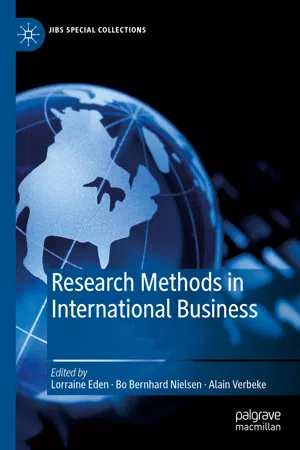
eBook - ePub
Research Methods in International Business
- English
- ePUB (mobile friendly)
- Available on iOS & Android
eBook - ePub
Research Methods in International Business
About this book
Information
© The Author(s) 2020
L. Eden et al. (eds.)Research Methods in International BusinessJIBS Special Collectionshttps://doi.org/10.1007/978-3-030-22113-3_11. Research Methods in International Business: Challenges and Advances
Bo Bernhard Nielsen1, 2 , Lorraine Eden3 and Alain Verbeke4, 5, 6
(1)
The University of Sydney Business School, The University of Sydney, Sydney, NSW, Australia
(2)
Copenhagen Business School, Frederiksberg, Denmark
(3)
Department of Management, Texas A&M University, College Station, TX, USA
(4)
University of Calgary, Calgary, AB, Canada
(5)
University of Reading, Reading, UK
(6)
Vrije Universiteit Brussel, Brussels, Belgium
We thank Agnieszka Chidlow, Henrik Gundelach, Stewart R. Miller, and Catherine Welch for their comments and help on an earlier draft of this chapter.
End AbstractIntroduction
Most, perhaps all, international business (IB) scholars would now agree that the above statement, made more than 35 years ago, is no longer valid. The challenges and costs associated with obtaining adequate samples and/or measures do not free a researcher from the responsibility of crafting a well-thought-out research design and adopting rigorous research methods. Gone are the days when IB researchers could be excused for a relative lack of methodological rigor due to “real-world constraints”, such as the absence of requisite financial resources to deploy the most advanced methodological approaches in complex international settings (Yang et al. 2006). For today’s scholars, staying up to date—that is, understanding and using the best available and most appropriate research methods—clearly matters.It is because cross-national research is so consuming of time and other resources that we ought to be willing to settle for less than the ideal research designs. It is also in this context that we should be more forgiving of researchers who might seem opportunistic in selecting the countries and problems for cross-cultural research. (Sekaran 1983: 69)
There have been several calls for expanding research settings and using more advanced methods to analyse complex, cross-border phenomena. A recent review of the methodological trajectories found in JIBS over the past 50 years (1970–2019) shows a dramatic rise in sophistication of the methods deployed (Nielsen et al. 2019), which is a testament to a maturing field. In fact, most IB journals with high Web-of-Science impact scores now formally or informally adhere to rigorous methodological standards and impose requirements on authors similar to the ones prevailing at the leading journals in other business disciplines such as marketing, organizational studies, and strategy (e.g., Hahn and Ang 2017; Meyer et al. 2017).
Moreover, during the past two decades, much has been written on sound methodological practices and rigor in IB research, some of which is documented in this book (see also, e.g., Nielsen and Raswant 2018; Nielsen et al. 2019). While Organizational Research Methods remains the primary outlet for pure methods articles, several of our scholarly journals, particularly JIBS and the Academy of Management Journal, have regularly published editorials and articles on best practices in research methods. Some of the best JIBS editorials on research methods have been included in this book.
IB scholars, like academics everywhere, study basic research methods in undergraduate and graduate classes such as statistics, econometrics, qualitative methods, and research design. We learn or teach ourselves how to use STATA, SPSS, SAS, or NVivo. These activities happen early in our careers, so we need to update our knowledge of best research methods practices on a regular basis. To partially address this need, within professional associations such as the Academy of International Business (AIB) and the Academy of Management (AOM), much attention is paid to sharing knowledge on best research practices through, for example, doctoral and junior faculty consortia. The Research Methods Shared Interest Group (RM-SIG) was recently established within the AIB to promote the advancement, quality, diversity, and understanding of research methodologies by IB scholars. The RM-SIG is just one example of a broad range of initiatives being undertaken by the global community of IB scholars to both help keep scholars abreast of the latest research methods and to push the field forward in the methods sphere.
We view our book as part of this ongoing initiative, which has spread across all business and social science disciplines, of improving the overall quality of methods used in business research. Our specific focus in this book is best practices in IB research methods. We take stock of some key challenges faced by the field in the realm of research design and methods deployed, and we also discuss recent advances in overcoming these challenges. We view our book as a unique, up-to-date reference source on good and best practices. By identifying and assembling a set of exemplary JIBS articles together with commentaries and reflections on these articles, we hope to share with the IB research community at large what now constitutes these best practices.
Our objectives for this introductory chapter are four-fold. First, we think that it is important to reiterate how and why high-quality research methods matter to IB scholars. Our second goal is to identify a number of base-line systemic methodological challenges facing scholars in IB research. A third goal is to introduce the various JIBS articles included in the book, which were selected because they represent sound and best practices to help overcome these challenges. We also briefly introduce the insightful commentaries and reflections provided by leading scholars on each of the JIBS pieces. Our last goal is to provide recommendations to IB scholars in the hope that the field will continue its positive trajectory and evolve into a net exporter of research methodology.
How and Why High-Quality Research Methods Matter?
The answer to the questions “How and why high-quality methods matter in international business research?” may be self-evident; however, we believe it is worth reiterating the benefits of using high-quality research methods—and the costs of using inadequate, outdated, or sloppy methods—to the field of IB studies.
First, the benefits. Acting with academic integrity means being consistent with “the values of honesty, trust, fairness, respect and responsibility in learning, teaching and research” (Bretag 2019). Acting with integrity in our research requires using high-quality research methods that promote the “truth” and minimize error. Our research is often motivated by puzzles we see around us in the real world. We use and test theories in order to better understand the world in which we live. We want our research to be credible and useful to other scholars, policy makers, managers, and the public. As is the case with any area of research, the choice and application of specific research methods largely determine the quality of subsequent knowledge creation, as well as the intellectual contribution made to the field. A well-crafted methodological approach can go a long way towards establishing a study’s rigor and relevance, thereby enhancing its potential impact, both in terms of scholarly advancement and improvement of managerial and policy practice. Only by practising the state-of-the-art in terms of research design, including sampling, measurement, analysis, and interpretation of results, will other scholars have confidence in the field’s findings. In fact, sound methodology—“research that implements sound scientific methods and processes in both quantitative and qualitative or both theoretical and empirical domains”—is one of the seven core guiding principles of the movement for Responsible Research in Business and Management (https://rrbm.network/).
However, scholars often view the benefits from research integrity as accruing only in the long term and primarily to society as a whole. In the short term, pressures to publish and the desire for tenure and promotion may be much more salient. Eden, Lund Dean, and Vaaler (2018: 21–22) argue that academia is full of “research pitfalls for the unwary” that can derail even well-intentioned faculty who believe they are acting with academic integrity. Doctoral students and junior faculty members are especially susceptible to these pitfalls due to the challenges they face as new entrants to academia—the liabilities of newness, resource dependence, and outsiderness.
The polar opposite of academic integrity is “scientists behaving badly” by engaging in academic misconduct/dishonesty (Eden 2010; Bedeian, Taylor and Miller 2010). IB scholars, similar to scholars throughout the social and physical sciences, are familiar with the three main types of academic misconduct: falsification (manipulating or distorting data or results), fabrication (inventing data or cases), and plagiarism (copying without attribution). In FFP (falsification, fabrication, and plagiarism) cases, researchers fail to tell the truth in scientific communications about their research (Butler et al. 2017). Such academic misconduct corrupts the research process and damages public trust in scientific literature. Research misconduct occasionally leads to retraction of the published work, and there is empirical evidence that the majority of retracted journal articles were retracted due to misconduct by the authors (Fang et al. 2012). Retraction also carries with it significant financial and personal consequences for the authors and substantial ripple effects on one’s colleagues, students, prior collaborators, and home institutions; see, for example, the types and estimates of costs in Stern, Casadevall, Steen and Fang (2014); Michalek, Hutson, Wicher and Tru...
Table of contents
- Cover
- Front Matter
- Part I. Introduction
- Part II. Reproducibility and Replicability
- Part III. Hypothesis-Testing Research
- Part IV. Trusting Findings
- Part V. Theorizing from Cases
- Part VI. Longitudinal Qualitative Research
- Part VII. Fuzzy-Set Qualitative Methods
- Part VIII. Interaction Effects
- Part IX. Endogeneity
- Part X. Common Method Variance
- Part XI. Multilevel Models
- Part XII. Distance
- Back Matter
Trusted by 375,005 students
Access to over 1.5 million titles for a fair monthly price.
Study more efficiently using our study tools.
Frequently asked questions
Yes, you can cancel anytime from the Subscription tab in your account settings on the Perlego website. Your subscription will stay active until the end of your current billing period. Learn how to cancel your subscription
No, books cannot be downloaded as external files, such as PDFs, for use outside of Perlego. However, you can download books within the Perlego app for offline reading on mobile or tablet. Learn how to download books offline
Perlego offers two plans: Essential and Complete
- Essential is ideal for learners and professionals who enjoy exploring a wide range of subjects. Access the Essential Library with 800,000+ trusted titles and best-sellers across business, personal growth, and the humanities. Includes unlimited reading time and Standard Read Aloud voice.
- Complete: Perfect for advanced learners and researchers needing full, unrestricted access. Unlock 1.5M+ books across hundreds of subjects, including academic and specialized titles. The Complete Plan also includes advanced features like Premium Read Aloud and Research Assistant.
We are an online textbook subscription service, where you can get access to an entire online library for less than the price of a single book per month. With over 1.5 million books across 990+ topics, we’ve got you covered! Learn about our mission
Look out for the read-aloud symbol on your next book to see if you can listen to it. The read-aloud tool reads text aloud for you, highlighting the text as it is being read. You can pause it, speed it up and slow it down. Learn more about Read Aloud
Yes! You can use the Perlego app on both iOS and Android devices to read anytime, anywhere — even offline. Perfect for commutes or when you’re on the go.
Please note we cannot support devices running on iOS 13 and Android 7 or earlier. Learn more about using the app
Please note we cannot support devices running on iOS 13 and Android 7 or earlier. Learn more about using the app
Yes, you can access Research Methods in International Business by Lorraine Eden, Bo Bernhard Nielsen, Alain Verbeke, Lorraine Eden,Bo Bernhard Nielsen,Alain Verbeke in PDF and/or ePUB format, as well as other popular books in Business & Entrepreneurship. We have over 1.5 million books available in our catalogue for you to explore.