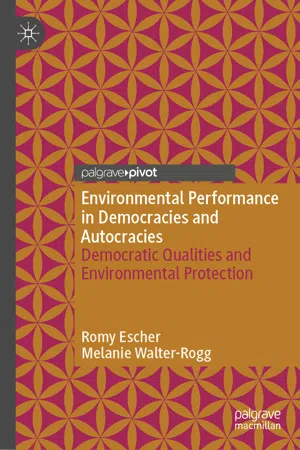
There are considerable differences in environmental performance and outcomes across both democracies and autocracies, but there is little understanding of how levels of democracy and autocracy influence environmental performance. This book examines whether analysing the effects of individual democratic features separately can contribute to a better understanding of cross-national variance in environmental performance. The authors show that levels of social equality in particular, as well as the strength of local and regional democracy, contribute significantly to explaining cross-national variation in environmental performance. On the other hand, a high level of political corruption affects a country's ability to adopt and implement environmental policies effectively. In exploring the inter-relationship between democratic qualities, political corruption, and environmental performance, this book presents policymakers and political theorists with a clear picture of which aspects of democratic societies are most conducive to producing a better environment.
eBook - ePub
Environmental Performance in Democracies and Autocracies
Democratic Qualities and Environmental Protection
- English
- ePUB (mobile friendly)
- Available on iOS & Android
eBook - ePub
Environmental Performance in Democracies and Autocracies
Democratic Qualities and Environmental Protection
About this book
Information
© The Author(s) 2020
R. Escher, M. Walter-RoggEnvironmental Performance in Democracies and Autocracieshttps://doi.org/10.1007/978-3-030-38054-0_11. Introduction
Romy Escher1 and Melanie Walter-Rogg1
(1)
Institut für Politikwissenschaft, University of Regensburg, Regensburg, Bayern, Germany
Abstract
This chapter introduces the core theme of the book and outlines its structure. There are considerable differences in environmental performance across democracies, and environmental outcomes vary among autocracies as well. There is little knowledge about how democracy influences environmental performance, though multiple features of democracy are emphasized in the literature. Democracies vary in non-electoral aspects. Autocracies differ in the extent to which they hold competitive elections and implement non-electoral traits of democracy. Thus, this book examines whether analysing the effects of each democratic feature separately contributes to a better understanding of cross-national variance in environmental performance across democracies and across autocracies. Political corruption affects a country’s ability to adopt and implement environmental policies. Therefore, this book also studies the joint influence of different democratic qualities and political corruption.
Keywords
Climate policyDemocracyAutocracyEnvironmental performanceEnvironmental degradation is a major challenge of our time. Local pollution, e.g., of air and water, affects our health, our economy and our culture as well as fellow species on earth. Global pollutants such as greenhouse gas emissions endanger coastal areas and small island states with accelerated sea level rise; affect agriculture and fisheries with ocean warming and acidification and droughts; endanger human life with extreme weather events; and contribute to species extinction. Scholars and political decision-makers emphasize the security consequences of global warming (Detraz 2011; Hartmann 2010). Since the 1970s, nation-states have adopted policies to protect the environment, and currently, most states regard environmental protection as state responsibility (Duit 2014, p. 1). In the early 1990s, global environmental change was also recognized as a political problem on the international level. However, environmental performance varies considerably between countries and over time. This book examines whether an analysis of the effects of different democratic qualities improves our understanding of cross-national variation in environmental performance among democracies and among autocracies.
General performance is differentiated into procedural performance , i.e., “the capability, stability, and efficiency of the government” (Hanusch 2018, p. 31) and substantive performance , i.e., a country’s performance in specific policy fields (e.g., Roller 2005; Weaver and Rockman 1993). Environmental performance is defined as the degree to which a society attains environmental goals (Meadowcroft 2014; Roller 2005). There are two approaches to studying environmental performance: the first studies the adoption and stringency of environmental policies (environmental outputs), while the second examines the results of these policies, i.e., their impacts on air pollution (environmental outcomes) (e.g., Roller 2005; Scruggs 2003). This book contributes to academic research on the determinants of environmental outcomes.
Green political theorists have been debating about the nature of the relationship between democracy and the environment since the 1970s. Policy-makers and journalists hope that democracy contributes to environmental and climate protection (Petherick 2014). The former Vice-President of the United States (US) Gore (1992, p. 179) regarded “the spread of democratic government to more nations of the world … [as] an essential prerequisite for saving the environment.” By contrast, green political theorists in the 1970s argued that democracy would hinder the solution of environmental challenges (Heilbroner 1974; Ophuls 1977; Ophuls and Boyan 1992) because the focus on individual rights would undermine efforts to protect the environment. Similarly, scholars of the eco-authoritarian school of political theory argue for less democracy or favour autocracy when addressing global environmental change (e.g., Beeson 2010, 2016; Gilley 2012; Shearman and Smith 2007). These scholars question the assumption that participation and decentralization contribute to environmental protection. However, only a small number of scholars see democracy as undermining environmental performance. Observing environmental degradation in communist countries in Eastern Europe as well as in autocracies in the developing world in the 1980s, scholars linked democracy positively to environmental performance (Pellegrini and Gerlagh 2006, p. 334). Most scholars currently believe that democracy is compatible with environmental protection (e.g., Gleditsch and Sverdrup 2002; Payne 1995; Walker 1999).
Referring to the theoretical debate, numerous statistical studies have examined the relationship between regime type and environmental performance (e.g., Barrett and Graddy 2000; Bättig and Bernauer 2009; Congleton 1992; Farzin and Bond 2006; Fredriksson and Neumayer 2013; Neumayer 2002; Wurster 2013). Empirical research partly indicates that democracies perform better in solving local and regional environmental problems (e.g., Barrett and Graddy 2000; Bernauer and Koubi 2009; Li and Reuveny 2006; Ward 2008; Winslow 2005; Wurster 2013) than their autocratic counterparts (see also Fiorino 2011, pp. 375ff.). However, some studies find no effect of democracy on environmental policy stringency (e.g., Pellegrini and Gerlagh 2006). The academic literature is also ambiguous about the relevance of the regime type for environmental problems that demand considerable behavioural changes such as climate change (e.g., Bättig and Bernauer 2009; Fredriksson and Neumayer 2013, 2016; Gleditsch and Sverdrup 2002; Kneuer 2012; Li and Reuveny 2006; Midlarsky 1998; Policardo 2016; Spilker 2012, 2013; Wurster 2013, see also Christoff and Eckersley 2011; Wurster 2013, p. 89).
Previous quantitative research has mainly focused on regime type divides in environmental performance. However, there are considerable differences in environmental performance among democracies as well as among autocracies. Moreover, environmental protection also varies over time. Despite high levels of democracy, established democracies show considerable differences in their climate performance (Christoff and Eckersley 2011, p. 439; Clulow 2018, p. 2; Povitkina 2018, p. 411). For example, recently, there has been a decline in environmental performance in the US, one of the first countries to introduce environmental policies. Not only democracies but also autocracies engage in environmental protection (Sonnenfeld and Taylor 2018, p. 518). While the US government has been weakening environmental regulations and withdrawing from the Paris Climate Agreement, China has been adopting measures to reduce air pollution and support international climate cooperation. China has reduced coal use per capita and, to this end, closed or relocated pollution-intensive firms (Beeson 2018, p. 39). In fact, China urged the Trump administration not to leave the Paris agreement, as in doing so, the US would act against the policy preferences of global society (Clark 2016). In earlier stages of the climate change regime, the positions of China and the US contributed to the failure of the Copenhagen summit (Christoff 2010). Thus, the democracy-environment literature lacks an explanation of country differences in environmental performance among democracies as well as among autocracies. There has been little research in this regard (e.g., Escher and Walter-Rogg 2018; Hanusch 2018; Kim et al. 2019).
To explain country differences in environmental performance among democracies and among autocracies, empirical research has examined the role of the type of democracy and autocracy, institutional constraints and electoral systems (e.g., Madden 2014; Poloni-Staudinger 2008; Scruggs 2003; Wurster 2013). More recently, empirical research has examined whether the specific traits of democracy (e.g., Escher and Walter-Rogg 2018) contribute to a better understanding of the relationship between the regime type and environmental performance. In fact, there is no consensus in the theoretical literature on how democracy influences environmental performance. Green political theory discusses the environmental consequences of different models of democracy (e.g., liberal democracy , deliberative democracy, participatory democracy ). Moreover, the literature emphasizes particular aspects of these democracy concepts as being crucial for the environment, including competitive elections, political rights, checks and balances, civil rights , deliberation quality, social equality and non-electoral forms of participation, including direct democracy , civil society participation and local and regional democracy . There ...
Table of contents
- Cover
- Front Matter
- 1. Introduction
- 2. Disentangling the Effect of the Regime Type on Environmental Performance
- 3. Democratic Qualities and Environmental Performance in Democracies
- 4. Democratic Qualities and Environmental Performance in Autocracies
- 5. Democracy Quality, Political Corruption and Environmental Performance
- 6. Summary, Conclusions and Policy Implications
- Back Matter
Trusted by 375,005 students
Access to over 1.5 million titles for a fair monthly price.
Study more efficiently using our study tools.
Frequently asked questions
Yes, you can cancel anytime from the Subscription tab in your account settings on the Perlego website. Your subscription will stay active until the end of your current billing period. Learn how to cancel your subscription
No, books cannot be downloaded as external files, such as PDFs, for use outside of Perlego. However, you can download books within the Perlego app for offline reading on mobile or tablet. Learn how to download books offline
Perlego offers two plans: Essential and Complete
- Essential is ideal for learners and professionals who enjoy exploring a wide range of subjects. Access the Essential Library with 800,000+ trusted titles and best-sellers across business, personal growth, and the humanities. Includes unlimited reading time and Standard Read Aloud voice.
- Complete: Perfect for advanced learners and researchers needing full, unrestricted access. Unlock 1.5M+ books across hundreds of subjects, including academic and specialized titles. The Complete Plan also includes advanced features like Premium Read Aloud and Research Assistant.
We are an online textbook subscription service, where you can get access to an entire online library for less than the price of a single book per month. With over 1.5 million books across 990+ topics, we’ve got you covered! Learn about our mission
Look out for the read-aloud symbol on your next book to see if you can listen to it. The read-aloud tool reads text aloud for you, highlighting the text as it is being read. You can pause it, speed it up and slow it down. Learn more about Read Aloud
Yes! You can use the Perlego app on both iOS and Android devices to read anytime, anywhere — even offline. Perfect for commutes or when you’re on the go.
Please note we cannot support devices running on iOS 13 and Android 7 or earlier. Learn more about using the app
Please note we cannot support devices running on iOS 13 and Android 7 or earlier. Learn more about using the app
Yes, you can access Environmental Performance in Democracies and Autocracies by Romy Escher,Melanie Walter-Rogg in PDF and/or ePUB format, as well as other popular books in Politics & International Relations & Comparative Politics. We have over 1.5 million books available in our catalogue for you to explore.