Through the analysis of eighteen years of presidential data, this book shows how Presidents Bush, Obama, and Trump have conducted and framed the war on terror since its inception in 2001. Examining all presidential speeches about terrorism from George W. Bush's two terms as President, Barack Obama's two terms as President, and Donald Trump's first year as President, this book is the first to compare the three post-9/11 presidents in how they have dealt with the terror threat. Presidential Rhetoric on Terrorism under Bush, Obama, and Trump argues that when policies need to be "sold" to the public and Congress, presidents make their pertinent issues seem urgent through frequent speech-making and threat inflation. It further illustrates how after policies are sold, a new President's reticence may signify quiet acceptance of the old regime's approach. After examining the conduct of the war on terror to date, it concludes by posing policy suggestions for the future.
eBook - ePub
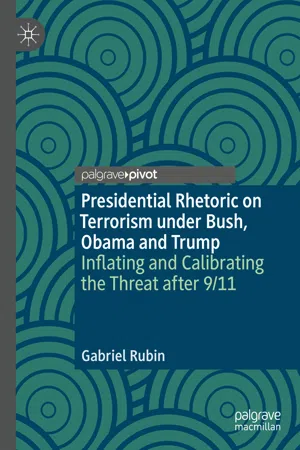
Presidential Rhetoric on Terrorism under Bush, Obama and Trump
Inflating and Calibrating the Threat after 9/11
- English
- ePUB (mobile friendly)
- Available on iOS & Android
eBook - ePub
Presidential Rhetoric on Terrorism under Bush, Obama and Trump
Inflating and Calibrating the Threat after 9/11
About this book
Information
© The Author(s) 2020
G. RubinPresidential Rhetoric on Terrorism under Bush, Obama and Trumphttps://doi.org/10.1007/978-3-030-30167-5_11. Inflating the Terror Threat Since 2001
Gabriel Rubin1
(1)
Montclair State University, Montclair, NJ, USA
Abstract
Presidential rhetoric serves a critical interpretive role in defining events, particularly the threat of terrorism. As Richard Neustadt argues, the power of the presidency lies in the leader’s power to persuade. Presidents frame the terror threat by setting the country’s policy agenda. They then try to sell policies to Congress and the public through the pressure they can employ using their rhetoric and their office. This study, based on content analysis speech data ranging from September 2001 to February 2019, delves into why presidents speak the way they do about terrorism looking both at the content and frequency of their speeches. This chapter lays out the main contours and theory of the book, while subsequent chapters present empirical findings.
Keywords
Presidential rhetoricThe American presidencyAgenda-settingPolicy sellingTerror threatWhen tragic events occur, people turn to their government leaders for reassurance, information, and direction. After the initial information-gathering phase, people in the public will want to know how leadership will prevent similar tragedies from occurring in future. Identifying what went wrong and who or what is at fault is critical to preventing future crises. This identification period allows for interpretation. How leaders communicate colors how the public will view events. What information trickles out to the public dictates how the tragedy is viewed.
Assigning blame and crafting appropriate responses gets particularly cloudy when a tragedy is driven by terrorists for a number of reasons. First, definitional issues obfuscate who is a terrorist or what terrorism is. While politically motivated violence is an accepted definition of terrorism, governments may simply label groups they don’t like as terrorists.1
Second, information asymmetries between the government and the public obscure the true nature of the terrorist threat. As Marc Sageman notes, terrorism scholars rarely gather firsthand data or even engage in interviews with relevant parties. Instead, governments and intelligence agencies hold these bits of information to themselves and many times withhold access to the accused as well as to important documents.2 Knowing how real a threat is when confidential information is used to determine the threat level is akin to projecting the weather from a windowless basement. Further there is a level of subjectivity to threat evaluation; the scary looking creature in the shadows could be a bear or a pile of sheets—on some level we don’t know until we turn on the lights. To this end, scholars can, many times in retrospect, determine whether a terrorist threat is being oversold to the public, but terrorism scholars do not have the certainty of chemists in their findings. Hindsight also is no great recourse in a scientific endeavor; it would be nice to have more foreknowledge of mischaracterized threats.
Finally, a high-casualty or high-publicity terrorist incident doesn’t yield much clarity about how to prevent future attacks. Are there similar operatives out there? Are they in position to conduct attacks? What policies or practices might stop them from achieving their violent ends—if, indeed, they are determined to conduct violence? Hypotheticals fill the answers to these questions. The American government may view an actor as a ticking time bomb when in fact the individual is just going through growing pains.3
The words of our leaders are critical in this sphere due to the wide latitude governments have in defining and interpreting the threat of terrorism. Leaders can play down or ratchet up threats.4 These words are not just one scrap of a ball of information that media-consumers ingest. Presidential rhetoric on terrorism serves to frame how the issue is viewed, how fearful people are of the terrorist threat, and how the government is bound to react to it. Public opinion, as will be seen, is one piece of the puzzle, but one that crafty presidents can push in their favor. As Anthony DiMaggio shows, modern presidents have typically determined policy with regard to the terrorist threat. One way they have done this is by successfully convincing legislators and the government to pursue their desired actions.5
This book asks two sets of questions about this process of how presidential rhetoric defines the terror threat. The first set is:In order to answer the first set of questions, a database of presidential speeches made by Presidents George W. Bush, Barack Obama, and Donald Trump since the 9/11 attacks will be examined and compared. It will be shown that presidents use their rhetoric to set the political agenda and to sell policies. These questions will be dealt with theoretically here in the first chapter and in more fine-grained detail in the three empirical chapters on each individual President.
- Why do Presidents talk the way they do about terrorism? What themes do they use? What factors determine the frequency and content of their pronouncements about terrorism?
The second set of questions that will be dealt with in the empirical chapters and the conclusion are as follows:Obviously, answering these questions is more an exercise in analysis and projection. The policy proposals on how best to calibrate the terrorist threat will be based on appropriate comparisons from the empirical chapters.
- How should Presidents calibrate the threat? Do they overinflate it? Are there risks to downplaying it? Are there any policy proposals that can be derived from the comparison of post-9/11 presidential rhetoric?
Presidential rhetoric is critically important in guiding American foreign and domestic policy as well as in determining which threats are pursued by the American government.6 After the 9/11 attacks, terrorism was touted as a threat that would “never again” be ignored. Previous to the attacks, the terror threat flitted into and out of American public consciousness, gaining attention when attacks occurred and then fading away.7
This study examines how the terror threat is constructed and sold to the public by American presidents. Other studies have examined how public opinion is moved by the terror threat.8 Here presidential rhetoric will be examined as an independent variable that leads to the main dependent variable of foreign and domestic policy regarding terrorism. Public opinion, as will be seen below, is a factor in the passage of foreign policy, but it is not a critical piece. If the public truly hates a president’s policies, they can surely vote him or her9 out of office, but the public has a smaller role in the legislative process than mos...
Table of contents
- Cover
- Front Matter
- 1. Inflating the Terror Threat Since 2001
- 2. George W. Bush: Policy Selling and Agenda-Setting After 9/11
- 3. Barack Obama: From an End to Terror to Drone Wars and ISIS
- 4. Donald Trump, Twitter, and Islamophobia: The End of Dignity in Presidential Rhetoric About Terrorism
- 5. How Can Presidents Properly Calibrate the Terror Threat?
- Back Matter
Trusted by 375,005 students
Access to over 1.5 million titles for a fair monthly price.
Study more efficiently using our study tools.
Frequently asked questions
Yes, you can cancel anytime from the Subscription tab in your account settings on the Perlego website. Your subscription will stay active until the end of your current billing period. Learn how to cancel your subscription
No, books cannot be downloaded as external files, such as PDFs, for use outside of Perlego. However, you can download books within the Perlego app for offline reading on mobile or tablet. Learn how to download books offline
Perlego offers two plans: Essential and Complete
- Essential is ideal for learners and professionals who enjoy exploring a wide range of subjects. Access the Essential Library with 800,000+ trusted titles and best-sellers across business, personal growth, and the humanities. Includes unlimited reading time and Standard Read Aloud voice.
- Complete: Perfect for advanced learners and researchers needing full, unrestricted access. Unlock 1.5M+ books across hundreds of subjects, including academic and specialized titles. The Complete Plan also includes advanced features like Premium Read Aloud and Research Assistant.
We are an online textbook subscription service, where you can get access to an entire online library for less than the price of a single book per month. With over 1.5 million books across 990+ topics, we’ve got you covered! Learn about our mission
Look out for the read-aloud symbol on your next book to see if you can listen to it. The read-aloud tool reads text aloud for you, highlighting the text as it is being read. You can pause it, speed it up and slow it down. Learn more about Read Aloud
Yes! You can use the Perlego app on both iOS and Android devices to read anytime, anywhere — even offline. Perfect for commutes or when you’re on the go.
Please note we cannot support devices running on iOS 13 and Android 7 or earlier. Learn more about using the app
Please note we cannot support devices running on iOS 13 and Android 7 or earlier. Learn more about using the app
Yes, you can access Presidential Rhetoric on Terrorism under Bush, Obama and Trump by Gabriel Rubin in PDF and/or ePUB format, as well as other popular books in Politics & International Relations & American Government. We have over 1.5 million books available in our catalogue for you to explore.