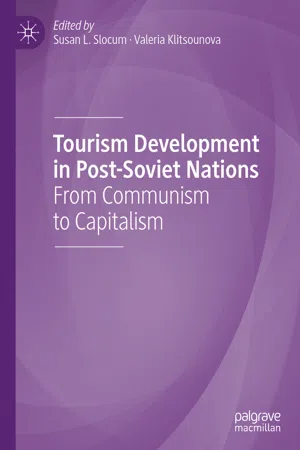
Former communist countries face unique issues in developing and marketing tourism businesses, communities, and attractions because of centralized polices that discouraged international influences. While soviet economies relied on state policies to facilitate community development, the success of capitalism lies in access to a variety of resources, such as the environment, fiscal services, infrastructure, and market knowledge at the local level. Moreover, communal societies potentially possess social capital that can provide unique economic development opportunities.This book incorporates a regional perspective that widens the tourism development debate to include theoretical analyses, applied research, and case studies that document the broader successes and challenges that affect tourism stakeholders and addresses the necessary elements that facilitate a comprehensive tourism development strategy in emerging and transitioning former communist countries.
eBook - ePub
Tourism Development in Post-Soviet Nations
From Communism to Capitalism
- English
- ePUB (mobile friendly)
- Available on iOS & Android
eBook - ePub
Tourism Development in Post-Soviet Nations
From Communism to Capitalism
About this book
Information
© The Author(s) 2020
S. L. Slocum, V. Klitsounova (eds.)Tourism Development in Post-Soviet Nationshttps://doi.org/10.1007/978-3-030-30715-8_11. Introduction
Valeria Klitsounova1 and Susan L. Slocum2
(1)
Belarusian State University, Minsk, Belarus
(2)
George Mason University, Manassas, VA, USA
Valeria Klitsounova (Corresponding author)
The year 2021 celebrates 30 years since the collapse of the Soviet Union and the opening of numerous economies to capitalism in Eastern Europe and Asia. Capitalism has had major impacts on these countries including increased economic opportunity and quality of life, while presenting numerous social challenges including the exodus of young adults to the West, exposure to globalization and cultural change, rural-to-urban migration, and increased tensions between local populations and international visitors.
Former Soviet bloc countries have chosen a variety of liberalization paths as a means to enter the global economy. Eastern European countries have taken one of two paths to establish market privation after the fall of communism. Countries like Hungary, Poland, and the Baltic states have embraced Western values and sought alliance with the European Union (EU). Other countries, such as Belarus, have maintained strong ties with Russia. In Asia, Kazakhstan and Mongolia have aligned their economic relations with China or close Islamic/Buddhist neighbours (Abdelal, 2002). However, most of these countries have struggled to reach the economic growth goals that capitalism promised, including stable inflation , investment in infrastructure, higher wages, and a transition to a democratic political system. Tourism, through its capitalist nature, promotes Western values of independence, consumerism, and cultural exploitation (Sharpley, 2009). These values are often in sharp contrast to the communist ideals of solidarity and the collective proletariat. As Lagace (2000) writes, “An explanation…lies in nationalism: in the degree to which these countries constructed and embraced their own concepts of national identity and allowed such concepts to influence economic policy” (n.p.).
The aim of this book is to provide a comprehensive research-related book to inform the opportunities and challenges facing former communist countries in tourism development. These countries face unique issues in developing and marketing tourism businesses, communities, and attractions because of polices that discourage international influences. While Soviet economies relied on state influences to facilitate community development, the success of capitalism lies in access to a variety of resources (capitals), such as the environment, fiscal services, infrastructure, and market knowledge at the local level. Moreover, communal societies potentially possess social capital that can provide unique economic development opportunities. Therefore, this book attempts to incorporate a regional perspective that widens the tourism development debate to include theoretical perspectives, applied research, and case studies that document the broader successes and challenges that affect tourism stakeholders and address the necessary elements that facilitate a comprehensive tourism development strategy in emerging former communist countries.
This book is different from most books about tourism development in post-Soviet countries, which are generally authored or edited by Western academics. These former publications generally reflect the views of researches of the Anglo-Saxon school. Here you will find the views of insiders—those who are native to, or live and work in, post-Soviet countries. Many of our authors were born during the socialist period and have grown up with socialist ideals. Most are old enough to have witnessed the revolutionary period and the collapse of the communist system. Moreover, our authors range from seasoned academics to those who work in tourism non-governmental organizations. All of our contributors have been at the forefront of tourism capitalistic development in former communist countries. These authors have also been vital players throughout the transitionary period, experiencing a different pace of life and trying to find their way, and their country’s way, in a new world. We are happy to present their voices and to help them find a wider audience for their institutional and personal knowledge and development lessons. We hope that this book will be not only interesting but an important counterpoint to previous research derived from the West.
The list of destinations and topics described in these chapters is rather wide and, initially, may look random. However, they are written by professionals from tourism post-Soviet professional circles, by authors well established in their fields. In fact, it is this very randomness that represents and reflects the diversity of the process happening in this part of the world.
The geographical context of the book is rather diverse as well—from Estonia in the North to Georgia in the South, from the Slovenia in the West to Kazakhstan in the East. All of these countries belonged to the so-called Eastern Bloc including regions within the USSR. The Cold War left a long-lasting geographical discourse, a sort of dichotomy, between ‘us’ and ‘them’—the developed Western democracies. This group of countries possess immense diversity and heterogeneity, while also having experienced similar histories and ideologies. Some of these countries went straight to capitalism, such as Poland, some have tried to follow a ‘convergence theory’ like Belarus, and some are looking for their own path towards socio-economic development.
The goal of this book was never to cover all countries from the former Soviet bloc, but rather to conceptualize the process of post-socialism transformation typical for this area, using tourism as a social lens. We do not treat these tourism destinations monolithically, which we hope will make this book interesting—different scenarios, a different pace, and different models of economic and political development which are reflected through tourism. Additionally, by allowing local actors to tell this story, we hope that the issues of importance are well represented.
Historical Contexts
The historical context of this book mainly covers the period after the collapse of socialism (1989–1990) and the breaking of the ‘Iron Curtain’ through to today. However, some articles highlight the periods after World War II, including representative experiences during communism and throughout the transition stages. Most authors have distinguished three stages in tourism development—the periods of socialism, transition, and global emergence.
The Period of Socialism
In relation to tourism, the period between 1945 and 1990 could be described as the ‘social’ or ‘domestic’ tourism period. People did not travel much because of a lack of freedom for movement outside of the Eastern Bloc. Visa restriction, financial problem, and difficulty in obtaining a passport for travelling created limitation in mobility. However, there were a lot of organized travellers inside these countries, and three tourism organizations promoted domestic travel round the region (Intourist , Trade Union Tourism, and Sputnik). These organizations were governed by the state and served as travel agencies for excursionists inside the Soviet bloc. In the USSR, all tourism enterprises and organizations were state owned, but in Poland, Hungary, Yugoslavia, and East Germany, the private sector was allowed to develop minor tourism business units especially in the mountains and seaside resorts.
The primary focus of tourism was social tourism where sanatoriums and recreational resorts boomed. Primarily for workers and their families, facilities were dynamically developed to provide access to leisure and recreation. Everything was subsidized by the state. Excursions were organized for school groups, students, and workers to enhance education and promote socialist-value propaganda goals. Holidays were not bought but were partly ‘granted’ by one’s employment organization. As a matter of tradition, travellers paid 10–20% of the cost, or many paid nothing. Tourism was not a business but rather a social activity. Some international tourism existed but was highly controlled by state tourism agencies.
The Transition
The period 1990–2004/2006 is called the ‘touristification’ period by some experts. The focus of tourism development during that time changed from domestic leisure to international investment and marketing. Western foreign currency for regional economic growth was needed, and tourism supported foreign exchange earnings. Political transformations boosted mobility and the dynamic development o...
Table of contents
- Cover
- Front Matter
- 1. Introduction
- Part I. Transitions and Indicators of Progress
- Part II. Case Studies
- Back Matter
Trusted by 375,005 students
Access to over 1.5 million titles for a fair monthly price.
Study more efficiently using our study tools.
Frequently asked questions
Yes, you can cancel anytime from the Subscription tab in your account settings on the Perlego website. Your subscription will stay active until the end of your current billing period. Learn how to cancel your subscription
No, books cannot be downloaded as external files, such as PDFs, for use outside of Perlego. However, you can download books within the Perlego app for offline reading on mobile or tablet. Learn how to download books offline
Perlego offers two plans: Essential and Complete
- Essential is ideal for learners and professionals who enjoy exploring a wide range of subjects. Access the Essential Library with 800,000+ trusted titles and best-sellers across business, personal growth, and the humanities. Includes unlimited reading time and Standard Read Aloud voice.
- Complete: Perfect for advanced learners and researchers needing full, unrestricted access. Unlock 1.5M+ books across hundreds of subjects, including academic and specialized titles. The Complete Plan also includes advanced features like Premium Read Aloud and Research Assistant.
We are an online textbook subscription service, where you can get access to an entire online library for less than the price of a single book per month. With over 1.5 million books across 990+ topics, we’ve got you covered! Learn about our mission
Look out for the read-aloud symbol on your next book to see if you can listen to it. The read-aloud tool reads text aloud for you, highlighting the text as it is being read. You can pause it, speed it up and slow it down. Learn more about Read Aloud
Yes! You can use the Perlego app on both iOS and Android devices to read anytime, anywhere — even offline. Perfect for commutes or when you’re on the go.
Please note we cannot support devices running on iOS 13 and Android 7 or earlier. Learn more about using the app
Please note we cannot support devices running on iOS 13 and Android 7 or earlier. Learn more about using the app
Yes, you can access Tourism Development in Post-Soviet Nations by Susan L. Slocum, Valeria Klitsounova, Susan L. Slocum,Valeria Klitsounova in PDF and/or ePUB format, as well as other popular books in Économie & Industrie de l'hôtellerie, du voyage et du tourisme. We have over 1.5 million books available in our catalogue for you to explore.