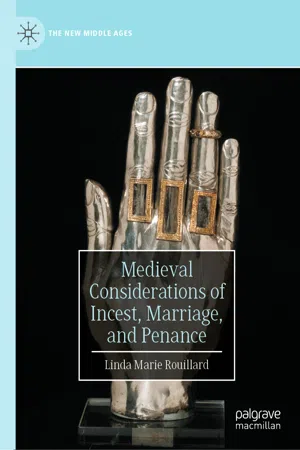
Medieval Considerations of Incest, Marriage, and Penance focuses on the incest motif as used in numerous medieval narratives. Explaining the weakness of great rulers, such as Charlemagne, or the fall of legendary heroes, such as Arthur, incest stories also reflect on changes to the sacramental regulations and practices related to marriage and penance. Such changes demonstrate the Church's increasing authority over the daily lives and relationships of the laity. Treated here are a wide variety of medieval texts, using as a central reference point Philippe de Rémi's thirteenth-century La Manekine, which presents one lay author's reflections on the role of consent in marriage, the nature of contrition and forgiveness, and even the meaning of relics. Studying a variety of genres including medieval romance, epic, miracles, and drama along with modern memoirs, films, and novels, Linda Rouillard emphasizes connections between medieval and modern social concerns. Rouillard concludes with a consideration of the legacy of the incest motif for the twenty-first century, including survivor narratives, and new incest anxieties associated with assisted reproductive technology.
- English
- ePUB (mobile friendly)
- Available on iOS & Android
eBook - ePub
Medieval Considerations of Incest, Marriage, and Penance
About this book
Information
© The Author(s) 2020
L. M. RouillardMedieval Considerations of Incest, Marriage, and PenanceThe New Middle Ageshttps://doi.org/10.1007/978-3-030-35602-6_11. Introduction: Too Close for Comfort
Linda Marie Rouillard1
(1)
The University of Toledo, Toledo, OH, USA
Linda Marie Rouillard
Why in the twenty-first century write a book about twelfth-and thirteenth-century medieval French poems preoccupied with incest, marriage, and penance? Can literary narratives from eight and nine centuries ago possibly enlighten us about current issues related to sexual abuse in particular, or to marriage and social relationships in general? For centuries, we have turned to stories and metaphors from literature to grapple with and understand the conflicts, suffering, and trauma of our lives: the Oedipal story in particular has shaped our views of parent–child relationships and of the destinies we feel doomed to live out. Biblical stories (such as the incest story from the Old Testament about Lot and his daughters) are common currency even in the world outside of religious practice. Fairy tales and folktales amuse us and instruct us. Poetry in particular consoles us and seduces us as it transforms reality at the most basic level: the linguistic level in which ordinary speech and syntax are “reformed” into an extra-ordinary language that allows us a new perspective on our lives. Indeed, it is sometimes only in this poetic language that we can address those experiences for which we have no words in everyday language.
This book starts from the premise that medieval musings on social institutions and medieval definitions of human relationships remain pertinent to modern society, and can provide valuable insights into the manner of categorizing and prescribing human interactions and perceptions; insights into the anxiety related to contemporary changing definitions of legally recognized relationships; and insights into modern customs of reconciliation for fractured social connections.
In the modern era, we typically study incest to better understand the trauma experienced by victims, to develop treatment and support systems, and to find ways of preventing the abuse. For the twenty-first century, incest is a devastating reality of greater frequency than previously understood, but there is no reason to assume that incest did not occur with great frequency as well in the Middle Ages. This book will reference a long tradition of stories of incest, but a tradition that typically uses the motif as a metaphor for broader discussions of social relationships. It is also important to remember in the twelfth and thirteenth centuries when the majority of our referenced works were written, incest had a much more extensive definition, referring not only to interdicted consanguineous relationships, but also to marriage between those with spiritual connections—specifically, between godparent and godchild—and between those with affine connections, meaning relatives of relatives by marriage, or even relatives of a previous sexual partner. Because of these interdictions, many potential marriage partners, even though distant relatives by our standards, fell into the category of still “too close for comfort.”
Chapters 2 and 3 of this book study numerous medieval examples of this classical metaphor, that of an incestuous relationship. While a modern reader is more likely accustomed to learn about incest in the form of survivor narratives, psychological analyses, and newspaper articles, it is unlikely that medieval readers interpreted medieval poems using the incest motif as exposés of sexual abuse or of potential sexual abuse in the Middle Ages. As twenty-first century readers, however, informed by modern incest survivor narratives, we can interpret such stories on multiple levels, from the psychological experience of trauma to a symbolic parable about the potential positive or negative consequences of social change.
As we study incest narratives against the ideological background of the medieval Churchʼs evolving definition of marriage, the institution that positioned itself to regulate sexual behavior, among other behaviors, often in competition with familial material interests, we will connect the themes of medieval texts to modern preoccupations and conflicts over the nature of matrimony in Chapter 4. During the High Middle Ages, the institution of marriage was being redefined by the Church, which now insisted that a valid marriage required the individual consent of both spouses to the union; a legitimate marriage, in theory then, could not be the result of parental coercion, though arranged and forced marriages nonetheless continued well beyond the Middle Ages. By the thirteenth century, however, the Church had come to exercise much more control over marital relationships that had historically been the purview of the male heads of households. The pronouncements of the 1215 Fourth Lateran Council reduced the Church’s previous extensive consanguinity regulations that had greatly limited potential marriage partners and had caused many headaches for noble families longing to consolidate lands and power through the arranged marriages of their children. The Church’s insistence on verifying the individual consent of the marriage partners certainly diluted some paternal authority in the matter of marriage, and thus could frustrate to a certain degree the conglomeration of dynastic wealth.
The sacrament of penance had also undergone numerous changes by the mid-thirteenth century, evolving from a “tariff” system of formulaic punishments to an emphasis on the emotion of contrition, and to a renewed emphasis on the efficacy of absolution by the priest.
The depiction of individualized repentance and public forgiveness in medieval narratives also resonates with our need for a modern form of public confession in order to reestablish faith and trust between the general public and those in power who abuse that faith, the subject of Chapter 5. One need only evoke the political careers of Bill Clinton or Andrew Weiner to understand the general public’s need and the media’s obsession for broadcasts of admission of personal failure by the famous and the powerful. The calls for public accountability and a televised day of reckoning make for good religious theater as well as for increased viewer ratings, just as medieval public performances of penance provided interesting occasions for the congregation to be reminded of God’s infinite mercy.
In conjunction with the Churchʼs ever-increasing authority over human relationships through its changes of perspective on marriage and penance, Chapter 6 considers bodily fragmentation and miraculous grafts, in particular as related to the tradition of relics, another way of maintaining relationships severed by death, enabling the faithful to establish a connection with the saintly and the divine. Once again, the Church insists it has the ultimate authority to determine authentic relics and prevent abuse of such sacred objects by both the clergy and the laity.
Because marriage and penance are sacramental traditions in which words play an important role, we consider the relationship between women and men with language itself in Chapter 7: rash boons, deceptive obedience, and forged missives produce a tension between the letter of the text and the spirit of the text. How are we to interpret “narratives” or declarations: is a knight really obliged to kill his sister because he blindly promised a rash boon to a seemingly innocent maiden? Is it disloyal for a vassal to save a maidenʼs life by creating the appearance of obeying a written royal order to execute her?
The early twentieth-century psychoanalyst Otto Rank studied a corpus of incest narratives with the goal of better understanding the imprint of an author’s psyche on his or her literary creation, insisting more specifically that “the incest fantasy is of primary importance in the psychic life of the author.”1 The purpose of this book, however, is not to better understand the life of medieval poets who wrote about incest, authors for whom we typically have limited knowledge; rather it is to use medieval narratives to better understand social and cultural mentalities of some twelfth- and thirteenth-century western European societies, as well as some of their beliefs and attitudes toward religious practices. In addition, such a study can help us to better understand our own twenty-first-century anxieties about social change to accepted forms of marriage, and even new anxieties about inadvertent incest resulting from technological advances such as assisted reproductive procedures, some of the topics in our concluding chapter. Just as in the Middle Ages, publicly redefining what constitutes accepted and acceptable relationships in the twenty-first century has important consequences and often triggers strong reactive stances in religious and legal arenas. For instance, the modern debate over the definition of marriage asks whether a valid marriage is limited only to a man and a woman, or will we recognize same-sex unions? The modern social fears and political conflict resulting from this question, along with the consequences for such issues as shared property, medical decisions, and adoption, are front-page news on a regular basis. While the June 2015 Supreme Court ruling in Obergefell v. Hodges made same-sex marriage legal in the U.S., the topic remains a rhetorical battleground for debates on state versus federal authority to define and “protect” the institution of marriage. The process of asserting the authority to define a legal marriage is just one of many issues that connect us to the medieval past.
We conclude this work with some modern uses of the incest motif in a variety of genres, including films, novels, memoirs, and popular and sensational media accounts. As a narrative motif and metaphor used to discuss social changes, class conflict, and culture wars, the incest theme has a place in modern reflections on broad social problems as well. Gillian Harkins in her book Everybodyʼs Family Romance: Incest in Neoliberal America, observes, for instance, that the epidemic of incest and sexual abuse so prevalent in the popular media in the 1990s was racialized by the popular media. “Black women were positioned once again as the insignificant real of sexual violence, while white women were the hyperreal of narcissistic sex panic and self-aggrandizement. Privileged (coded as white) women took over the more legitimate stories of child sexual abuse among the poor and populations of color (where it really happens but doesnʼt really matter) and used them to theatricalize their own middle-class angst on the stage of world historical suffering.”2 In Harkinsʼs assessment, modern popular media in the U.S. have used the incest motif to conduct their version of class and race warfare as they pit white women against black women, and upper classes against lower classes, portray...
Table of contents
- Cover
- Front Matter
- 1. Introduction: Too Close for Comfort
- 2. Kinship Matters: An Immodest Proposal
- 3. Heroines, Villains, and Barbarians in Other Medieval Incest Narratives
- 4. Medieval Marriage, Misogamy, Misogyny
- 5. The Hand of Forgiveness
- 6. Regurgitation, Restitution, Resurrection, and Relics
- 7. Spirit and Letter: Speech Acts in Selected Medieval Texts
- 8. Conclusion: The Legacy of the Incest Motif
- Back Matter
Trusted by 375,005 students
Access to over 1.5 million titles for a fair monthly price.
Study more efficiently using our study tools.
Frequently asked questions
Yes, you can cancel anytime from the Subscription tab in your account settings on the Perlego website. Your subscription will stay active until the end of your current billing period. Learn how to cancel your subscription
No, books cannot be downloaded as external files, such as PDFs, for use outside of Perlego. However, you can download books within the Perlego app for offline reading on mobile or tablet. Learn how to download books offline
Perlego offers two plans: Essential and Complete
- Essential is ideal for learners and professionals who enjoy exploring a wide range of subjects. Access the Essential Library with 800,000+ trusted titles and best-sellers across business, personal growth, and the humanities. Includes unlimited reading time and Standard Read Aloud voice.
- Complete: Perfect for advanced learners and researchers needing full, unrestricted access. Unlock 1.5M+ books across hundreds of subjects, including academic and specialized titles. The Complete Plan also includes advanced features like Premium Read Aloud and Research Assistant.
We are an online textbook subscription service, where you can get access to an entire online library for less than the price of a single book per month. With over 1.5 million books across 990+ topics, we’ve got you covered! Learn about our mission
Look out for the read-aloud symbol on your next book to see if you can listen to it. The read-aloud tool reads text aloud for you, highlighting the text as it is being read. You can pause it, speed it up and slow it down. Learn more about Read Aloud
Yes! You can use the Perlego app on both iOS and Android devices to read anytime, anywhere — even offline. Perfect for commutes or when you’re on the go.
Please note we cannot support devices running on iOS 13 and Android 7 or earlier. Learn more about using the app
Please note we cannot support devices running on iOS 13 and Android 7 or earlier. Learn more about using the app
Yes, you can access Medieval Considerations of Incest, Marriage, and Penance by Linda Marie Rouillard in PDF and/or ePUB format, as well as other popular books in Literature & European Medieval History. We have over 1.5 million books available in our catalogue for you to explore.