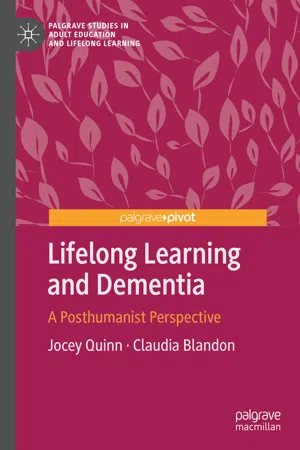
This book explores the potential for lifelong learning in dementia. A growing social issue, dementia has previously been understood as a wasteland for learning: at best, those with dementia are helped to hold on to some pre-existing skills. This book draws on extensive qualitative data with people with dementia and their families to demonstrate that new forms of learning can happen in dementia, with positive outcomes for both the learner and those around them. In doing so, this book demonstrates that those with dementia help us to understand learning differently, thus providing a breakthrough in our understanding and theorising of lifelong learning. Using posthuman theory to scaffold and discuss the findings, this pioneering book will appeal to scholars of dementia, lifelong learning and the posthuman.
- English
- ePUB (mobile friendly)
- Available on iOS & Android
eBook - ePub
About this book
Information
Topic
EducationSubtopic
Adult Education© The Author(s) 2020
J. Quinn, C. BlandonLifelong Learning and DementiaPalgrave Studies in Adult Education and Lifelong Learninghttps://doi.org/10.1007/978-3-030-42231-8_11. Introduction to Dementia and Lifelong Learning
Jocey Quinn1 and Claudia Blandon1
(1)
Plymouth Institute of Education, Plymouth University, Plymouth, UK
Abstract
In this chapter we introduce the key arguments of this book. First, a posthumanist perspective helps understand and value the lives of people with dementia, and second, they are capable of learning and teaching. It introduces dementia as a global social issue and cultural phenomenon and critiques the dominant narratives of loss and punishment surrounding it. Drawing on interviews with families of people with dementia it acknowledges the pain they experience, but also introduces a hopeful posthumanist perspective on dementia. The chapter shows that although arts interventions have demonstrated their creative potential, people with dementia have been largely absent from lifelong learning literature and policy. Finally, it outlines the research studies that will be used in this book: Beyond Words and Making Bridges with Music .
Keywords
DementiaLifelong learningPosthumanismFamiliesFeminismChallenging the Loss Narrative of Dementia
‘Be kind and patient, for I have lost the best of me’, so reads a poem on the walls of a care home that looks after residents with dementia. This trope of loss shapes the dominant global response to those experiencing dementia. Here dementia is nothing but a deficit state with all that is valuable left behind in the past. This book draws on our research with people with dementia and their close networks to challenge this vision of loss and to develop a different way of understanding dementia, drawing on posthuman ideas. Rather than positioning them in an educational wasteland, we see people with dementia both as learners and teachers and dementia as an essential but neglected part of lifelong learning. The book will use a wide range of data throughout drawn from two research projects Beyond Words and Making Bridges with Music (MBWM), including longitudinal observations, arts workshops, interviews and focus groups.
The Significance of a Posthumanist Perspective
Dementia is uniquely challenging because it undermines the certainty of identity, destabilising any sense that we know who and what we are as humans or can trust that knowledge as a bedrock of our existence. The virtue of posthuman ideas is that they can help to understand that we are all in a relationship with the world that is not dependent on fixed boundaries, voice, identity and rationality; that questions our limited view of what a ‘human’ is. In more clearly revealing these unfixed relationships with the world, people with dementia may be in the vanguard, potential leaders not losers. In this book we value them as they are and move beyond dementia as a deficit category.
JQ: And do you think in any way she is teaching you things?Yeah, I mean you have got to start looking at things from a completely different perspective, so it has definitely helped me in ways of looking … and seeing different possibilities. (Helen, support care worker, interview)
It is such a ‘completely new perspective’ that we are fostering in this book, in order to develop more positive ways of understanding and approaching dementia. In this chapter we will explore how dementia is currently positioned as a ‘scourge’ and social problem and as a glaring absence in the lifelong learning agenda. In Chap. 2 we will discuss the posthuman ideas we have found most useful in rethinking dementia, and in Chaps. 3 and 4 we will put these ideas to work with our research studies to reveal the ways in which people with dementia can learn and teach. Finally, in Chap. 5 we will draw out a vision of participative lifelong learning for people with dementia and discuss its contribution to a sustainable world.
Dementia: ‘Scourge’, ‘Plague’ and Punishment
Dementia is an umbrella term for a range of conditions such as Alzheimer’s disease , vascular dementia or mixed dementia. It is a terminal consequence of brain degeneration and is characterised by memory loss or confusion in interpreting space and meaning, often with a gradual reduction in speech, and is often accompanied by depression, anxiety and isolation. As Ken, husband of one of our participants, says, it tends to be a gradual process of ‘plateau, dip, plateau dip, plateau dip … it’s surprising how far you go before you face the fact that there is a real issue here’. Dementia is not confined to the elderly; Allegranti (2013), for example, has conducted research with young people who have early onset dementia and their families. Nevertheless, with an ageing population, dementia is most likely to set in in advanced old age, once people have survived other life threats: so that one in six people over eighty in the UK now gets dementia. It is one of the most challenging social issues of our time.
The popular metaphors dementia conjures are ones of contagion, and devastation: ‘the scourge of our age’ (Bosely 2019, p. 53) or ‘the plague of our time’ (Gerrard 2019). There is a strong sense of punishment in the way that dementia is framed. Dementia is punishment for living too long, punishment for the hubris of cherishing personal identity and freedom. In Illness as Metaphor (1978, p. 1), Susan Sontag famously challenged such metaphorical thinking:If we don’t get a handle on it it’s going to be disastrous, it is a disaster now, it’s going to be a crisis …because there are so many people, so, so, many people. (Ken, interview)
The punishment narrative of dementia has been naturalised, much like the metaphors attached to cancer and TB that Sontag discusses, and in order to rethink dementia we must abandon this landscape.My subject is not physical illness itself but the uses of illness as a figure or metaphor. My point is that illness is not a metaphor, and that the most truthful way of regarding illness—and the healthiest way of being ill—is one most purified of, most resistant to, metaphoric thinking. Yet it is hardly possible to take up one’s residence in the kingdom of the ill unprejudiced by the lurid metaphors with which it has been landscaped.
This is not easy to do. There are very few people who have not been touched by dementia. We can ourselves draw on past and present experience of supporting those with dementia within our close networks and this has not been comfortable or easy.
There are some hopeful signs that the loss narrative is being contested. One of the objectives of the UK interdisciplinary programme Created out of Mind (2018) was to explore and contest assumptions about dementia through a range of measures including analysis of media discourse and opportunities to communicate with people with dementia via digital media. Zeilig et al. (2018) outline how this programme produced opportunities for ‘co-creativity’ that challenge the dominant biomedical and social paradigms that associate ‘dementia’ with irretrievable loss and decline. In a sociological context, Jenkins (2014) critiques the person-centred interventions that make up the current landscape of dementia care, which seek to ‘revive or repair a hitherto ‘broken’ self’ (Jenkins 2014, p. 7). Jenkins, on the other hand, demonstrates how people with dementia in Scotland have rejected the idea that they currently have no agency or selfhood and have formed their own campaigning groups where interacting with others can enable individuals to create a ‘third self’ beyond the self of the past or the self of dementia. As Kontos discusses, a diagnosis of Alzheimer’s disease is habitually met with horror because it has connoted a loss of ‘the self’ and an entry into what has been termed ‘social death’. Her own ethnographic research in a care home for people with Alzheimer’s in Canada has led her to claim another form of selfhood for people with dementia: ‘they interacted meaningfully with the world through activity and engagement rather than contemplation or reflection … selfhood is embodied’ (2004, p. 831). She provides a rich picture of their embodied lives and the pleasures and reciprocal moments therein, which includes dancing, singing, socialising and caring.I watched as H gradually forgot many of the people who had been most important to her. I heard her panic and speak in a babble and leave the TV on a rolling programme of the shopping channel. Now J is also in a nursing home for her own safety. She still looks up into the blue and exclaims ‘look at that sky!’ (JQ diary)
However, all these researchers still speak in terms of ‘self’, albeit a self that is differently constituted. As we shall discuss in Chap. 2, in this book we use posthuman ideas to move beyond notions of the self and see people with dementia in terms of ‘agentic assemblages’ (Bennett 2010) and ‘intra-activity’ (Barad 2007).
Dementia as a Global Issue and Cultural Phenomenon
The prevalence of dementia is a global health issue. Frightening statistics abound. According ...
Table of contents
- Cover
- Front Matter
- 1. Introduction to Dementia and Lifelong Learning
- 2. A Posthumanist Perspective on Dementia
- 3. Dementia and the Post-verbal
- 4. Intergenerational Learning and Dementia
- 5. Conclusion
- Back Matter
Trusted by 375,005 students
Access to over 1.5 million titles for a fair monthly price.
Study more efficiently using our study tools.
Frequently asked questions
Yes, you can cancel anytime from the Subscription tab in your account settings on the Perlego website. Your subscription will stay active until the end of your current billing period. Learn how to cancel your subscription
No, books cannot be downloaded as external files, such as PDFs, for use outside of Perlego. However, you can download books within the Perlego app for offline reading on mobile or tablet. Learn how to download books offline
We are an online textbook subscription service, where you can get access to an entire online library for less than the price of a single book per month. With over 1.5 million books across 990+ topics, we’ve got you covered! Learn about our mission
Look out for the read-aloud symbol on your next book to see if you can listen to it. The read-aloud tool reads text aloud for you, highlighting the text as it is being read. You can pause it, speed it up and slow it down. Learn more about Read Aloud
Yes! You can use the Perlego app on both iOS and Android devices to read anytime, anywhere — even offline. Perfect for commutes or when you’re on the go.
Please note we cannot support devices running on iOS 13 and Android 7 or earlier. Learn more about using the app
Please note we cannot support devices running on iOS 13 and Android 7 or earlier. Learn more about using the app
Yes, you can access Lifelong Learning and Dementia by Jocey Quinn,Claudia Blandon in PDF and/or ePUB format, as well as other popular books in Education & Adult Education. We have over 1.5 million books available in our catalogue for you to explore.