eBook - ePub
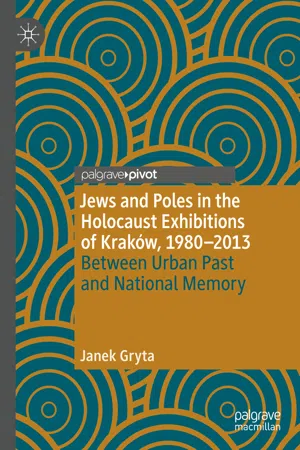
Jews and Poles in the Holocaust Exhibitions of Kraków, 1980–2013
Between Urban Past and National Memory
- English
- ePUB (mobile friendly)
- Available on iOS & Android
eBook - ePub
Jews and Poles in the Holocaust Exhibitions of Kraków, 1980–2013
Between Urban Past and National Memory
About this book
This book offers a unique approach to memory studies by focusing on local memory work conducted across the divide of the fall of Communism, whereas other histories have consistently used 1989 as a watershed moment. By examining the ways in which the Holocaust has been exhibited in Kraków, it investigates the impact local memory work has had on Polish collective memory and problematizes the importance of the fall of Communism for memory work. Using the Polish case study, it contributes to international debates on the nature of urban memory. It brings to the fore the role of mid-ranking governmental and municipal activists for local remembrance, investigates the relationship between the form and the content of the exhibitions, and highlights the importance of authenticity and emotional evocations for Holocaust remembrance. In particular, it focuses on the emergence of cosmopolitan memory of the Holocaust, a process with local, Kraków, sources.
Information
© The Author(s) 2020
J. GrytaJews and Poles in the Holocaust Exhibitions of Kraków, 1980–2013https://doi.org/10.1007/978-3-030-38979-6_11. Introduction
Kraków: Nodal Point in Polish-Jewish History
The Battlefield of Polish Memory
Memory, Museum and Identity
Book Structure and Sources
Bibliography
Abstract
The last decades of the twentieth century witnessed the emergence of cosmopolitan memory of the Holocaust, which has the potential to promote the global human rights regime. It is often seen as an American/Western European invention which spread to the East after the fall of the Iron Curtain, to the clear benefit of local populations. Yet in Poland, commemorations of the victims, and sometimes also of the perpetrators, of the Jewish Genocide have been a far more complex process. This study demonstrates that remembrance of the Holocaust in Kraków followed the cosmopolitan path long before this became a global standard, and that it offered a critical reading of the Polish national past which challenged ethno-nationalist visions of history and of the nation. This chapter outlines the most salient aspects of the Kraków past, sets out the battlefield of Polish memory and defines the basic terms which inform the study.
Keywords
Cultural memoryMuseumKrakówJewish historyIn the early years of the twenty-first century, if the Western media commented on Polish history or memory, it was generally because of Polish anti-Semitism. In 2018, the year in which I am writing these words, the Polish government has tried to criminalise information about Polish implication in the Holocaust. It granted new powers to the Institute of National Remembrance (Instytut Pamięci Narodowej, IPN), the state memorial agency. For a short while, the Institute could prosecute people who talked about ‘Polish death camps’ and, more importantly, who suggested that the Polish nation or the Polish state shared some responsibility for the crimes perpetrated by the Nazis. Such accounts were, according to the legislation, ‘against the facts.’1 The law was highly controversial. How can a legislature decide what is ‘against the facts’? What were the ‘facts’ to which it was referring? After all, research into Polish implication in Nazi crimes is ongoing, and even the most obvious and well-supported cases are contested.2 Scholarly and artistic activities, though these were not defined, were nominally exempt from prosecution, but tourism was not. In theory, Israeli guides could be sent to prison if they mentioned Polish crimes to their students during school trips to death camps.3 The new law was roundly criticised and stirred up international controversy.4 This escalated to the point that, allegedly, the American government threatened to limit military cooperation with the Polish state.5 Eventually, the controversial law was retracted.6 The affair has, nevertheless, confirmed the strength of the belligerent ethno-nationalism and anti-Semitism which were still widespread in Poland.
This book tells the other, far more salient side of the history of Polish memory. The conservative government felt the need to criminalise reference to Polish guilt because in 2018, in complete contrast to 1980, such information was widespread and readily accessible. In other words, and seen from historical distance, the ethno-nationalist vision of the past that insisted on Polish blamelessness and heroism was in retreat. It was still the dominant interpretation and it occasionally made surprising headway. However, it was not the only vision of Polish past. Polish cultural memory came to encompass (though it was still shrouded in controversy) information about Polish complacency and guilt that qualified stories of Polish heroism and martyrdom. By looking at thirty years of Holocaust exhibitions in Kraków, the ‘cultural capital’ of Poland, this book traces this seismic change in Polish memory and, consequently, in Polish national identity.
The initial idea for this project was somewhat broader. From the start, I was interested in the Holocaust exhibitions in Kraków, but my assumption was that they would follow the mould and insist on Polonising the past. After all, the activists in Warsaw and even Auschwitz followed that pattern.7 However, local activists in Kraków took a significantly different route. They focused on local, urban past, told the story of Jewish suffering and offered a more critical and open reading of the Polish nation’s past.
This book examines the genealogy of the unique, critical and inclusive Holocaust exhibitions in Kraków, contrasting them with the ethno-nationalist projects which have otherwise dominated Polish memory work. In 1980, the starting point of this book, a new, tiny, one-room Holocaust exhibition was unveiled in Kraków. It constituted part of an exhibition at an Old Synagogue; this was the Jewish branch of the Historical Museum of the City of Kraków (Muzeum Historyczne Miasta Krakowa, MHK), which was, back then, one of its least popular branches.8 In 1983 the first stand-alone Polish Holocaust museum opened in the city in the Eagle Pharmacy, a wartime ghetto apothecary. Both presentations offered a new vision of Kraków’s and Poland’s past by including the Jewish past in the history of Poland. More importantly, they were created at a time when the Holocaust was excluded from exhibitions in other museums. Even at Auschwitz, Jewish suffering was pushed into the background and Polish martyrdom was highlighted.9 Fast forward thirty years and, in Kraków, Jewish histories moved from the margins of the museum world to its centre. The year 2013 witnessed the completion of a multisite memorial project, the Memory Trail. Initiated by the MHK, the Trail narrated the whole of Kraków’s war history. Here, the Jewish past was an integral part of the city’s history and Jews were depicted as Krakowians, as Poles of Jewish ethnicity. The Schindler’s Factory, a key part of the Trail, became the most popular of all the MHK branches.10
Mapping the origins and developments of those exhibitions, and placing them in the context of changes in the broader cityscape, this book makes three claims. It analyses the process of the cosmopolitanisation of memory in Kraków; it traces the rise of urban memory; it problematises the importance of the 1989 threshold for memory studies.
Firstly, the book charts the cosmopolitanisation of memory of the war past. Based on a belief in the equality of all human beings, cosmopolitan memory supports openness, tolerance and inclusivity. It seeks to recognise the difference between human beings, and at the same time to prevent stigmatisation or alienation.11 Indeed, it is characterised by ‘the adherence to a set of principles and values destined to attain global social justice.’12 In practical terms, cosmopolitan memory aims for the pluralisation of memorial narratives, the transition from narratives centred on a nation’s heroes to those focused on the victims of a nation’s crimes and the ‘proliferation of decontextualized and universalised histori...
Table of contents
- Cover
- Front Matter
- 1. Introduction
- 2. The Shaping of Holocaust Memory Before the Fall of Communism: The 1980s
- 3. Freezing and Restoring the Memory of the Holocaust: From 1989 to 2004
- 4. Feeling (for) Kraków’s Traumatic Past: The 2010s
- 5. Conclusion
- Back Matter
Trusted by 375,005 students
Access to over 1.5 million titles for a fair monthly price.
Study more efficiently using our study tools.
Frequently asked questions
Yes, you can cancel anytime from the Subscription tab in your account settings on the Perlego website. Your subscription will stay active until the end of your current billing period. Learn how to cancel your subscription
No, books cannot be downloaded as external files, such as PDFs, for use outside of Perlego. However, you can download books within the Perlego app for offline reading on mobile or tablet. Learn how to download books offline
Perlego offers two plans: Essential and Complete
- Essential is ideal for learners and professionals who enjoy exploring a wide range of subjects. Access the Essential Library with 800,000+ trusted titles and best-sellers across business, personal growth, and the humanities. Includes unlimited reading time and Standard Read Aloud voice.
- Complete: Perfect for advanced learners and researchers needing full, unrestricted access. Unlock 1.5M+ books across hundreds of subjects, including academic and specialized titles. The Complete Plan also includes advanced features like Premium Read Aloud and Research Assistant.
We are an online textbook subscription service, where you can get access to an entire online library for less than the price of a single book per month. With over 1.5 million books across 990+ topics, we’ve got you covered! Learn about our mission
Look out for the read-aloud symbol on your next book to see if you can listen to it. The read-aloud tool reads text aloud for you, highlighting the text as it is being read. You can pause it, speed it up and slow it down. Learn more about Read Aloud
Yes! You can use the Perlego app on both iOS and Android devices to read anytime, anywhere — even offline. Perfect for commutes or when you’re on the go.
Please note we cannot support devices running on iOS 13 and Android 7 or earlier. Learn more about using the app
Please note we cannot support devices running on iOS 13 and Android 7 or earlier. Learn more about using the app
Yes, you can access Jews and Poles in the Holocaust Exhibitions of Kraków, 1980–2013 by Janek Gryta in PDF and/or ePUB format, as well as other popular books in History & Eastern European History. We have over 1.5 million books available in our catalogue for you to explore.