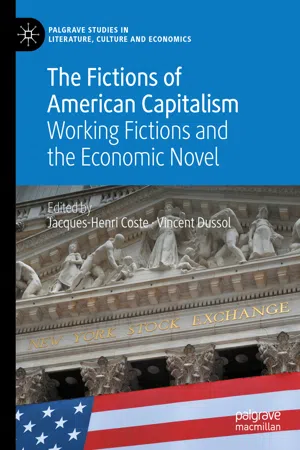
The Fictions of American Capitalism: Working Fictions and the Economic Novel introduces a new way of thinking about fiction in connection with capitalism, especially American capitalism. These essays demonstrate how fiction fulfills a major function of the American capitalist engine, presenting various formulations of American capitalism from the perspective of economists, social scientists, and literary critics. Focusing on three narratives—fictitious capital, working fictions, and the economic novel—the volume questions whether these three types of fiction can be linked under the sign of capitalism. This collection seeks to illustrate the American economy's dependence on fictitiousness, America's ideological fictions, and the nation's creative literary fiction. In relation to what the credit and banking crisis of 2007–2008 exposed about the "unreal" base of the economy, the volume concludes with a call to recognize the economic humanities, arguing that American fiction and American literary studies can provide a useful mirror for economists.
eBook - ePub
The Fictions of American Capitalism
Working Fictions and the Economic Novel
- English
- ePUB (mobile friendly)
- Available on iOS & Android
eBook - ePub
The Fictions of American Capitalism
Working Fictions and the Economic Novel
About this book
Information
Topic
LetteraturaSubtopic
Storia economica© The Author(s) 2020
J.-H. Coste, V. Dussol (eds.)The Fictions of American CapitalismPalgrave Studies in Literature, Culture and Economicshttps://doi.org/10.1007/978-3-030-36564-6_11. The Fictions of American Capitalism: An Introduction
Jacques-Henri Coste1 and Vincent Dussol2
(1)
Université Sorbonne Nouvelle - Paris 3, Paris, France
(2)
Université Paul-Valéry Montpellier 3, Montpellier, France
The 2008 Crisis as Seen Through the Prism of Fiction
Robert E. Lucas , 1995 Nobel laureate, developed a model of “rational expectations,” in which agents are posited as rational actors making predictions, benchmarking their preferences on the information and paradigms at their disposal and acting accordingly. Fictional representations of future states matter in choice-making, hence the need to create make-believe analogues: models of the represented target system which help reduce uncertainty and risk. In “What Economists Do,” Lucas provocatively emphasizes the role of modeling as a form of useful prospective fictionality: conformity with an existing theoretical model fosters a convergence of choices on a common representation of the future to-come. He writes about the economist’s profession: “but we are basically story-tellers, creators of make-believe economic systems”; and he proceeds to give substance to his words: “Rather than try to explain what this story-telling activity is about and why I think it is a useful—even an essential—activity, I thought I would just tell you a story and let you make of it what you like” (1988). This description of his discipline by a leading economist, acknowledging the part played in it by forms of fiction, takes us to the heart of the present book.
Our purpose is to introduce a new, transdisciplinary , critical way of thinking about fiction in connection with capitalism, particularly American capitalism, in relation to what the credit and banking crisis of 2007–2008 exposed about the “unreal ” base of the economy. Marx named stocks and securities fiktives Kapital (Marx 1894 , III, V, p. 25). The concept (translated as “fictitious capital ”) gained fresh currency after the crisis and has since been reconsidered from a variety of perspectives.1
In periods when the logics of finance become pervasive, there is a growing disconnect between production dynamics and capital expansion. Surplus value is primarily reinvested through financial channels rather than through fixed capital. The locus of accumulation shifts to finance capital. Credit, shares, debt or various types of paper money become abstract financial instruments that derive their value from the representation of the future profits that they promise to bring. Speculation outpaces industrial production and consumption. Money turns into a “fictitious commodity ” (Polanyi 1944, p. 71) when it demands the mediation of futurity for outcomes in the present. The economy becomes unreal , that is to say fictional. A “free-floating” dimension is then imparted to capital (Jameson 1997; Finch 2015), exempting it from a referential imperative or from fixed geographical locations (Castells 1996; Harvey 2010). Critics coming from the Humanities (Goux 1994; Jameson 2000; Nilges 2014) have described the process as a gradually developing assumption among financial circles that the abstract power of money as an immaterial signifier is bound to make it a reflexive and self-generating form of value. The rules of abstraction (La Berge 2014b) worked hand in hand with the fictions of the market’s god-like agency and unlimited reflexivity. Belief in boundless growth was adhered to until 2008; the financial bubble burst and all that had seemed solid vanished into thin air.
When governments and financial institutions rescued a threatened capitalist system by taking over bad debts and bailing out a number of hand-picked sinking banks, the semiotic and reflexive substance of economic value turned more political. Massive amounts of money were created and injected into the economy through stabilizing plans, quantitative easing and forward guidance. The exposure of “the fictiveness of fictitious capital” that crystallizes into liquidity (the capitalist dematerialized abstraction of value), and in the power of granting credits and canceling debts, was a shock for the mainstream economists believing in the substantive value of money and for the staunch advocates of a self-regulated financial market. This exposure acted as a reminder that fiat money is devoid of intrinsic value, even though it is the fundamental collective institution and social link in market economies (Aglietta 1976/2016; Orléan and Diaz-Bone 2013 ; Orléan 2014). The crisis also revealed the hidden market/state nexus presiding over its own invisibility, and uncovered its institutional and political stability (Cossu-Beaumont et al. 2016).
On the theoretical front, the 2008 crisis evidenced the constructivist intentions behind economic models , their rhetorical, political and performative orientations (Morgan 2001; Butler 2010), which were not overly concerned with factual truth. It acted as an epiphany, revealing that “th[e] [e]xisting economic order was no more than the implementation of a utopia” and its “tutelary theory a pure mathematical fiction” (Bourdieu 1998). Had not Milton Friedman (1953) provocatively argued that the realism of assumptions does not matter as long as the predictions derived from them are correct? That was when economics, queen of the more objective social sciences, became an “unrealistic discipline” challenging science’s rational quest for truth, with a contrasting counterfactual approach that turned its models into virtual works of fiction (McCloskey 1990, 1998; Frigg 2010; Boyer , infra). Economists’ reliance on a “philosophy of ‘as if’” (Vaihinger 1924; Appiah 2017) was made plain, justifying McCloskey’s description of the profession as “tellers of stories and makers of poems” (1990, p. 5).
Which Theory of Capitalism Informs This Collection?
Capitalism is a controversial concept and process that has engendered a conflict of paradigms and a long ideological war of words when defining the term as a feature of society or as a socioeconomic totality (Braudel 1977; Boyer 1990; Streeck 2012; Kramer 2016; Piketty 2014; Hodgson 2015; Kocka 2016; Levy ...
Table of contents
- Cover
- Front Matter
- 1. The Fictions of American Capitalism: An Introduction
- Part I. Theoretical Overviews
- Part II. Non-Literary Fictions of American Capitalism
- Part III. Literary Representations of Capitalism
- Part IV. Coda
- Back Matter
Trusted by 375,005 students
Access to over 1.5 million titles for a fair monthly price.
Study more efficiently using our study tools.
Frequently asked questions
Yes, you can cancel anytime from the Subscription tab in your account settings on the Perlego website. Your subscription will stay active until the end of your current billing period. Learn how to cancel your subscription
No, books cannot be downloaded as external files, such as PDFs, for use outside of Perlego. However, you can download books within the Perlego app for offline reading on mobile or tablet. Learn how to download books offline
We are an online textbook subscription service, where you can get access to an entire online library for less than the price of a single book per month. With over 1.5 million books across 990+ topics, we’ve got you covered! Learn about our mission
Look out for the read-aloud symbol on your next book to see if you can listen to it. The read-aloud tool reads text aloud for you, highlighting the text as it is being read. You can pause it, speed it up and slow it down. Learn more about Read Aloud
Yes! You can use the Perlego app on both iOS and Android devices to read anytime, anywhere — even offline. Perfect for commutes or when you’re on the go.
Please note we cannot support devices running on iOS 13 and Android 7 or earlier. Learn more about using the app
Please note we cannot support devices running on iOS 13 and Android 7 or earlier. Learn more about using the app
Yes, you can access The Fictions of American Capitalism by Jacques-Henri Coste, Vincent Dussol, Jacques-Henri Coste,Vincent Dussol in PDF and/or ePUB format, as well as other popular books in Letteratura & Storia economica. We have over 1.5 million books available in our catalogue for you to explore.