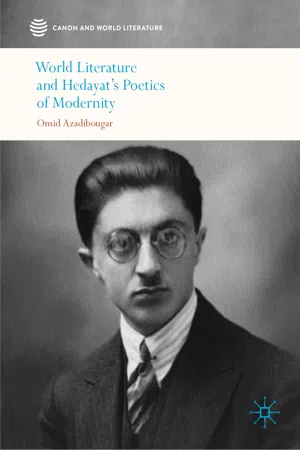
This book introduces the canonical figure Sadegh Hedayat (1903–1951) and draws a comprehensive image of a major intellectual force in the context of both modern Persian Literature and World Literature. A prolific writer known for his magnum opus, The Blind Owl (1936), Hedayat established the use of common language for literary purposes, opened new horizons on imaginative literature and explored a variety of genres in his creative career. This book looks beyond the reductive critical tendencies that read a rich and diverse literary profile in light of Hedayat's suicide, arguing instead that his literary imagination was not solely the result of genius but rather enriched by a vast network of the world's literary traditions. This study reflects on Hedayat's attempts at various genres of artistic creation, including painting, fiction writing, satire and scholarly research, as well as his persistent struggles for artistic authenticity, which transcended solidly established literary and artistic norms. Providing a critical reading of Hedayat's work to untangle aspects of his writing – including reflections on science, religion, nationalism and coloniality – alongside his pioneering work on folk culture, and how humor informs his writings, this text offers a critical review of the status of Persian literature in the contemporary landscape of the world's literary studies.
- English
- ePUB (mobile friendly)
- Available on iOS & Android
eBook - ePub
World Literature and Hedayat’s Poetics of Modernity
About this book
Information
© The Author(s) 2020
O. AzadibougarWorld Literature and Hedayat’s Poetics of ModernityCanon and World Literaturehttps://doi.org/10.1007/978-981-15-1691-7_11. Persian Literature, World Literature
Omid Azadibougar1
(1)
Hunan Normal University, Changsha, China
Omid Azadibougar
Research for this study was carried out in an academic environment where the humanities, in general, and the study of literature, in particular, are subdued by three powerful forces. First, practical fields, specifically the sciences, are attributed more significance to by universities; therefore, research infrastructure is funneled toward these fields and the process marginalizes the humanities, blocking growth. Second, work in the humanities is strictly contained by religious establishments that aspire to Islamicize the disciplines as well as by political institutions that control a centralized education system and the publishing market, substantially limiting the potentials of creative research. Third, literary studies are in a constant struggle with the hegemony of Western theories and ideas in the intellectual sphere; this reduces the study of literature to the importation and application of theory, often used quite religiously as a set of pre-established ideas without much critical engagement; this kind of criticism prefers ready-made ideas to creative practices. What this means for Persian literary studies is that its critical relevance is systematically muted, and its potential contributions to literary studies interrupted.
The impact of these three forces may be inevitable at the current historical moment. Nevertheless, their existence implies that while speaking of world literature in an unwelcoming context might seem to be slightly out of touch with the immediate environment, it also provides a new space to deliberate over these and other issues. However, regardless of how we define what world literature is as a scholarly perspective through which we engage with both what the world is and what constitutes literature, there is unanimous agreement that the field of literary dissemination and consumption is not level. In other words, not all literary cultures have equitable visibility, however it may be measured; this restricts the potentials of world literature for Persian literary studies. Despite the differences in their approaches to world literature as a concept, solutions have been proposed to revisit, study, appreciate, and recognize literary traditions or works that have so far been neglected in comparative literary studies, particularly at Western institutions. This neglect could be either due to the disadvantaged position of those traditions in the world’s network of literary dissemination , or ensue from the hegemony of critical grids that have somehow not allowed valuable works or literary traditions to become internationally known or visible.
As such, therefore, a promise of world literature is a less asymmetrical and more egalitarian field for the study of the literatures of the world, as parts of a whole that are connected and matter. This is a narrow space that a literary tradition such as modern Persian could use not only to counter the influence of repressive forces, but also to seek international recognition, achieve relative awareness of its historical moment, and theorize its condition. If one subscribed to this vision, however, discussing the canon of Persian literature, particularly modern literature, may strike one as slightly hypocritical for a variety of reasons.
For one thing, if there is a relationship between literary criticism and the world at large, discussing the canon of modern Persian literature in Iran will only contribute to strengthening the hegemony of Persian in a context where non-Persian speaking populations (e.g., Turkish, Kurdish, Baluchi, Lori, among many others) are not given equal access to the cultural apparatuses of representation. As a result of the existing linguistic imbalance in political and cultural fields, world literature could seem like a luxury concept: Scholarly literature has only occasionally acknowledged the plurilingual composition of contemporary Iranian society (Azadibougar and Haddadian-Moghaddam 2019; Haddadian-Moghaddam and Meylaerts 2014, 2015) and because of that speaking of the world’s languages and literatures merely postpones more urgent questions; charity indeed begins at home. Further work on Persian would only exacerbate the situation for languages that are struggling—politically, socially, and culturally—for their existence and recognition.
In fact, while presenting Persian as the only linguistic vehicle that represents the entirety of Iran’s population and corpus of literary production goes against the egalitarian promise of world literature, it hides the other side of the dominance of the language in Iran. There is no doubt that in the modern world Persian is a peripheral language: Contributions by Persian literature, particularly modern, to world literature have been few and, compared to other languages, the number of literary documents translated from the language is rather small.1 Despite its international position, however, the institutions that regulate and promote Persian have resisted the proper recognition of other Iranian languages and literatures under the banner of nationalism . In 2014, for instance, the plan to introduce other Iranian languages and literatures, “mother tongues,” at universities was abandoned because of objections from the Academy of Persian Language and Literature, a powerful cultural institution; the plan was conceived to be “a serious threat to the Persian language” (Fararu 2014), i.e., the “national language.”
At the same time, the modern Persian literary history that is written and studied in Iran conveniently neglects the transnational history of the language, something that has been the subject of extensive research at non-Iranian institutions (Sharma 2000; Dudney 2015; Keshavmurthy 2016; Perry 2018; Green 2019). Persian is in contemporary use as an official language in Afghanistan and Tajikistan and is widely spoken in Uzbekistan, and contributions by intellectuals and authors from these and other contexts are currently excluded from Persian literary history (Ahmadi 2004; Green and Arbabzadeh 2012; Fani 2019).2 This implies that in the interests of national cultural identity politics, the transnational aspects and potentials of the language are simply muted at Iranian institutions. Hence, the contradictory position of Persian between its national and international positions and a reason why the study of world literature might seem less than effective as a critical discourse.
Besides, if one considered other issues like gender equality , the rights of religious minorities, authoritarian governance, unsustainable development, economic grievances, and delayed democratization, then discussing world literature stands closer to an abstract distraction than a critical force for constructive literary or cultural critique. Due to the multiplicity of urgent issues, there is in fact sufficient reason to argue that the study of world literature is a secondary concern: As Persian literature is restricted by political strife and censorship, it is at a disadvantage for competition in the global market with burgeoning languages of more liberal environments; so, without changing the status quo to give intellectual endeavors the space to freely develop, creativity will not have an opportunity to flourish and that is why the political may seem to essentially precede the literary.
There is also a bitter irony in speaking about world literature from an Iranian perspective. If the “world” implied in the phrase somehow refers to the modern notions of globalism, there is no doubt that Iran is one of the world’s last remaining sociocultural spheres that, wrapped in a voluntary isolation, the result of a revolutionary history, has not been integrated into global economy yet; add the fact that nativism is pretty much alive and quite powerful, defending “our” culture and shielding it from foreign influence.3 This emerges most tangibly in the unresolved intellectual and troubled political relations between Iran and “the West” (and the “modernity” it stands for). From this point of view, with a world that is inaccessible for a variety of reasons, studying world literature seems to be irrelevant, something that is compounded by the declining status of literature in general and falling readership during the past decades.
From a disciplinary point of view, too, engaging world literature in an academic system that does not have a single department of Comparative Literature proper can be a problem, perhaps suggesting that the idea is attractive because of its current appeal rather than its genuine scholarly potentials and contextual relevance. Theo D’haen argues that national thinking in history and culture preceded the introduction of comparative perspectives that emerged in Comparative Literature as a discipline (2011, 47–52). This might be key to understanding the delayed introduction of comparative literary studies in Iran.
If national thinking is a precondition of Comparative Literature, then one should take a look at the process of the formation of the Iranian modern nation-state to understand the delayed introduction of the discipline at universities, which could be partly due to the unfinished nation-building project. If we approached this question from a linguistic perspective, things could be better explained. The modern nation-state established Persian as the “national language” without giving other Iranian languages proper recognition 4 or offering solutions to reconcile the national status of Persian with coexisting “local” languages. As a result, even though Persian ...
Table of contents
- Cover
- Front Matter
- 1. Persian Literature, World Literature
- 2. Writing for His Shadow
- 3. Contested Canonization
- 4. Dreaming from the Margins
- 5. Intellectual Journeys
- 6. Textual Strategies
- 7. Scholarly Ventures
- Back Matter
Trusted by 375,005 students
Access to over 1.5 million titles for a fair monthly price.
Study more efficiently using our study tools.
Frequently asked questions
Yes, you can cancel anytime from the Subscription tab in your account settings on the Perlego website. Your subscription will stay active until the end of your current billing period. Learn how to cancel your subscription
No, books cannot be downloaded as external files, such as PDFs, for use outside of Perlego. However, you can download books within the Perlego app for offline reading on mobile or tablet. Learn how to download books offline
Perlego offers two plans: Essential and Complete
- Essential is ideal for learners and professionals who enjoy exploring a wide range of subjects. Access the Essential Library with 800,000+ trusted titles and best-sellers across business, personal growth, and the humanities. Includes unlimited reading time and Standard Read Aloud voice.
- Complete: Perfect for advanced learners and researchers needing full, unrestricted access. Unlock 1.5M+ books across hundreds of subjects, including academic and specialized titles. The Complete Plan also includes advanced features like Premium Read Aloud and Research Assistant.
We are an online textbook subscription service, where you can get access to an entire online library for less than the price of a single book per month. With over 1.5 million books across 990+ topics, we’ve got you covered! Learn about our mission
Look out for the read-aloud symbol on your next book to see if you can listen to it. The read-aloud tool reads text aloud for you, highlighting the text as it is being read. You can pause it, speed it up and slow it down. Learn more about Read Aloud
Yes! You can use the Perlego app on both iOS and Android devices to read anytime, anywhere — even offline. Perfect for commutes or when you’re on the go.
Please note we cannot support devices running on iOS 13 and Android 7 or earlier. Learn more about using the app
Please note we cannot support devices running on iOS 13 and Android 7 or earlier. Learn more about using the app
Yes, you can access World Literature and Hedayat’s Poetics of Modernity by Omid Azadibougar in PDF and/or ePUB format, as well as other popular books in Literature & Languages. We have over 1.5 million books available in our catalogue for you to explore.