Cosmopolitan Education and Inclusion
eBook - ePub

Cosmopolitan Education and Inclusion

Human Engagement and the Self

  1. English
  2. ePUB (mobile friendly)
  3. Available on iOS & Android
eBook - ePub

Cosmopolitan Education and Inclusion

Human Engagement and the Self

About this book

This book expands understanding of cosmopolitan education that has the potential
to cultivate deliberative pedagogical encounters in universities. The authors
argue that cosmopolitan education in itself is an act of engaging with strangeness,
otherness, difference and inclusion/exclusion. What follows is the engendering
of inclusive human encounters in which freedom and rationality – guided
by co-operative, co-existential and oppositional acts of resistance – can be exercised.
The chapters centre around the enactment of universal hospitality, unconditional
engagement, difference, intercultural learning, democratic justice and
openness to develop a robust and reflexive defence of cosmopolitan education.
This book will appeal to scholars of cosmopolitan education as well as democratic
and inclusive education.

Trusted by 375,005 students

Access to over 1.5 million titles for a fair monthly price.

Study more efficiently using our study tools.

Information

Year
2020
Print ISBN
9783030384265
eBook ISBN
9783030384272
Š The Author(s) 2020
Y. Waghid et al.Cosmopolitan Education and Inclusionhttps://doi.org/10.1007/978-3-030-38427-2_1
Begin Abstract

1. Citizens of the World: A Neo-Kantian View

Yusef Waghid1 , Chikumbutso Herbert Manthalu2 , Judith Terblanche3 , Faiq Waghid4 and Zayd Waghid5
(1)
Stellenbosch University, Stellenbosch, South Africa
(2)
School of Education, University of Malawi, Zomba, Malawi
(3)
Department of Accounting, University of the Western Cape, Bellville, South Africa
(4)
Centre for Innovative Learning Technology, Cape Peninsula University of Technology, Cape Town, South Africa
(5)
Faculty of Education, Cape Peninsula University of Technology, Mowbray, South Africa
Yusef Waghid (Corresponding author)
Chikumbutso Herbert Manthalu
Judith Terblanche
Faiq Waghid
Zayd Waghid

Abstract

In this chapter, we expound on Martha C. Nussbaum’s notion of universal hospitality in the pursuit of universal aspirations and world co-operation in an atmosphere of respect and human dignity. We specifically show why respect for cultural differences and an enactment of human responsibility can contribute towards confronting human problems on the basis of critical argumentation and deliberation as human beings endeavour to eradicate prejudice, inequality and injustices vis-à-vis their educational concerns. Nussbaum frames her understanding of cosmopolitanism in light of Greek Stoicism, which considers the basis for human community as constituted in the worth of reason in each and every human being. We specifically expound on the idea of a cosmopolitan as a citizen of the world whose dignity is bounded by reason and respect for other human beings. Thereafter, we show how such a view of cosmopolitanism influences education, more specifically teaching and learning at universities.
Keywords
Universal hospitalityCo-operationRespectDignityCultural differencesResponsibilityArgumentationDeliberationPrejudiceInequalityInjusticesEducational concernsCosmopolitanismCommunityReasonCitizenTeachingLearningUniversities
End Abstract

Introduction

One of the most vigorous proponents of a neo-Kantian understanding of cosmopolitanism is the American political philosopher, Martha Nussbaum (2010). Nussbaum frames her understanding of cosmopolitanism in light of Greek Stoicism, which considers the basis for human community as constituted in ‘the worth of reason in each and every human being’ (2010, p. 30). In this chapter, referring to Martha Nussbaum’s notion of a cosmopolitan being, we expound on the idea of a cosmopolitan as a citizen of the world whose dignity is bounded by reason and respect for other human beings. Thereafter, we show how such a view of cosmopolitanism influences education, more specifically teaching and learning at universities.

Reason, Respect and Deliberation

According to Nussbaum (2010, p. 30), cosmopolitans revere reason as the basis for all human action. Citing the Greek Stoic, Cicero, Nussbaum (2010, p. 30) holds that every human being ought to promote the moral well-being of all other humans on the grounds of being rational. By rationality, Nussbaum recognises the importance of holding all humans accountable to the moral standards of treating all other humans with equal respect irrespective of their differences in nationality, class, ethnic affiliation or gender (Nussbaum, 2010, p. 31). Consequently, discriminating against human beings on the basis of the above-mentioned differences is not only tantamount to an act of showing disrespect but also acting irrationally, and by implication, in an un-cosmopolitan way. Without exercising respect for reason, humans would not be capable of resolving their problems. This is so, because humans cannot make moral judgements about other human beings without the virtue of respect and dignity towards others. And, when humans do not act rationally, they would in any case be incapable of engaging in deliberations about problems common to all humans, including themselves. Put differently, human problems ought to be resolved on the basis of deliberations guided by acts of rationality . The latter practice is the first condition of acting in a cosmopolitan manner. That is, humans live out their lives as citizens of the world or cosmopolitans when they engage with all other humans on the grounds of rationality and respect for one another (Nussbaum, 2010, p. 30). Acting in a cosmopolitan manner, therefore, has at least the following three practices in mind:
Firstly, central to treating all human beings with dignity and respect as citizens of the world is the idea that all humans are “our fellow city dwellers” and should not be thought of as “strangers” (Nussbaum, 2010, p. 31). Drawing on Cicero once again, Nussbaum posits “we should think of nobody as a stranger, as outside our sphere of concern and obligation” (2010, p. 31). And, when no one in a cosmopolitan world is considered a stranger then all humans are considered welcome everywhere. By implication, human hospitality seems to be the basis according to which all human beings are recognised and treated respectfully everywhere. In this regard, Nussbaum (2010, p. 32) extends the idea of cosmopolitan hospitality to “come to respect the humanity even of our political enemies, thinking of ourselves as born to work together and inspired by a common purpose.” The upshot of such a view of cosmopolitanism is that humans would not be in a position to deliberate with one another about their common problems if they do not show respect for one another’s perspectives and treat one another’s different points of view with the dignity it deserves. The practice of cosmopolitan hospitality seems to be connected to cultivating deliberations about human problems. Irrespective of whether human beings were to be waged in war or their actions motivated by feelings of wanting to see the extermination of others and hatred for others, respect for human dignity and the virtue of reason should always be revered (Nussbaum, 2010, p. 33). Nussbaum (2010, p. 32) avers that such Stoic cosmopolitanism is primarily concerned with the “renunciation of aggression and the resort to force only in self-defense, when all discussion has proven futile” (Nussbaum, 2010, p. 32). In other words, cosmopolitans do not rule out hostility in its entirety, but only when all efforts at rational human engagement have failed to yield desirable results, “punishments” may be meted out. Here, one specifically thinks of the necessity to curb further acts of violence perpetrated against the citizens of Yemen. The incumbent (and we would argue, necessary) hostile actions of others in avoiding further starvation of many of the citizens of the beleaguered and war-stricken country, become necessary to prevent further acts of aggression on the part of those who perpetrate violence on local communities. In other words, when deliberations about peaceful co-existence and respect for human dignity have not had the desired effects, acts of hostility become necessary to halt further violations of human rights and dignity . It behoves antagonistic groups in the Saudis and Houthis of Yemen—claimed to be supported by Shia militia funded by Iran—to engage rationally in deliberation about the ongoing and devastating war in the country that has already resulted in human starvation and genocide. Only then would respect for reason and human dignity have manifested in the actions of people. That is, the possibility of living in a cosmopolitan way would be enhanced when rationality and respect for one another would hold sway.
Secondly, Nussbaum uses the view Diogenes, the Greek Cynic had of being “a citizen of the world” as a premise to espouse the insistence of cosmopolitanism that humans are affiliated both to their rationality and to “universal aspirations and concerns” (2010, p. 29). Being affiliated to her rational humanity, a “citizen of the world,” following Nussbaum (2010, pp. 29–30), in effect dwells in two communities: the local community of his or her birth and the community of human argument and engagement. And, as for the Stoics and Nussbaum, this collective community comprises both a moral and a social world. In a moral world, cosmopolitans do ...
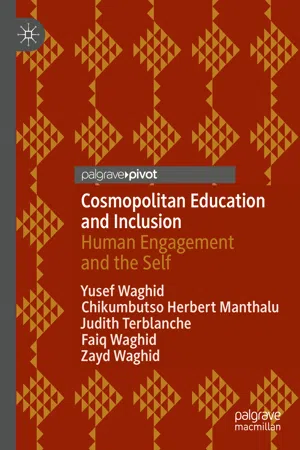
Table of contents

  1. Cover
  2. Front Matter
  3. 1. Citizens of the World: A Neo-Kantian View
  4. 2. A City of Refuge for Innocents: Cosmopolitanism as an Interruption
  5. 3. Cosmopolitan Norms and the Art of Deliberation: Beyond Forgiveness
  6. 4. Rooted Cosmopolitan Education
  7. 5. The Challenge of Culture in Cosmopolitanism
  8. 6. Universalism and Judgements in Educational Encounters
  9. 7. Centring Deliberation in Modern Educational Encounters
  10. 8. On Cosmopolitanism Through Deliberative Education Extended: Beyond Moral Respect
  11. 9. In Becoming Reflexive: Implications for Education
  12. 10. Developing a Cosmopolitanist-deliberative Framework for MOOCs in South African (Higher) Education
  13. Back Matter

Frequently asked questions

Yes, you can cancel anytime from the Subscription tab in your account settings on the Perlego website. Your subscription will stay active until the end of your current billing period. Learn how to cancel your subscription
No, books cannot be downloaded as external files, such as PDFs, for use outside of Perlego. However, you can download books within the Perlego app for offline reading on mobile or tablet. Learn how to download books offline
Perlego offers two plans: Essential and Complete
  • Essential is ideal for learners and professionals who enjoy exploring a wide range of subjects. Access the Essential Library with 800,000+ trusted titles and best-sellers across business, personal growth, and the humanities. Includes unlimited reading time and Standard Read Aloud voice.
  • Complete: Perfect for advanced learners and researchers needing full, unrestricted access. Unlock 1.5M+ books across hundreds of subjects, including academic and specialized titles. The Complete Plan also includes advanced features like Premium Read Aloud and Research Assistant.
Both plans are available with monthly, semester, or annual billing cycles.
We are an online textbook subscription service, where you can get access to an entire online library for less than the price of a single book per month. With over 1.5 million books across 990+ topics, we’ve got you covered! Learn about our mission
Look out for the read-aloud symbol on your next book to see if you can listen to it. The read-aloud tool reads text aloud for you, highlighting the text as it is being read. You can pause it, speed it up and slow it down. Learn more about Read Aloud
Yes! You can use the Perlego app on both iOS and Android devices to read anytime, anywhere — even offline. Perfect for commutes or when you’re on the go.
Please note we cannot support devices running on iOS 13 and Android 7 or earlier. Learn more about using the app
Yes, you can access Cosmopolitan Education and Inclusion by Yusef Waghid,Chikumbutso Herbert Manthalu,Judith Terblanche,Faiq Waghid,Zayd Waghid in PDF and/or ePUB format, as well as other popular books in Education & Education Theory & Practice. We have over 1.5 million books available in our catalogue for you to explore.