eBook - ePub
Romanticism and the Letter
- English
- ePUB (mobile friendly)
- Available on iOS & Android
eBook - ePub
Romanticism and the Letter
About this book
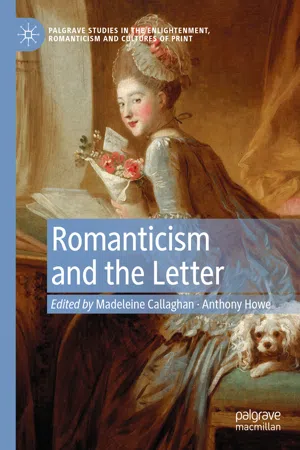
Romanticism and the Letter is a collection of essays that explore various aspects of letter writing in the Romantic period of British Literature. Although the correspondence of the Romantics constitutes a major literary achievement in its own right, it has received relatively little critical attention. Essays focus on the letters of major poets, including Wordsworth, Byron, Shelley and Keats; novelists and prose writers, including Jane Austen, Leigh Hunt and Charles Lamb; and lesser-known writers such as Melesina Trench and Mary Leadbeater. Moving from theories of letter writing, through the period's diverse epistolary culture, to essays on individual writers, the collection opens new perspectives for students and scholars of the Romantic period.
Information
© The Author(s) 2020
M. Callaghan, A. Howe (eds.)Romanticism and the LetterPalgrave Studies in the Enlightenment, Romanticism and Cultures of Printhttps://doi.org/10.1007/978-3-030-29310-9_11. Romanticism and the Letter: Introduction
Madeleine Callaghan1 and Anthony Howe2
(1)
University of Sheffield, Sheffield, UK
(2)
Birmingham City University, Birmingham, UK
The period 1700 to 1918, write Frank and Anita Kermode, is ‘the great age of letter-writing’.1 It is also three distinctive periods of letter writing, the first of which, the eighteenth century, has often been singled out for its literary superiority. Masters of the form such as Walpole, Chesterfield, Gray, and Pope have been widely praised for their elegance of style and cultured familiarity of address. The letter was leisured, fine writing and, in more than one case, the line between private correspondence and published work is blurred, deliberately or otherwise. The nineteenth century, so the story goes, was too fast to sustain such excellence and ushered in a decline in literary letter writing that technology would eventually render absolute. Thus Richard Garnett, editing a late Victorian selection of Shelley’s letters, commends the ‘familiar ease’ of the eighteenth-century letter as the acme of the form’s ‘literary value’ while regretting that in his own century letter writing is no longer ‘an art among men of culture’ but has become the ‘earnest practical thing which it had always been among men of business’.2 This apparent falling off is mirrored in the generic composition of published writings, with epistolary literature declining in popularity as the nineteenth century proceeded.3
Epistolary communication, as we approach the British Romantic period, was in a state of bustle and progress, largely determined by the need for faster communications during the alarums of a French invasion. Thomas De Quincey recalled these, for him, profoundly exciting changes, in his nostalgic final contribution to Blackwood’s Magazine, ‘The English Mail–Coach, Or the Glory of Motion’ (1849):
SOME twenty or more years before I matriculated at Oxford, Mr Palmer, M. P. for Bath, had accomplished two things, very hard to do on our planet, the Earth, however cheap they may happen to be held by the eccentric people in comets: he had invented mail-coaches, and he had married the daughter of a duke.4
Although John Palmer did not marry the daughter of a Duke, he did, approximately twenty years before De Quincey’s arrival at Oxford in 1803, usher in what Howard Robinson calls a ‘new era in postal services’, one that would last half a century until rail would bring another revolution in epistolary communication.5 For the authors considered in the following pages, however, Palmer’s revolution was immediately transformative. His new mail coaches were lighter, faster, and more secure than the crawling, highwayman-ravaged stagecoaches they replaced. They benefitted from better, increasingly ‘macadamized’ roads, regular changes of high-quality horses, and, unlike the creaking stagecoaches, stopped only for official postal business.6 ‘It’s felony to stop the mail’, De Quincey exulted: ‘Look at those turnpike gates; with what deferential hurry, with what an obedient start, they fly open at our approach!’.7 In 1780, the journey from London to Sheffield took twenty-six hours; twenty years earlier the same journey had taken four days.8 Such ‘velocity’ was ‘at that time unprecedented’ and captivated the daredevil while terrifying the timid.9 If the young De Quincey was spellbound, then for Wordsworth, the ‘fierce career’ of coach travel summarized the relentlessness of modernity while encouraging and enabling the tourism of surfaces he so despised.10 Although, with its ‘natural pace of ten miles an hour’,11 the mail coach’s role as vehicle of the sublime may be hard to imagine for the twenty-first-century traveller, its effects were radical.
The idea of the Romantic writer as isolated genius has been thoroughly challenged by recent scholarship, partly through an increased recognition and understanding of close literary and social groupings, such as those centring on Leigh Hunt and the publisher Joseph Johnson.12 Often, such coteries were urban in nature and dependent upon regular and reliable correspondence. If London-based writers were brought closer to Bristol, the Lake District, and other important Romantic locales by the mail coach, they were particularly well served in their correspondence with each other. The Romantic-period Londoner, using the established and efficient ‘Penny Post’ (which rose in price significantly through the period) when corresponding with other Londoners, might receive a reply to a letter delivered before 10 am the same day by the evening post, something today’s Londoner could not expect.
If London-based writers could exchange their work and ideas rapidly, those reliant on piecemeal international modes of communication were not so lucky. Letters could take weeks, even months, to reach their destination and, especially during times of war, might not be delivered at all (ships carrying post were enemy targets and, if attacked, might jettison letters and other non-essentials to increase their chance of escape). Coleridge lost scores of manuscripts abandoned at sea en route from Malta to England. Byron was relentlessly baffled in his attempts to communicate with England from abroad. His letters often advertise a precariousness that also shapes them. ‘I shall scribble no further’, he writes to John Cam Hobhouse:
I believe the best way is to write frequently and briefly—both on account of weight—& the chance of letters reaching their destination—you must forgive repetitions (as uncertainty induces them) and amongst others the repetition of my beingVery much & ever yrs.Byron.13
Although an admirer of the great, elegant letter writers of the previous century, Byron’s circumstances, for much of his life, did not favour epistolary craft. The rough-edged, dashing aspect of Byron’s letters, which later readers have found so appealing, speaks of real life in ways published works cannot easily recreate.
If international mail was unpredictable, it was also, in a period of revolutionary war and domestic political reaction, prone to suspicion. ‘Jacobin’ ideas were seen everywhere and closely monitored by a jumpy British government. The link with letter writing was very clear. The London Corresponding Society (formed 1792) was perceived as a major threat. Its leaders were arrested for treason in 1794, in the wake of the Traitorous Correspondence Bill of the previous year. The government attempted to present Society members as an armed body of Jacobin insurgents and the latter were accused, without credible evidence, of more than one plot to assassinate the king. Personal letters were also intercepted and monitored by government agents, a fate which befell more than one of the writers considered in these essays. Shelley’s correspondence with Elizabeth Hitchener, a young woman with whom he exchanged radical views, was brought to the attention of Francis Freeling (Palmer’s successor), who was concerned enough to forward the matter to the Earl of Chichester, the Postmaster general.14 Letter-based works by anti-establishment writers such as Helen Maria Williams’s Letters Written in France (1790) and Mary Wollstonecraft’s Letters Written in Sweden, Norway, and Denmark (1796) only confirmed the connection in conservative minds. The demise of the epistolary novel in the Romantic period had as much to do with politics as it did changing literary trends.15
The decline of epistolary literature as we enter the Romantic period seems clear enough, but it was from a very high height and it was not absolute. Scott and Austen may not rely upon the letter to the extent that Richardson did, but their novels are full of letters and depend upon their readers’ understanding of epistolary culture. To take just one example: whole chapters of Scott’s Guy Mannering are letters—written by Julia Mannering—a calculated ploy that does a great deal to shape the reader’s understanding of that character. The period’s great poets are not great epistolary poets as Dryden and Pope were, but Coleridge’s achievement as a poet, to name one, remains strongly wedded to the traditions of epistolary verse.16 Many writers of the period were voluminous correspondents and even those who were not fond of letter writing (notably Wordsworth) were immersed in the habits and tacit comprehensions of epistolary culture. Authors were highly sensitized to nuances of address and to the letter’s complex play between public and private.17 They knew the various strands of epistolary tradition and were adept in deploying, as Janet Gurkin Altman puts it, the ‘letter’s formal properties to create meaning’.18 This ingrained comprehension of the letter’s complexity was shared by the period’s readers. Readers of literary periodicals, in particular, would likely share the political and cultural inclinations of authors associated with those publications, a situation in which the epistolary mode takes on an extra significance in implying a broad, but not unlimited, intellectual collective.
This is nowhere more evident than in the pages of The Monthly Magazine , first edited by John Aikin, the physician-belle lettrist, friend of Joseph Johnson, and author of the Letters from a father to his son, on various topics, relative to literature and the conduct of life (1794). The Monthly published, among others, Anna Laetitia Barbauld (Aikin’s sister), William Blake, Coleridge, and Charles Lamb. Barbauld’s ‘To Mr Coleridge...
Table of contents
- Cover
- Front Matter
- 1. Romanticism and the Letter: Introduction
- 2. Romantic Letter Writing and the Publisher
- 3. The Letter and the Literary Circle: Mary Leadbeater, Melesina Trench, and the Epistolary Salon
- 4. The Disappointment of Wordsworth’s Letters
- 5. Two Wordsworths: Mountain-climbing, Letter-writing
- 6. ‘Hare and Hound’: Ends and Means in Coleridge’s Letters
- 7. The ‘Entire Man of Letters’?: Robert Southey, Correspondence and Romantic Incompleteness
- 8. Charles Lamb and the Rattle of Existence
- 9. The Tensions of Jane Austen’s Epistolary Style
- 10. ‘Transported to your presence’: Leigh Hunt’s Letters to the Shelleys
- 11. ‘Foam is their foundation’: The Poetics of Byron’s Letters
- 12. Byron, Shelley, and Keats, and the Limits of Letters
- 13. ‘The Varied Pauses of His Style’: Shelley’s Letters from Italy
- 14. John Keats’s Epistolary Intimacy
- 15. ‘don’t imagine it an a propos des bottes’: Keats, the Letter and the Poem
- 16. ‘The house of misery’: Space and Memory in the Later Correspondence and Literature of Mary Wollstonecraft Shelley
- Back Matter
Trusted by 375,005 students
Access to over 1.5 million titles for a fair monthly price.
Study more efficiently using our study tools.
Frequently asked questions
Yes, you can cancel anytime from the Subscription tab in your account settings on the Perlego website. Your subscription will stay active until the end of your current billing period. Learn how to cancel your subscription
No, books cannot be downloaded as external files, such as PDFs, for use outside of Perlego. However, you can download books within the Perlego app for offline reading on mobile or tablet. Learn how to download books offline
Perlego offers two plans: Essential and Complete
- Essential is ideal for learners and professionals who enjoy exploring a wide range of subjects. Access the Essential Library with 800,000+ trusted titles and best-sellers across business, personal growth, and the humanities. Includes unlimited reading time and Standard Read Aloud voice.
- Complete: Perfect for advanced learners and researchers needing full, unrestricted access. Unlock 1.5M+ books across hundreds of subjects, including academic and specialized titles. The Complete Plan also includes advanced features like Premium Read Aloud and Research Assistant.
We are an online textbook subscription service, where you can get access to an entire online library for less than the price of a single book per month. With over 1.5 million books across 990+ topics, we’ve got you covered! Learn about our mission
Look out for the read-aloud symbol on your next book to see if you can listen to it. The read-aloud tool reads text aloud for you, highlighting the text as it is being read. You can pause it, speed it up and slow it down. Learn more about Read Aloud
Yes! You can use the Perlego app on both iOS and Android devices to read anytime, anywhere — even offline. Perfect for commutes or when you’re on the go.
Please note we cannot support devices running on iOS 13 and Android 7 or earlier. Learn more about using the app
Please note we cannot support devices running on iOS 13 and Android 7 or earlier. Learn more about using the app
Yes, you can access Romanticism and the Letter by Madeleine Callaghan, Anthony Howe, Madeleine Callaghan,Anthony Howe in PDF and/or ePUB format, as well as other popular books in Literature & Medieval & Early Modern Literary Criticism. We have over 1.5 million books available in our catalogue for you to explore.