This book explores the form, function and meaning of crime and execution broadsides printed in nineteenth-century Britain. By presenting a detailed discourse analysis of 650 broadsides printed across Britain between the years 1800-1850, this book provides a unique and alternative interpretation as to their narratives of crime. This criminological interpretation is based upon the social theories of Emile Durkheim, who recognised the higher utility of crime and punishment as being one of social integration and the preservation of moral boundaries. The central aim of this book is to show that broadsides relating to crime and punishment served as a form of moral communication for the masses and that they are examples of how the working class once attempted to bolster a sense of stability and community, during the transitional years of the early nineteenth century, by effectively representing both a consolidation and celebration of their core values and beliefs.
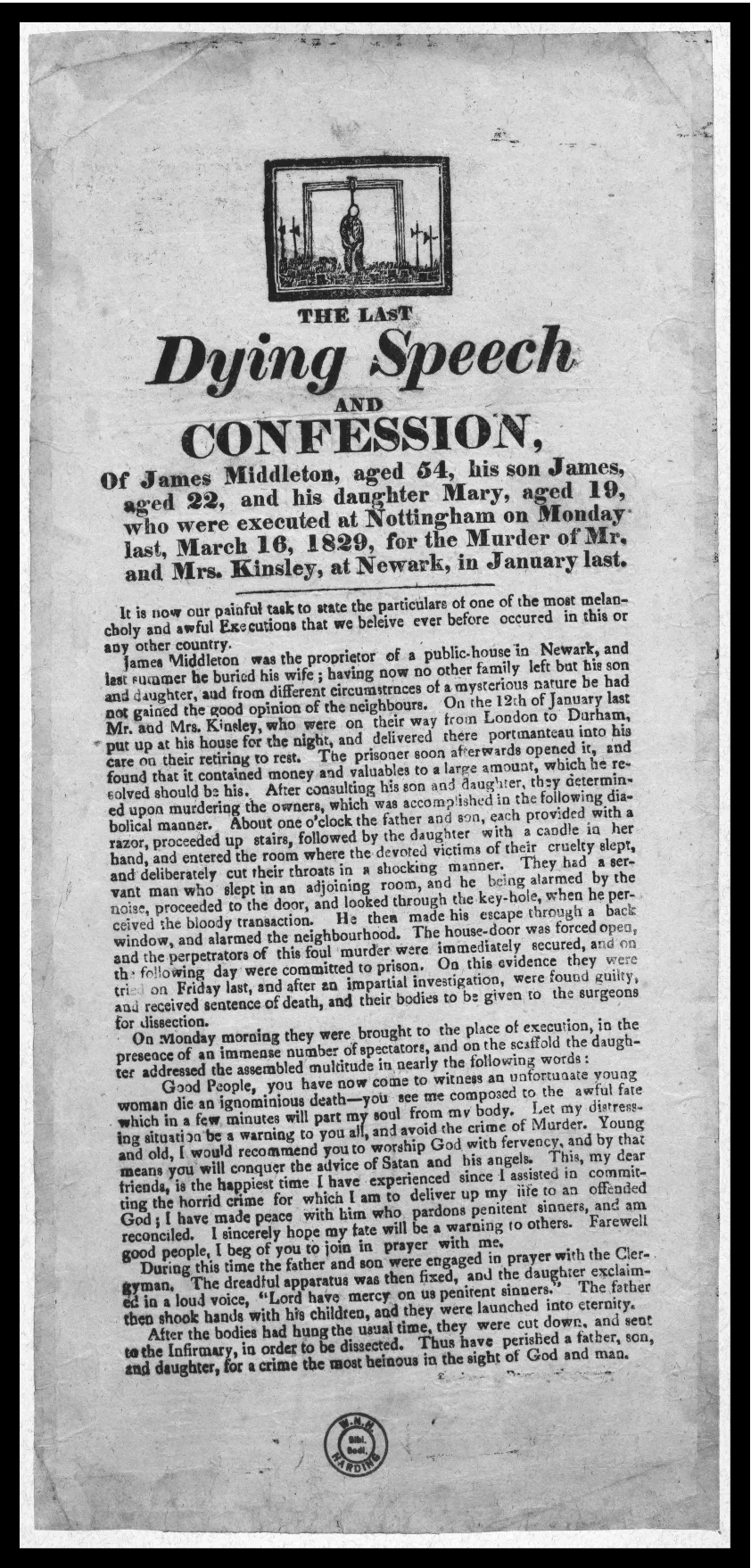
A broadside, dated 16 March 1829, chronicles the last dying speech and confession of James Middleton and his children James and Mary for the crime of murder (see Illustration 1.1).1 James was a 54-year-old widower and the proprietor of a public house in Newark, Nottinghamshire, who together with his children, James aged 22 and Mary aged 19, savagely murdered a journeying couple, Mr. and Mrs. Kinsley, who had lodged at his inn for the night. The broadside begins with a statement from the author/s saying that: ‘It is now our painful task to state the particulars of one of the most melancholy and awful Executions [sic] that we believe ever before occurred in this or any other country’. It then sets out the details of the crime wherein James, having had delivered into his care the couple’s portmanteau whilst they retired for the evening, opened it and found it contained ‘money and valuables to a large amount, which he resolved should be his’. James then ‘consulted’ his children and they ‘determined upon murdering the owners’. At approximately 1 o’clock that morning, the father and son ‘each provided with a razor’ proceeded upstairs, followed by the daughter, Mary, who lit their way by candlelight, and entered the room where ‘the devoted victims of their cruelty slept, and deliberately cut their throats in a shocking manner’. A servant sleeping in an adjoining room ‘being alarmed by the noise’ investigated by peering through the room’s keyhole and ‘perceived the bloody transaction’. He then raised the alarm and the perpetrators were immediately captured and committed to prison. The broadside then, in one sentence, tells of how the Middletons were found guilty ‘after an impartial investigation’ and sentenced to death, and their bodies to be given for dissection by the surgeons. The focus of the broadside then turns to the scene of execution where, before ‘an immense number of spectators’, the condemned daughter, Mary, addressed the crowd. In this dying speech, stating that she was ‘composed to the awful fate which in a few minutes will part my soul from my body’, Mary proceeded to warn ‘young and old’ to ‘worship God with fervency’ and thereby ‘conquer the advice of Satan and his angels’. She claimed to have made peace with ‘an offended God’ who ‘pardons penitent sinners’ and finished her gallows address by saying: ‘Farewell good people, I beg of you to join in prayer with me’. The broadside then describes how, during Mary’s speech, her father and brother were ‘engaged in prayer with the Clergyman’, and that once the ‘dreadful apparatus’ was fixed, James Middleton ‘shook hands with his children, and they were launched into eternity’.
Illustration 1.1
Broadside entitled ‘The Last Dying Speech And Confession, of James Middleton, aged 54, his son James, aged 22, and his daughter Mary, aged 19, who were executed at Nottingham on Monday last, March 16, 1829, for the Murder of Mr. and Mrs. Kinsley, at Newark, in January last’. Bodleian Libraries, University of Oxford: Harding B 9/2 (83)
This broadside tale of true crime is a classic example of the genre that is the focus of this study. Broadsides were a form of street literature and, for almost 300 years until the mid-nineteenth century, they were printed and sold all over the country. They were published on a wide range of topics, from politics to royal scandals, but the most popular subjects covered by broadsides were undoubtedly related to crime and punishment, especially murders and executions. These accounts could run to several editions of a series of broadsides and would cover all aspects of the criminal justice process, from details of the crime scene, to the trial and verbatim transcriptions of murderers’ last words as they faced the hangman. At first glance, such printed ephemera as these nineteenth-century broadsides may appear to be a trivial and peripheral source for academic analysis. For, being merely single sheets of paper, with print on only one side, this form of cheap literature would seem to be an aged version of our modern tabloid newspapers: cheap, throwaway and sensationalistic reading. However, upon closer scrutiny, it becomes evident that a critical reading of broadsides provides a portal through which we may capture an insight into the lives and losses of past generations and that this can enable us to recapture the mental attitudes and mores of a nation. Hence, the importance of such ephemera is not to be denied and increasingly scholars are valuing the social and cultural evidence they provide.
However, it is not only the specific narrative content or factual detail provided in any one particular broadside that affords so much opportunity for analysis but, more importantly, it is the cumulative gleaning of the whole genre as equating to a printed lore that found its way into the psyche of the masses that provides a crucial insight. For broadsides were produced with the intention of being both accessible and affordable, costing the price of only one penny, and thus enabled a wide public consumption. As such, they clearly represent an early example of mass culture and reflect the general public’s apparently enduring fascination with crime and punishment. Their popularity in the nineteenth century can certainly not be denied, as it is documented by contemporaries that they were produced in vast numbers. Even Henry Mayhew (1861, 284), the famed social investigator, was to note that one particular broadside, reporting the execution and confession of a notorious criminal, sold over two and a half million copies. Indeed, such was the voracious demand for every macabre detail of the latest serious crime that, by the early nineteenth century, each provincial town had its own organised network of broadside printers , pedlars and eager public.
The content of these broadsides therefore provides an opportunity to gather what the great majority of the general population in the early nineteenth century understood to be issues of crime and punishment. However, it is a specific view of the world, since the great majority of these broadsides were bought and read by the poor and uneducated masses. This fact is an important focus for this book, as the content of broadsides was tailored quite deliberately for that specific audience and would often take the form of a moral tale. This has led many scholars to view these broadsides as merely entertainment with a rough edge, since not only did they feed the general public’s apparently insatiable appetite for gruesome details of crime and punishment, but these simple tales of judicial vengeance could also subtly manipulate their readers’ thoughts and actions. However, it is to be argued here that this prime focus on issues of criminal morality achieved a more specific purpose , namely the arousal of emotions , since the reports and images circulated in terms of crime and punishment sought to affectively provoke their readers and, in doing so, expanded their ability to embrace certain complexities of the wider world. This emphasis on the role of emotion in broadsides is at the very heart of this study and exactly which emotions were evoked and for what purpose will provide a focus for much of the discussion in later chapters of the book.
It is debatable, therefore, whether serious journalism was the main concern for either broadside authors or their readers and, although efforts were made to relay facts pertaining to individual cases and circumstances, often by ‘cribbing ’ from local newspaper reports, broadsides, especially those recounting supposed last words and confessions, could frequently be nothing more than flights of imaginative fancy. Why then were they bought so avidly? Were they merely a form of morbid entertainment or did these coarse sheets of paper provide their readers with something more meaningful? One dominant and recurring theme of the genre certainly suggests the latter, as despite the apparent variety in style and specific content, what is eminently striking from reading these broadsides is their overall moralistic and commanding nature. It is evident that the producers of these broadsides would freely appoint themselves as moral guardians to their readers and would often produce works, fictional or otherwise, for the purpose of moral instruction. For example, one favoured theme was the criminal biography where the circumstances leading to an individual’s descent into a life of crime would be described, in order to present the readers with a stark warning and to encourage them to improve their own moral conduct and to lead upright lives. Indeed, it is a central contention of this book that this habitual emphasis on morality must be of social significance and therefore needs to be further explored.
Furthermore, it is perhaps ironic that broadsides were traditionally one of the few pieces of non-religious reading available to the poor, since their content was often rich in religious and biblical imagery and sentiment. For example, and as evidenced earlier, an emotive theme repeatedly alluded to in broadside content is the last dying speech or confession of the condemned criminal about to be executed. Within these speeches, we typically find exhortations to renounce sin and embrace a Christian way of life and very often they will contain powerful reminders that God is a vengeful and omniscient judge. The standard lament usually portrays the misery and regret of the condemned, with prayers for forgiveness and heartfelt repentance being offered to both God and fellow man. Finally, there is often a strong emphasis on finding redemption and inner peace from both religion and the recognition that justice has been served. It is precisely this juxtaposition between earthly acts and spiritual salvation that gives the crime broadside genre its wider meaning, and this important interaction between religious and secular subject matter has been d...
Table of contents
Cover
Front Matter
1. Introduction: The Broadside Enigma and Its Historical Development
2. Broadsides as Sources: A Methodological Discussion and Overview of Key Findings
3. A ‘Barbarous’ Trade: Early-Nineteenth-Century Broadsides in Social and Historical Context
4. ‘A Full and Particular Account’: Representations of Morality and Justice in Broadside Discourse
5. Collective Representations: A Durkheimian Interpretation of Crime Broadsides
6. Ballads of Blood: The Form and Function of Crime Narratives
7. Conclusion: The Social Significance of Crime Broadsides—Bonding Not Binding
Back Matter
Trusted by 375,005 students
Access to over 1.5 million titles for a fair monthly price.
Study more efficiently using our study tools.
Frequently asked questions
Yes, you can cancel anytime from the Subscription tab in your account settings on the Perlego website. Your subscription will stay active until the end of your current billing period. Learn how to cancel your subscription
No, books cannot be downloaded as external files, such as PDFs, for use outside of Perlego. However, you can download books within the Perlego app for offline reading on mobile or tablet. Learn how to download books offline
Perlego offers two plans: Essential and Complete
Essential is ideal for learners and professionals who enjoy exploring a wide range of subjects. Access the Essential Library with 800,000+ trusted titles and best-sellers across business, personal growth, and the humanities. Includes unlimited reading time and Standard Read Aloud voice.
Complete: Perfect for advanced learners and researchers needing full, unrestricted access. Unlock 1.5M+ books across hundreds of subjects, including academic and specialized titles. The Complete Plan also includes advanced features like Premium Read Aloud and Research Assistant.
Both plans are available with monthly, semester, or annual billing cycles.
We are an online textbook subscription service, where you can get access to an entire online library for less than the price of a single book per month. With over 1.5 million books across 990+ topics, we’ve got you covered! Learn about our mission
Look out for the read-aloud symbol on your next book to see if you can listen to it. The read-aloud tool reads text aloud for you, highlighting the text as it is being read. You can pause it, speed it up and slow it down. Learn more about Read Aloud
Yes! You can use the Perlego app on both iOS and Android devices to read anytime, anywhere — even offline. Perfect for commutes or when you’re on the go. Please note we cannot support devices running on iOS 13 and Android 7 or earlier. Learn more about using the app
Yes, you can access Crime, Broadsides and Social Change, 1800-1850 by Kate Bates in PDF and/or ePUB format, as well as other popular books in Social Sciences & British History. We have over 1.5 million books available in our catalogue for you to explore.