This book explores student-staff partnerships through a breadth of co-authored research projects. There is a significant gap in current literature regarding student-staff partnerships, both in the sharing of examples as well as in the examination of partnership working and its impact. Organised into four thematic sections, the editors and contributors highlight the diversity of routes students and staff can take to work in partnership, as well as how research, learning and teaching can be co-created. Written by both university staff and student researchers, the chapters consider the benefits of student-staff partnerships as an antidote to consumerist visions of higher education, and a way of celebrating the potential of students and their voices. This book will be of interest and value to scholars of student-staff partnerships.
eBook - ePub
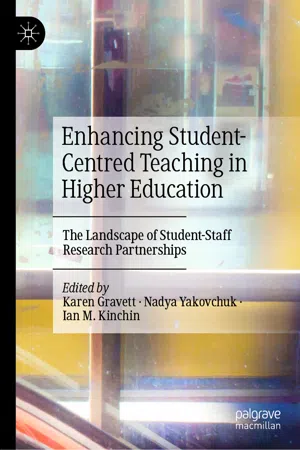
Enhancing Student-Centred Teaching in Higher Education
The Landscape of Student-Staff Research Partnerships
- English
- ePUB (mobile friendly)
- Available on iOS & Android
eBook - ePub
Enhancing Student-Centred Teaching in Higher Education
The Landscape of Student-Staff Research Partnerships
About this book
Information
Topic
EducationSubtopic
Adult Education© The Author(s) 2020
K. Gravett et al. (eds.)Enhancing Student-Centred Teaching in Higher Educationhttps://doi.org/10.1007/978-3-030-35396-4_11. Introduction: Context and Scope
Nadya Yakovchuk1 , Karen Gravett2 and Ian M. Kinchin2
(1)
Researcher Development Programme, Doctoral College, University of Surrey, Guildford, UK
(2)
Department of Higher Education, University of Surrey, Guildford, UK
In recent years there has been considerable interest from the international higher education community in exploring how staff and students can work in partnership to carry out research, and to develop and enhance learning and teaching (Bovill, Cook-Sather, Felten, Millard, & Moore-Cherry, 2016; Cook-Sather, 2014; Cook-Sather, Bovill, & Felten, 2014; Healey, Flint, & Harrington, 2014; Little, 2011; Matthews et al., 2019; Mercer-Mapstone & Marie, 2019; Mercer-Mapstone et al., 2017; Moore-Cherry, Healey, Nicholson, & Andrews, 2016). In a key publication on student engagement through partnership, Healey et al. (2014) stated that “engaging students and staff effectively as partners in learning and teaching is arguably one of the most important issues facing higher education in the 21st century” (p. 7). From a student’s point of view, the UK National Union of Students (NUS) (2014) emphasised that
in order for universities to foster more inclusive learning environments, we believe that students must be empowered as active and participatory agents, not as mere consumers, so that they can articulate their own conceptions of what makes good learning environments, and work in partnership with academics and administrators to realise these conceptions. (p. 8)
The sector to date has articulated the multiple and significant benefits of partnership models; for example, Bovill (2017) argues that co-creation breaks down “the traditional barriers between students and staff’” and “opens up higher education learning and teaching to become a dialogue between staff and students” (p. 152). Healey et al. (2014) believe that partnership “represents a sophisticated and effective approach to student engagement because it offers the potential for a more authentic engagement with the nature of learning itself and the possibility for genuinely transformative learning experiences for all involved” (p. 7). Gravett, Kinchin, and Winstone (2019) contend that students as partners initiatives are emerging in universities as a means to offer a more participative agenda: to enable students to become “more than customers”. At the same time, working in partnership brings some very particular challenges around, for example, status and power relations, reward and recognition, identity transformation, vulnerability and resistance to change (Healey et al., 2014), as well as recognising and respecting both student and staff voices (Cook-Sather, 2019).
This edited volume is our response, and contribution, to the expanding landscape of conversations about staff and students working in partnership. It explores the topic of student–staff partnerships through a collection of case studies in order to showcase and evaluate the ways in which students and staff can become effective co-researchers and co-creators. Covering a broad selection of interdisciplinary research projects, this book seeks to highlight the diversity of routes that students and staff can take to work in partnership to explore ways of enhancing learning and teaching. Through exploring what such partnerships mean, and how they are realised in the context of one institution, the University of Surrey, UK, the authors consider the implications of these collaborations for a wide range of disciplines and the higher education sector as a whole. These case studies offer a variety of practical examples from different disciplines, whilst the book as a whole provides a critical, theoretical, examination of this significant area of higher education research, policy and practice.
The student–staff collaborations at the heart of this book stem from a Student–Staff Research Partnership Project—a university-wide initiative led by the Department of Higher Education at the University of Surrey. Launched in 2018, the project’s aim was to establish and support student–staff research partnerships to enhance student-centred practice across the institution, and to develop an embedded culture of pedagogical research. This was in line with the institution’s Education Strategy focusing on the key values of being “student-centred, co-developed with students, and inclusive” (University of Surrey, 2019).
This partnership work was supported by institutional funding allocated via an internal Teaching Quality working group through which a call was announced requesting invitations for tender from student–staff teams. Eighteen of these research projects form the core of this book (Chapters 3–21). Whilst staff did this work as part of their contracted workload, student partners received a small bursary based on an expectation that the project would take up no more than 25–30 hours of their time. The students were involved in formulating the details of the projects, collecting and analysing data, and contributing to the final write-up. Projects obtained ethical clearance through the institutional research ethics procedures.
Our role in this project was not only to act as editors of this publication, but also to form a project team to support the evolving partnerships. This involved providing ongoing developmental opportunities to the participants throughout the life of the project. The project partners were encouraged to work within the framework of the values identified by Healey et al. (2014) as underpinning successful student engagement through partnership: authenticity, honesty, inclusivity, reciprocity, empowerment, trust, courage, plurality and responsibility. Workshops and guidance were provided for staff and student partners to support the development of appropriate research skills and to ensure consistency in the format of the final chapter, and we were available to provide additional support throughout the project. In addition, chapter author teams were paired up and had an opportunity to review and comment on one other chapter during the peer review stage and, likewise, receive feedback on their own draft from another project team. As such, the project involved a high level of collaboration on a number of levels: between student and staff partners, between the project team, between the project team and partners and between the partner teams themselves.
What resulted from this dedicated effort is the edited volume in front of you. All chapters, apart from the Introduction (this chapter) and Conclusion (Chapter 22), have been co-authored by the staff and student researchers. The book is organised into four thematic parts. These parts encompass different aspects of student–staff partnerships: creative and innovative partnership approaches; evaluating teaching approaches; partnership approaches to assessment, feedback, and student–staff dialogue; and reflections on the themes generated by student–staff partnerships. A distinctive feature of the book is the use of reflective vignettes at the end of each case study. Co-authored by students and staff, these vignettes provide insightful reflections upon the projects, outlining the benefits of individual collaborative partnerships and examining some of the challenges the partners faced. We hope that these vignettes have allowed both students and staff a further opportunity to “develop voices that both speak respectfully and are self-respecting” (Cook-Sather, 2019), and that this open sharing of experiences will inspire others to engage in similar projects, as well as inform their efforts in doing so.
In this introductory chapter, we present the rationale for this book, situate the student–staff partnership case studies that constitute its core within the institutional context of the University of Surrey and the wider higher education agendas and debates, and outline the scope of this volume by providing a brief overview of each individual chapter. The literature review (Chapter 2) by Ollis and Gravett examines the growing literature on Students and Partners, considers the benefits of student–staff partnerships as an antidote to dominant consumerist visions of higher education and as a way of promoting and celebrating the potential of students and their voices, and explores a number of chal...
Table of contents
- Cover
- Front Matter
- 1. Introduction: Context and Scope
- 2. The Emerging Landscape of Student–Staff Partnerships in Higher Education
- Part I. Collaboration and Creativity: Exploring Innovative Partnership Approaches
- Part II. Evaluating Teaching and Learning Approaches
- Part III. Partnership Approaches to Assessment, Feedback, and Student-Staff Dialogue
- Part IV. Staff-Student Partnerships: Reflections and Considerations
- Back Matter
Trusted by 375,005 students
Access to over 1.5 million titles for a fair monthly price.
Study more efficiently using our study tools.
Frequently asked questions
Yes, you can cancel anytime from the Subscription tab in your account settings on the Perlego website. Your subscription will stay active until the end of your current billing period. Learn how to cancel your subscription
No, books cannot be downloaded as external files, such as PDFs, for use outside of Perlego. However, you can download books within the Perlego app for offline reading on mobile or tablet. Learn how to download books offline
Perlego offers two plans: Essential and Complete
- Essential is ideal for learners and professionals who enjoy exploring a wide range of subjects. Access the Essential Library with 800,000+ trusted titles and best-sellers across business, personal growth, and the humanities. Includes unlimited reading time and Standard Read Aloud voice.
- Complete: Perfect for advanced learners and researchers needing full, unrestricted access. Unlock 1.5M+ books across hundreds of subjects, including academic and specialized titles. The Complete Plan also includes advanced features like Premium Read Aloud and Research Assistant.
We are an online textbook subscription service, where you can get access to an entire online library for less than the price of a single book per month. With over 1.5 million books across 990+ topics, we’ve got you covered! Learn about our mission
Look out for the read-aloud symbol on your next book to see if you can listen to it. The read-aloud tool reads text aloud for you, highlighting the text as it is being read. You can pause it, speed it up and slow it down. Learn more about Read Aloud
Yes! You can use the Perlego app on both iOS and Android devices to read anytime, anywhere — even offline. Perfect for commutes or when you’re on the go.
Please note we cannot support devices running on iOS 13 and Android 7 or earlier. Learn more about using the app
Please note we cannot support devices running on iOS 13 and Android 7 or earlier. Learn more about using the app
Yes, you can access Enhancing Student-Centred Teaching in Higher Education by Karen Gravett, Nadya Yakovchuk, Ian M. Kinchin, Karen Gravett,Nadya Yakovchuk,Ian M. Kinchin in PDF and/or ePUB format, as well as other popular books in Education & Adult Education. We have over 1.5 million books available in our catalogue for you to explore.