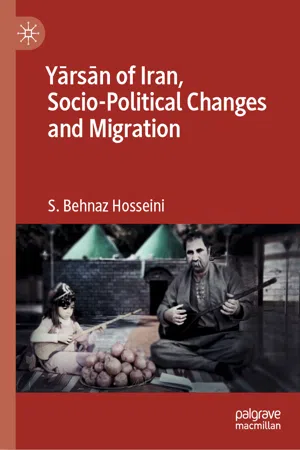
This book examines how socio-political surroundings have affected the evolution of Y?rs?ni religious thought and why the Y?rs?ni religious belief, despite its fundamental disagreement with Islamic tenets, has been affiliated with Islam. It also considers the historical context and socio-religious milieu in which the Y?rs?ni belief appropriates religious forces to survive, how Y?rs?nis experience their religion in Islamic society, and what differences are significant in their lived experiences. The author explores how the experience of worship influences real life for the Y?rs?nis from the perspectives of sociology, behaviorism, content analysis, cultural studies and ethnography in Iran and diaspora with focus on Sweden. Y?rs?ni followers became known as those who "don't tell secrets," primarily because they were not allowed to promote and advertise their religion in public, but recently have started to reveal their religion, especially in social media. This book discovers thetransformation of this religion, and in particular in which context an individual can change the content of religion, and bring about new ideas regarding religion and belief.
- English
- ePUB (mobile friendly)
- Available on iOS & Android
eBook - ePub
Yārsān of Iran, Socio-Political Changes and Migration
About this book
Information
© The Author(s) 2020
S. B. HosseiniYārsān of Iran, Socio-Political Changes and Migrationhttps://doi.org/10.1007/978-981-15-2635-0_11. Research Overview
S. Behnaz Hosseini1
(1)
University of Oxford, Oxford, UK
S. Behnaz Hosseini
Abstract
This opening chapter will present a structural and theoretical orientation of ethnoreligious of the Yārsān people that will be introduced, with particular attention paid to the aspect of migration. This chapter will take account of the previous research regarding Kurdish Yārsāni diaspora, an introduction is given to the Yārsāni people, religion, and their recent history, with regard to the Kurdish diaspora in Sweden and mention of conditions of diaspora affecting Yārsāni communities in Sweden. In the first chapter, I have dealt with a contextualization of the historical framework and presented a general background of Yārsān in Iranian Kurdistan, their religion (religious and territorial backgrounds), and their historical background (up to the present day) within the context of transnationalism and religion.
Keywords
HistoryReligionKurdish diasporaSwedenHistorical Framework of the Study
Yārsān, also known as Kaka-i or Ahl-e Ḥaqq, meaning “Fellows of Truth,” is a religion popular among inhabitants of the southern regions of Kurdistan, across the Iran–Iraq border. Its territory is roughly restricted to areas where Kurds speaking the Gūrani language live.1 Yārsāni followers are also known as Ali-Allāhi (considering Imam Ali as the incarnated God), or Ahl-e Ḥaqq (which is rooted in translation of an Arabic term meaning loyal, trustful, and honest people), or pejoratively as “Shaytān Parastān” (devil-worshippers).2,3 It is a religious belief of Indo-Iranian origin with some seven million4 followers, living in various parts of the Middle East. About two million Yārsāni are Turkic, and live in the areas of Tehran, Karaj, Qazvin, Hashtgerd, Karaj, Zanjān, Hamedan, Tabriz, Ūrumia, and Miandoab. Yārsān is a noteworthy example of survival of a minority faith, with its success attributed to its openness to reappropriation, and the resilience of its people in a hostile religious environment. Yārsāni followers are especially concentrated in Hūrāmān, Iranian Kurdistan. Followers share selected characteristics with various branches of Shi’a Islam, although Islam has had minimal influence on the vast majority of Yārsāni traditions and beliefs. The roots and fundamental themes concerning the principles of Yārsān can also be found in pre-Islamic Iranian religions, such as Mithraism (Kreyenbroek, 1992, 2017).
Ethnic and religious conflicts and changes in immigration patterns have become focal points of scholarly interest for those researching ethnic-religious communities. The Yārsāni are the subject of religious conflict and social exclusion, however, to date their experiences have been largely overlooked.
Research Aims
Yārsāni’ ethnicity, and the important features by which a nation or a minority group can be identified, is central to the concept of diaspora identity. The final key concept is presented in the last part of this section, which relates to “religious transnationalism” and the experience of those who have left their home country because of religious oppression. It constitutes one of the main principles of religious organization and for the Yārsāni, has replaced other forms of belonging, such as religiosity and other personal identities based upon local ties. The main purpose of this study is to understand how beliefs and ethnic identity between Yārsāni are expressed through diaspora; gathering empirical data is an important part of this research due to the fact that there is no previous research on Yārsāni in the diaspora.
Regarding Yārsāni living in Sweden, the present research will focus on the experiences of transition into Swedish culture. Yārsāni tradition is primarily oral, with many community members having historically avoided documentation of their activity. Although literacy is not a new phenomenon for the community, only a limited number of written records were kept in order to maintain the secrecy of the religion. Therefore, respectfully researching this group is a complex process.
Why Study the Yārsāni Community?
Research suggests that, while different immigrant groups vary in their religious expression, religious expression can indicate the identity of Yārsāni in the diaspora. Within the Yārsāni community, factors such as the Yārsāni migration to Europe, urban settlement, community aging, and the various ways the community has adapted (particularly the younger generation), can all influence how individuals identify as Yārsāni. Furthermore, Yārsāni identification can include adherence to principles of their religious manuscript, or other aspects of Yārsāni religious ritual. Religious identity has been influenced by the context of migration and assimilation processes by Yārsāni to function within Swedish urban life. These experiences have led to changed ideas regarding religion that may not have occurred without the impact of diaspora experience outside the homeland. Thus, I will investigate the ways in which Yārsāni define themselves and their ethnic identity in a diaspora context.
This book will explore the differences in Yārsāni communities across different contexts and geographical spaces. Historically the Yārsāni people have evolved to change their religious beliefs and behavior when they migrate internationally, in order to better assimilate into a new country and society. Specifically, I will discuss the religious affiliations of Yārsāni in their host country and analyze what happens to them as a religious minority group when they migrate from their home country to another. I will compare and contrast Yārsāni experiences from immigrants living in Sweden, as well as from Yārsāni living in Iran. In this framework, I will also seek to understand the use of social media as a platform of self-expression for the Yārsāni people, as social media has had a great impact on this religious minority in recent years.
Empirical data is limited to the Swedish and Iranian context, and examines identity issues of Yārsāni immigrants, from the first generation of immigrants to those who have arrived in recent decades. There is also data collected from groups of younger Yārsāni born or raised in Sweden, who might be considered second-generation immigrants. My interviews also include discussions with known cultural experts in Yārsāni canonical texts currently living in Sweden.
Why Study the Yārsāni in Sweden?
What happens to a religious minority community when the surrounding social majority becomes more accommodating in the country of migration compared to society in the country of origin? I will discuss the transborder aspect of religious faith and identity by looking beyond Swedish national boundaries, and analyze important commonalities and differences stemming from disparities in the sociopolitical contexts where members of the Yārsāni community reside. I will consider the possibilities of religious reform, attachment and detachment to new or previous homelands, evidence of protection from persecution in Iran and the feeling of being safe, and integration.
To analyze this, it is necessary to understand the kind of changes that can occur among immigrants’ identities through their encounters with another culture. Anthias (2002) asserts that through new sociocultural positions and by examining common identities, the researcher can begin to understand where (or to what extent) individuals belong to their identity. Moreover, it is necessary to know whether immigrants continue to conform to a previous understanding of religion, or if they adopt new approaches that correspond with the new context in their host country. It is also important to know the possible ways through which those immigrants might attempt to maintain a balance between their pre- and post-migration identities (ibid.).
Another key issue in the study of minority groups such as the Yārsāni is the relationship between ethnicity and religion, given the history of ethnically and religiously motivated exclusion in their home country. In the present study, all of these notions are investigated through a number of narratives that give voice to the Yārsāni people, to interpret their core beliefs about their religious practice in Sweden. Studies have shown that religion continues to be important for new migrants and that it provides social spaces for ethnic differences and identity. Religion can also function as an agent for assimilation into wider society for certain immigrant members, or religious identity can emphasize an ethnic core. However, others stress that ethnic identity and religious institutions are needed to preserve cultural tradition and ethnic boundaries (Levitt, 2003). Ethnic identity is central to the social construction of identity, and religious faith can easily color both ethnic and national identities. Accordingly, this book will discuss religion in relation to the concepts of diaspora, nationalism, and ethnic identity.
A key objective of this research is how Yārsāni communities have narrated their religion and ethnicity in Swedish exile, and how the ethnic and religious narrative of the Yārsāni people has become apparent in a diaspora setting. Ethnoreligious conflicts tend to be rooted in unsettled political disputes or in conflicts over the political, religious, or ethnic division of resources. Conflicts between the central power and a religious ethnicity often result in the latter being forced to emigrate from their homeland countries and to reestablish their lives as refugees in other countries.
Previous Research on the Kurdish Diaspora and Yārsāni Religion
This book also includes extensive analysis of some of the core opinions and research on the Kurdish diaspora, given that the Yārsāni are a Kurdish group. An extensive literature review on the Kurdish diaspora was undertaken, where it became clear that that there is no existing research on the Yārsāni diaspora. As van Bruinessen (2014) pointed out, there is “no significant Ahl-e-Haqq diaspora in western Europe” (p. 58). However, this book is more specific in its focus on religion and identity among Yārsāni in both Iran and the (Swedish) European diaspora.
One particular emphasis of the present study is the focus on the influence of Yārsāni religious faith in shaping identity. My focus will be on defining Yārsāni religious identity in the diaspora, and how the diaspora in turn influences the migrants’ sense of self. The aim is to determine the importance of religion for Yārsāni, and whether they maintain their religious identity at all. I will discuss whether Yārsānism is dependent on religion, or if the Yārsāni no longer rely on religion for identity determination, but instead consider Yārsāni status as a set of customs without religious observance. It is necessary to address the purpose of identifying as either a secular or a religious Yārsāni, due to the persecution in their homeland, which may lead some to marginalize and restri...
Table of contents
- Cover
- Front Matter
- 1. Research Overview
- 2. Diaspora and Identity
- 3. Yārsāni Religious Practice and Identity
- 4. Yārsāni Religious Innovation and Transformation
- 5. Yārsāni Community and the Internet
- Back Matter
Trusted by 375,005 students
Access to over 1.5 million titles for a fair monthly price.
Study more efficiently using our study tools.
Frequently asked questions
Yes, you can cancel anytime from the Subscription tab in your account settings on the Perlego website. Your subscription will stay active until the end of your current billing period. Learn how to cancel your subscription
No, books cannot be downloaded as external files, such as PDFs, for use outside of Perlego. However, you can download books within the Perlego app for offline reading on mobile or tablet. Learn how to download books offline
Perlego offers two plans: Essential and Complete
- Essential is ideal for learners and professionals who enjoy exploring a wide range of subjects. Access the Essential Library with 800,000+ trusted titles and best-sellers across business, personal growth, and the humanities. Includes unlimited reading time and Standard Read Aloud voice.
- Complete: Perfect for advanced learners and researchers needing full, unrestricted access. Unlock 1.5M+ books across hundreds of subjects, including academic and specialized titles. The Complete Plan also includes advanced features like Premium Read Aloud and Research Assistant.
We are an online textbook subscription service, where you can get access to an entire online library for less than the price of a single book per month. With over 1.5 million books across 990+ topics, we’ve got you covered! Learn about our mission
Look out for the read-aloud symbol on your next book to see if you can listen to it. The read-aloud tool reads text aloud for you, highlighting the text as it is being read. You can pause it, speed it up and slow it down. Learn more about Read Aloud
Yes! You can use the Perlego app on both iOS and Android devices to read anytime, anywhere — even offline. Perfect for commutes or when you’re on the go.
Please note we cannot support devices running on iOS 13 and Android 7 or earlier. Learn more about using the app
Please note we cannot support devices running on iOS 13 and Android 7 or earlier. Learn more about using the app
Yes, you can access Yārsān of Iran, Socio-Political Changes and Migration by S. Behnaz Hosseini in PDF and/or ePUB format, as well as other popular books in Social Sciences & Cultural & Social Anthropology. We have over 1.5 million books available in our catalogue for you to explore.