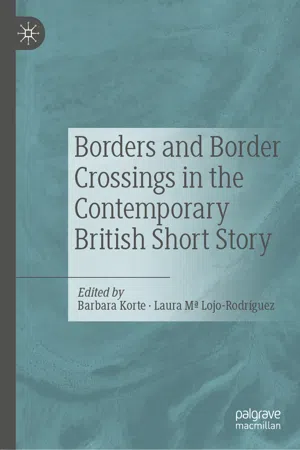
This book represents a contribution to both border studies and short story studies. In today's world, there is ample evidence of the return of borders worldwide: as material reality, as a concept, and as a way of thinking. This collection of critical essays focuses on the ways in which the contemporary British short story mirrors, questions and engages with border issues in national and individual life. At the same time, the concept of the border, as well as neighbouring notions of liminality and intersectionality, is used to illuminate the short story's unique aesthetic potential. The first section, "Geopolitics and Grievable Lives", includes chapters that address the various ways in which contemporary stories engage with our newly bordered world and borders within contemporary Britain. The second section examines how British short stories engage with "Ethnicity and Liminal Identities", while the third, "Animal Encounters and Metamorphic Bodies", focuses on stories concernedwith epistemological borders and borderlands of existence and identity. Taken together, the chapters in this volume demonstrate the varied and complex ways in which British short stories in the twenty-first century engage with the concept of the border.
eBook - ePub
Borders and Border Crossings in the Contemporary British Short Story
- English
- ePUB (mobile friendly)
- Available on iOS & Android
eBook - ePub
Borders and Border Crossings in the Contemporary British Short Story
About this book
Information
© The Author(s) 2019
B. Korte, L. M. Lojo-Rodríguez (eds.)Borders and Border Crossings in the Contemporary British Short Storyhttps://doi.org/10.1007/978-3-030-30359-4_11. Introduction: Border(ing)s in Contemporary Short Stories of the British Isles
Barbara Korte1 and Laura Mª Lojo-Rodríguez2
(1)
English Department, University of Freiburg, Freiburg, Germany
(2)
University of Santiago de Compostela, Santiago de Compostela, Spain
Keywords
BordersBorder crossingsShort story form21st-century British literatureLiminalityIntersectionalityThe Resurgence of Borders in the Contemporary World
This book is published at a cultural moment when British culture and cultural production are still haunted by Brexit—a landmark event affecting the United Kingdom and Ireland, as well as the European continent. Britain voted to leave the European Union in June 2016: the Brexit decision and the debate that surrounded it were aimed to re-affirm an external border of the United Kingdom vis-à-vis Europe. At the same time, however, they exposed and aggravated existing rifts within British society, between regions, classes, races and ethnic and religious communities. Two decades before the Leave vote, Julian Barnes published a short-story collection, Cross Channel, which is concerned with European history and collective memory. As Dean Baldwin writes in his analysis of the collection’s final story:
‘Tunnel’ echoes the historical themes of ‘Evermore’ [the volume’s fifth story] and even refers to the concern about erasing the memories and cemeteries of the First World War, but the tone is lighter, even droll; reversing history, Barnes projects himself forward to 2015, as a sixty-nine-year-old taking Eurostar to France and reflecting on his past, imagining lives for his fellow passengers, and contemplating his own ageing. (Baldwin 2016, 249)1
Re-read after 2016, Cross Channel seems to speak of another era—one in which borders were there to be transgressed, where divisions appeared to be less important than what connects and unites people. Postmodernity in the 1990s was inclined towards mixing and fluidity; likewise, social discourse, cultural production and theory emphasised diversity, hybridity and third spaces of encounter. Of course, the 1990s also saw the fragmentation of former Yugoslavia and a civil war aimed to re-establish territorial and ethnic borderlines. But the more widespread mood in Europe during the final decade of the twentieth century was that borderlines should and could become permeable. In the second decade of the twenty-first century, the Eurostar tunnel is now perceived as a risk for national security and integrity, the Channel has re-gained its significance as Britain’s natural frontier and bulwark against Continental invasion, and the tone is no longer light. The “Jungle” at Calais, the notorious camp for refugees and migrants detained at the French side of the Channel, has already inspired a collection of short stories with the suggestive title Breach (Popoola and Holmes 2016). It was reviewed by Kapka Kassabova in the Guardian (2016) as “fine, suspenseful fiction” and “an attempt to explore both the lives of those on the run and the fears of those who wish to close borders”.
The United Kingdom is not alone in its renewed emphasis on the “value” of borders. The British foreign-affairs journalist Tim Marshall portrays the twenty-first century as an “Age of Walls”, which is the subtitle of his book Divided, and analyses the proliferation of new borders since the Berlin Wall fell in 1989, an event which then seemed to ring in a new age:
In recent years, the cry ‘Tear down this wall’ is losing the argument against ‘fortress mentality’. It is struggling to be heard, unable to compete with the frightening heights of mass migration, the backlash against globalization, the resurgence of nationalism, the collapse of Communism and the 9/11 attacks and their aftermath. These are the fault lines that will shape our world for years to come. (2018, 1)
As Marshall observes further, “[a]t least sixty-five countries, more than a third of the world’s nation states, have built barriers along their borders; half of those erected since the Second World War sprang up between 2000 and now”; even where there are no physical walls, there is often separation in our minds, and “[t]hese invisible barriers are often just as effective” (2).
The new walls are, at least in part, a reaction to the alleged “liquidity” of late modernity (Bauman 2000) and to the emphatic statement on the flows and connections that characterise the age of globalisation. The twenty-first century provides ample evidence for the return of borders worldwide: as material reality, as a concept and as a way of thinking that fences off what it fears and deems undesirable.2 As the geographer David Newman writes, we are witnessing the “emergence of a counternarrative to the borderless and deterritorialized world discourse which has accompanied much of globalization theory” (2006, 1), and he further notes that “it is clear to all scholars of borders that we live in a hierarchical world of rigid ordering and that borders—be they territorial or aspatial —are very much part of our daily lives” (14).3
Research on Border Phenomena
The topicality of borders in both the mind and in contemporary policies has given rise to “border studies”, an interdisciplinary field that studies borders as central “to human social interaction and the exercise of power” (Diener and Hagen 2012, 24).4 It needs to be emphasised, however, that border phenomena and border imaginaries have invited critical attention for some time, and across a wide range of disciplines: in human and cultural geography,5 political science,6 social theory,7 anthropology and cultural theory,8 and not least in postcolonial studies. As Walter Mignolo, for example, points out, globalisation has implied a readjustment of borders that are “broken”, while migrants “manage to crack the walls and move around police forces to enter developing countries and blur the distinction between Western and Eastern civilizations, Christianity and Islam, Latin and Anglo America, and Africa and Europe” (2000, x). Border studies emphasises that borders—and related concepts such as “boundaries”, “thresholds”, “liminality”—are central in organising the human lifeworld, people’s experience, thought, understanding of themselves and their place in society. At the same time, border studies maintains that even the apparently most natural borders—such as the English Channel—are essentially cultural: they are made, “scaped”,9 and they can therefore be re-scaped, re-negotiated, re-thought. Current conceptualisations of “the border” are sensitive to the fact that borders can be fluid, generative and culturally productive. Such understanding of borders as bordering processes, rather than fixed entities, also informs the studies in an interdisciplinary volume edited by Nicola Gardini and others: Minding Borders (2017), which focuses on the creative aspect of borders, their status as contact zones, spaces of hybridity, exchange and translation. Even if such dynamics are often denied, borders can be considered fundamentally shiftable, permeable and transgressable. Borders as spatial configurations, Ana Mª Manzanas observes, “respond to contradictory urges: to separate and divide on the one hand, and to welcome and allow passage on the other” (2007, 9). Finally, when borders are viewed as essentially complex and multi-layered phenomena, it reveals the fact that the territorial, political, social and psychological dimensions of the border are intersectional and inseparable from each other.
The effectiveness in the mind of borders and borderings is especially prominent in studies that focus on the aesthetics of borders and the way they are represented in different media of artistic expression. The introductory chapter to Schimanski and Wolfe’s volume Border Aesthetics points out that an aesthetic approach is particularly apt for revealing the dynamic and productive element of the border.10 As Mireille Rosello and Stephen Wolfe claim in this chapter, “borders can have a life of their own”, and “they can reinforce the symbolic difference that created them, or even cause changes in these symbolic differences”; they may even “continue to have effects after the symbolic differences that caused them have disappeared or lessened” (2017, 2). Rosello and Wolfe distinguish five aesthetic planes on which borders manifest, often on several levels at the same time:
Topographically , the border divides and unites spaces […]. Symbolically , the border distinguishes between values […]. On the temporal plane the border separates time zones […]. On the epistemological plane it splits the known and the unknown. Finally, textually , the border organizes the different parts of the text and distinguishes between what is in or out of the textual unit. (14)
While the dimensions distinguished here do not seem to be exhaustive, Rosello and Wolfe make the important point that works of art negotiate border phenomena, not only on the level of content, but also through their own specific form and with their own formal boundaries.
This is also reflected in our volume, which focuses on the contempo...
Table of contents
- Cover
- Front Matter
- 1. Introduction: Border(ing)s in Contemporary Short Stories of the British Isles
- Part I. Geopolitics and Grievable Lives
- Part II. Ethnicity and Liminal Identities
- Part III. Animal Encounters and Metamorphic Bodies
- Part IV. The Short Story, Borders and Intermediality
- Back Matter
Trusted by 375,005 students
Access to over 1.5 million titles for a fair monthly price.
Study more efficiently using our study tools.
Frequently asked questions
Yes, you can cancel anytime from the Subscription tab in your account settings on the Perlego website. Your subscription will stay active until the end of your current billing period. Learn how to cancel your subscription
No, books cannot be downloaded as external files, such as PDFs, for use outside of Perlego. However, you can download books within the Perlego app for offline reading on mobile or tablet. Learn how to download books offline
Perlego offers two plans: Essential and Complete
- Essential is ideal for learners and professionals who enjoy exploring a wide range of subjects. Access the Essential Library with 800,000+ trusted titles and best-sellers across business, personal growth, and the humanities. Includes unlimited reading time and Standard Read Aloud voice.
- Complete: Perfect for advanced learners and researchers needing full, unrestricted access. Unlock 1.5M+ books across hundreds of subjects, including academic and specialized titles. The Complete Plan also includes advanced features like Premium Read Aloud and Research Assistant.
We are an online textbook subscription service, where you can get access to an entire online library for less than the price of a single book per month. With over 1.5 million books across 990+ topics, we’ve got you covered! Learn about our mission
Look out for the read-aloud symbol on your next book to see if you can listen to it. The read-aloud tool reads text aloud for you, highlighting the text as it is being read. You can pause it, speed it up and slow it down. Learn more about Read Aloud
Yes! You can use the Perlego app on both iOS and Android devices to read anytime, anywhere — even offline. Perfect for commutes or when you’re on the go.
Please note we cannot support devices running on iOS 13 and Android 7 or earlier. Learn more about using the app
Please note we cannot support devices running on iOS 13 and Android 7 or earlier. Learn more about using the app
Yes, you can access Borders and Border Crossings in the Contemporary British Short Story by Barbara Korte, Laura Mª Lojo-Rodríguez, Barbara Korte,Laura Mª Lojo-Rodríguez in PDF and/or ePUB format, as well as other popular books in Literature & European Literary Criticism. We have over 1.5 million books available in our catalogue for you to explore.