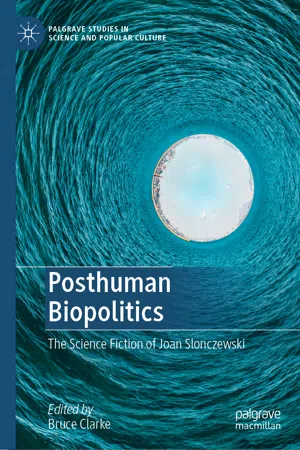
This volume presents the first collection of essays dedicated to the science fiction of microbiologist Joan Slonczewski. Posthuman Biopolitics consolidates the scholarly literature on Slonczewski's fiction and demonstrates fruitful lines of engagement for the critical, cultural, and theoretical treatment of her characters, plots, and storyworlds. Her novels treat feminism in relation to scientific practice, resistance to domination, pacifism versus militarism, the extension of human rights to nonhuman and posthuman actors, biopolitics and posthuman ethics, and symbiosis and communication across planetary scales. Posthuman Biopolitics explores the breadth and depth of Joan Slonczewski's vision, uncovering the reflective ethical practice that informs her science fiction.
- English
- ePUB (mobile friendly)
- Available on iOS & Android
eBook - ePub
About this book
Information
Topic
LiteraturSubtopic
Film & Video© The Author(s) 2020
B. Clarke (ed.)Posthuman BiopoliticsPalgrave Studies in Science and Popular Culturehttps://doi.org/10.1007/978-3-030-36486-1_11. An Interview with Joan Slonczewski
Joan Slonczewski1
(1)
Department of Biology, Kenyon College, Gambier, OH, USA
Joan Slonczewski
This interview collects a virtual group conversation between the author and the contributors. It ranges through a series of topics that cover Slonczewski’s scientific and fictional fields of interest: microbes in particular, humanity and its future prospects in general, science fiction as a literary genre, and her own writing. “Microbes have been my business since graduate school.” This part of the conversation ranges across issues from the microbiome and probiotics to symbiosis, extremophile metabolisms, and the corporate medical complex. The biomedical orientation of her science is one motivation of her consistent creation of caregivers as main characters. Regarding the status of humanity in a posthuman world, Slonczewski practices a particularly humane variety of the posthuman imaginary. Human history is never far from being the ultimate referent of her chronicles of the future. In keeping with these cultural and material registrations, socioeconomic disparities and ethnic tensions are also primary players in her biopolitical scenarios. But such modes of circumstantial difference are not fundamental and may be overridden, always with difficulty, by the creation of spiritual mutuality. Slonczewski expresses her posthumanism by questioning the contingencies of selfhood. Slonczewski’s fiction consorts with various echelons of sentient machines, but she distinguishes her approach from the cyberpunk trends contemporary with her writing of the Elysium Cycle. She views cyberpunk’s oppositional and gendered splice between the organic and the mechanical as having been resolved in actual scientific practice by refinements in molecular biology that open life forms to vistas of physical and chemical manipulation. Addressing the recurrent theological themes throughout her fiction, Slonczewski discusses her most recent novel, The Highest Frontier, and drops some hints about its eventual sequel.
Microbes
- Recently science and technology studies (STS) scholars have begun to study the implications of the human microbiome, how the human cannot be understood in detachment from the microbiome in which we reside (and which resides in us), leading to new conceptualizations such as the “holobiont” or “supraindividual” to try to acknowledge how centrally “we” are multi-genomic organisms. This perspective, it seems, has already shaped a lot of your fiction. What are your thoughts about the challenges of writing microbe characters, both before and after the dissemination of these recent findings concerning the role of the microcosm?
Joan Slonczewski: Microbes have been my business since graduate school. The main challenge for me in writing microbial characters is getting the science-fiction millennial critics to engage it. Brain Plague was ahead of its time, but the critics said it wasn’t possible (and went on to the next space-warp adventure). Today, in my own lab we are showing how microbes, the “microbial society,” plays its part in the human being. Even viruses now are part of our microbiome; about eight percent of our genome makes our own endogenous viruses. Now that new pronouns are coming in (our student life director gave us a list of a dozen, from ze to hirs) I’ve switched to “they, theirs” in recognition of our microbial community. Thus, “Robert Koch set up an anthrax lab in their patients’ waiting room.”
- Staying with the topic of microbes, STS scholar Heather Paxson has written about “good microbes” to reposition how we think about food cultures and health, using “raw” cheese to conceptualize what she calls the “microbiopolitics” of how to live with microbes, good and bad. She has also been critical of a more recent turn toward “post-Pasteurian cultures” celebrated by some people, coming out of a recognition of the positive benefits of living with some microbes (Paxson 2013). Do you have any comments on “microbiopolitics” or the “post-Pasteurian” as they relate to your work, both as a scientist and as a writer?
JS: Yes, the vast majority of microbes do us no harm, and in fact enable us to live. But the few that cause trouble (diphtheria and tuberculosis, etc.) kill vast numbers of people. So, the trick is to find a middle path. Pasteurization itself is a moderate path, in that the relatively brief heat treatment kills the worst pathogens without sterilizing everything.
The trouble with probiotics is that most people, and most commercial manufacturers, have no idea what they’re doing. Which kind of microbial communities are actually good for us? Theory is lacking; we can only try things and see what works. Like fecal bacteriotherapy—after weeks of the runs with C. diff, one is willing to try anything, and sure enough, it works. My own research is now looking at how our human body can control our own microbiomes, to moderate their abilities such as drug resistance. We find that aspirin metabolites, which were common in preindustrial vegan diets, can select for microbial populations that are drug sensitive–and exclude drug resistant pathogens. Microbiology is even more amazing than science fiction.
- In a 2003 interview published in Nature, when asked What book has been most influential in your scientific career? you replied: “The works of Lynn Margulis on symbiogenesis have had a major impact on my scientific vision. The evolution of predatory protists into multiple endosymbionts is more amazing than most science fiction.” How would you now assess her importance for our current understanding of the microcosm in relation to the biosphere?
JS: Lynn’s insights on symbiogenesis were remarkable at that time. She did few experiments, but observed the natural world. When she began doing science, symbiosis was considered a “special exception” to the central role of competition in shaping life. Today, we increasingly find symbiosis at the center along with competition. The human body includes one’s gut microbes as essential partners, responsible for modifying our nutrients and producing our neurotransmitters.
- Our current appreciation of symbiosis and of Margulis’s prescience concerning its importance rests on more recent “dry” techniques of genetic sampling and sequencing that to some extent are opposed to her preference for “wet” biology and observation of phenotypes in the field.
JS: The most exciting work today combines DNA with “wet” biology. For example, the microbes I brought back from Antarctica were living organisms, but we knew no way to grow them in culture. So we sequenced their DNA to gain clues as to what they could do. We discovered some of the samples were cyanobacteria, chloroplast-like bacteria that fix carbon and produce oxygen. But one sample was mostly purple bacteria–a different microbe that can grow without oxygen and produces hydrogen. Because the DNA told us that, we were able to devise a culture medium to grow this strange purple life form. Our knowledge of microbial symbiosis today goes beyond what even Margulis imagined. For instance, we find retroviruses integrated throughout our genomes, and the viral genes have evolved new essential functions in our cells. The human embryo actually generates viral particles as part of normal development.
- John F. Stolz has written about “a robust biogeochemical cycle and ecology based on arsenic. That microbial arsenic cycling was important in the evolution of life has been further bolstered through molecular investigations of arsenic based ecosystems” (Stolz 2017). Were “arsenic-based ecosystems” on the horizon of biological knowledge when you made this form of biochemistry indigenous to the biosphere of the fictional planet Prokaryon in the later 1990s?
JS: In imagining the biosphere of Prokaryon, I was aware of the phenomenon of arsenate respiration. Arsenate respiration refers to the use of arsenic-oxygen compounds to receive electrons, in place of diatomic oxygen gas. What has not yet been demonstrated is the arsenic replacement of phosphorus in metabolism, such as the phosphorus atoms of ATP. Arsenate bonds are too easily broken, under physiological conditions, to replace phosphorus in most phosphorylated compounds. Nonetheless, one might imagine such a scenario in science fiction.
- An issue frequently raised in recent biopolitical criticism is the idea of the corporate medical complex taking greater control of our bodies. One might argue that the main character of Brain Plague is coerced—even co-opted—into the community of “carriers.” And this topic seems to surface in fiction often when immortality is on the table (one thinks especially of Jim Gunn’s Immortals). Do you see the symbiosis of different species in the Elysium novels—Sharer medicine or the manipulation/negotiation of microbial viruses—as a viable answer to what might be a medical complex grown too big and unsustainable? A potential for grassroots response to corporatized medicine?
JS: The corporate medical complex is in the background of Brain Plague. The doctor-machines are not entirely good. The powerful ones want to control humans by drugging them. The more modest community-based doctors find themselves perpetually putting out fires. The lead carriers, Daeren and Andra, I see as community organizers, trying to haul in the drug addicts and save them despite themselves.
Humanity
- Another particularly compelling biological idea that you’ve worked into the Elysium novels is the unit of selection. The tiny masters of Children Star and the micros of Brain Plague, in particular, seem to imply that humanity can be found just about anywhere.
JS: I’m intrigued by the idea that perhaps humanity (like microbes) can be found anywhere. The unit of natural selection keeps getting larger, the more closely we look. Is it possible that a swarm of smaller creatures could develop a network that achieves a conscious existence? Some researchers argue that a termite mound has this capability.
- Good science fiction makes us think through this idea in terms of recent events, for instance, the shooting and protests in Ferguson, Missouri in August 2014. I wonder what kind of humanity, say, a Sharer might find in these situations.
JS: The Sharers would see in Ferguson a public health crisis. They would say that all the parties involved are “sick children.” But the Sharers are a small community with an exceptionally advanced social philosophy. Brain Plague, published in 2000, does show what happens when prejudice leads to violence in the Underground—while the wealthy, who live literally “up” levels, don’t care. They don’t care until the pathogenic microbes find their way up to the top. Brain Plague effectively predicted the socioeconomic system we now inhabit—rich versus poor, the divide amplified by sentient machines, and everywhere the dangers of obsession and addiction.
- And, more importantly, would you say that it is the grassroots resistance or the power of the city-state that we need to put under the micro...
Table of contents
- Cover
- Front Matter
- 1. An Interview with Joan Slonczewski
- 2. Posthuman Narration in the Elysium Cycle
- 3. A Door into Ocean as a Model for Feminist Science
- 4. “Then Came Pantropy”: Grotesque Bodies, Multispecies Flourishing, and Human–Animal Relationships in A Door into Ocean
- 5. Bodies That Remember: History and Age in The Children Star and Brain Plague
- 6. Microbial Life and Posthuman Ethics from The Children Star to The Highest Frontier
- 7. The Future at Stake: Modes of Speculation in The Highest Frontier and Microbiology: An Evolving Science
- 8. Wisdom Is an Odd Number: Community and the Anthropocene in The Highest Frontier
- Back Matter
Trusted by 375,005 students
Access to over 1.5 million titles for a fair monthly price.
Study more efficiently using our study tools.
Frequently asked questions
Yes, you can cancel anytime from the Subscription tab in your account settings on the Perlego website. Your subscription will stay active until the end of your current billing period. Learn how to cancel your subscription
No, books cannot be downloaded as external files, such as PDFs, for use outside of Perlego. However, you can download books within the Perlego app for offline reading on mobile or tablet. Learn how to download books offline
Perlego offers two plans: Essential and Complete
- Essential is ideal for learners and professionals who enjoy exploring a wide range of subjects. Access the Essential Library with 800,000+ trusted titles and best-sellers across business, personal growth, and the humanities. Includes unlimited reading time and Standard Read Aloud voice.
- Complete: Perfect for advanced learners and researchers needing full, unrestricted access. Unlock 1.5M+ books across hundreds of subjects, including academic and specialized titles. The Complete Plan also includes advanced features like Premium Read Aloud and Research Assistant.
We are an online textbook subscription service, where you can get access to an entire online library for less than the price of a single book per month. With over 1.5 million books across 990+ topics, we’ve got you covered! Learn about our mission
Look out for the read-aloud symbol on your next book to see if you can listen to it. The read-aloud tool reads text aloud for you, highlighting the text as it is being read. You can pause it, speed it up and slow it down. Learn more about Read Aloud
Yes! You can use the Perlego app on both iOS and Android devices to read anytime, anywhere — even offline. Perfect for commutes or when you’re on the go.
Please note we cannot support devices running on iOS 13 and Android 7 or earlier. Learn more about using the app
Please note we cannot support devices running on iOS 13 and Android 7 or earlier. Learn more about using the app
Yes, you can access Posthuman Biopolitics by Bruce Clarke in PDF and/or ePUB format, as well as other popular books in Literatur & Film & Video. We have over 1.5 million books available in our catalogue for you to explore.