Health systems worldwide are grappling with the challenge of coordinating difference in an increasingly complex care environment. In response this book features the latest research on organizational studies in healthcare and explores the relationship between strategic and organic change and what this means for the way we organize health work. Focusing on the complexity of healthcare environments, it discusses the need to cross professional and organizational boundaries. Specifically, this book focuses on the implications for health systems in the way that they continue to balance planning and intervention with organic learning systems.
Comprising the best contributions from the 2018 Conference on Organizational Behaviour in Health Care (OBHC), this book is an important resource for healthcare researchers, as well as policy-makers and managers within the industry. Contributors explore the extent to which healthcare is codified through empirical analysis of practical interventions and conceptual debate.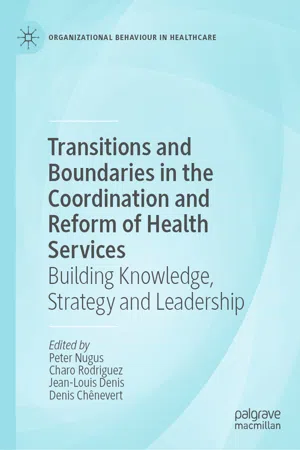
eBook - ePub
Transitions and Boundaries in the Coordination and Reform of Health Services
Building Knowledge, Strategy and Leadership
- English
- ePUB (mobile friendly)
- Available on iOS & Android
eBook - ePub
Transitions and Boundaries in the Coordination and Reform of Health Services
Building Knowledge, Strategy and Leadership
About this book
Information
Part ICoordinating Care Across Organisational and Sectoral Boundaries
This first Part orients the book with a series of conceptually-informed innovations in policy and practice that aim to contribute to care coordination across organisational and sectoral boundaries. The first chapter, contributed by Maniatopoulos and colleagues, focuses on initiatives in the National Health Service of England, to support system-wide lessons of care organisation among a select group of “Vanguard” sites. In the second chapter, also from the UK, Bridges and colleagues trace the contextual factors that are central to embedding compassionate care interventions and micro and meso organisational levels. The following chapter, contributed by Dickinson and colleagues, stands outside conventional health services, showing how a single Australian organisation, One Disease, is able to optimise various and diverse networks that might be less easy for embedded health services to reach. Finally, Goldberg and Mohan’s study, from the US, shows the dexterity of local health services to be able to respond uniquely and appropriately, through multi-sector collaboration, relationship-building and embedding professional training opportunities, to the health and social needs of vulnerable communities.
© The Author(s) 2020
P. Nugus et al. (eds.)Transitions and Boundaries in the Coordination and Reform of Health ServicesOrganizational Behaviour in Healthcarehttps://doi.org/10.1007/978-3-030-26684-4_11. Implementing the New Care Models in the NHS: Reconfiguring the Multilevel Nature of Context to Make It Happen
Gregory Maniatopoulos1 , David J. Hunter1 , Jonathan Erskine2 and Bob Hudson3
(1)
Institute of Health and Society, Newcastle University, Newcastle upon Tyne, UK
(2)
Durham University, Durham, UK
(3)
Center for Health Services, University of Kent, Canterbury, UK
Keywords
New care modelsHealth systemsImplementationNational Health ServiceEnglandList of Abbreviations
- ACC:
- Acute Care Collaboration Vanguard
- ACO:
- Accountable Care Organisations
- CCG:
- Clinical Commissioning Group
- EHCH:
- Enhanced Health in Care Homes
- GP:
- General Practice
- ICP:
- Integrated Care Partnerships
- MCPs:
- Multispeciality Community Providers
- MDT:
- Multidisciplinary Team
- NCMs:
- New Care Models
- NHS:
- National Health System
- PACS:
- Primary and Acute Care Systems
- PbR:
- Payments by Results
- STPs:
- Sustainability and Transformation Partnerships
- UEC:
- Urgent and Emergency Care
- UK:
- United Kingdom
- 5YFV:
- NHS Five Year Forward View
Introduction
With health systems globally facing new and complex challenges, policy-makers are increasingly preoccupied with and thus prioritize transforming the way services are organised and provided to meet rapidly changing conditions (Hunter 2016; Hunter et al. 2015; WHO 2016, 2018). In the UK, the health and social care system faces mounting pressures to improve outcomes and reduce inequalities despite increasing financial stringency and uncertainty.
Following publication of the NHS Five Year Forward View (5YFV) in 2014, a Vanguard programme was introduced by NHS England (the executive non-departmental public body of the Department of Health and Social Care oversees the NHS) to test different approaches to health and social care service delivery (NHS England 2017). The reform programme has constituted the most significant and ambitious set of changes experienced by the health and social care sectors in England in recent years. In particular, the changes are not concerned primarily with structures or top-down reform edicts; rather, they seek new ways of working and joining up care across a whole system, driven by those on the front line. These reform initiatives have typically taken place under the banner of “Triple Aim” thinking, focusing on population health, effective patient-centred care, and per capita cost (Berwick et al. 2008). The NHS invited individual organisations and partnerships, including those with voluntary and community sector involvement, to apply to become pilot sites for the Vanguard new care models (NCMs) programme. In this context, the term “Vanguard” signifies a new care model that is exemplary in its innovative capacity to optimise the health of individuals and the population, through and while providing efficient health care. Overall, 50 Vanguards were established across England, tasked with designing and delivering a range of NCMs to tackle deep-seated problems typical of all health systems to a greater or lesser degree.
The NCMs include managing rising demand on accident and emergency services, keeping people out of hospital, effecting rapid discharge for those no longer in need of acute care, integrating health and social care, reducing silo working, and giving higher priority to prevention. The reform is intended to foster greater engagement of frontline staff by providing innovative ways of working that connect care and lessons across other services and indeed the whole health system, rather than rely solely on top-down reform edicts.
Against this background, we explore factors shaping the implementation of five Vanguard pilot sites for the NCM programme in the North East region of England. We draw upon an evaluation study, conducted over 12 months, which explored the implementation arrangements of the following Vanguards: Multispecialty Community Providers (MCP); Integrated Primary and Acute Care Systems (PACS) Vanguard; Acute Care Collaboration (ACC) Vanguard; Enhanced Health in Care Homes (EHCH) Vanguard; and Urgent and Emergency Care (UEC) Vanguard (see Appendix A for a brief description of each Vanguard). The evaluation was conducted during a time of ongoing policy changes, notably developments surrounding Sustainability and Transformation Partnerships (STPs), Accountable Care Organisations (ACOs), and Integrated Care Partnerships (ICPs).
In seeking to understand the changes and the likelihood of success, we draw upon Pettigrew et al.’s (1992a) “receptive contexts for change” framework, which we combine with more recent theoretical developments aiming to address the multilevel nature of context (Maniatopoulos et al. 2015; Greenhalgh et al. 2017). Despite its emphasis on the complex, multifaceted nature of implementing changes, we consider that the framework of “receptive contexts” acquires even greater nuance when framed in terms of multiple levels of context (macro-, meso-, and micro-) which has gained increasing currency among organisational and healthcare researchers (ibid.). Our purpose here is to broaden the scope and scale of analysis across the multiple levels of context shaping both process and outcomes of health systems transformation.
Implementation, Context, and Change: Towards a Multilevel Contextual Analysis
Theory and research addressing the diffusion of changes in healthcare organisations have accelerated and developed across a large, diverse, and complex literature, related frameworks, and disciplines, seeking to explore the contextual factors shaping the implementation process (Greenhalgh et al. 2004, 2005; Dopson and Fitzgerald 2005; Kaplan et al. 2010; Aarons et al. 2011; Bate 2014; Greener et al. 2014; Fulop and Robert 2015; Squires et al. 2015; May et al. 2016; Kyratsis et al. 2012; Nilsen 2015). Various conceptualisations of context reflect the different perspectives exploring the recursive relationship between human action and the wider organisational and system context (Greenhalgh et al. 2016; Damschroder et al. 2009).
Pettigrew et al.’s (1992a) “receptive contexts for change” framework was one of the first attempts to explicitly recognise the complex, multifaceted nature of implementing changes in practice. Such a perspective challenges the conventional split between policy formulation and implementation by viewing these processes not as discrete but as interactive (Pettigrew 1990; Pettigrew et al. 1992b). Its basic proposition is that any analysis of change should focus not solely on the content of the change initiative, but also on the process (including actions and interactions of key players) and on the context (both local or “inner” context and the “outer” context of national and regional policies and events) (Pettigrew et al. 1992a). This requires viewing change as a multifaceted process, involving social, political, cultural, environmental, and structural dimensions. As such, “receptive contexts” are defined as situations where there are features of both context and individual action that seem to be favourably disposed to change. Conversely, non-receptive contexts are those situations where a combination of conditions effectively creates blockages or resistance to change. The key fact...
Table of contents
- Cover
- Front Matter
- Part I. Coordinating Care Across Organisational and Sectoral Boundaries
- Part II. Reaching Across Ideological, Learning and Practice Boundaries
- Part III. Leadership as Boundary-Spanning Between Strategy, Identity, Knowledge and Change
- Part IV. Enacting Boundary Capabilities
- Back Matter
Trusted by 375,005 students
Access to over 1.5 million titles for a fair monthly price.
Study more efficiently using our study tools.
Frequently asked questions
Yes, you can cancel anytime from the Subscription tab in your account settings on the Perlego website. Your subscription will stay active until the end of your current billing period. Learn how to cancel your subscription
No, books cannot be downloaded as external files, such as PDFs, for use outside of Perlego. However, you can download books within the Perlego app for offline reading on mobile or tablet. Learn how to download books offline
Perlego offers two plans: Essential and Complete
- Essential is ideal for learners and professionals who enjoy exploring a wide range of subjects. Access the Essential Library with 800,000+ trusted titles and best-sellers across business, personal growth, and the humanities. Includes unlimited reading time and Standard Read Aloud voice.
- Complete: Perfect for advanced learners and researchers needing full, unrestricted access. Unlock 1.5M+ books across hundreds of subjects, including academic and specialized titles. The Complete Plan also includes advanced features like Premium Read Aloud and Research Assistant.
We are an online textbook subscription service, where you can get access to an entire online library for less than the price of a single book per month. With over 1.5 million books across 990+ topics, we’ve got you covered! Learn about our mission
Look out for the read-aloud symbol on your next book to see if you can listen to it. The read-aloud tool reads text aloud for you, highlighting the text as it is being read. You can pause it, speed it up and slow it down. Learn more about Read Aloud
Yes! You can use the Perlego app on both iOS and Android devices to read anytime, anywhere — even offline. Perfect for commutes or when you’re on the go.
Please note we cannot support devices running on iOS 13 and Android 7 or earlier. Learn more about using the app
Please note we cannot support devices running on iOS 13 and Android 7 or earlier. Learn more about using the app
Yes, you can access Transitions and Boundaries in the Coordination and Reform of Health Services by Peter Nugus, Charo Rodriguez, Jean-Louis Denis, Denis Chênevert, Peter Nugus,Charo Rodriguez,Jean-Louis Denis,Denis Chênevert in PDF and/or ePUB format, as well as other popular books in Business & Business Strategy. We have over 1.5 million books available in our catalogue for you to explore.