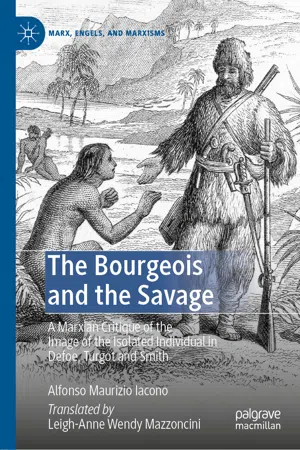
This classic text in Italian history of political philosophy, translated into English for the first time, investigates the philosophical and ideological conceptions hidden beneath the modern image of the isolated individual. In The Bourgeois and the Savage, Alfonso Maurizio Iacono reveals that this apparently simple and transparent image is imbued with a profound complexity containing human and social relationships, which are intertwined with relationships of power, domination, inequality, colonisation and servitude. As Karl Marx argued, and as was later confirmed by twentieth-century anthropology, the isolated individual does not stand at the beginning of history; he can emerge only where social relationships are already very developed and where society appears as a tool used for private purposes. Considering the writings of Daniel Defoe, the great French Enlightenment philosopher Turgot, and the father of political economy Adam Smith, The Bourgeois and the Savage critically analyses the process which led to the naturalisation of the image of the isolated man and traces its development and transformation into a still dominant paradigm.
eBook - ePub
The Bourgeois and the Savage
A Marxian Critique of the Image of the Isolated Individual in Defoe, Turgot and Smith
- English
- ePUB (mobile friendly)
- Available on iOS & Android
eBook - ePub
The Bourgeois and the Savage
A Marxian Critique of the Image of the Isolated Individual in Defoe, Turgot and Smith
About this book
Information
© The Author(s) 2020
A. M. IaconoThe Bourgeois and the SavageMarx, Engels, and Marxismshttps://doi.org/10.1007/978-3-030-39508-7_11. Introduction
Alfonso Maurizio Iacono1
(1)
University of Pisa, Pisa, Italy
Bibliography
The book Tristes tropiques1 (1955; A World on the Wane) by Claude Lévi-Strauss is considered to be a turning point in the Philosophical debate. In this book, released in 1955, the anthropologist is forced to question himself and his culture in a very serious way while working in the field.2 He begins to ask questions about habits, culture and cultural and political history that led him to learn about the other; he wonders above all about that aspect of the problem that disappears in the history of consciousness, that is, on the fact that the study of the other, the knowledge of the other, has almost always occurred on the terrain of the conquest of the other, on the terrain of colonialism. Hence, this is the decisive point, even if, from a historical-philosophical aspect, it is not a novelty. It would be sufficient enough to name Montaigne, who is the first of a list of modern philosophers who, by comparing the customs and habits of non-Western cultures, critically reflects upon Western customs and cultures. But it is perhaps with Tristes tropiques that for the first time anthropology as field research and also as an epistemological reflection on the knowledge of the other, takes an interest in disciplines that are external to anthropology itself, i.e. it begins to acquire an interest both in the field of historiography, and in the field of historical-philosophical reflection, building premises for an effective theoretical interaction between these different perspectives.3
As Michèle Duchet4 had already pointed out, the eighteenth century represented an important turning point in the way of relating to the other. This change refers to some theoretical elements that had developed in the fifteenth and in the sixteenth century that now began to be systematized by contributing to the change. When considering the organization of the ways in which the other is characterized, a very significant element of the eighteenth-century definition of the modern western identity is given by the fact that the spatial differences in the eighteenth century are assimilated to the temporal differences. Time devours space through a procedure that Lévi-Strauss had in his time called ‘false evolutionism’.5 The contrasted path, which goes from the discovery of America to the Enlightenment and beyond, has been effectively summarized by Anthony Pagden in terms of a far-reaching change in the way of understanding human societies. This change is marked by the passage from a description of cultures based on a concept of human nature considered constant in time and space to a broader anthropological and historical relativism. Pagden says, ‘it begins with a fact, the discovery of the American man, and ends with a simple proposition: that for the historian of cultures—who had inherited from the theologians that project which in the nineteenth century became “anthropology”—spatial differences were comparable to temporal differences’.6
Consequently, it was a Jesuit who took on the task of carrying out this change which would then be acquired by the Enlightenment tradition. Joseph-François Lafitau may be considered as the true founding father of modern comparativism. He lived for a long period among the Iroquois and the Urons in North America and upon his return to Europe, he wrote and published in 17247 a book entitled: Moeurs des sauvages américains comparées aux moeurs des premiers temps. (Customs of the American Indians Compared with the Customs of Primitive Times.)
Lafitau writes in the preparation stage of the work:
I have not limited myself to learning the characteristics of the Indian and informing myself about their customs and practices, I have sought in these practices and customs, vestiges of the most remote antiquity. I have read carefully [the works] of the earliest writers who treated the customs, laws and usages of the peoples of whom they had some knowledge. I have made a comparison of these customs with each other. I confess that, if the ancient authors have given me information on which to base happy conjectures about the Indians, the customs of the Indians have given me information on the basis of which I can understand more easily and explain more readily, any things in the ancient authors.8
There is no doubt that this statement represents a real methodological manifesto. However Lafitau, in affirming the comparative method, is supported by his convictions as a Jesuit: starting from his field research during his stay among the American Indians, he started looking for confirmation of the biblical theses. Lafitau presumes that American savages are the testimony of European savages, just as they must have lived before the age of the ancient Greeks. The point was precisely this: even the Greeks had been savages, so it was possible to make a comparison. But what could legitimize a comparison between the American savages and the European inhabitants of primordial times, from which, as mentioned, the ancient Greeks would then have descended? Simply the assimilation of spatial differences from temporal differences. In this perspective, the American savages are primitives, they are still men of the early times, men who find themselves, so to speak, behind the evolutionary scale that others have already crossed. The American savages are comparable with the European men of primordial times precisely because in reality, even though from a chronological point of view they are contemporary to Europeans like Lafitau, from a historical point of view they are not: in this respect they belong to the time of those who lived in Europe in the times that preceded the birth of ancient Greece. As claimed by the contemporary historian, Reinhardt Koselleck, ‘the American savages represent the condition of contemporaneity of the non-contemporaries’.9
Lafitau’s work, despite having been the object of heavy irony by Voltaire10 and de Pauw,11 actually became one of the decisive sources for all Enlightenment philosophers, from Voltaire himself to the Scots, Adam Smith and Adam Ferguson.12 Turgot, a leading figure in the French Enlightenment, wrote:
The people which were the first to acquire a little more knowledge quickly became superior to its neighbours; and each step in its progress made the next one easier. Thus the development of one nation accelerated from day to day, while others stayed in their state of mediocrity, immobilized by particular circumstances, and others remained in a state of barbarism. A glance over the earth puts before our eyes, even today, the whole history of the human race, showing us traces of all the steps and monuments of all the stages through which it has passed from the barbarism, still in existence, of the American peoples to the civilization of the most enlightened nations of Europe. Alas! our ancestors and the Pelasgians who pre- ceded the Greeks were like the savages of America!13
The theory that the ancient Greeks derive from the Pelasgians and that they were savages like the American Indians, is taken from Lafitau’s argumentations. Turgot is one of the philosophers who, in the eighteenth century, used the so-called four-stages theory to explain the changes and progress of populations and nations in an overview of the course of all humanity. Adam Smith also uses this theory independently from Turgot. Ronald Meek, in the book The Ignoble Savage, provided a detailed analysis of the history of this theory which asserted itself simultaneously in France and Scotland in the mid-eighteenth century.14 The four stages of universal history are: hunting, pastoralism, agriculture and commercial society. Basically, the ages of change in nations and people are marked on a progressive scale by their livelihood, that is, by the way in which men organize their physical sustenance, socially and technologically.15 The theorists of the four stages perceive that the forms of relationships, cultures, customs, religions must be explained starting from the livelihood of men, but with the tendency of giving it all a very deterministic outline. According to both Turgot and Adam Smith the nations or populations necessarily pass through the four stages of civilization, but they differ in the pace with which the crossing occurs. Thus it may happen that some populations are still at the hunting stage, while others are pastoralists, and some are already at the commercial stage. Hence, therefore, the development and, at the same time, the twist that the original comparative idea of Lafitau receives. The theorists of the four stages can explain what has been called the contemporaneity of ...
Table of contents
- Cover
- Front Matter
- 1. Introduction
- 2. Robinson Crusoe’s Adventure on the Island: From the Isolated Economy to Political Supremacy
- 3. An Attempt to Explain the Theory of Value: Turgot’s Simplification
- 4. The ‘Rude State of Society’ and the Reason for Abundance: Adam Smith’s Model
- 5. Political Philosophy on ‘The Gift’: Sahlins’s Interpretation
- Back Matter
Trusted by 375,005 students
Access to over 1.5 million titles for a fair monthly price.
Study more efficiently using our study tools.
Frequently asked questions
Yes, you can cancel anytime from the Subscription tab in your account settings on the Perlego website. Your subscription will stay active until the end of your current billing period. Learn how to cancel your subscription
No, books cannot be downloaded as external files, such as PDFs, for use outside of Perlego. However, you can download books within the Perlego app for offline reading on mobile or tablet. Learn how to download books offline
Perlego offers two plans: Essential and Complete
- Essential is ideal for learners and professionals who enjoy exploring a wide range of subjects. Access the Essential Library with 800,000+ trusted titles and best-sellers across business, personal growth, and the humanities. Includes unlimited reading time and Standard Read Aloud voice.
- Complete: Perfect for advanced learners and researchers needing full, unrestricted access. Unlock 1.5M+ books across hundreds of subjects, including academic and specialized titles. The Complete Plan also includes advanced features like Premium Read Aloud and Research Assistant.
We are an online textbook subscription service, where you can get access to an entire online library for less than the price of a single book per month. With over 1.5 million books across 990+ topics, we’ve got you covered! Learn about our mission
Look out for the read-aloud symbol on your next book to see if you can listen to it. The read-aloud tool reads text aloud for you, highlighting the text as it is being read. You can pause it, speed it up and slow it down. Learn more about Read Aloud
Yes! You can use the Perlego app on both iOS and Android devices to read anytime, anywhere — even offline. Perfect for commutes or when you’re on the go.
Please note we cannot support devices running on iOS 13 and Android 7 or earlier. Learn more about using the app
Please note we cannot support devices running on iOS 13 and Android 7 or earlier. Learn more about using the app
Yes, you can access The Bourgeois and the Savage by Alfonso Maurizio Iacono, Leigh-Anne Wendy Mazzoncini in PDF and/or ePUB format, as well as other popular books in Politics & International Relations & European History. We have over 1.5 million books available in our catalogue for you to explore.