This book gathers original, empirical and conceptual papers that address the complex challenges of conducting responsible research in the business and management professions. It includes contributions related to, and reflecting on, the vision of the Responsible Research in Business and Management (RRBM) network, which proposes that business can help provide a better world if it is informed by responsible research. The responsible research agenda requires new methods of scholarly assessment that include criteria for measuring impact, systemic solutions and practitioner relevance. Theories greatly influence business and management practices, and as the late Sumantra Ghoshal warned, bad management theories are destroying good management practices. The authors of this book believe that good management theories can help to create new and better business practices.
eBook - ePub
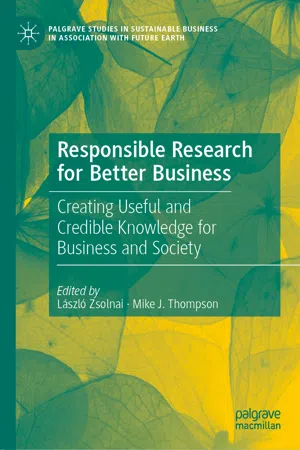
Responsible Research for Better Business
Creating Useful and Credible Knowledge for Business and Society
- English
- ePUB (mobile friendly)
- Available on iOS & Android
eBook - ePub
Responsible Research for Better Business
Creating Useful and Credible Knowledge for Business and Society
About this book
Information
Part IIntroduction
© The Author(s) 2020
L. Zsolnai, M. J. Thompson (eds.)Responsible Research for Better BusinessPalgrave Studies in Sustainable Business In Association with Future Earthhttps://doi.org/10.1007/978-3-030-37810-3_1The Call for Responsible Research in Business and Management
László Zsolnai1 and Mike J. Thompson2
(1)
Business Ethics Center, Corvinus University of Budapest, Budapest, Hungary
(2)
Anthesis, London and the Gustavson School of Business, University of Victoria, Victoria, BC, Canada
Keywords
Problem formulationProblem-solvingResponsibilityEthicsTheories greatly influence business and management practices. In his seminal work the late London Business School professor Sumantra Ghoshal (2005) warned that bad management theories are destroying good management practices. Similarly, good management theories may help to bring forth new and better business practices.
One of the most influential moral philosophers of our time, Hans Jonas (1984) suggested that responsibility should be understood as caring for the beings whose functioning is under one’s action and consideration. From Jonas’ theory of responsibility it follows that business and management researchers should not be passive observers of the subjects they study. Rather, responsible scholars should develop sensitivity and responsiveness toward the fate and well-being of organizations and other social systems they happen to focus on.
In 2017, Notre Dame University professor Anne Tsui initiated the creation of an international network of leading scholars and universities has been formed to promote Responsible Research in Business and Management (RRBM). The core vision of RRBM is that
business can be a means for a better world if it is informed by responsible research. (…) Research is the foundation of business education and practice, yet business research has failed to live up to its promise in promoting better policies and best practices. If nothing is done, business research will lose its legitimacy at best; at worst, it will waste money, talent, and opportunity. (RRBM 2019)
The voices of internal and external business school stakeholders (for example, Ghoshal 2005; Segalla 2008; Simons 2013; Cannon 2015; de Bettignies 2018; Elangovan, and Hoffman 2019) have become increasingly strident in their challenges to the business research agenda. Such voices convey a sense that perceived academic elitism, competition, and imperialism has led to a multitude of ever-increasing “cul-de-sacs” of knowledge creation which fail to translate appropriately and relevantly to knowledge dissemination. Despite grand objectives that point toward contemporary management needs, opportunities, and challenges, the internal business academic scholarship system tends to promote self-service (Starbuck 2007, 24), rather than leading responsibly as a steward of knowledge creation, applied learning and impactful research.
Brannick and Coghlan’s well-documented survey of the literature on the perceived relevance gap between academics and practitioners painted a disquieting picture in 2006. They noted that the business world appeared to be “generally ignoring the research and consequent knowledge produced by business schools or academia, since it feels it is irrelevant to its purposes” (Brannick and Coghlan 2006, 2). Publications in the field since then have continued to question the nature and relevance of business and management research and many scholars have shown support for the view expressed by the RRBM that although “research is the foundation of business education and practice, yet business research has failed to live up to its promise in promoting better policies and best practices” (RRBM 2019). Business research questions, methods, predictions, and prescriptions are perceived by practitioners, such as James Wallis in this volume, to reflect a habitus that does not reflect the kind of research insights that contemporary management needs. In Wallis’s words, there is “a mismatch between the conventional concepts of business and the demands of sustainable change.” He calls for a future paradigm of research and practice as “the natural and obvious path, as opposed the anomalous and exceptional one” (Chapter 10).
The diagnosis for the flaws in the prevailing business and management research paradigm conditions frequently reference the over-arching demands of the academic journal ranking system in shaping research agendas and in maintaining particular forms of organizational and social scientific methodologies and theories. This has led to a narrowing frame of reference for discursive enquiry within business disciplines rather than toward an integration of business disciplines which align with the trend of companies to pursue agile strategies that integrate business functions (Visée 2015).
Business and management scholarship tends to follow the conventions of other academies in aligning academic career development through journal publication filters. But, like the engineering and technology academies, business schools are expected to create fundamental knowledge that can be applied to practice “in applied domains to address pressing and current issues” (RRBM 2019). Managers require theory, design, concepts, modeling and research insights that help them to develop new markets and improve operational decision-making and processes. They also require more accessible and applied knowledge through business practitioner media.
The business management paradigm creates a tension for business scholars between their vocation to use management science to serve business and society and the business journal ranking system measures that appear as an unbending career master. Research quality and focus is measured by the number of A-level journal publications, h-index, citation scores, and the like at the risk of “using a language that broader audiences do not understand, publishing in journals that they don’t read, and asking questions for which they have little concern” (Elangovan and Hoffman 2019).
Responsible business research expressed in the seven RRBM Principles outlined below and the “real” research needs of management face obfuscation by the idiosyncratic particularities and limitations of A-level journals which, as Adler and Harzburg point out,
…neither claim to comprehensively include “the best of the best” nor do they inadvertently succeed in such a task. The journals included in the FT40 and the UTD lists, for example, are merely a sample of high-quality journals; they do not even attempt to represent (let alone equitably and comprehensively include) all 13 (AACSB-defined) disciplines associated with business. (Adler and Harzburg 2009, 76)1
Adler and Harzburg summarize a commonly expressed complaint by faculty that articles published in new journals remain invisible to most citation indices and to almost all ranking systems. The responsible research agenda requires new methods of scholarly assessment and success that include criteria that measure impact, systemic solutions and practitioner-relevance. One way would be for business school faculty appointment committees in assessing candidates to give equal weight to the impact of their scholarship through the weighting of citations and articles in the practitioner press.
Business and management research can do much more to contribute solutions to the global challenges expressed by the UN Sustainable Development Goals. To this end, the RRBM formulated a Position Paper from April to September 2017 supported by 85 cosigners from over 75 institutions in 21 countries, representing senior scholars, deans, university, and business leaders. The Paper sets a vision for the role of business schools in contributing to societal well-being and the UN Sustainable Development Goals. It also sets out the Principles of Responsible Science that will “guide business and management research to build a sound body of knowledge that serves society” (RRBM 2019). In summary form, the seven RRBM Principles for transforming business and management research are:
- 1.Service to Society: Development of knowledge that benefits business and the broader society, locally and globally, for the ultimate purpose of creating a better world.
- 2.Stakeholder Involvement: Research that engages different stakeholders in the research process, without compromising the independence of inquiry.
- 3.Impact on Stakeholders: Research that has an impact on diverse stakeholders, especially research that contributes to better business and a better world.
- 4.Valuing Both Basic and Applied Contributions: Contributions in both the theoretical domain to create fundamental knowledge and in applied domains to address pressing and current issues.
- 5.Valuing Plurality and Multidisciplinary Collaboration: Diversity in research themes, methods, forms of scholarship, types of inquiry, and interdisciplinary collaboration to reflect the plurality and complexity of business and societ...
Table of contents
- Cover
- Front Matter
- Part I. Introduction
- Part II. Methodologies for Responsible Business Research
- Part III. Getting Closer to Real World Business
- Back Matter
Trusted by 375,005 students
Access to over 1.5 million titles for a fair monthly price.
Study more efficiently using our study tools.
Frequently asked questions
Yes, you can cancel anytime from the Subscription tab in your account settings on the Perlego website. Your subscription will stay active until the end of your current billing period. Learn how to cancel your subscription
No, books cannot be downloaded as external files, such as PDFs, for use outside of Perlego. However, you can download books within the Perlego app for offline reading on mobile or tablet. Learn how to download books offline
We are an online textbook subscription service, where you can get access to an entire online library for less than the price of a single book per month. With over 1.5 million books across 990+ topics, we’ve got you covered! Learn about our mission
Look out for the read-aloud symbol on your next book to see if you can listen to it. The read-aloud tool reads text aloud for you, highlighting the text as it is being read. You can pause it, speed it up and slow it down. Learn more about Read Aloud
Yes! You can use the Perlego app on both iOS and Android devices to read anytime, anywhere — even offline. Perfect for commutes or when you’re on the go.
Please note we cannot support devices running on iOS 13 and Android 7 or earlier. Learn more about using the app
Please note we cannot support devices running on iOS 13 and Android 7 or earlier. Learn more about using the app
Yes, you can access Responsible Research for Better Business by László Zsolnai, Mike J. Thompson, László Zsolnai,Mike J. Thompson in PDF and/or ePUB format, as well as other popular books in Business & Business Ethics. We have over 1.5 million books available in our catalogue for you to explore.