- English
- ePUB (mobile friendly)
- Available on iOS & Android
eBook - ePub
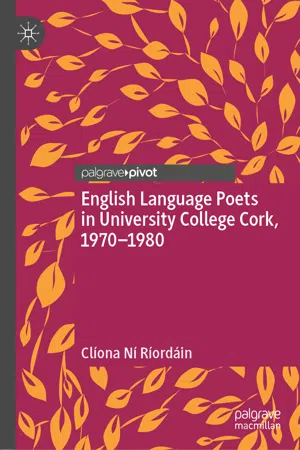
English Language Poets in University College Cork, 1970–1980
About this book
This book looks at a cohort of poets who studied at University College Cork during the 1970s and early 1980s. Based on extensive interviews and archival work, the book examines the notion that the poets form a "generation" in sociological terms. It proposes an analysis of the work of the poets, studying the thematics and preoccupations that shape their oeuvre. Among the poets that figure in the book are Greg Delanty, Theo Dorgan, Seán Dunne, Gerry Murphy, Thomas McCarthy, Gregory O'Donoghue, and Maurice Riordan. The volume is prefaced by Eiléan Ní Chuilleanáin.
Information
Topic
LetteraturaSubtopic
Critica letteraria europea© The Author(s) 2020
C. Ní RíordáinEnglish Language Poets in University College Cork, 1970–1980https://doi.org/10.1007/978-3-030-38573-6_11. Beginnings
Clíona Ní Ríordáin1
(1)
Institut du Monde Anglophone, Université Sorbonne Nouvelle-Paris 3, Paris, France
Clíona Ní Ríordáin
Abstract
This chapter examines the emergence of a generation of English-language poets in UCC between 1970 and 1980. It compares the relatively little critical attention they garnered by comparison to the Irish-language poets who were associated with the journal INNTI. The chapter then offers an overview of the social and economic climate in Cork during the late 1960s and early 1970s. It highlights the absence of women writers in the cohort under study. An account is given of the changes occurring in University College Cork in the wake of the O’Malley Education Act of 1967. The presence of tutelary figures among the staff is discussed, chief among them Seán Lucy and John Montague.
Keywords
UCC poetsINNTI Tutelary figuresSeán LucyJohn MontagueIn the late 1960s and 1970s, a number of remarkable poets emerged from University College Cork. They wrote both in Irish and in English. The Irish-language poets, now known as the INNTI poets, after the name of the journal edited by Michael Davitt in which their work was published, are widely acknowledged as forming an important group and occupying a special place in relation to Irish language literature. Several studies have been devoted to their work1 and they have been subsumed into the canon—appearing regularly in school textbooks and on university courses. Comparatively little has been written however about the English-language poets,2 Greg Delanty, Theo Dorgan, Seán Dunne, Thomas McCarthy, Gerry Murphy, Gregory O’Donoghue, Maurice Riordan. This was symptomatic of a wider lack of interest highlighted by Sebastian Barry in his anthology The Inherited Boundaries: Younger Poets of the Republic of Ireland.3 In his introduction, Barry underlined the richness of the poetry being written in the Republic of Ireland by poets born in the 1950s, and although he acknowledged the due recognition awarded Northern poets, his anthology hoped to find an audience for the poets he had selected. Thomas McCarthy, who was included in Barry’s anthology, has compared the act of writing poetry in those years to “gardening in the rain”. This eloquent metaphor became the working title for my study.
The present volume seeks to redress the balance, to remedy the benign neglect by drawing attention to the writing of this cohort of English language poets. Other young poets had emerged from UCC before that date, Eiléan Ní Chuilleanáin,4 or Augustus Young,5 for instance, yet they seem to have evolved as talented individuals,6 finding a poetic voice in isolation, without a sense of a network or a collective identity. Paul Durcan7 was also a student at UCC during the period under review. However, he was an established poet at that stage, having already published several volumes of poetry, for that reason his work is not included in the study. His presence in the college at that time was nonetheless a vital one and I have established a series of correspondences between individual poems in his work and those that figure in the work of the other poets.
While concentrating on the English language poets, this study proposes to look at both English and Irish language groups as an organic whole and examines the circumstances and the context in which they came to poetry. In so doing, I will pursue the traces and trails laid down by Frank Sewell who suggests that a dialogue between Irish poets writing in the Irish and English languages has been insufficiently acknowledged and studied.8 I will also address the claim made by Seán Dunne in his anthology Poets of Munster that apart from attending University College Cork in the 1970s: “they have little else in common”.9 Ten years later, in the preface to an anthology of poetry written by poets educated in UCC, Jumping off Shadows (edited by Greg Delanty and Nuala Ní Dhomhnaill), Philip O’Leary invoked the tripartite obsessions of Daniel Corkery10 (“The Religious Consciousness of the People, Irish Nationalism and the Land11”) as a yardstick to measure the younger poets’ work. O’Leary underlined the new generations’ divergence from the themes that dominated Corkery’s oeuvre. Nonetheless, the inclusion of Corkery’s chief preoccupations signals his totemic presence in the literary historiography of the city. Corkery was Professor of English at UCC from 1931–194712 and is remembered today for his critical work, as the author of The Hidden Ireland; yet, he was also a poet, dramatist, short story writer and novelist.
Although the figure of Corkery cannot be discounted entirely as an influence (he was the subject of Thomas McCarthy’s MA thesis), I would argue that the literary forerunners of this particular generation are to be found elsewhere. Chief among these avatars is the figure of the nineteenth-century Cork-born poet Francis Sylvester Mahony,13 better known as Father Prout. Mahony’s prodigious output included many translations or pseudo translations from a variety of European languages. Another influence was that of Corkery’s former protégé, Seán O’Faoláin,14 an intellectual engagé, and editor of The Bell. Both Mahony and O’Faoláin managed to combine writing about their native place with a cosmopolitan disdain for the constraints of such a small, often narrow-minded city.
My project combines biographical writing with studies of the work of each of the poets. In keeping with the developments in the study of biography, and more broadly the contemporary interest in life-writing,15 the approach adopted here as a result is that of a group biography, as such it brings together common thematic strands in the work of the poets. The biographical element seems vital in this the first extended study of this group of poets. As well as proposing a linear narrative of the poets’ lives, I place them in a wider socio-historical perspective, examining the social fabric of their lives, in Bourdieu’s terms their habitus. I attempt to assess how these poets can, after the studies of Karl Mannheim, be considered to be a generation of poets. For Mannheim, in his seminal essay “The Problem of Generations”,16 a generation was not to be understood in a biological sense of being members of a same family group; rather it entailed a cohort of people born around the same time. Significantly, Mannheim took into account the sociological dimension of the environment the group were born into, location and the socio-historical events playing an important role in determining the sense of identification shared by a group of young people in their formative years. The generation, in Mannheim’s elaboration of the term, became a potential source of identity and political mobilisation. It is the capacity for self-identification and the political content of their poetry, I argue, which set these Cork poets apart from many of their counterparts, whose treatment of politics is more ironic and circumspect.
This book shows how a group of poets, growing up in Ireland, at a time of profound social change, emerged from the education system convinced of their calling as poets. Their place in that education system was linked to Donogh O’Malley’s edu...
Table of contents
- Cover
- Front Matter
- 1. Beginnings
- 2. A Terrace of Generations
- 3. The Brindled Cats: Language and Translation
- 4. Journeys to the Past: Identities, Histories, and Myth
- 5. The Grumbling Questioning Poet: Politics and Social Engagement
- 6. Conclusion
- Back Matter
Trusted by 375,005 students
Access to over 1.5 million titles for a fair monthly price.
Study more efficiently using our study tools.
Frequently asked questions
Yes, you can cancel anytime from the Subscription tab in your account settings on the Perlego website. Your subscription will stay active until the end of your current billing period. Learn how to cancel your subscription
No, books cannot be downloaded as external files, such as PDFs, for use outside of Perlego. However, you can download books within the Perlego app for offline reading on mobile or tablet. Learn how to download books offline
We are an online textbook subscription service, where you can get access to an entire online library for less than the price of a single book per month. With over 1.5 million books across 990+ topics, we’ve got you covered! Learn about our mission
Look out for the read-aloud symbol on your next book to see if you can listen to it. The read-aloud tool reads text aloud for you, highlighting the text as it is being read. You can pause it, speed it up and slow it down. Learn more about Read Aloud
Yes! You can use the Perlego app on both iOS and Android devices to read anytime, anywhere — even offline. Perfect for commutes or when you’re on the go.
Please note we cannot support devices running on iOS 13 and Android 7 or earlier. Learn more about using the app
Please note we cannot support devices running on iOS 13 and Android 7 or earlier. Learn more about using the app
Yes, you can access English Language Poets in University College Cork, 1970–1980 by Clíona Ní Ríordáin in PDF and/or ePUB format, as well as other popular books in Letteratura & Critica letteraria europea. We have over 1.5 million books available in our catalogue for you to explore.