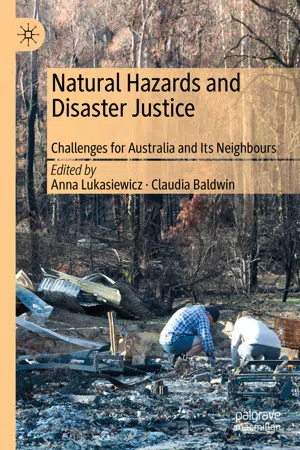
This book explores policy, legal, and practice implications regarding the emerging field of disaster justice, using case studies of floods, bushfires, heatwaves, and earthquakes in Australia and Southern and South-east Asia. It reveals geographic locational and social disadvantage and structural inequities that lead to increased risk and vulnerability to disaster, and which impact ability to recover post-disaster. Written by multidisciplinary disaster researchers, the book addresses all stages of the disaster management cycle, demonstrating or recommending just approaches to preparation, response and recovery. It notably reveals how procedural, distributional and interactional aspects of justice enhance resilience, and offers a cutting edge analysis of disaster justice for managers, policy makers, researchers in justice, climate change or emergency management.
A. Lukasiewicz, C. Baldwin (eds.)Natural Hazards and Disaster Justicehttps://doi.org/10.1007/978-981-15-0466-2_1
Begin Abstract
1. The Emerging Imperative of Disaster Justice
Anna Lukasiewicz1
(1)
Fenner School of Environment and Society and Institute for Integrated Research on Disaster Risk Science, Australian National University, Canberra, ACT, Australia
Social justiceEnvironmental justiceClimate justiceEcological justiceDisaster governancePPRR
End Abstract
1.1 Why a Book on Disaster Justice?
Disasters, and their impacts, are increasing all over the world, with the Asia Pacific region being particularly susceptible. The region experiences the largest amount of natural disasters in the world; between the years 2014 and 2017 there were 55 earthquakes, 217 storms and cyclones and 236 cases of severe flooding in the Asia Pacific region, which affected 650 million people and caused 33,000 deaths (OCHA, 2019, p. 15).
Australia is not immune from these statistics. Its economic losses alone added up to $171.5 billion1 (which includes the costs of deaths and injuries) during the period 1967–2013 and have continued to climb, mostly due to population growth, rather than a growth in the number of natural hazards, suggesting that Australia’s disaster risk is driven by socio-economic trends (Handmer, Ladds, & Magee, 2018).
1.2 What Is a Disaster?
Before launching into an explanation of Disaster Justice, a short discussion of disasters is necessary. What constitutes a disaster? Most definitions highlight the destructive nature of disasters (human lives lost, damaged infrastructure) and an acute time-delineated event (an earthquake, an epidemic), however even these lines are murky when we start to consider slow onset disasters such as droughts, cascading disasters (Pescaroli & Alexander, 2015) or when using a systemic approach (O’Connell et al., 2018). The IPCC adopted the following definition of disasters in 2012:
Severe alterations in the normal functioning of a community or a society due to hazardous physical events interacting with vulnerablesocial conditions, leading to widespread adverse human, material, economic, or environmental effects that require immediate emergencyresponseto satisfy critical human needs and that may require external support for recovery. (IPCC, 2012, p. 558)
This and other widely used definitions highlight the following aspects of disasters:
A disruption or an alteration of normal functioning
An interplay between a physical event and social condition of those affected
Loss or impact; human, material, economic and/or environmental
The coping capability of those impacted being affected or exceeded, leading to a need for outside intervention
There is much more to the definitions of disasters, as entire books have been devoted to this question (see Perry & Quarantelli, 2005) but the four points outlined above are particularly important in discussing climate and environmental crises and very pertinent to the following discussion of disaster justice. I have not mentioned here the delineation between a natural and a man-made disaster, because as the subsequent discussion makes clear, there is no such thing as a purely ‘natural’ disaster; “natural disasters are in fact social disasters waiting to happen that may be triggered by a particular natural force” (Pelling, quoted in Verchick, 2012, p. 34).
Another important consideration of disasters for our purpose is the expectation around their management. Lauta (2015) persuasively argues that the way we view disasters has changed. Disasters used to be seen as ‘Acts of God’—divine punishment for society’s shortcomings. Then they came to be seen as an unstoppable and unmanageable force of ‘Nature’. Now they are mostly considered to be consequences of human decisions (such as maintaining settlements in flood, storm, or earthquake-prone areas). While the majority of disaster justice writings to date are based on this view, some point out that it is in itself a form of cultural blindness in disaster management. For example, in his criticism of this ‘western’ or ‘North Atlantic’ view of disasters, Bankoff (2018) points out that this progression suggests an ‘evolution’, one that is linear and absolute implying that viewing a disaster as a form of divine punishment (as some cultures still do) is somehow incorrect. This could lead to a denial of cultural knowledges and practices of affected communities, a point I will return to later in the chapter.
1.3 What Is Justice?
Justice is arguably a much harder concept to define than disasters. It has been a preoccupation of both ancient and modern philosophers and identified as the first key ethic necessary for human society. For example, it is a central virtue to Rawls, who posits justice as the basis of a social contract between citizens and their governing institutions (Rawls, 1971). John Stuart Mill called it “the chief part, and incomparably the most sacred and binding part, of all morality” (quoted in Riley, 2010). Justice is not just a virtue—it is the supreme virtue by which other values are measured; it is an implicit expectation of any society and something that governments are expected to provide.
Justice is an incredibly complex idea and has been pursued in isolation by many academic disciplines—philosophy, law, economics, and numerous social sciences to name but a few. Our understanding of it is thus fragmented and interdisciplinary approaches to justice research are rare. Figure 1.12 captures some of the different types of justice that readers of this book might come across. Starting at the bottom left corner of the figure, we can look at justice by focusing on the subjects of justice—as individuals (or groups, e.g. nonhumans, organisations or ecosystems). Going up to the top left, we can conversely look at justice through the lens of space and time (a common approach of geographers), again focusing on a specific group or multiple groups in a specific time and location. At the bottom left, there are spiritual and religious approaches to justice sitting next to normative approaches such as philosophy and the law. In the middle are what I call ‘composite’ justice types (as they can be made up of any of the surrounding elements).
Fig. 1.1
A typology of justice that illustrates its complexity
At the top, right hand side, we can look at justice as the result of distribution (how do we distribute rights, resources, burdens and privileges within a society?) and process (how do we decide this distribution?). Within procedural justice (which can be thought of as the structures, rules and methods of decision-making), some scholars separate interactional or relational justice (concerned with how stakeholders and decision-makers are treated). This is a common approach to justice, particularly practised in the discipline of social psychology and used by myself (see Lukasiewicz, 2017b) and others in this book (e.g. see Chaps. 5 and 16). The typology presented here is one representation and to some extent simplified, but serves to illustrate the complexity. For example, the principle ofrecognition (i.e. acknowledging the rights to be heard and enabling inclusion of a stakeholder) can be inserted into procedural justice or sit above the entire diagram. Another typology is a thematic approach—climate justice, water justice, food justice, and so on. A thematic typology will still incorporate the mixture of approaches presented in Fig. 1.1.
While much more can be said about the complexity of justice (see Lukasiewicz, 2017a), I will only point out a couple of issues most pertinent to disaster management.
Talking about justice immediately involves talking about authorities and institutions which are meant to administer or ensure justice. In most societies, this is the role of the legal system. Indeed, ‘the law’ is meant to ensure the attainment of a just society, even though it inadvertently fails due to the complexity and fluidity of justice as a concept (Sarat & Kearns, 1996). When it comes to disaster management, the most obvious authority in charge is the government; and the pursuit of justice is inextricably tied to government capability and intent, a point I will return to later. Connected to this is the concept of ‘moral community’, that is, those to whom justice is owed (Deutsch, 1985). Once we start talking about justice, an obvious question to ask is ‘justice for whom?’ This could be individuals, different groups within society; it could be nonhumans—for example, domesticated animals, wildlife or ecosystems, or future generations (both human and otherwise).
Another important point about justice is that it is often considered a specific outcome—a decision or an event, whereas in fact it should be viewed more as a process (see Patrick, 2014). Think about any res...
Table of contents
Cover
Front Matter
Part I. Introduction
Part II. Governance
Part III. Vulnerability and Resilience
Back Matter
Trusted by 375,005 students
Access to over 1.5 million titles for a fair monthly price.
Study more efficiently using our study tools.
Frequently asked questions
Yes, you can cancel anytime from the Subscription tab in your account settings on the Perlego website. Your subscription will stay active until the end of your current billing period. Learn how to cancel your subscription
No, books cannot be downloaded as external files, such as PDFs, for use outside of Perlego. However, you can download books within the Perlego app for offline reading on mobile or tablet. Learn how to download books offline
Perlego offers two plans: Essential and Complete
Essential is ideal for learners and professionals who enjoy exploring a wide range of subjects. Access the Essential Library with 800,000+ trusted titles and best-sellers across business, personal growth, and the humanities. Includes unlimited reading time and Standard Read Aloud voice.
Complete: Perfect for advanced learners and researchers needing full, unrestricted access. Unlock 1.5M+ books across hundreds of subjects, including academic and specialized titles. The Complete Plan also includes advanced features like Premium Read Aloud and Research Assistant.
Both plans are available with monthly, semester, or annual billing cycles.
We are an online textbook subscription service, where you can get access to an entire online library for less than the price of a single book per month. With over 1.5 million books across 990+ topics, we’ve got you covered! Learn about our mission
Look out for the read-aloud symbol on your next book to see if you can listen to it. The read-aloud tool reads text aloud for you, highlighting the text as it is being read. You can pause it, speed it up and slow it down. Learn more about Read Aloud
Yes! You can use the Perlego app on both iOS and Android devices to read anytime, anywhere — even offline. Perfect for commutes or when you’re on the go. Please note we cannot support devices running on iOS 13 and Android 7 or earlier. Learn more about using the app
Yes, you can access Natural Hazards and Disaster Justice by Anna Lukasiewicz, Claudia Baldwin, Anna Lukasiewicz,Claudia Baldwin in PDF and/or ePUB format, as well as other popular books in Biological Sciences & Environmental Law. We have over 1.5 million books available in our catalogue for you to explore.