Building on co-author Sharon Williams' previous title Improving Healthcare Operations, this book examines the role of co-design and coproduction in health and social care. Extending current thinking on coproduction in healthcare and how this can be operationalised, this book opens a discussion around how it can contribute to improvement. Providing a number of case studies, it links previous public service management, operations management and supply chain management research by extending and translating these core design and improvement principles into health and social care. Considering the wider role of patients, communities and other stakeholders it will challenge and develop existing thinking in relation to co-design, coproduction and redesign of services.
eBook - ePub
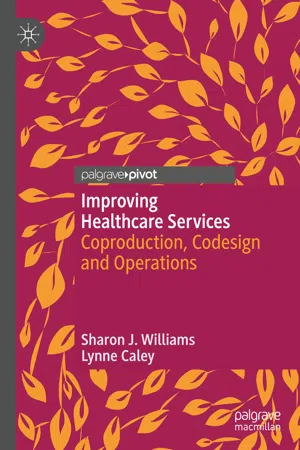
Improving Healthcare Services
Coproduction, Codesign and Operations
- English
- ePUB (mobile friendly)
- Available on iOS & Android
eBook - ePub
About this book
Information
© The Author(s) 2020
S. J. Williams, L. CaleyImproving Healthcare Serviceshttps://doi.org/10.1007/978-3-030-36498-4_11. Introduction to Public Service Management and Service Operations
Sharon J. Williams1 and Lynne Caley2
(1)
College of Human & Health Sciences, Swansea University, Swansea, UK
(2)
Consolidated Caley Ltd, Peterborough, UK
Lynne Caley
Abstract
This chapter introduces the concept of service operations and the need for continuous improvement. We offer three interacting approaches by which public sector design and delivery may be assessed. We introduce the concepts of co-production and co-design, which have been popularised in healthcare in terms of both practice and research. We highlight the work done to promote quality improvement in healthcare. Finally, we emphasise the need to bring together these three approaches and consider how this might work in practice.
Keywords
Service operations managementPublic servicesCo-designCo-productionService-dominant logicHealthcareIntroduction
In this chapter , we briefly consider the trajectory of service operations management and the role of citizens/customers/users, which includes the emergence of service dominance logic within public-sector management. Our discussion extends from the public sector to public services and discuss why involving users in improving the management and operation of the public sector is essential to the design and provision of public services. Specifically we link our discussion to healthcare which is the public service that is the main feature of this text. However, we feel much of what we are proposing is applicable to other public services and private healthcare systems with some adjustment for context.
Service Operations Management
“Service” at one time only implied face-to-face interactions between two people, that is the service provider and the person receiving the service (service user) (Glushko and Tabas 2009). Today the design and delivery of services is much more complex (Glushko 2010); services can involve different person-to-person encounters, modes of delivery (e.g. self-service, online), multi-channels of distribution, multi devices from various locations in different contexts. Many of these interactions (also known as moments of truth) will be information intensive and perhaps to a lesser extent will be designed to deliver a bespoke service to the user, what might be called a person or citizen-centred approach.
The ‘service concept’, a termed coined by Sasser et al. (1978), has been described as playing a key role in service design and development. It explains the “how and what” of service design, what Sasser et al. (1978) defined as the total bundle of goods and services sold to the customer. The service concept helps mediate between what customers identify they actually want and need, and the organisation’s strategic intent and ability to deliver and meet these needs (Meyer Goldstein et al. 2002).
Harvey’s (1990) research in social services explains how relationships in professional services influence process design and consequently service outcomes. The balance of power in professional service organizations can also influence the relationships among professionals, service users and managers. In subsequent research, Harvey (1992) recognized that the knowledge gap between the professional and the customer requires attention if services are to be improved.
All of this discussion around the interaction between service providers and users relies on the ability to identify the target market (e.g. the right customer). Many organisations segment their potential customers based on common attributes and characteristics (e.g. demographics). In service operations management, customers tend to be segmented based on operational attributions (e.g. amount of customer contact and/or level of customisation) (Chase et al. 1998; Schmenner 1986, 1995; Chase and Tansik 1983; Chase 1981). Customer segmentation is an important area that seems under-researched within public services and specifically healthcare, yet is crucial to service (re)design and the co-production agenda.
Returning to the service concept, Roth and Menor (2003) suggest that one of the first steps in designing a new service or assessing its effectiveness is to consider all the elements of the service from the perspective of the consumer and the provider. Usually, this will include a combination of tangible and intangible elements. We suggest a similar process needs to happen when redesigning services. When reviewing a service often the assessment is limited to defined parts of the process rather than all elements.
Early studies on service management considered the interaction between service users and service providers (e.g. organisations) in the process of providing services (Fuchs 1968). More recently, service operations management has focused on service design (as well as management), particularly the interaction between the professional (e.g. front-line staff) actually delivering the service and the customer or service user. Radnor and Bateman (2016) refer to service operations management as being concerned with both the output (outcome) of the services (e.g. customer service) and the service organisation – in terms of how it is configured and managed to provide (value-adding) services to its customers. This presents two perspectives of the service:
- 1.From an operation’s point of view, -in terms of the service provided; and
- 2.From a service user’s viewpoint in terms of how the service is received.
The traditional input-process-output model is central to (service) operations management. Each service operation (e.g. hospital) will manage and use input resources (e.g. Medicines, scanners, IT, beds etc.). One significant point to highlight (different to managing product operations) is that the service user who is receiving the service/treatment or the member of staff who requires support from IT are seen as important inputs. Typically service organisations provide many services (e.g. surgery, outpatient clinics, A&E, diagnostic services, reception, catering) which process the inputs to hopefully provide the desired outputs (outcomes such as good quality of care, more knowledgeable staff, availability of information). The service provided is the service process which involves the service user – therefore services are co-created or co-produced with the service user – and outputs are produced (e.g. patient outcome – better health; personalised care; organisational outcomes – good use of theatres, number of operations performed). The service received is the experience of the service provided – the service user’s interpretation of and response to their journey. The interaction between the service provider and the service user is the opportunity to create value (Johnston and Kong 2011; Johnston et al. 2012).
Public Service Operations Management
Radnor and Bateman (2016) recently called for the development of (service) operations management thinking and theory to be applied to public sector organisations and public services in general – which they termed public service operations management. The focus of this new discipline is for OM scholars to adapt traditional frameworks and concepts originally developed with manufacturing and private service organisations to the context and workings of public services (e.g. healthcare, emergency services, local government, third sector and voluntary organisations). Within each service, there will be high levels of variation when delivering local services. Key areas of (service) operations management such as development of an operations strategy, managing capacity and demand are typically not well understood or practiced in public services. Recently, improving operations has featured more prominently in public services; this is largely due to the need for efficiency gains, a reduction in budgets and the recognition of involving citizens and users in the design and delivery of services (Radnor and Bateman 2016).
It is important to note the point made about the adaption (not adoption) of operations management strategies and methods to public services. Scholars (e.g. Osborne and Brown 2011) highlight the ‘fatal flaw’ of viewing public services as manufacturing rather than as service processes. In other words, the majority of public goods (whether delivered by government, non-profit and third sector or private sector) are not public products but public services that are part of people’s lives. Public services are often intangible and service-driven. Radnor et al. (2014), among others, have argued for public services to move away from this product-dominant logic, where production and consumption are separated as discrete processes. To a (public) services-dominant logic where the service experience is placed at the centre of public services delivery, (Osborne et al. 2015; Virtanen and Stenvall 2014), and where citizens are seen as co-producers of public services rather than solely the client or receiver of services (Radnor and Bateman 2016). This work has been extended to explore the benefits of public service-dominant logic to lean improvement methodologies in healthcare (Radnor and Osborne 2013).
Interactions in healthcare are often complex and may involve multiple providers, with differing skills, roles and competences. Value is likely to differ across the different providers which may cause confusion for patients and a reluctance to participate in co-production activity (Fyrberg Yngfalk 2013; Hardyman et al. 2015).
Healthcare Operations Management
In recent times, all healthcare systems have been facing a number of challenges such as ageing populations, shrinking budgets and higher expectations for effective and efficient treatments. Therefore, imp...
Table of contents
- Cover
- Front Matter
- 1. Introduction to Public Service Management and Service Operations
- 2. Quality Improvement in Healthcare: Where Are We Now and Where Next?
- 3. Citizen Involvement: What Does It Mean?
- 4. Defining Co-production
- 5. Quality Improvement and Co-production and Co-design Models and Approaches
- 6. Case Study: Improving a Pulmonary Rehabilitation Programme – A Co-produced Approach
- 7. Case Study: Improving a Community Based Huntington’s Disease Service – A Family-Centred Approach
- 8. Co-producing Quality Improvement: Cases from the Published Literature
- 9. The Role of Co-design and Co-production in Improving Healthcare Services: Conclusion and Future Research Agenda
- Back Matter
Trusted by 375,005 students
Access to over 1.5 million titles for a fair monthly price.
Study more efficiently using our study tools.
Frequently asked questions
Yes, you can cancel anytime from the Subscription tab in your account settings on the Perlego website. Your subscription will stay active until the end of your current billing period. Learn how to cancel your subscription
No, books cannot be downloaded as external files, such as PDFs, for use outside of Perlego. However, you can download books within the Perlego app for offline reading on mobile or tablet. Learn how to download books offline
Perlego offers two plans: Essential and Complete
- Essential is ideal for learners and professionals who enjoy exploring a wide range of subjects. Access the Essential Library with 800,000+ trusted titles and best-sellers across business, personal growth, and the humanities. Includes unlimited reading time and Standard Read Aloud voice.
- Complete: Perfect for advanced learners and researchers needing full, unrestricted access. Unlock 1.5M+ books across hundreds of subjects, including academic and specialized titles. The Complete Plan also includes advanced features like Premium Read Aloud and Research Assistant.
We are an online textbook subscription service, where you can get access to an entire online library for less than the price of a single book per month. With over 1.5 million books across 990+ topics, we’ve got you covered! Learn about our mission
Look out for the read-aloud symbol on your next book to see if you can listen to it. The read-aloud tool reads text aloud for you, highlighting the text as it is being read. You can pause it, speed it up and slow it down. Learn more about Read Aloud
Yes! You can use the Perlego app on both iOS and Android devices to read anytime, anywhere — even offline. Perfect for commutes or when you’re on the go.
Please note we cannot support devices running on iOS 13 and Android 7 or earlier. Learn more about using the app
Please note we cannot support devices running on iOS 13 and Android 7 or earlier. Learn more about using the app
Yes, you can access Improving Healthcare Services by Sharon J. Williams,Lynne Caley in PDF and/or ePUB format, as well as other popular books in Business & Management. We have over 1.5 million books available in our catalogue for you to explore.