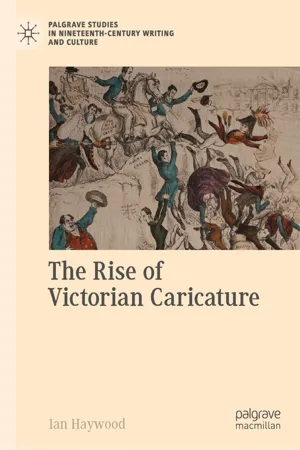
This book serves as a retrieval and reevaluation of a rich haul of comic caricatures from the turbulent years between the Reform Bill crisis of the early 1830s and the rise and fall of Chartism in the 1840s. With a telling selection of illustrations, this book deploys the techniques of close reading and political contextualization to demonstrate the aesthetic and ideological clout of a neglected tranche of satirical prints and periodicals dismissed as ineffectual by historians or distasteful by contemporaries. The prime exhibits are the work of Robert Seymour and C.J. Grant giving acerbic comic edge to the case for reform against class and state oppression and the excesses of the monarchical regime under the young Queen Victoria.
- English
- ePUB (mobile friendly)
- Available on iOS & Android
eBook - ePub
The Rise of Victorian Caricature
About this book
Information
© The Author(s) 2020
I. HaywoodThe Rise of Victorian Caricature Palgrave Studies in Nineteenth-Century Writing and Culturehttps://doi.org/10.1007/978-3-030-34659-1_11. Introduction: Graphic Arguments and Serial Offenders
Keywords
Elizabeth GaskellVictorian caricatureChartismRobert SeymourCharles Jameson GrantPeriodicalsIn Chapter XVI of Elizabeth Gaskell’s novel Mary Barton (1848), a ragged delegation of northern industrial mill-workers, including the eponymous heroine’s Chartist father John Barton, attends a meeting with their employers to attempt to resolve their differences.1 The starving workers’ demand for a substantial increase in wages is unceremoniously rebuffed, and they leave in an embittered mood to consider their next course of action. What follows is curious and unexpected. Instead of basing their response on rational argument and collective wisdom, the operatives are impelled into tragic violence by a caricature. During the meeting with the masters, Harry Carson—Mary Barton’s secret lover and ‘the head and voice of the violent party among the masters’—took out his ‘silver pencil’ and quickly sketched ‘an admirable caricature’ of the workers, ‘lank, ragged, dispirited and famine-stricken’. He adds ‘a hasty quotation’ from Falstaff’s ‘well-known speech’ in Henry IV Part One in which foot soldiers are described as ‘food for powder’ (IV. 2. 66–69)2 and passes the cartoon round his peers ‘who all smiled’ (242–243). Carson then tears up the caricature and throws it into the fireplace, unaware that it fails to catch fire. One of the workers spots this and returns to retrieve the discarded drawing on the pretence that his son loves ‘a bit of a picture’. At the subsequent trade-union meeting, this euphemistic ‘bit of a picture’ has a devastating effect: ‘The heads clustered together, to gaze at and detect the likenesses’ (246). The unflattering accuracy of the depiction makes the workers feel as if their identities have been stolen and their suffering shamelessly displayed and mocked in front of their masters. To ridicule the oppressed and powerless is morally indefensible, as one worker makes clear:
I could laugh at a jest as well as e’er the best on ‘em, though it did tell again myself, if I were not clemming…It seems to make me sad that there is any as can make game on what they’ve never know’d; as can make such laughable pictures on men, whose very hearts within ‘em are so raw and sore… (247)
For John Barton, ‘making jesting pictures on us’ (248) at this juncture is tantamount to a physical assault that justifies vengeance. The men decide to draw lots to determine who will assassinate Carson: appropriately, they tear up the caricature into a number of pieces of paper ‘and one was marked’ (249). Carson’s squib has literally become his death warrant, his ‘marked’ paper has made him a marked man, and the workers will, after a fashion, have the last laugh. Within his own private coterie, Carson’s lampoon was harmless, but once it was made public and viewed by its victims, its lethality rebounded on its creator.
Though it occurs within a novel, this scene is a unique and illuminating example of the response of the nineteenth-century working class to political caricature. Its surprising, seemingly extraneous inclusion in Gaskell’s novel is testimony to the power and prevalence of ‘laughable pictures’ in Victorian political life and print culture. Indeed, it one wanted to pursue further the finer exegetical points of Carson’s intervention, it would become apparent that he probably imitates the style of ‘H.B.’ John Doyle’s Political Sketches (1829–1851), the longest-running series of political caricature in British history. Doyle’s trademark genteel style utilized a close ‘likeness’ of parliamentary politicians within parodic contexts often drawn from high-cultural sources. His expensive lithographed prints were aimed at entertaining the middle and upper classes and were completely unsympathetic to the Chartist cause, just as Carson with his ‘silver pencil’ intended his ‘sketch’ to be viewed only by other employers. The novel’s narrator is also tuned into this bourgeois satirical wavelength, able to offer a reprimand to the smug masters by likening them to ‘Roman senators’ and perhaps even jesting about the ragged appearance of the workers, observing that they ‘had more regard to their brains, and power of speech, than to their wardrobes’ and suggesting that they ‘might have read’ Sartor Resartus (241).3 But once Carson’s image is in the hands of the workers, the boundaries of polite discourse collapse and a much more volatile and incendiary reaction occurs, fuelled by class conflict and industrial struggle. Where previously, the discarded scrap ‘fell just short of any consuming cinders’ (244), now it combusts into a conflagration more terrible in its consequences than the factory fire which occurred earlier in the narrative. No longer a parlour joke, the ‘marked’ paper is reanimated as a weapon in a class war which has some obvious and dangerous parallels in the revolutionary events of 1848. Gaskell’s middle-class readers would have known that H.B. was not the only cartoonist actively maligning radical politics at this time, and they only had to turn the pages of Punch or some its imitators to find a plentiful supply of anti-Chartist satire. From this perspective, one way to explain the pivotal role of caricature in Mary Barton is that Gaskell wanted to recognize the injustice of this unequal state of affairs and premised her hero’s tragic downfall on a principled, though misguided act of resistance to misrepresentation. Lacking the cultural capital of the ‘silver pencil’ to respond in kind (tellingly, the workers are forced into ‘blinking at the excess of light’ [244] as they enter the masters’ room), Barton and his beleaguered colleagues resort to drawing lots rather than cartoons. Though he is unaware of the terrible irony of the pun, Barton had indeed ‘sworn to act according to his drawing!’ (251).
But the satirical odds had not always been so stacked against the workers, and the aim of The Rise of Victorian Caricature is to bring to light the largely unknown back story to Barton’s demise. Gaskell’s episode implies that caricature was monopolized by the mainstream political establishment, and although this was certainly the case in 1848, it was not at all true in the period in which the novel is set, the Chartist campaigns of 1839–1842. On the contrary, the late 1830s and early 1840s was actually the heyday of radical domination of the popular satirical image, and in reality, Barton and his fellow strikers would have had easy access to a variety of illustrated penny periodicals in which the government and its associated institutions (church, army, monarchy , taxation) were lambasted and lampooned on a weekly basis.4 The fact that these titles—Figaro in London, Cleave’s Gazette of Variety, Penny Satirist, Odd Fellow—have been all but erased from cultural memory is testimony to the success of Victorian newspaper historians who played down the importance and achievements of the radical-satirical press in their ‘respectable’ and gradualist narrative of cultural progress and enlightenment.5 Overlapping with this distorted historiography is a long-standing misconception about the supposed disappearance of caricature in the wake of the demise of the ‘Golden Age’ of Georgian graphic satire. In this story, the only title which really matters is Punch , a periodical that allegedly single-handedly restored the fortunes of caricature by severely moderating its offensiveness and subjecting it to editorial control. The gap between the grand finale of the single-sheet caricature in the Reform Bill crisis and the emergence of Punch is, at best, regarded as a period of experimentation and ephemera which laid some of the groundwork for the new publication. This teleology ensures that all the caricature ventures and ‘fugitive and forgettable comic papers’6 of the 1830s and early 1840s can be safely subordinated to the status of Punch precursors, adding to our understanding and appreciation of this towering cultural presence but of little interest in their own right.7 The Rise of Victorian Caricature takes the opposite view and rewrites the caricature history of the period from the bottom up, only citing Punch where relevant. The absence of a separate chapter on Punch reflects this re-prioritization and also acknowledges the substantial body of extant critical work on this iconic source.8 Having said that, it is to be hoped that the methodology and insights of the book could provide some new lines of investigation into the ways that Punch rose to market dominance by appropriating and modifying the formulas and conventions of its rivals.
It needs to said at them outset that I use the term ‘caricature’ to refer to political caricature (and by ‘political’, I mean the public politics of reform campaigns and the parliamentary process), and this is one immediate differentiation between The Rise of Victorian Caricature and other work in the field. As explained at the beginning of Chapter 2, the misconceptions adumbrated in the previous paragraph have begun to be challenged by a number of scholars, and I owe a debt of gratitude to this work, in particular to the pioneering research of Brian Maidment .9 More than any other critic, Maidment has shown how periodicals and serials were instrumental in the transformation of the single-sheet satirical image into a variety of comic formats aimed at a rapidly expanding readership and viewership. This enabled caricature to reach a much wider audience than before, and it is at this juncture that my own interest kicks in, as this was obviously a highly advantageous development for political reformers who wanted to disseminate their message as widely as possible. While Maidment focuses on social and comic themes, The Rise of Victorian Caricature continues my work on politically engaged literary and visual culture in the era of the ‘making’ of the English working class. In some ways, the book can be considered a sequel to Romanticism and Caricature (2013), which ended its chronological coverage at the Reform Bill and the closure of the Romantic period. This new study continues the story of political caricature into almost completely uncharted cultural waters. It begins where Romanticism and Caricature left off but takes a very different approach, analysing the Reform Bill crisis as the starting point for various innovations in the re-presentation of caricature as a multiple, popular form. The key breakthrough for popular politics was the launch of Figaro in London, the first cheap satirical periodical to carry a front-page caricature woodcut as a key component in the weekly commentary on the news. As the heady optimism of the Reform Bill gave way to the disillusio...
Table of contents
- Cover
- Front Matter
- 1. Introduction: Graphic Arguments and Serial Offenders
- 2. Re-forming Caricature: Political Crisis and the Reinvention of the Satirical Image 1830–1832
- 3. Everybody’s Caricature: Charles Jameson Grant
- 4. The Reform Hurricane: Radical Satirical Broadsheets
- 5. The Chartist Carnival
- 6. Laughing at Victoria: A Queen in Caricature
- Back Matter
Trusted by 375,005 students
Access to over 1.5 million titles for a fair monthly price.
Study more efficiently using our study tools.
Frequently asked questions
Yes, you can cancel anytime from the Subscription tab in your account settings on the Perlego website. Your subscription will stay active until the end of your current billing period. Learn how to cancel your subscription
No, books cannot be downloaded as external files, such as PDFs, for use outside of Perlego. However, you can download books within the Perlego app for offline reading on mobile or tablet. Learn how to download books offline
Perlego offers two plans: Essential and Complete
- Essential is ideal for learners and professionals who enjoy exploring a wide range of subjects. Access the Essential Library with 800,000+ trusted titles and best-sellers across business, personal growth, and the humanities. Includes unlimited reading time and Standard Read Aloud voice.
- Complete: Perfect for advanced learners and researchers needing full, unrestricted access. Unlock 1.5M+ books across hundreds of subjects, including academic and specialized titles. The Complete Plan also includes advanced features like Premium Read Aloud and Research Assistant.
We are an online textbook subscription service, where you can get access to an entire online library for less than the price of a single book per month. With over 1.5 million books across 990+ topics, we’ve got you covered! Learn about our mission
Look out for the read-aloud symbol on your next book to see if you can listen to it. The read-aloud tool reads text aloud for you, highlighting the text as it is being read. You can pause it, speed it up and slow it down. Learn more about Read Aloud
Yes! You can use the Perlego app on both iOS and Android devices to read anytime, anywhere — even offline. Perfect for commutes or when you’re on the go.
Please note we cannot support devices running on iOS 13 and Android 7 or earlier. Learn more about using the app
Please note we cannot support devices running on iOS 13 and Android 7 or earlier. Learn more about using the app
Yes, you can access The Rise of Victorian Caricature by Ian Haywood in PDF and/or ePUB format, as well as other popular books in Literature & European Literary Criticism. We have over 1.5 million books available in our catalogue for you to explore.