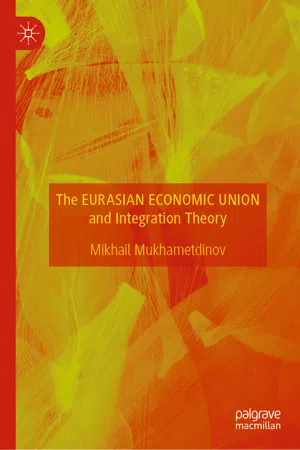
This book evaluates the utility of the Eurasian Economic Union in economic, political, cultural and geostrategic dimensions. It does so through a systematic comparison of the bloc with aspects of the European Union along a number of criteria derived from integration theory. The book concludes that the EAEU is a useless undertaking, at least for Russia, in any of the integration dimensions discussed. This is so because of the inherent properties of the region, and also because of the behaviour of the member states in the context of Russia's resistance to the West. Besides, the principles of liberal economics, endorsed by the union, contribute to asymmetries in development among its member states. In addition to a symbolic event spotlighting Russia's regional leadership, the union appears mainly as a shop where gas is sold below market prices, and as an import base of unskilled labour for Russia in conditions of Russia's high unemployment and underemployment. Concurrently, the bookdiscusses Russia's grievances with the West, which have been inducing and constraining Eurasian integration at the same time.
- English
- ePUB (mobile friendly)
- Available on iOS & Android
eBook - ePub
The Eurasian Economic Union and Integration Theory
About this book
Information
© The Author(s) 2020
M. MukhametdinovThe Eurasian Economic Union and Integration Theoryhttps://doi.org/10.1007/978-3-030-34288-3_11. Analytical Framework for the Comparison of Regions
Mikhail Mukhametdinov1
(1)
Department of Foreign Languages, Samara College for the Humanities, Samara, Russia
Mikhail Mukhametdinov
The author is wholeheartedly thankful to the Commonwealth of Australia for the generous funding for his work on this book at Macquarie and Harvard Universities.
End AbstractAmong regional integration groups the EU receives most of the scholarly attention, and no other integration bloc has been studied and theorized to the extent of the EU. Yet, regional integration is a global phenomenon, and cases other than Western Europe offer additional insights to integration studies. The EAEU, a process involving five countries of the former USSR, is interesting in that its development is occurring while other regional integration processes in Europe, the Americas, and Asia are stagnating following their boom in the 1990s—the period characterized by prevalence of fragmentation on the post-Soviet territory. Despite uncertainty over regional integration efforts and disappointment about asymmetric development results enforced by regional blocs, interest in regionalism remains strong. This book on the EAEU is timely and highly relevant for several reasons: (1) Protectionism under Trump’s administration is giving a new boost to re-evaluation and development of regional blocs like the EAEU. (2) Increasing political and social instability along with coups and revolutions all over the world lay new hopes on regions as potential sources of stabilizing influence. (3) The EAEU is receiving increasing attention as a Russia-led initiative intended to increase Russian political influence and economic power in the period of time when there are many concerns over the country’s behaviour in the West. (4) The bloc is expanding both in depth and scope, and its regional institutions, including the Eurasian Economic Commission, are growing. (5) In the meantime, another important region, the EU, is experiencing serious fragmentation tendencies like Brexit with far-reaching implications for global regionalism.
The EAEU is a much younger process than the EU, and its integration achievement is modest. The EAEU institutions are less developed and they deal with a narrower scope of issues, and only in the economic domain of integration. This monograph evaluates the current condition of integration in the EAEU in relation to the Single European Market, explains why the two regional polities are characterized by markedly different outcomes of integration including their institutional forms, and tests the EAEU against criteria derived from European integration theories to identify EAEU’s persistent limitations. To these ends the study proposes a special analytical framework for the comparison of the EAEU with the EU, which can be used for the analyzes of other contemporary regions, and which has already been applied to an analysis of MERCOSUR.1
Both the EAEU and the EU are perceived as regions in the literature on regional integration, which elaborates on a wide range of cooperation issues within various groups of countries. The majority of scholars adhere to a broad definition of regional integration as ‘institutionalised cross-border cooperation’. There are no excessive criteria in the definitions of institutionalised, cross-border, and regional.2 The degree of institutionalization may vary from formal organizations to informal political consultations. Cross-border cooperation may apply both to spontaneous social interactions across borders between territories of contiguous states and to government-promoted inter-state cooperation. Regions can be defined as groups of contiguous territories linked by a degree of interdependence that incorporates interaction and possibility of cooperation.
Some authors insist that integration should be defined in more narrow terms to distinguish it from coordination and other forms of cooperation.3 Thus coordination most commonly implies the exchange of information. A deeper form of shared action, cooperation means taking joint decisions. Integration more accurately refers to policies and decisions stemming from binding agreements and supranational institutions. The following stage of merging national policy emitters into one entity and the single policy coming from such entity is called unification. I propose to define regional integration primarily as intentional harmonization of national policies among several countries as pursued by a common regional authority. Such understanding of integration automatically brings forward the necessity to consider the specific areas where integration (or policy harmonization) is taking place, thus highlighting the dimension-specific and issue-specific character of the process across various temporal and spatial examples of regionalism. However, integration in narrow terms is not the exclusive focus of this study because other forms of cooperation accompany it and affect regional cohesiveness.
There are several grounds for the comparison of the EAEU with the EU. Both are geographically contingent areas. Both have expressed commitments to a common market and have undertaken measures for its full or partial implementation.4 The two blocs have accepted states’ competences in the field of commercial policy and have received powers to represent their members in international commercial agreements as a single entity. Thus they have acquired international juridical personalities and recognition as actors in international law with the ability to be subject to international agreements. On the surface, the two blocs appear to have parallel institutional systems, and every major EU institution except the European Parliament and the European Central Bank has an analogue in the EAEU. Also, the two blocs share relative similarity in terms of the economic process. They generally confirm the conventional logic of economic integration sequence from an FTA to a customs union and then to a common market.5
However, the EAEU brings together Russian-language countries that used to be constituent entities of one state, the Russian Empire and then of the Soviet Union. They are former “second world” countries, which have effectively descended into “third world” status to become fully dependent on commodity trade with rich countries. Regional integration in the EAEU is unable to significantly reduce the dependence of the region on better developed countries in its economics, politics, and capital and technology needs. The EU, on the contrary, is a group of predominantly rich and self-sufficient countries. Also, the EAEU is a very recent process. The EAEC was founded in 2001 while the EEC has operated since 1957. The EAEU has fewer member states, five countries versus 27 in the EU. The EAEU’s basic indicators differ substantially from those of the EU correlating from 1:2.5 (population) to 4:8:1 (territory), 1:3.8 (GRP), and 1:1.5 (GRP per capita).6
The degree of commercial interdependence within the EU is at least eight times that of the EAEU (Table 2.1B). There are 24 official languages in the EU and only five in the EAEU reflecting dramatic differences in the degree of cultural diversity. Further, the EU with its three principal actors Germany, France, and Italy is unfamiliar with the degree of power asymmetry in the EAEU where Russia stands out as a predominant country. The two blocs have had different geostrategic motivations. These are most prominently characterized by the different nature and impact of the US policy in relation to the two regions (supporting the EU and opposing to the EAEU as a restoration of the USSR), and by consequences of WW2 in Europe and the degradation of the post-Soviet economies in the 1990s and thereafter.
Despite parallel institutional structures in the two unions, there is a striking variation between the forms of regional institutions and the ways they operate: the EU is an organization with various supranational competences compared with the intergovernmental structure of the EAEU. The EU exercises supranational authority in many economic, environmental, juridical, and security spheres. Depending on the area, EU institutions can take decisions by consensus, absolute majority or qualified majority. The EAEU’s competences cover only economic domains of social life. Its regional bureaucracy is very small, and all officials responsible for the integration agenda are representatives of the member state governments. The major regional institutions with decision-making powers are collegiate. They produce decisions through intergovernmental mechanisms that usually require unanimity.
In the analysis of quality and outcomes of integration regional institutions have an important position both as by-products of integration and as agencies that affect the processes through their various functions and roles, which stem out from their specific features. Supranational institutions in the EU are believed to pursue interests of the bloc as a whole, and at times they are able to enforce decisions contrary to the will of individual states.7 However, the EAEU intergovernmental system is restricted to advancing only those measures of integration that have been agreed upon by all member states. This might reduce the scope, depth, and speed of integration. Concurrently, the EAEU lags behind the EU not only in institutional development but also in economic integration. Despite the pronounced goals, the EAEU is not a fully operational common market yet, and even its free trade agreements are repeatedly infringed.
The slow progress of institutional development and policy harmonization in the EAEU vis-à-vis the EU might seem surprising as a number of factors could have allowed expectations of a faster progress of the EAEU. For example, it has to reconcile far fewer countries over common policies; and there are fewer cultural barriers to intra-regional integration among its countries that used to be entities of a de facto unitary state. The more rapid transformation of the world economy today than in the years of the EC formation in the 1960s–1980s may have been expected to accelerate the consolidation of the common market in the EAEU. When the EEC was born, few foresaw the freedom of capital movement within its borders; on the other hand, the EAEU has evolved in a period when capital transfers are so significant that they cannot be ignored. Also, the historic precedents of European economic integration and other regional processes offer a great deal of available practical and theoretical experience. More recently, the deterioration of the international security environment and increased geopolitical rivalry could have contributed to rapprochement among the post-Soviet states; however, the smaller states of the EAEU remain very sovereignty-protective and display no signs of aligning their foreign policies with Russia.
This monograph offers a complex explanation of the gap between EAEU goals and achievements. Its narrative is based on important as...
Table of contents
- Cover
- Front Matter
- 1. Analytical Framework for the Comparison of Regions
- 2. Economic Integration
- 3. Structural Factors
- 4. Overcoming Cultural Barriers?
- 5. External Factors and Geostrategic Considerations
- 6. Conclusion
- Back Matter
Trusted by 375,005 students
Access to over 1.5 million titles for a fair monthly price.
Study more efficiently using our study tools.
Frequently asked questions
Yes, you can cancel anytime from the Subscription tab in your account settings on the Perlego website. Your subscription will stay active until the end of your current billing period. Learn how to cancel your subscription
No, books cannot be downloaded as external files, such as PDFs, for use outside of Perlego. However, you can download books within the Perlego app for offline reading on mobile or tablet. Learn how to download books offline
Perlego offers two plans: Essential and Complete
- Essential is ideal for learners and professionals who enjoy exploring a wide range of subjects. Access the Essential Library with 800,000+ trusted titles and best-sellers across business, personal growth, and the humanities. Includes unlimited reading time and Standard Read Aloud voice.
- Complete: Perfect for advanced learners and researchers needing full, unrestricted access. Unlock 1.5M+ books across hundreds of subjects, including academic and specialized titles. The Complete Plan also includes advanced features like Premium Read Aloud and Research Assistant.
We are an online textbook subscription service, where you can get access to an entire online library for less than the price of a single book per month. With over 1.5 million books across 990+ topics, we’ve got you covered! Learn about our mission
Look out for the read-aloud symbol on your next book to see if you can listen to it. The read-aloud tool reads text aloud for you, highlighting the text as it is being read. You can pause it, speed it up and slow it down. Learn more about Read Aloud
Yes! You can use the Perlego app on both iOS and Android devices to read anytime, anywhere — even offline. Perfect for commutes or when you’re on the go.
Please note we cannot support devices running on iOS 13 and Android 7 or earlier. Learn more about using the app
Please note we cannot support devices running on iOS 13 and Android 7 or earlier. Learn more about using the app
Yes, you can access The Eurasian Economic Union and Integration Theory by Mikhail Mukhametdinov in PDF and/or ePUB format, as well as other popular books in Politique et relations internationales & Politique comparée. We have over 1.5 million books available in our catalogue for you to explore.