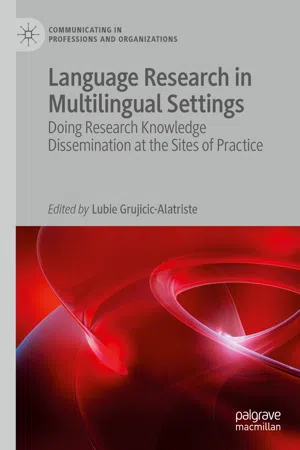
This book describes the steps undertaken by language researchers to disseminate their findings at sites of practice. It discusses questions that arise from such efforts and provides meaningful, real-life, first-hand accounts of both interactions with practitioners and practitioners' feedback. The authors use narrative accounts, case studies, and semi-ethnographies of focus groups and workshops to draw a full picture of dissemination, its intricacies, multiple stakeholder interests, reflexivity challenges, and future relevance and responsibility for all parties involved. It is an attempt to fill the gap between the end of research domains and the places of dissemination of research findings, and the book will be of interest to applied linguistics researchers, students and scholars of organisational discourse, and practitioners working in multilingual settings.
eBook - ePub
Language Research in Multilingual Settings
Doing Research Knowledge Dissemination at the Sites of Practice
- English
- ePUB (mobile friendly)
- Available on iOS & Android
eBook - ePub
Language Research in Multilingual Settings
Doing Research Knowledge Dissemination at the Sites of Practice
About this book
Information
© The Author(s) 2020
L. Grujicic-Alatriste (ed.)Language Research in Multilingual SettingsCommunicating in Professions and Organizationshttps://doi.org/10.1007/978-3-030-34671-3_11. Knowledge Translation at the Sites of Practice: From Outreach and Dissemination to Reflexive Evaluation
Lubie Grujicic-Alatriste1
(1)
NYC College of Technology, City University of New York, New York, NY, USA
Keywords
Language research impactResearch disseminationTranslating research resultsResearch-based praxisDiscourse studiesMultilingual settings researchThis chapter introduces the concept of translating data-driven research to sites of practice in a more transparent way. Since the publication of the first volume that proposed a more systematic framework for translating applied linguistics (AL) research to practice (Grujicic-Alatriste, 2015), a few other publications followed suit (e.g., Lawson & Sayers, 2016; McIntyre & Price, 2018), engaging the question of relevance and impact in the various fields of AL and interdisciplinary studies. The drive for measuring research impact has been central to the United Kingdom-based AL projects (e.g., Brown, Sawyer, & Norris, 2016; Lawson & Sayers, 2016), possibly in response to broader societal forces pushing for ways to measure research impact in social sciences (the so-called impact movement).
This volume differs from the ones that aim to measure impact in a pre-determined way because it focuses on the concrete steps undertaken by language researchers themselves to disseminate their own findings at suitable sites of professional practice. Thus, it begins with the onset of outreach, not with the end result of impact. It discusses questions that arise from such onset efforts and provides meaningful, firsthand accounts of both the interaction with practitioners and the practitioners’ feedback. The authors in this volume use narrative accounts, case studies, and semi-ethnographies of focus groups and workshops to draw a fuller picture of dissemination, its intricacies, multiple stakeholders’ interests, reflexivity challenges, and future relevance. They do this within the scope of responsibility for all parties involved. Thus, praxis and practicality, including their challenges, are central to our volume as a whole, and to each individual chapter.
The topic of translating research into practice is here seen as a multistep activity consisting of outreach, dissemination, engagement with practitioners, and feedback loop leading to future collaboration. These elements, in turn, can initiate change in real-world professional or public settings where language plays a key role. The initiatives to translate research findings into practice are not new in the areas of medical sciences, nursing, and counselling, and these disciplines have been leaders in moving their fields towards practice-oriented moors. Within discourse studies, in general, and conversations analysis (CA), in particular, Candlin and Candlin (2003) initially engaged with health care communication in their comprehensive overview of the role of discourse studies in intercultural professional interaction (see also Sarangi & van Leeuwen, 2003). Later, Antaki’s ground-breaking book Applied Conversation Analysis (2011) brought spotlight to intervention and change in institutional settings by successfully showcasing the key areas of ‘real-life’ language application where stakeholders can benefit from academic research (including medical sites such as a doctor’s office). Candlin and Sarangi (2004a) have been calling for reflexivity and relevance in applied linguistics for over two decades, contributing wholesomely to a substantial body of published research on the topic (e.g., 2010). Sarangi has expanded this work (e.g., 2014) by continuing to contribute to the Journal of Applied Linguistics and Professional Practice (ALAPP) and the annual conference with the same name.
In educational linguistics, recent attempts are noted with intent to bring more evidence-based practice to teacher education (e.g., Ding & Bruce, 2017). However, although application has been addressed, there seems to be no single volume that accounts for dissemination efforts from the initiation stage to collaborative praxis in multiple settings, as given by our volume’s authors—in real time at the sites of practice. In other publications, such sites tend to be assumed, or inferred, not openly presented, and thus, perhaps impeding the potential development of a broader understanding of dissemination and its value to the field of applied linguistics as a whole.
In this vein, the current volume is an attempt to fill the gap between the end of research domains and the onset of dissemination of research findings. Researchers are here seen as ‘language research knowledge producers’ (Curry & Lillis, 2017), who try to offer a fairer, more equitable way of knowledge access, sharing, application, and its use. In line with the issue of fairness, we acknowledge recent movements that have raised awareness about knowledge sharing and responsibility of all parties involved (e.g., Ostman & Solin, 2015), and we include those issues across chapters when we assess our realistic outcomes and challenges. The sites of responsible exchange are here seen as bidirectional: researchers bring their findings to the stakeholders, and stakeholders, in turn, bring their knowledge, experience, and needs to these places of intersection. Both parties ‘negotiate’ the research findings, the ‘value’ they may have, or the issues they may raise for other stakeholders. In this bringing together, some modification of data sets and some adjustments to suit the target audience’s needs have been necessary, although they too need scrutiny and evaluation (Koulikov, 2011). We have also felt the need to adjust the data and approximate the knowledge-sharing targets to the needs of specific professional communities.
Our volume endorses the stance that researchers and their actions need to be equitable and ethical (Cromdal & Tholander, 2014). In other words, knowledge and expertise, be it theoretical or practical, needs to be shared both ways. The data sharing also needs to be presented in ways that are respectful to the participants and practitioners alike. At the same time, the chapters account for challenges that remain. In fact, challenges and limitations are discussed throughout the book, both practically and theoretically. Specifically, the chapters in this volume address the following: (a) active and equitable engagement of knowledge dissemination with many language users who have a stake in positive communicative outcomes; (b) reflexive professional interaction; (c) thoughtful examination of data-sharing opportunities and inequities; (d) facing the tough questions of one’s own research usefulness, practicality, and real-world reach; and (e) dealing with newly found truths about relevance of one’s work as perceived by different stakeholders. Many of these elements have their roots in Candlin and Sarangi’s insightful Editorial on motivational relevance in research and practice (2010) that we considered as our initial starting point in the previous volume (Grujicic-Alatriste, 2015), but are here expanded to include a more up-to-date theoretical and practical discussion.
Although a completely new set of research studies is reported here, half of them are a continuation from the initial project reported in 2015 (Grujicic-Alatriste). In order to assist with full understanding of the interdisciplinarity and multilinguality of the new volume, with research being conducted in diverse professional multilingual settings on a chapter level (e.g., China, Belgium, Denmark, Germany, France, and Switzerland), and on the collection level representing six different languages, each chapter will refer to the same Framework for Application (Grujicic-Alatriste, 2015), and will use English as the main reporting language. However, other languages, such as Chinese, Spanish, French, Dutch, and German will be evidenced in the data sets. Therefore, although multilingual settings are represented in this volume, we do not engage the issues related to multilingual research, or translation from one language to English, but we do acknowledge here that a variety of concerns can be raised in relation to multilingualism versus English as a dominant language of the narrative in this volume. That in itself is a question of equity and access to knowledge and should be discussed more openly within the field of AL.
The original, cutting-edge, multisetting discourse studies included in this volume have been conducted across different continents, thus providing a global orientation to the translation of research into practice—its promises, challenges, and impact. The research settings represent wide-ranging professional and personal/private contexts, including the following: the streets of homelessness, home employment, disability in public spaces, second-language college classrooms, language policy departments, spaces of political engagement for citizenry, police training sessions, translation news bureaus, and private discourse settings of home and family.
In order to clarify our goals, the scholarship in the area of application and translation to practice will be foregrounded in the next section, and the most pertinent recent work will be reviewed.
Review of Recent Literature on Knowledge Translation and Impact
While a plethora of books appeared in the past 20 years either addressing language in the real-world settings or recommending applications of language research (for a detailed review, see Grujicic-Alatriste, 2015, Chapter One), only a handful of very recent books attempts to systematically engage dissemination and application of linguistic research beyond the world of academia. Few provide a framework for equitable knowledge sharing via focus groups, workshops, and info-sessions in professional settings, as this volume does. Here, we discuss five recently published titles that speak more directly to research relevance efforts and are considered complementary to our volume because they provide different aspects of the dissemination and impact issues.
To begin with, in Applying Linguistics: Language and Impact Agenda, McIntyre and Price (2018) explore the challenges of demonstrating the sociocultural and economic impact of research in linguistics. The chapters provide a critical discussion of the concept of impact, as well as an examination of both the constraints and opportunities of the impact agenda (the measurable outcomes of research). However, our volume examines the ‘relevance’ of one’s own research findings, based on how the researchers and stakeholders themselves gauge it, not an outside measuring body. We also discuss the perceived relevance across multiple countries and multilingual contexts, as opposed to a single country/monolanguage context represented in McIntyre and Price. In this way, our volume is challenging the mono nature of knowledge production and ownership. Finally, our notion of relevance is understood as the value and usefulness of one’s work for the populations that either participated in research or have some stakes in the findings (Candlin & Sarangi, 2004b). Therefore, it is the immediate closest stakeholders whose views we feature, making this distinction the key asset. The outreach is ultimately local as it is the local efforts and immediacy of collaboration that we view as key in the uptake of findings.
Second, Lawson and Sayers’ Sociolinguistic Research: Application and Impact (2016) offers an overview of international impact projects, showcases po...
Table of contents
- Cover
- Front Matter
- 1. Knowledge Translation at the Sites of Practice: From Outreach and Dissemination to Reflexive Evaluation
- 2. Police Work Under Scrutiny: (Self-)criticism in an Ethnographic Focus Group
- 3. How Francophone Soon-to-Be Journalists Perceive the Dutch Language in Multilingual Belgium: A Research and Application Design
- 4. Institutionalization in News Translation: The Use and Abuse of Manipulation
- 5. Discursive Mindfulness Among Practitioners Analyzing Social Work Communication
- 6. Navigating Mother-Adolescent Daughter (Dis)harmonious Interactions
- 7. Teaching About Disability Discourse in the College Classroom
- 8. Bringing Narrative Discourse to the Field
- 9. Outreach and Collaboration with Au-Pair Girls in Home Employment Settings
- 10. Reflections on Art-Based Participatory Research with Middle School Bilingual Youth
- 11. Genre Writing and Communicative Purpose: Sharing Research Insights with Teachers as Stakeholders
- Back Matter
Trusted by 375,005 students
Access to over 1.5 million titles for a fair monthly price.
Study more efficiently using our study tools.
Frequently asked questions
Yes, you can cancel anytime from the Subscription tab in your account settings on the Perlego website. Your subscription will stay active until the end of your current billing period. Learn how to cancel your subscription
No, books cannot be downloaded as external files, such as PDFs, for use outside of Perlego. However, you can download books within the Perlego app for offline reading on mobile or tablet. Learn how to download books offline
Perlego offers two plans: Essential and Complete
- Essential is ideal for learners and professionals who enjoy exploring a wide range of subjects. Access the Essential Library with 800,000+ trusted titles and best-sellers across business, personal growth, and the humanities. Includes unlimited reading time and Standard Read Aloud voice.
- Complete: Perfect for advanced learners and researchers needing full, unrestricted access. Unlock 1.5M+ books across hundreds of subjects, including academic and specialized titles. The Complete Plan also includes advanced features like Premium Read Aloud and Research Assistant.
We are an online textbook subscription service, where you can get access to an entire online library for less than the price of a single book per month. With over 1.5 million books across 990+ topics, we’ve got you covered! Learn about our mission
Look out for the read-aloud symbol on your next book to see if you can listen to it. The read-aloud tool reads text aloud for you, highlighting the text as it is being read. You can pause it, speed it up and slow it down. Learn more about Read Aloud
Yes! You can use the Perlego app on both iOS and Android devices to read anytime, anywhere — even offline. Perfect for commutes or when you’re on the go.
Please note we cannot support devices running on iOS 13 and Android 7 or earlier. Learn more about using the app
Please note we cannot support devices running on iOS 13 and Android 7 or earlier. Learn more about using the app
Yes, you can access Language Research in Multilingual Settings by Lubie Grujicic-Alatriste in PDF and/or ePUB format, as well as other popular books in Languages & Linguistics & Management. We have over 1.5 million books available in our catalogue for you to explore.